Demi Cup vs Full Cup Bra: Coverage, Fit and Which to Choose
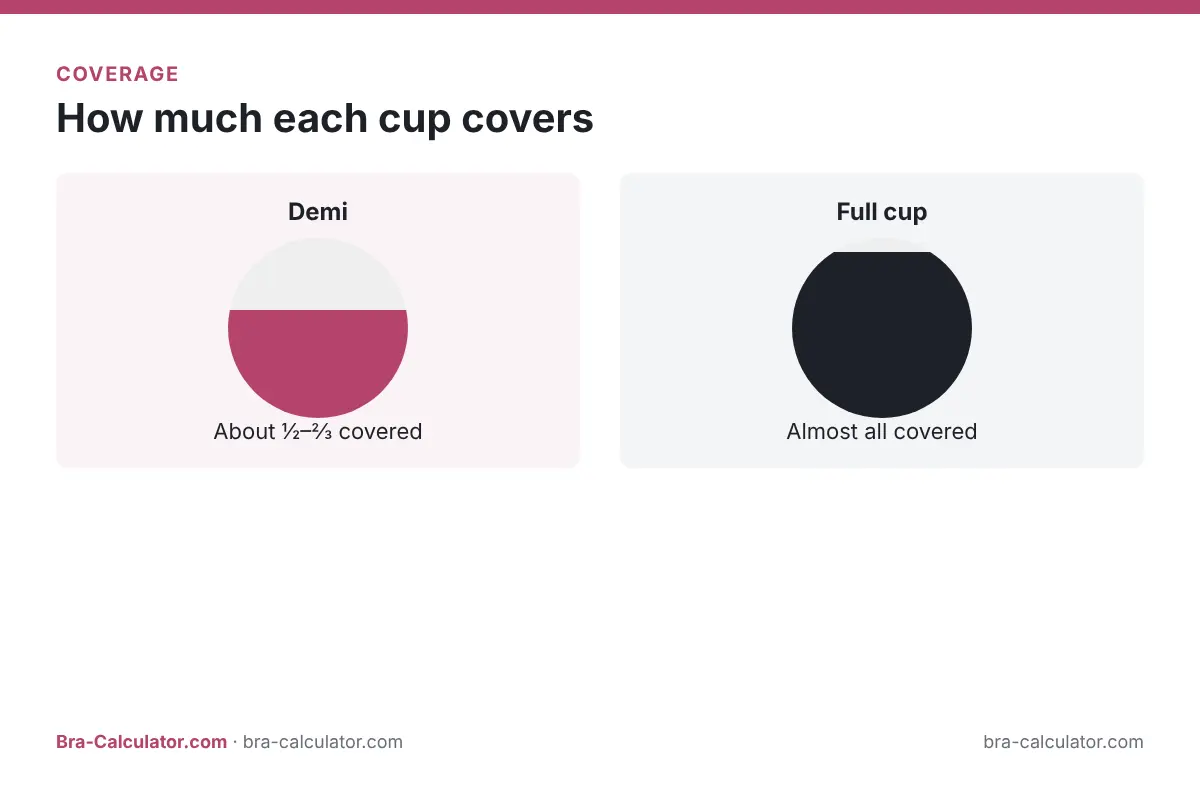
In a demi cup vs full cup comparison, the difference is coverage. A demi cup covers roughly the lower half to two-thirds of the breast, with a low, curved top edge that shows the upper curve. It suits shallow, bottom-heavy and smaller busts and lower necklines. A full cup covers nearly all of the breast tissue, with a higher top edge and taller sides. It suits projected, top-full and fuller busts, high necklines, and anyone who wants maximum containment. Your size is usually the same in both.
Jump to a Section
Demi vs Full Cup at a Glance
| Feature | Demi cup | Full cup |
|---|---|---|
| Coverage | About ½ to ⅔ of the breast | Almost all of the breast |
| Top edge | Low, curved, near or just above the nipple line | High, close to the top of the breast |
| Side coverage | Lower | Taller side panels |
| Look | Lifted upper curve, open neckline | Smooth, contained, rounded |
| Best necklines | Scoop, square, sweetheart, wide | Crew, high neck, button shirts, sheer tops |
| Best breast shapes | Shallow, bottom-heavy, full on bottom | Projected, full on top, soft tissue |
| Best sizes | AA–DD especially; available higher | Every size; most common in DD+ |
| Support feel | Lift from below | Containment all round |
What Is a Demi Cup and What Is a Full Cup?
Demi means “half”, and a demi cup is cut to cover the lower part of the breast. The top edge typically runs about one inch above the nipple, curving gently, and the straps attach toward the centre of the cup. The upper breast is uncovered, so a demi gives a lifted, open look. Many balconettes are demis with wider-set straps and a straighter edge, and brands often use the two names interchangeably. See our best balconette bras for that close cousin.
A full cup, or full-coverage cup, is cut to enclose the breast. The top edge sits close to the top of the breast tissue, the side panels are taller, and the cup wraps further under the arm. Everything is contained, so movement is minimised and the outline under clothes is smooth and rounded. Full cups are the backbone of most full-bust ranges and most everyday T-shirt bras.
Neither style changes your size. A 36C demi and a 36C full cup hold the same volume. The full cup simply has more fabric above it. Check your size with the bra size calculator, then use shape and neckline to choose the coverage.
Coverage is not the same as support. Support comes mostly from a firm, correctly sized band. A demi on the right band can support a fuller bust very well, and a full cup on a loose band will not.
Demi vs full cup coverage
How They Look and Feel
- Visible upper curve
- Lifted, “rounded” neckline
- More décolletage
- Natural centre
- Smooth, contained outline
- Hides the upper breast
- Invisible under sheer and high tops
- Rounder, more uniform shape
- Less fabric, lighter
- Cooler
- Can feel less contained on projected tissue
- Easy to wear under low tops
- Very secure and enclosed
- Warmer
- Less movement during activity
- Calm, “held” feeling
- Overflow at the top if too small or if projected
- Nipple close to the edge
- Strap slip with wide-set straps
- Gaping at the top on shallow tissue
- Sides dig into the armpit if the wire is tall
- Shows at low necklines
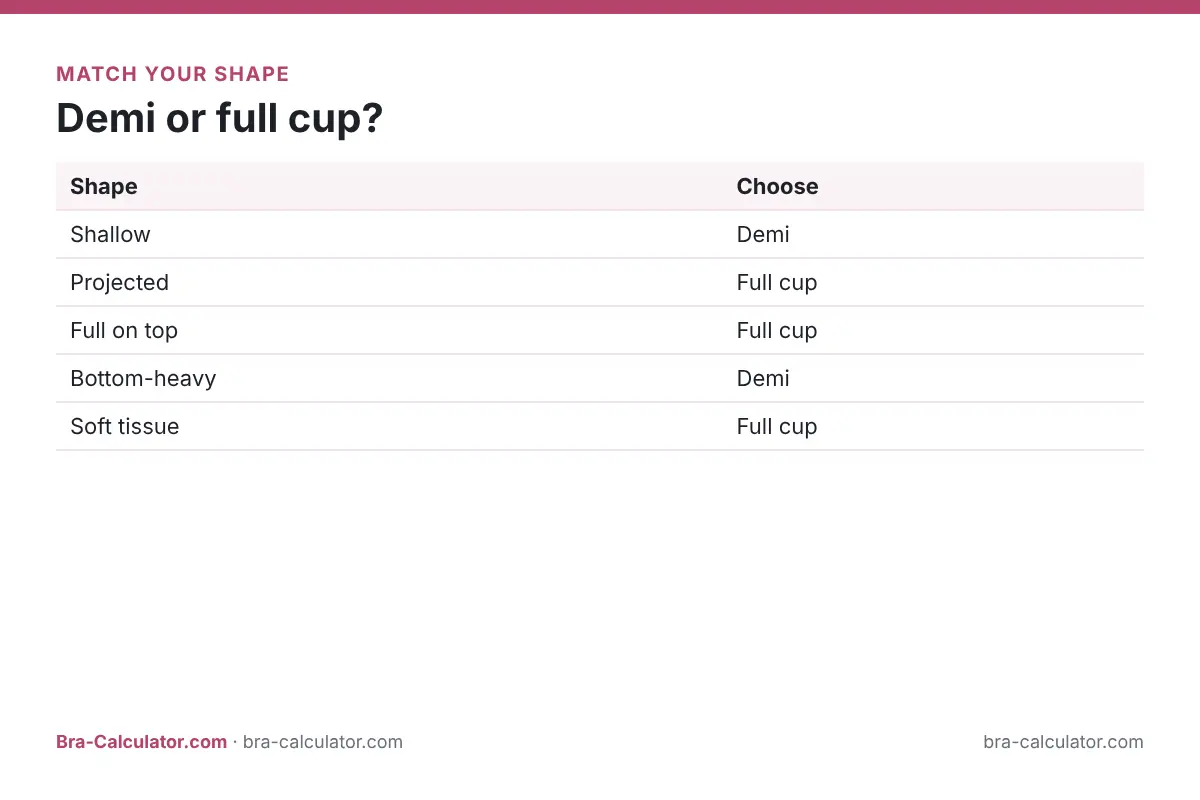
Which Suits Your Breast Shape?
| Breast shape | Better choice | Why |
|---|---|---|
| Shallow (wide, little projection) | Demi | A tall full cup leaves an empty space at the top that gapes |
| Projected (forward volume) | Full cup | Low demi edges can cut across forward tissue |
| Full on top | Full cup | The upper fullness needs a cup above it |
| Full on bottom / bottom-heavy | Demi | Lift comes from below; little tissue at the top |
| Soft / less dense tissue | Full cup | More containment, less movement |
| Wide-set | Demi plunge or full cup with a low gore | Either works if the gore is low |
| Asymmetric | Full cup with a removable pad | More fabric hides size differences |
Shape explains most “my demi always overflows” or “my full cups always gape” complaints. If you are not sure of your shape, our breast shapes guide and identifier will tell you in a minute. For a full style-by-shape map, see bra types for every breast shape.
Breast shape guide
Which Coverage for Which Outfit?
| Outfit | Demi | Full cup |
|---|---|---|
| Scoop or square neck | ✓ Ideal | ✗ The cup edge may show |
| Sweetheart | ✓ Ideal | ✗ Usually shows |
| Crew neck T-shirt | ✓ Fine | ✓ Smoothest |
| Button-up shirt | Possible: may show a ridge across the bust | ✓ Ideal |
| Sheer blouse | A visible line across the breast | ✓ Smooth and uniform |
| V-neck | A low demi works | Choose a plunge full cup |
| Office / uniform | Either | ✓ The most modest |
Demis can show a horizontal line across the breast under thin, close-fitting fabric, where the cup edge meets the skin. If that bothers you, choose a demi with a lace or stretch top edge, or a full cup for those outfits. For fitted T-shirts, see our best T-shirt bras.
Demi vs Full Cup by Bust Size
| Size range | Demi | Full cup | Next step |
|---|---|---|---|
| AA–B | ✓ Often the best fit; little upper tissue | Can gape at the top | small-bust bras |
| C–D | ✓ Very popular | ✓ Very popular | Choose by shape |
| DD–F | ✓ If shallow or bottom-heavy | ✓ If projected or full on top | full coverage for DD |
| G+ | Available from full-bust brands | ✓ The widest choice | best full-coverage DD+ bras |
A common belief is that fuller busts need full cups. That is true for projected and top-full shapes, but many shallow DD–G wearers find a demi or balconette more comfortable and better looking, because tall full cups gape on them. Size does not decide coverage; shape does.
Which Is More Supportive?
Full cups contain more and minimise movement, so they feel more supportive, especially on soft or heavy tissue and during brisk walking. Demis lift effectively from below but leave the upper breast free to move. For most everyday activity, both are perfectly supportive on a correct band. The band carries most of the weight, and the cup shapes and contains.
Where full cups really help is with movement-heavy days and with fuller, softer tissue. If you find a demi makes you feel “loose” at the top, or you want to minimise bounce on a long day, a full cup is the better everyday choice. For exercise, neither replaces a sports bra; see how to choose a sports bra.
There is also a comfort difference that is easy to miss. Because full cups enclose more tissue, they hold more heat, and the taller side panels sit closer to the armpit. In hot weather, or for people who dislike pressure under the arm, a demi can be noticeably more comfortable over a long day. If you love the security of a full cup but find it warm, look for a full cup with spacer foam or an unlined seamed construction, which breathe much better than standard moulded foam.
Lined, Unlined and Seamed Versions of Each
Coverage and construction are separate choices, and the combination changes the result a lot.
The classic T-shirt bra. One piece of foam, no seams, invisible under knits. The best everyday choice for projected and top-full shapes.
Two- or three-part cups lift and project fuller busts. Common in full-bust brands; slightly visible under very thin fabric.
A smooth demi gives a lifted upper curve under scoop necks. Watch the top edge on thin fabric.
Very light and breathable. Shows a natural shape and suits shallow tissue very well.
Graduated pads push tissue up into the open top. Can overflow if the cup is too small.
If you wear fuller cups and prefer a full cup, a seamed construction usually lifts and shapes better than moulded foam at G and above. If you are shallow and like a smooth look, a moulded demi with a lower edge is often the answer to “every T-shirt bra gapes on me”.
Coverage Through Life Changes
Many people move between the two over time. After pregnancy, breastfeeding or weight loss, tissue often becomes softer and more bottom-heavy, and many find demis and balconettes start to fit better than the full cups they wore before. During pregnancy and nursing, full cups, or stretch-lace cups with a full shape, handle size changes through the day better. See our maternity bra guide. In later life, softer tissue often prefers the containment of a full cup with a wide, comfortable band; see bras for older women.
The lesson is to re-check, not to assume. If a style that has always worked starts to gape or overflow, your shape has changed, and the other coverage may now suit you better.
Should You Own Both?
Most people benefit from owning both, because necklines decide as much as shape does. A sensible core set is two everyday bras in the coverage that suits your shape, plus one in the other coverage for specific outfits. If you are projected, that means two full cups for work and daily wear and a demi for scoop and square necklines. If you are shallow, two demis or balconettes for everyday wear and a smooth full cup for sheer blouses and shirts.
Rotate them so no bra is worn two days running. Elastic recovers between wears, so a rotation of three makes each bra last noticeably longer. Replace any bra whose band no longer feels firm on the tightest hook. A tired band undermines support in either coverage, and the cup starts to gape or overflow as the band rides up. Our guide on how often to replace a bra lists the signs.
Choose in 60 Seconds
On top or forward: full cup. On the bottom or spread wide: demi.
Square, scoop or sweetheart: demi. High, sheer or shirt: full cup.
Yes: try a demi. If they overflow at the top, try a full cup.
Maximum containment: full cup. Light and open: demi.
Demis use less fabric and stay cooler.
One of Each Worth Trying
All picks are in stock on Amazon with at least a 4.0-star average and hundreds of verified ratings. Ratings were checked in November 2026.
A lightly padded mid-coverage cup with a soft lace edge that lies flat. A good first demi for B–DD. Check sizes on Amazon
A smooth full-coverage T-shirt cup with soft foam. A popular everyday full cup. Check sizes on Amazon
A seamless full-coverage underwire for DD+ with a smooth outline under clothes. Check sizes on Amazon
Affiliate disclosure: we earn a commission on qualifying Amazon purchases at no extra cost to you. Picks are chosen for fit, never for commission.
Common Fit Problems and Fixes
Projected or top-full tissue, or a cup that is too small.
The edge is too low for your shape.
A tall cup on shallow tissue.
Tall side wires on a short frame.
Strap placement does not suit your shoulders.
How to Test Coverage When You Try On
The band must be firm and level before you judge the cup.
Lean forward and bring tissue from under the arm into each cup.
A demi edge should lie flat with no cutting in; a full-cup edge should touch the breast with no gap.
A demi should not let tissue escape at the top; a full cup should not dig under the arm.
Look for a ridge (cup too small) or a hollow (cup too tall or deep).
Related guides
Frequently Asked Questions
A demi covers about half to two-thirds of the breast, with a low, curved top edge. A full cup covers nearly all of the breast tissue for maximum containment.
Yes, for shallow or bottom-heavy large breasts. Projected or top-full large breasts usually fit better in full cups.
It feels more contained and limits movement, but support mostly comes from the band. On a correct band both are supportive for daily wear.
Usually no. Some demis run slightly small at the top edge; if you overflow, try one cup up.
The cup is taller than your breast tissue, which is common with shallow breasts. Try a demi in the same size.
They are close. A balconette usually has a straighter top edge and wider-set straps; a demi has a curved edge and straps closer to the centre.
A full cup in a colour close to your skin tone, because it creates a smooth outline without a line across the breast.
A demi, because it uses less fabric and leaves more skin exposed.
Find your size first
Coverage changes the look, not the size. Measure once and get your size in every system.