Best Bras for Shallow Breasts: Styles That Stop Gaping (2026)
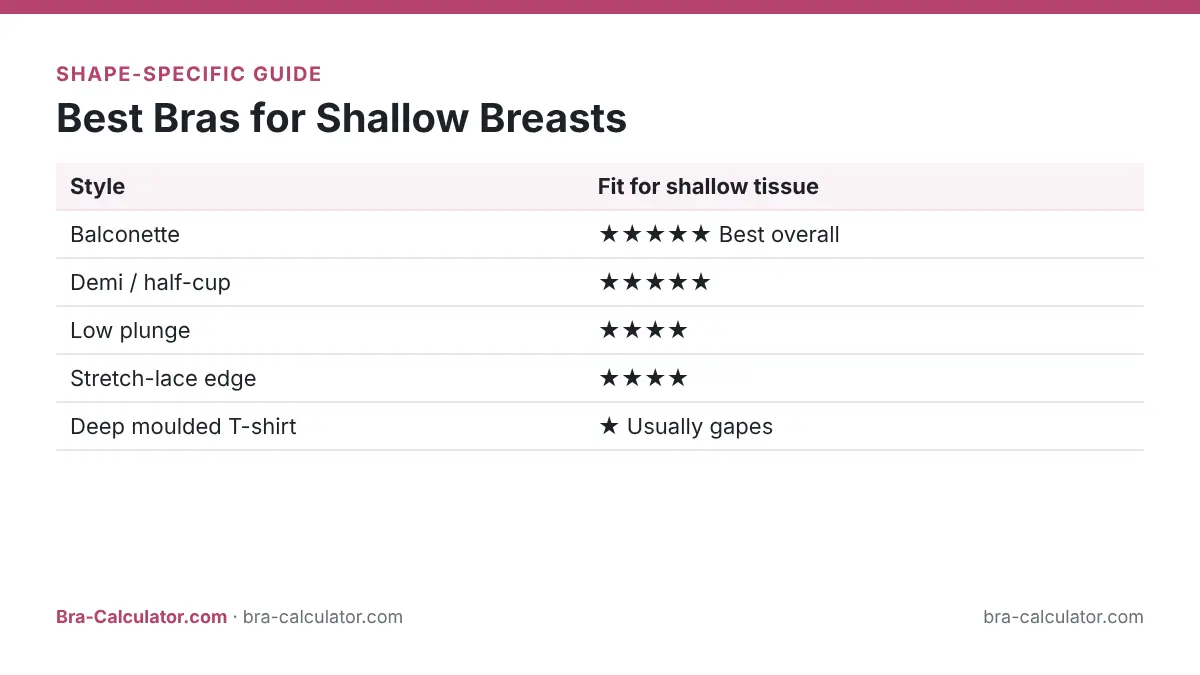
The best bras for shallow breasts have open, shallow cups: balconette, demi, low plunge and seamed horizontal-cut cups. Shallow breasts have a wide root and little projection, so deep moulded T-shirt cups leave an empty space at the top and gape. Keep your band size, and if a cup gapes, try a shallower style before dropping a cup size. Dropping a cup size usually makes the wire dig into tissue at the sides.
Jump to a Section
Shallow Breasts at a Glance
| Attribute | Detail |
|---|---|
| What “shallow” means | Volume spread over a wide base, with little forward projection from the chest wall |
| Most common sign | The top of the cup gapes or wrinkles even when the wire sits correctly |
| Best cup shapes | Balconette, demi, low plunge, horizontally seamed cups, stretch-lace top edges |
| Shapes to avoid | Deep moulded T-shirt cups, full-coverage cups with tall sides, push-up pads that sit high |
| Size rule | Keep the band. Change cup shape before you change cup letter |
| Common at | Any cup size: shallow is about distribution, not volume. Many DD–G wearers are shallow |
| Related shapes | Often occurs with wide-set, east-west or lower-fullness breasts |
What Are Shallow Breasts?
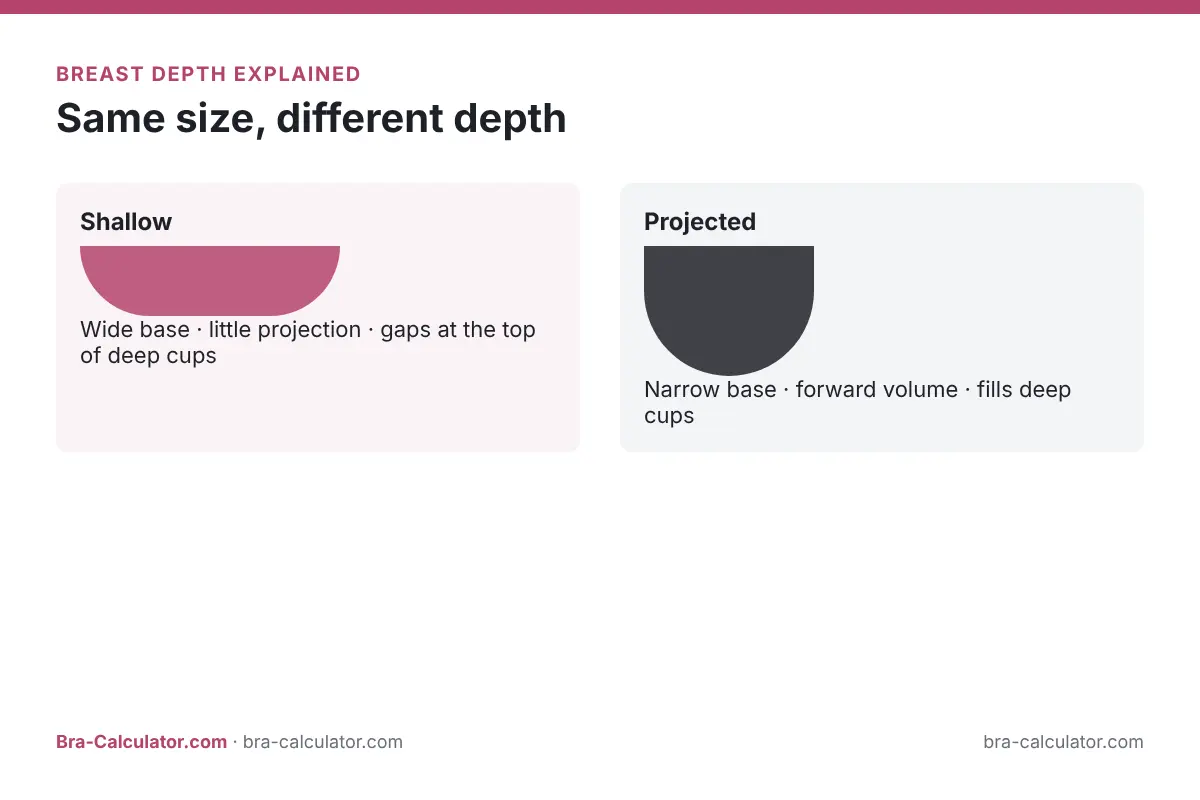
Breast “depth” describes how far your tissue projects forward from your chest compared with how wide it sits on the ribcage. Two people can both measure 34DD on our bra size calculator and have very different shapes. One has a narrow root and a lot of forward projection (projected). The other has a wide root with the same volume spread outward and downward (shallow). The volume is the same; the geometry is not.
That matters because cup depth is built into the pattern. A moulded T-shirt cup is a fixed dome, so it assumes a certain amount of forward projection. If your tissue does not fill that dome to the top, you get a hollow space above the nipple line. You will see it as gaping, a folded edge or a cup that “stands away” when you lean forward. It is the single most common reason shallow-breasted people believe they need a smaller cup.
Usually they don’t. Going down a cup letter shortens the wire too, so it lands on breast tissue at the sides rather than behind it. You trade gaping at the top for pinching under the arm. The fix is a cup that is wide at the base and short in height, not a smaller letter. Our guide to breast shapes covers how depth combines with fullness and root width, and the breast shape identifier walks you through it in under a minute.
Shallow is not the same as small. Small cups (AA–B) often look “empty” in deep cups too, but that is a volume problem. Shallow is a distribution problem and it shows up at every size. Many DD, E and G wearers are shallow.
Shallow vs projected breasts
The 2-Minute Shallow Breast Test
The band should sit level and be firm on the loosest hook. Do this test in an unlined bra if you can, because padding hides the shape.
Let your breasts fall naturally into the cups. Shallow tissue spreads into the lower half of the cup and leaves the top half loose.
A clear space between the top edge of the cup and your skin, with no wire digging at the sides, points to shallow tissue rather than an oversized cup.
Trace the wire with a finger. If it sits fully behind breast tissue and the gore lies flat, the cup letter is right. The cup shape is what is wrong.
Try the same size in a balconette or demi. If the gap disappears, you are shallow and that is your style family.
Best Bra Styles for Shallow Breasts, Ranked
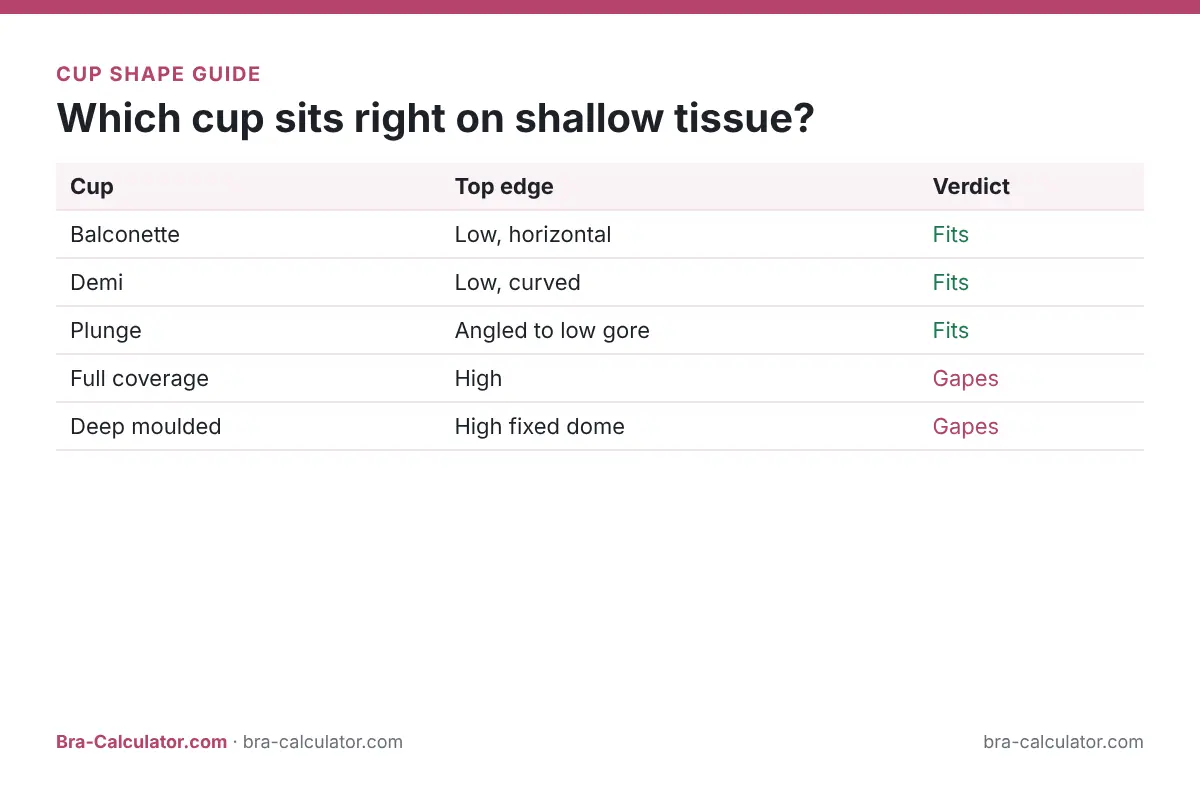
A horizontal top edge and short, wide cups sit low on the breast. There is very little cup above your tissue to gape, and the wide wire base suits a broad root.
Covers roughly the lower half to two-thirds of the breast. Shallow tissue fills it completely, so the neckline lies smooth under knits.
A low centre gore and angled cups follow the spread of shallow tissue toward the centre. Pick plunges with seamed or lightly lined cups, not thick push-up pads.
A stretch lace top panel hugs the upper breast and fills small differences in depth. It is the most forgiving option between sizes.
Vertical seams create projection, which shallow tissue does not need, but horizontally or diagonally seamed cups work well.
A fixed dome made for projected tissue. This is the most common cause of top-of-cup gaping in shallow wearers.
Tall cup sides and a high neckline leave room you cannot fill. Use a balconette instead if you want coverage.
Cup styles for shallow breasts
Shallow-Friendly Bras by Cup Size
Shallow shape behaves differently at each end of the size range. With small cups the problem is usually an empty dome. With fuller cups it is a cup that is the right volume but the wrong outline. Use the table to match your size and style, then follow the links for size-specific picks.
| Cup range | What shallow looks like | Best construction | Where to go next |
|---|---|---|---|
| AA–B | Moulded cups stand away entirely; bra rides up when you raise your arms | Triangle bralette, unlined demi, light plunge | AA cup bras · A cup bras |
| C–D | Gap at the top of T-shirt bras; cups wrinkle under fitted tops | Balconette, demi, low plunge with thin lining | C cup bras · balconette bras |
| DD–F | Wire fits but cups fold at the top; spillage under the arm if you size down | Wide-base balconette, horizontally seamed cups | E cup bras · F cup bras |
| G and up | Fuller cups made for projection collapse at the top | Specialist full-bust balconettes with wide wires | large-bust bras · G cup guide |
A useful pattern if you are in the D–G range: specialist full-bust brands make their balconettes with wider wires and shorter cups than mainstream T-shirt bras. That combination is almost made for shallow tissue. If the band feels right but you want to test a different volume, our sister size calculator shows the sizes that keep the same cup volume on a different band.
Bras That Work for Shallow Breasts
Every pick below is in stock on Amazon with at least a 4.0-star average and hundreds of verified ratings. We chose them for cup shape: each has a low or open top edge that suits shallow tissue. Ratings were checked in November 2026.
A non-padded balconette with wide, short cups and full-bust sizing. It is the classic shallow-friendly shape for D cups and up. Check sizes on Amazon
Low gore and angled contour cups that follow shallow tissue toward the centre. The cup edge is cut lower than most T-shirt bras. Check sizes on Amazon
Mid-coverage with a stretch-lace top edge that hugs the upper breast. It forgives small depth differences. Check sizes on Amazon
A seamless triangle with no fixed dome to fill, so it is ideal for shallow AA–B cups and for lounging. Check sizes on Amazon
Affiliate disclosure: we earn a commission on qualifying Amazon purchases at no extra cost to you. Picks are chosen for fit, never for commission.
Shallow Breast Fit Problems and Fixes
The cup is taller or deeper than your tissue.
A rigid moulded cup with an unfilled upper half.
The smaller cup has a shorter wire that sits on tissue.
Wide-set shallow tissue plus wide-set straps.
Usually a cup too small or too narrow at the base, not a shallow problem.
The band is too loose, so the cups tip forward and look empty.
Shallow Breasts and Other Breast Shapes
Shallow + wide-set
Space between the breasts plus a wide root. Choose low plunges with close-set straps.
PlungeShallow + east-west
Nipples point outward. Balconettes with side support guide tissue forward.
East-west guideShallow + bottom-heavy
More tissue below the nipple. Demi and balconette cups match this naturally.
DemiShallow + asymmetry
Fit the larger side and use a removable pad or a stretch-lace edge for the smaller side.
Asymmetry guideFor the full picture of how shape and style connect, see the best bra types for every breast shape.
Why Breasts Become Shallower Over Time
Depth is not fixed for life. Many people find a cup that fitted perfectly at 25 begins to gape at 40. The cup has not stretched; the tissue has changed shape. Three ordinary changes drive most of it.
Pregnancy and breastfeeding. Glandular tissue expands and then reduces after weaning. The skin envelope often stays slightly larger, so the same volume sits lower and flatter. Many people move from a projected shape to a shallower one with fuller lower poles after one or more pregnancies. The maternity bra guide covers sizing through those stages.
Weight change. Breast tissue is partly fat, so weight loss reduces volume. It often reduces projection more than root width, which leaves the same wide base with less forward fullness. That is the classic recipe for top-of-cup gaping in a band size that is otherwise unchanged.
Age and hormones. Around menopause, glandular tissue is gradually replaced by softer fatty tissue and the supporting ligaments relax. The breast tends to spread wider and sit lower. That is why bras for older women often lean toward balconettes and soft, seamed cups rather than deep moulded shapes.
If your shape changes suddenly on one side only, or you notice a new lump, skin dimpling or nipple change, see your GP. Those are not fit issues. Gradual, even changes in shape over months or years are normal.
Styling Tips for Shallow Breasts
The right bra solves most problems, but a few outfit choices make shallow tissue look smoother and fuller under clothes:
Pair them with a lightly lined balconette or a demi with a smooth lace edge. Avoid thick moulded cups, whose hollow top edge shows through fine fabric.
Balconettes are cut for these. The horizontal top edge sits under a square neckline without peeking out.
Choose a low plunge with a short centre gore. Shallow tissue usually sits well toward the centre in a plunge.
Use a strapless with a wide balconette-style cup and a firm, silicone-lined band. Do not size the band up to “feel comfortable”, because the band is all that is holding it. See bras for backless dresses.
Shallow-Breast Buying Checklist
Measure snug underbust and full bust with the calculator. Shape advice only works on top of a correct size.
Few brands label cups “shallow”. Filter for balconette, demi, balcony or plunge.
Look for a low top edge level with or below the nipple line, and a wide, rounded wire base.
Seams and stretch lace adapt to depth; a moulded dome cannot.
Do the scoop: lean forward, gather tissue into the cups, stand up. If the top still gapes, change style, not size.
Frequently Asked Questions
Shallow breasts have a wide base on the chest and little forward projection, so the volume is spread out rather than forward. It is a shape, not a size, and it happens at every cup size.
Balconette is usually best, followed by demi and low plunge styles. They have short, open cups that do not leave an empty space above shallow tissue.
Most often the cup is deeper than your tissue, which is common with shallow breasts. Try a balconette or demi in the same size before going down a cup, because a smaller cup usually makes the wire dig in at the sides.
Only if the wire also sits outside your breast tissue and the band is correct. If the wire fits and only the top gapes, change cup shape instead of size.
Many deep moulded T-shirt bras gape on shallow tissue. Look for T-shirt bras with a lower neckline, a thinner foam cup or a stretch-lace top edge.
Yes. Shallow describes how volume is distributed, not how much there is. Many DD to G cup wearers are shallow and fit best in wide-based balconettes.
Lean forward in an unpadded bra that fits in the band. Shallow tissue fills the lower cup and leaves the top loose; projected tissue fills the cup forward and may overflow at the centre.
Low push-up or plunge styles with thin pads can work, but thick pads that sit high often add to the gap. A lightly lined plunge is usually more reliable.
Find the right size first
Shape advice only works on a correct size. Measure once and get your size, sister sizes and international equivalents.