Do Breasts Get Bigger Before Your Period? Causes, Timeline & What to Expect (2026)
Yes. Breasts can temporarily get bigger before your period due to rising progesterone and estrogen levels in the luteal phase of your menstrual cycle. These hormones cause milk ducts to swell and fluid to accumulate in breast tissue, increasing volume by up to 25%. The swelling typically begins 7–14 days before menstruation and resolves within 1–3 days after your period starts.
If your bra feels inexplicably tighter at the same point every month — you’re not imagining it. Cyclic breast swelling before your period is one of the most common premenstrual symptoms, affecting an estimated 50–70% of people who menstruate. This guide explains exactly why it happens, when to expect it, how much swelling is normal, what the warning signs are, and — most practically — how to adjust your bra fit so that the days before your period don’t have to be uncomfortable.
⚡ Key Takeaways
- Breast enlargement before a period is hormonal — caused by progesterone and estrogen surges after ovulation, not by anything you’re doing wrong.
- Volume can increase up to 25% during the premenstrual luteal phase — enough for a bra that fitted perfectly last week to feel genuinely tight today.
- Swelling starts around day 14–16 of your cycle and typically peaks 2–3 days before your period arrives.
- It resolves within 1–3 days of menstruation beginning as hormone levels drop.
- Sister sizing is the smartest bra fix — going up one cup letter on the same band (e.g. 34B → 34C) or up one band with one cup down (34B → 36A) provides relief without buying a new bra.
- Wireless and soft-cup bras are significantly more comfortable during peak swelling days than underwire styles.
- Persistent, one-sided, or worsening swelling outside your cycle warrants a medical check — most cyclic breast changes are normal, but some patterns are worth discussing with a healthcare provider.
Why Do Breasts Get Bigger Before Your Period? The Hormonal Science
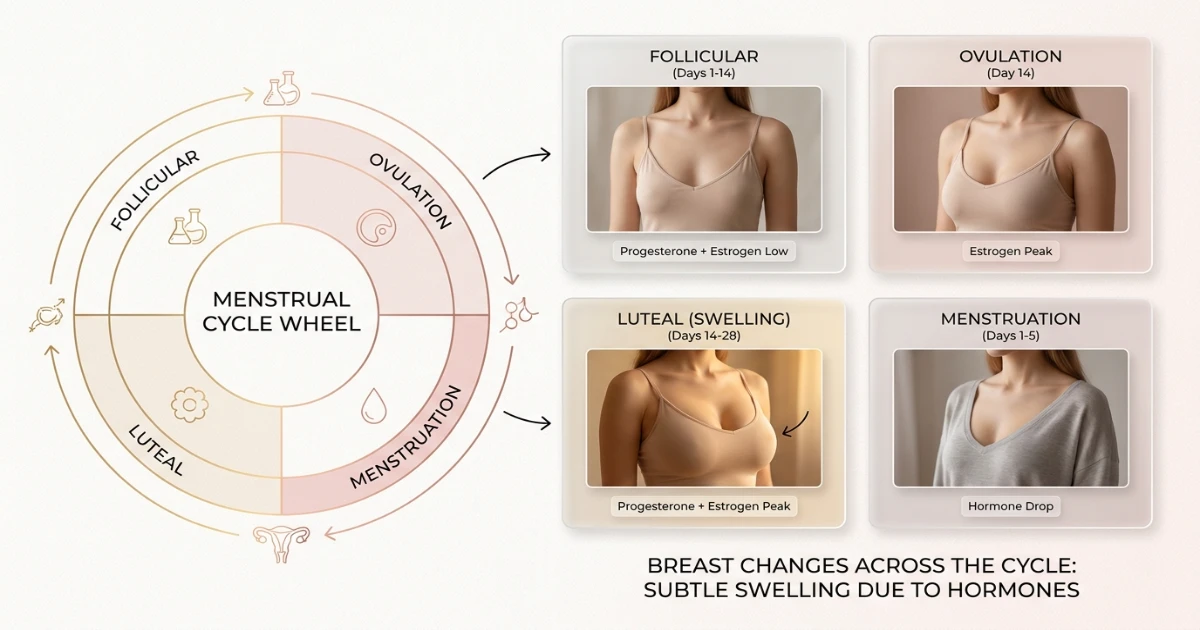
Breast tissue is uniquely hormonally responsive. Unlike most other tissue in the body, breast glands and ducts actively change throughout the menstrual cycle in direct response to estrogen and progesterone — which is why breasts are often described as a reliable barometer of where you are in your cycle.
Here is what happens during the luteal phase — the second half of your cycle, from ovulation to the start of menstruation:
- Progesterone rises sharply after ovulation (around day 14 of a standard 28-day cycle). This hormone signals milk-producing glands and lobules to enlarge — a biological preparation for potential pregnancy. Even when pregnancy doesn’t occur, the glandular response happens regardless.
- Estrogen peaks simultaneously, causing increased blood flow to breast tissue and triggering fluid retention (edema) in the surrounding cells and connective tissue.
- Prolactin levels also rise in some individuals, further stimulating glandular activity and contributing to a sensation of heaviness and fullness.
- Together, these hormones cause both structural swelling (in glandular tissue) and fluid accumulation — which is why breasts feel simultaneously larger and more tender rather than just one or the other.
When menstruation begins, progesterone and estrogen levels drop sharply. The swelling reverses, glandular tissue contracts, and breast volume returns to its individual baseline over 1–3 days.
Hormone Changes and Their Effect on Breast Tissue
| Hormone | Phase It Rises | Effect on Breast Tissue | Result |
|---|---|---|---|
| Progesterone | Luteal (Days 14–28) | Stimulates milk duct and gland growth | Fullness, enlargement |
| Estrogen | Follicular peak + Luteal | Increases blood flow, triggers fluid retention | Swelling, tenderness |
| Prolactin | Luteal (in some individuals) | Activates milk-producing lobules | Heaviness, heightened sensitivity |
| All three drop | Menstruation begins | Glands contract, fluid drains | Size returns to baseline |
Exact Timeline: When Do Breasts Swell Before Your Period?
Premenstrual breast swelling follows a predictable pattern tied to your cycle. The timing below reflects a standard 28-day cycle — if yours is shorter or longer, the luteal phase (and therefore the swelling window) remains approximately 12–14 days regardless of overall cycle length.
How Much Bigger Do Breasts Get Before a Period?
The degree of swelling varies significantly between individuals. Some people barely notice any change; others experience dramatic discomfort and visible size changes. Research measuring cyclical breast volume changes across the menstrual cycle found:
In practical bra terms, this commonly means:
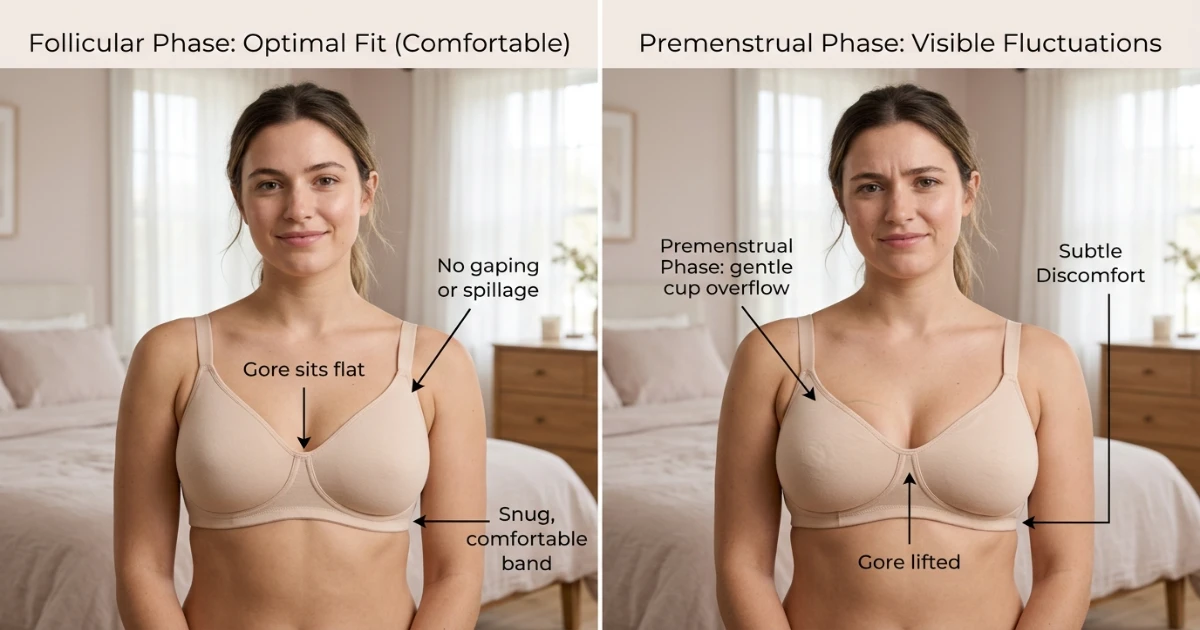
- A bra that fits perfectly in the first week of your cycle may feel genuinely tight or constricting in week three
- Underwire bras may dig into breast tissue at the sides or sit away from the sternum at the gore
- Cup spillage — where breast tissue overflows the top or sides of the cup — becomes more noticeable premenstrually even in a bra that fit fine the previous week
- Band tightness also increases because fluid retention affects the ribcage and surrounding tissue, not just the breast itself
- Breast asymmetry (one breast being larger than the other) often becomes more pronounced, because each breast may respond to hormonal changes differently
How to Adjust Your Bra Fit During Premenstrual Breast Swelling
Rather than buying an entirely separate bra wardrobe for the premenstrual phase, the most practical approach is to use your sister sizes. Sister sizes are bra sizes with a different band and cup letter combination that provide approximately the same enclosed cup volume — giving you flexibility within your existing wardrobe or with a single additional purchase.
How Sister Sizing Works for Premenstrual Swelling
The sister size principle: going up one band size and down one cup letter, or down one band size and up one cup letter, maintains approximately the same cup volume. When your breasts swell premenstrually, you have two options:
- Need more cup room but band is fine: Go up one cup letter on the same band (34B → 34C)
- Need both more cup room and a looser band: Go up one band and keep the same cup letter effectively (34B → 36A keeps the same volume; 34B → 36B adds cup volume on a wider band)
| Your Regular Size | Cup Relief (Same Band, +1 Cup) | Band + Cup Relief (Sister Size) |
|---|---|---|
| 32B | 32C | 34A (same volume, wider band) |
| 34A | 34B | 36AA (same volume, wider band) |
| 34B | 34C | 36A (same volume, wider band) |
| 34C | 34D | 36B (same volume, wider band) |
| 34D / 34DD | 34DD / 34DDD | 36C / 36D (same volume, wider band) |
| 36B | 36C | 38A (same volume, wider band) |
| 36C | 36D | 38B (same volume, wider band) |
| 36D | 36DD | 38C (same volume, wider band) |
| 38B | 38C | 40A (same volume, wider band) |
| 38C | 38D | 40B (same volume, wider band) |
During premenstrual swelling, wireless bras, soft-cup bras, and bralettes often feel significantly more comfortable because they don’t apply rigid pressure to swollen, tender glandular tissue. If you prefer underwire, choose a style with deeper cups and wider wires that sit flat on the ribcage rather than pressing into breast tissue from the sides. See our bra fit problems guide if your underwire is consistently digging in or floating away from the sternum.
How to Reduce Premenstrual Breast Swelling — 5 Evidence-Based Steps
Use a period tracking app to log when breast swelling starts, when it peaks, and when it resolves — every month. After 2–3 cycles, you’ll have a reliable personal map of your premenstrual pattern. This lets you plan ahead (switching bras before the worst days hit) and gives you data worth sharing with a healthcare provider if symptoms are severe or worsening.
High sodium intake directly worsens fluid retention throughout the body — including in breast tissue and the surrounding ribcage area. Caffeine increases breast tissue sensitivity and amplifies tenderness in many people. Reducing both in the week before your period (your late luteal phase) can meaningfully reduce both swelling and discomfort. This doesn’t require complete elimination — simply being aware of your intake during these days makes a practical difference.
On your highest-swelling days, swap to a wireless or soft-cup bra — ideally in your sister size if the swelling is significant. The goal during this phase is to support breast tissue without compressing swollen glands. Compression worsens tenderness; gentle support reduces it. Keeping one or two soft-cup options specifically for this phase of your cycle is one of the most practical solutions most people find.
Warm compresses increase blood flow and relieve the heavy, congested feeling that accompanies glandular swelling. Cold compresses reduce inflammation and numb acute tenderness. Both are supported by evidence for cyclical mastalgia (premenstrual breast pain). Use whichever feels better for your specific experience — there is no universally superior option, and individual preference varies considerably.
Evening primrose oil (containing gamma-linolenic acid) has some clinical evidence supporting its use for reducing cyclical breast pain. Vitamin E supplementation has also been studied for premenstrual mastalgia with generally positive, if mixed, results. Regular aerobic exercise (which helps regulate overall hormonal balance) is also consistently associated with reduced premenstrual symptoms across the board. Always consult a healthcare provider before starting supplements, particularly if you take any medications.
🛍️ Best Bras for Premenstrual Breast Swelling — Our Top Picks
These two bras are specifically suited for the premenstrual phase — when breast tissue is swollen, tender, and in need of support without compression. Both are available in a wide range of sizes and have been consistently praised by reviewers for all-day comfort during the most uncomfortable premenstrual days.

Glamorise Women’s Full Figure MagicLift Active Support Wirefree Bra #1005
Wide, cushioned non-slip straps prevent the shoulder dig-in that worsens during premenstrual breast heaviness, and the multi-hook back offers adjustability as the band tightness changes across your cycle. Available in an extended size run through 46H — so if your regular size is, say, a 36C and you need to sister-size to a 36D or 38B during your premenstrual phase, this bra accommodates that range. One of the most trusted wire-free options for larger cup sizes, with consistent review feedback specifically praising all-day comfort.
Available in: 36C–46H — covers standard and extended sizing for premenstrual sister sizing
View on Amazon →
Warner’s Women’s Elements of Bliss Wire-Free Contour Bra #1269
At over 14,000 Amazon reviews, this is one of the most validated wire-free options on the market — and the feedback specifically around comfort on sensitive days is consistently strong. The wide, structured back band stays level without rolling, which matters more during premenstrual fluid retention when the back and ribcage area also tend to feel tighter. At under $25, rotating between your regular size and your premenstrual sister size becomes genuinely practical without significant extra cost.
Available in: 32A–40DD — covers B and C cup sister sizing across most band sizes
View on Amazon →
Maidenform Women’s Comfort Devotion Extra Coverage Wire-Free Bra #09404
The smoothing side panel contains lateral tissue migration — the tendency of swollen breast tissue to spread toward the underarms — which is more pronounced during the premenstrual phase. This makes it an excellent choice for the days when your regular bra is leaving you with visible side spillage. Over 9,500 Amazon reviews confirm consistent all-day performance, and the multi-hook back delivers adjustability as your ribcage circumference fluctuates slightly with fluid retention across your cycle.
Available in: 32B–42DDD — covers extended sizes for premenstrual sister sizing across a wide range
View on Amazon →ℹ️ As an Amazon Associate, Bra Calculator earns from qualifying purchases. All picks are independently selected based on comfort, construction quality, and size range. Prices and availability subject to change.
When Breast Swelling Before Your Period May Be a Concern
Cyclic premenstrual breast swelling is completely normal and affects the majority of menstruating people. However, some patterns are worth medical attention:
| Symptom Pattern | Likely Explanation | Recommended Action |
|---|---|---|
| Swelling resolves 1–3 days after period begins | Normal cyclic hormonal change | No action needed — this is expected |
| Swelling doesn’t resolve after your period ends | Possible pregnancy, hormonal imbalance, or thyroid issue | Take a pregnancy test; see a doctor if negative |
| Noticeably more swelling in one breast only | Often normal asymmetry — or lymphatic issue | Monitor; see a doctor if persistent, hard, or painful |
| Hard lump discovered during the swollen phase | Could be a cyst (very common) or other mass | See a doctor for a clinical breast exam — most are benign |
| Nipple discharge alongside swelling | Could indicate prolactin imbalance or other cause | See a doctor — especially if discharge is bloody |
| Swelling is new and worsening each cycle | Could be hormonal contraceptive effect, perimenopause, or other hormonal shift | Discuss with a healthcare provider |
| Redness, warmth, or skin texture changes | Possible mastitis or, rarely, inflammatory breast condition | Seek medical attention promptly |
Premenstrual Breast Swelling vs Early Pregnancy: How to Tell the Difference
Both PMS and early pregnancy cause breast enlargement through similar hormonal pathways, which can make distinguishing the two confusing — particularly if your period is late. Here are the key differences:
| Feature | Premenstrual Swelling (PMS) | Early Pregnancy Swelling |
|---|---|---|
| When it starts | 7–14 days before period | 1–2 weeks after conception (often around the same time as expected period) |
| Duration | Resolves 1–3 days after period begins | Persists and often intensifies — does not resolve |
| Tenderness level | Moderate, predictably cyclic | Often more intense and constant, may feel different in quality |
| Nipple changes | Minimal or none | Nipples may darken; areola often enlarges and darkens |
| Other symptoms | Bloating, mood changes, cramping | Nausea, fatigue, frequent urination, missed period, heightened smell sensitivity |
| Resolves after period? | Yes — within 1–3 days of menstruation | No — persists throughout the first trimester and beyond |
The most reliable way to distinguish the two is to wait and see whether your period arrives. If it doesn’t, take a home pregnancy test — these are most accurate from the first day of a missed period. If breast swelling persists after your period has started and resolved, see a healthcare provider.
Not sure if your bra is genuinely the right size — or just too tight because of premenstrual swelling? The two feel different: a wrong-size bra is uncomfortable throughout your entire cycle, not just the 7–14 days before your period. Our AI calculator gives you your correct band and cup in under 2 minutes, based on your actual measurements.
Find My Correct Bra Size →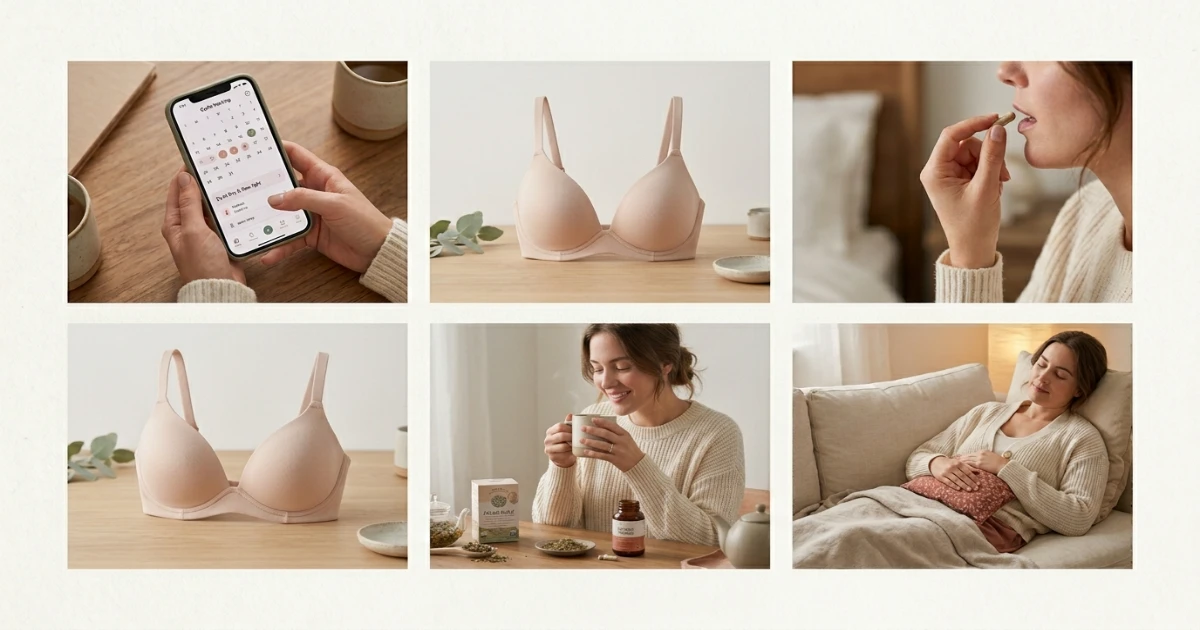
Frequently Asked Questions: Breasts Getting Bigger Before Your Period
Do breasts actually get bigger before your period?
Yes — this is well-documented and very common. Many people experience temporary breast enlargement in the 1–2 weeks before menstruation, caused by rising progesterone and estrogen levels that trigger fluid retention and glandular swelling in breast tissue. The enlargement is temporary and reverses naturally once menstruation begins and hormone levels drop. It is not a sign that anything is wrong.
How much bigger do breasts get before a period?
Breast volume can increase by up to 25% in the premenstrual luteal phase, according to research measuring cyclic breast volume changes. In practical bra terms, most people notice a half-cup to full-cup increase in bra tightness — meaning a bra that fit perfectly at the start of your cycle may feel noticeably constrictive by week three. The degree of swelling varies significantly between individuals and can change across different life stages.
When before your period do breasts start to swell?
Breast swelling typically begins around days 14–16 of the menstrual cycle — shortly after ovulation — and peaks in the 2–3 days immediately before menstruation starts. It usually subsides within 1–3 days after your period begins as progesterone and estrogen levels drop. The entire swelling window covers roughly 7–14 days for most people, though individual timings vary.
Why are my breasts sore and bigger before my period?
Both the soreness and the enlargement come from the same hormonal surge during the luteal phase. Rising progesterone causes milk ducts and glands to swell in preparation for potential pregnancy; rising estrogen causes increased blood flow and fluid retention in surrounding tissue. The result is both structural swelling (making breasts larger) and tissue inflammation (making them tender). When hormone levels drop at menstruation, both effects reverse simultaneously.
Should I size up my bra before my period?
Using your sister size during premenstrual breast swelling is a practical and effective solution. If you normally wear a 34B, trying a 34C (one cup larger, same band) or 36A (same cup volume as 34B but on a wider, slightly looser band) can significantly relieve compression discomfort without purchasing an entirely different bra size. Wireless or soft-cup options in your sister size are typically the most comfortable choice during peak swelling days.
Does breast swelling before a period mean pregnancy?
Not necessarily — premenstrual breast swelling is a normal symptom caused by the same hormones (estrogen and progesterone) that rise in early pregnancy. The key difference is what happens next: premenstrual swelling resolves within 1–3 days of your period starting. Pregnancy-related breast swelling persists and typically intensifies, accompanied by other early pregnancy signs like missed period, nausea, and nipple darkening. If swelling continues after your period should have started, take a pregnancy test.
Is it normal for only one breast to swell more before a period?
Yes — asymmetrical premenstrual breast swelling is common because the majority of people have naturally unequal breast sizes. When hormonal changes cause both breasts to swell, they swell from different starting points, which can make the difference between them appear more pronounced. This is normal. However, if one breast is dramatically larger, has changed in skin texture, feels hard, or is painful outside your normal cycle pattern, consult a healthcare provider.
How long does premenstrual breast swelling last?
Premenstrual breast swelling typically lasts 7–14 days during the luteal phase and resolves within 1–3 days after menstruation begins. If breast enlargement or tenderness persists beyond the first few days of your period, this may indicate a hormonal imbalance, thyroid issue, or — if you’ve had unprotected sex — pregnancy. Any pattern of breast changes that doesn’t follow your usual cycle is worth discussing with a healthcare provider.
What can I do to reduce breast swelling before my period?
The most effective evidence-supported approaches are: reducing sodium and caffeine intake in the 5–7 days before your period to limit fluid retention; wearing a supportive wireless or soft-cup bra with extra coverage rather than a compressive underwire; applying warm or cold compresses to relieve tenderness; regular aerobic exercise (which supports hormonal regulation across the cycle); and evening primrose oil supplementation under medical guidance. Tracking your cycle to anticipate your swelling window is also practically very useful.
Can breasts permanently grow due to premenstrual hormonal changes?
No — premenstrual breast changes are fully reversible and do not permanently increase breast size. The swelling is temporary fluid retention and glandular expansion, both of which reverse when hormone levels drop at menstruation. Breast tissue does grow permanently in response to other sustained hormonal shifts — pregnancy, breastfeeding, hormonal contraceptives, and significant weight changes — but cyclic monthly swelling does not produce permanent enlargement.
Does the contraceptive pill affect premenstrual breast swelling?
Yes — hormonal contraceptives affect cyclic breast changes in different ways depending on the type and formulation. Combined estrogen-progesterone pills can either reduce or worsen premenstrual breast symptoms depending on the progestin type and dosage used. Progestin-only pills and hormonal IUDs may cause a low-level constant breast fullness rather than cyclic swelling. If your contraceptive is significantly worsening breast swelling or tenderness, discussing alternative formulations with your doctor is worthwhile.
Why is my bra suddenly too tight before my period?
A bra that suddenly feels too tight before your period is reacting accurately to premenstrual breast swelling — the temporary increase in breast volume caused by progesterone and estrogen during the luteal phase. The tightness typically affects both the cups (glandular swelling increases breast volume) and the band (fluid retention affects the ribcage and surrounding tissue). This is normal, predictable, and the best practical solution is to temporarily switch to a sister size — particularly a wireless or soft-cup option.
Affiliate Disclosure: This article contains affiliate links to Amazon. If you purchase through these links, Bra Calculator may earn a small commission at no additional cost to you. All product recommendations are independently selected based on quality, comfort, and size range. Prices and availability are subject to change.