Breathe out normally, then wrap the tape snugly around your ribcage just beneath your bust. Keep it level all the way around. Use the nearest even number as your band size.
💡 Landed on an odd number? Try the even size on either side and keep the one that feels secure without digging in.
02
Overbust (Cup)
Wrap the tape around the fullest part of your bust, usually at nipple level. Keep it level and relaxed so it rests against you without pressing the tissue down. This is your bust measurement.
💡 For the clearest result, measure without a bra or while wearing a thin, unlined bra.
03
Work Out Your Cup Size
Subtract your band from your bust measurement. Each inch of difference usually moves you up one cup: 0″=AA, 1″=A, 2″=B, 3″=C, 4″=D, 5″=DD, 6″=DDD…
💡 Example: a 37″ bust minus a 34″ band leaves a 3″ difference, which points to a C cup and a starting size of 34C.
Recent Calculations
Nothing here yet. Your five most recent calculations will show up here.
Free Sister Size Bra Calculator · World Edition 2026
Sister Size Bra Calculator: Find a Tighter or Looser Band
Enter the bra size that is already close to fitting. We’ll show the nearest sister sizes for a firmer or roomier band, explain which direction makes sense for your fit issue, and convert the result across major sizing systems.
Reviewed by
Amelia · Founder & Bra Fit SpecialistSister-size logic and fit guidance reviewed · Updated August 22, 2026
Looser Band
More comfort · softer feel
Band +2
${esc(looseUS)}
Band +2 → Cup −1
Useful when the band digs in and you need more breathing room. ${advice.rec==="loose"?` ✓ Recommended`:""}
${advice.icon}
${esc(advice.title)}
${esc(advice.body)}
🌍 International Conversions${esc(REGIONS[region]?.flag)} ${esc(REGIONS[region]?.label)}
Size type
${tableHeaderCells}
${tableRows}
`;
const resultsEl = document.getElementById("results"); resultsEl.innerHTML = html;
document.getElementById("copyBtn")?.addEventListener("click",()=>{ navigator.clipboard.writeText(shareText).then(()=>{ const lbl=document.getElementById("copyLabel"); if(lbl) lbl.textContent="Copied!"; setTimeout(()=>{ if(lbl) lbl.textContent="Copy results"; },2500); }).catch(()=>alert(shareText)); });
document.getElementById("shareBtn")?.addEventListener("click",async ()=>{ if(navigator.share){ try{ await navigator.share({ title:`Sister Sizes for ${currentUS}`, text:shareText }); }catch{} } else { navigator.clipboard.writeText(window.location.href); } });
document.getElementById("printBtn")?.addEventListener("click",()=>window.print());
if (window.innerWidth <= 640) setTimeout(() => resultsEl.scrollIntoView({ behavior: "smooth", block: "start" }), 120);
requestAnimationFrame(() => { const fill = resultsEl.querySelector(".fit-score__fill"); if(fill) { fill.style.width="0%"; requestAnimationFrame(()=>{ fill.style.transition="width .7s"; fill.style.width=scoreWidth; }); } });
}/* ═══════════════════════════════════════════════════
THEME & INIT
═══════════════════════════════════════════════════ */
function initTheme() { const saved = localStorage.getItem("sscp_theme") ?? "dark"; applyTheme(saved); }
function applyTheme(theme) {
const app = document.getElementById("app");
if(theme === "light") { app.setAttribute("data-theme","light"); }
else { app.removeAttribute("data-theme"); }
const icon = document.getElementById("themeIcon"); if(icon) icon.textContent = theme==="light"?"🌙":"☀";
try { localStorage.setItem("sscp_theme", theme); } catch {}
}
function toggleTheme() { const current = document.getElementById("app")?.getAttribute("data-theme") ?? "dark"; applyTheme(current==="light"?"dark":"light"); }
function togglePanel(panelId, triggerId) {
const panel = document.getElementById(panelId), trigger = document.getElementById(triggerId);
if(!panel||!trigger) return; const isHidden = panel.hidden; panel.hidden = !isHidden; trigger.setAttribute("aria-expanded", String(isHidden));
if(isHidden) panel.scrollIntoView({ behavior:"smooth", block:"nearest" });
}
function reset() {
document.getElementById("bandSelect").value="32"; document.getElementById("cupSelect").value="C"; document.getElementById("regionSelect").value="US";
const noneRadio = document.querySelector('input[name="fitIssue"][value="none"]'); if(noneRadio) noneRadio.checked=true;
document.getElementById("results").innerHTML=""; document.getElementById("statusText").textContent="Ready";
}document.addEventListener("DOMContentLoaded", () => {
document.getElementById("calcBtn")?.addEventListener("click", calculate);
document.getElementById("calcBtnMobile")?.addEventListener("click", calculate);
document.getElementById("resetBtn")?.addEventListener("click", reset);
document.getElementById("themeToggle")?.addEventListener("click", toggleTheme);
document.getElementById("guideToggle")?.addEventListener("click", () => togglePanel("measureGuide", "guideToggle"));
document.getElementById("historyToggle")?.addEventListener("click", () => togglePanel("historyPanel", "historyToggle"));
document.getElementById("clearHistory")?.addEventListener("click", () => { try { localStorage.removeItem(HISTORY_KEY); } catch {} renderHistory(); });
document.addEventListener("click", e => { const closer = e.target.closest("[data-close]"); if(!closer) return; const panelId = closer.dataset.close; const panel = document.getElementById(panelId); if(panel) panel.hidden = true; const toggleId = { measureGuide:"guideToggle", historyPanel:"historyToggle" }[panelId]; if(toggleId) document.getElementById(toggleId)?.setAttribute("aria-expanded","false"); });
["bandSelect","cupSelect","regionSelect"].forEach(id => document.getElementById(id)?.addEventListener("change", calculate));
document.querySelectorAll('input[name="fitIssue"]').forEach(radio => radio.addEventListener("change", () => { if(document.getElementById("results").innerHTML) calculate(); }));
document.addEventListener("keydown", e => { if(e.key==="Escape"){ ["measureGuide","historyPanel"].forEach(id => { const panel=document.getElementById(id); if(panel&&!panel.hidden){ panel.hidden=true; const toggleId={ measureGuide:"guideToggle", historyPanel:"historyToggle"}[id]; if(toggleId) document.getElementById(toggleId)?.setAttribute("aria-expanded","false"); } }); } });
initTheme(); renderHistory(); calculate();
});/* ── WebMCP progressive enhancement ──
Exposes the existing sister-size calculator logic to compatible AI agents.
Does not change the visible calculator, UI state, history, theme, or current calculation flow. */
const sisModelContext =
(typeof document !== "undefined" && document.modelContext) ||
(typeof navigator !== "undefined" && navigator.modelContext);if (sisModelContext && typeof sisModelContext.registerTool === "function") {
function sisWebMCPResult(payload, isError) {
return {
content: [{
type: "text",
text: JSON.stringify(payload)
}],
isError: !!isError
};
}try {
const sisRegistration = sisModelContext.registerTool({
name: "find_sister_sizes",
title: "Find Sister Bra Sizes",
description: "Find the tighter-band and looser-band sister sizes for a US/CA base bra size using the same Bra-Calculator.com logic as the visible Sister Size Bra Calculator. Returns nearby sister-size chain options, international equivalents and optional fit-issue guidance without changing the page or storing the calculation.",
inputSchema: {
type: "object",
properties: {
band: {
type: "integer",
enum: [26,28,30,32,34,36,38,40,42,44,46,48,50,52,54],
description: "Current US/CA base band size."
},
cup: {
type: "string",
enum: ["AAA","AA","A","B","C","D","DD","DDD","G","H","I","J","K","L","M","N"],
description: "Current US/CA base cup label used by this calculator."
},
region: {
type: "string",
enum: ["US","UK","EU","AU","JP","FR"],
description: "Preferred region for the highlighted conversion. US means US/Canada, UK means UK/Ireland, EU means continental Europe, AU means Australia/New Zealand, JP means Japan, and FR means France/Spain/Belgium."
},
fitIssue: {
type: "string",
enum: ["none","band-tight","band-loose","cup-spill","cup-gap","wire-poke","strap-slip"],
description: "Optional fit issue for guidance. Use none when no fit problem is supplied."
}
},
required: ["band","cup","region"],
additionalProperties: false
},
annotations: {
readOnlyHint: true,
untrustedContentHint: false
},
execute: async function(input) {
const band = Number(input.band);
const cup = String(input.cup || "");
const region = String(input.region || "");
const issue = input.fitIssue ? String(input.fitIssue) : "none";if (!ALL_BANDS.includes(band) || !US_CUPS.includes(cup) || !REGIONS[region]) {
return sisWebMCPResult({
ok: false,
error: "Use a supported US/CA base band, cup label and region from the Sister Size Bra Calculator."
}, true);
}const allowedIssues = ["none","band-tight","band-loose","cup-spill","cup-gap","wire-poke","strap-slip"];
if (!allowedIssues.includes(issue)) {
return sisWebMCPResult({
ok: false,
error: "Unsupported fit issue."
}, true);
}const ci = cupIndex(cup);const t2Band = clampBand(band - 2), t2CupI = clampCup(ci + 1);
const l2Band = clampBand(band + 2), l2CupI = clampCup(ci - 1);
const t4Band = clampBand(band - 4), t4CupI = clampCup(ci + 2);
const l4Band = clampBand(band + 4), l4CupI = clampCup(ci - 2);
const t6Band = clampBand(band - 6), t6CupI = clampCup(ci + 3);
const l6Band = clampBand(band + 6), l6CupI = clampCup(ci - 3);const currentUS = `${band}${cup}`;
const tightUS = `${t2Band}${US_CUPS[t2CupI]}`;
const looseUS = `${l2Band}${US_CUPS[l2CupI]}`;
const advice = getFitAdvice(issue, tightUS, looseUS, band, cup);const chainData = [
{ band: t6Band, cupI: t6CupI, type: "far", label: "-6 band" },
{ band: t4Band, cupI: t4CupI, type: "far", label: "-4 band" },
{ band: t2Band, cupI: t2CupI, type: "tight", label: "Tighter" },
{ band: band, cupI: ci, type: "current", label: "Your size" },
{ band: l2Band, cupI: l2CupI, type: "loose", label: "Looser" },
{ band: l4Band, cupI: l4CupI, type: "far", label: "+4 band" },
{ band: l6Band, cupI: l6CupI, type: "far", label: "+6 band" }
].map(function(item) {
return {
size: formatSize(item.band, item.cupI, "US"),
type: item.type,
label: item.label,
recommended:
(advice.rec === "tight" && item.type === "tight") ||
(advice.rec === "loose" && item.type === "loose")
};
});const regionKeys = ["US","UK","EU","AU","JP","FR"];
const conversions = {};
regionKeys.forEach(function(key) {
conversions[key] = {
current: formatSize(band, ci, key),
tighterBand: formatSize(t2Band, t2CupI, key),
looserBand: formatSize(l2Band, l2CupI, key)
};
});let recommendation = "No sister size is specifically preferred from the fit information supplied.";
if (advice.rec === "tight") recommendation = `Try the tighter-band sister size ${tightUS}.`;
if (advice.rec === "loose") recommendation = `Try the looser-band sister size ${looseUS}.`;
if (advice.rec === "up") recommendation = "Change cup size first rather than relying on a sister size.";return sisWebMCPResult({
ok: true,
currentSizeUS: currentUS,
sisterSizes: {
tighterBand: tightUS,
looserBand: looseUS
},
preferredRegion: region,
preferredRegionSizes: conversions[region],
conversions: conversions,
sisterSizeChainUS: chainData,
fitIssue: issue,
recommendation: recommendation,
fitGuidance: {
title: advice.title,
body: advice.body,
score: advice.score,
scoreLabel: advice.scoreLabel
},
method: "Same calculator rule: band -2 with cup +1 for a tighter sister size; band +2 with cup -1 for a looser sister size, using the page's existing US/CA base cup progression and regional conversion tables."
}, false);
}
});if (sisRegistration && typeof sisRegistration.catch === "function") {
sisRegistration.catch(function() {
/* Keep the existing calculator unaffected if registration is rejected. */
});
}
} catch (e) {
/* Keep the existing calculator unaffected on older or experimental WebMCP builds. */
}
}/* ═══════════════════════════════════════════════════
PAGE SHARE BUTTONS
═══════════════════════════════════════════════════ */
document.querySelectorAll("[data-sis-share]").forEach(btn => {
btn.addEventListener("click", async (e) => {
e.preventDefault();
const type = btn.getAttribute("data-sis-share");
const url = encodeURIComponent(window.location.href);
const title = encodeURIComponent(document.title || "Sister Size Bra Calculator");
let target = "";
if (type === "facebook") target = "https://www.facebook.com/sharer/sharer.php?u=" + url;
if (type === "x") target = "https://twitter.com/intent/tweet?url=" + url + "&text=" + title;
if (type === "pinterest") target = "https://pinterest.com/pin/create/button/?url=" + url + "&description=" + title;
if (type === "copy") {
try {
await navigator.clipboard.writeText(window.location.href);
const old = btn.title;
btn.title = "Copied";
setTimeout(() => { btn.title = old || "Copy link"; }, 1500);
} catch {}
return;
}
if (target) window.open(target, "_blank", "noopener,noreferrer,width=720,height=560");
});
});})();
How to Use Sister Sizes Without Creating a New Fit Problem
Use the calculator above when your cups feel right but the band does not. It shows nearby sister sizes that keep the cup capacity closely matched while giving you a firmer or roomier band. Below, you’ll also learn when sister sizing is genuinely useful—and when measuring again will save you more frustration.
⬆
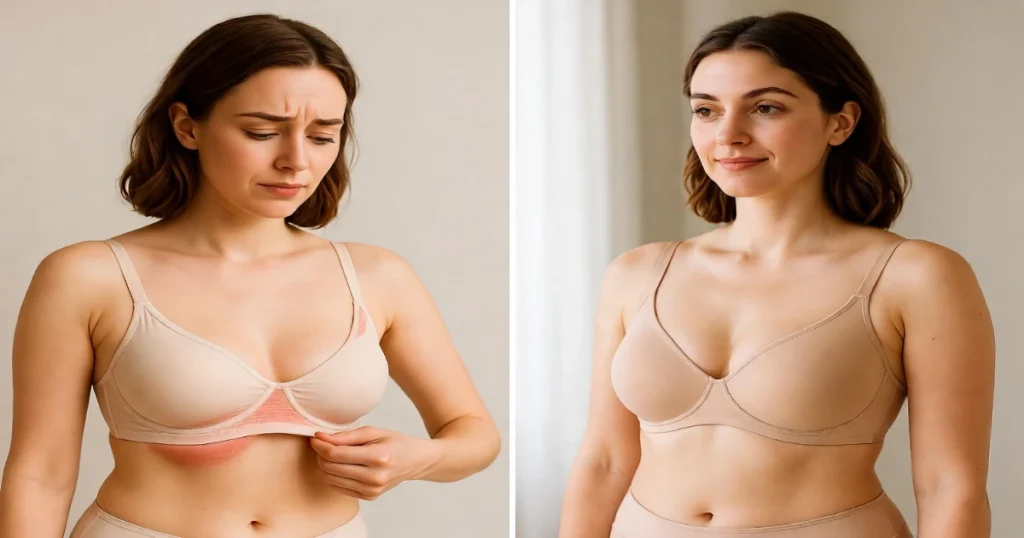
Band rides up?
Go down one band and up one cup. Example: 36C → 34D.
🌊
Band digs in, cups fit?
Go up one band and down one cup. Example: 34D → 36C.
📐
Cups spill or gape badly?
Don’t rely on sister sizing first. Recheck cup size, shape and your starting measurement.
Quick Answer
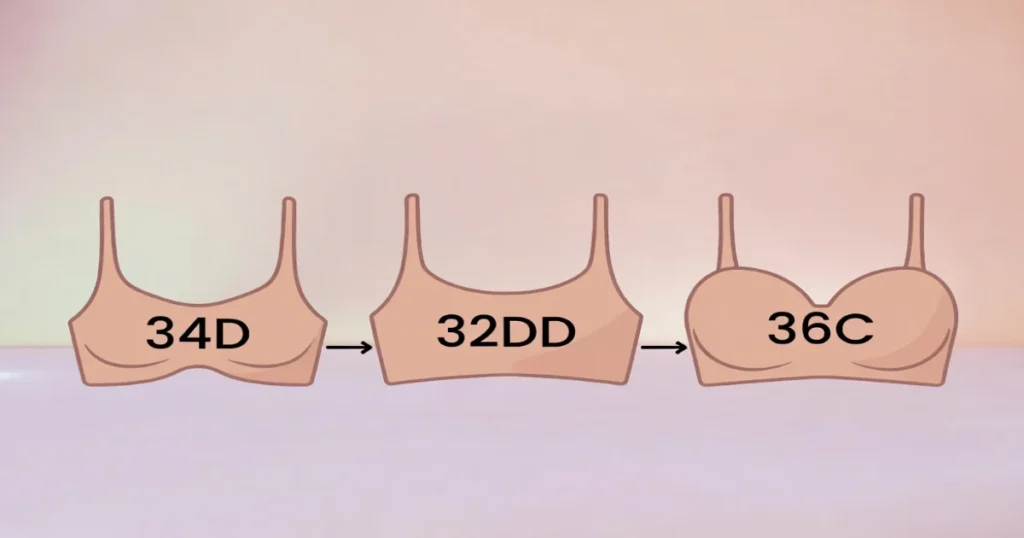
A sister size is a nearby bra size with a different band and a closely matched cup capacity. Move down one band size and up one cup letter for a firmer fit. Move up one band size and down one cup letter for a roomier fit. For example, 34D, 32DD and 36C are sister sizes: the cups hold about the same amount, while the band becomes firmer or looser.
Sister size logic: the cup capacity stays close while the band changes to feel firmer or more relaxed.
What Does “Sister Size” Mean?
A sister size is not just the next label on the rack. It is a deliberate adjustment that changes the band while keeping the cup capacity close to your current size. Cup letters never work on their own: a 30D cup is smaller than a 40D cup, so you always need to read the band number and cup letter together.
Advertisement
The easy rule is to move the band and cup in opposite directions. A smaller band needs a larger cup letter; a larger band needs a smaller cup letter.
Fit Goal
Rule
Example
What Changes
Firmer band
Band −2, cup +1
36C → 34D
A firmer anchor with closely matched cup room
Softer band
Band +2, cup −1
34D → 36C
More room around the ribs with closely matched cup room
Primary size
No adjustment
34D
Stay here when both the band and cups already feel right
When Sister Sizing Is Worth Trying
Sister sizing can help when
The cups feel right, but the band digs in or feels restrictive.
The cups fit, but the band creeps upward at the back.
Your usual size is unavailable in the bra you want.
A particular brand or style runs tighter or stretchier than usual.
You want a firmer anchor in a strapless or high-support bra.
Measure again or change cup size when
Breast tissue spills over the top or sides of the cup.
The center gore floats away from your chest.
The underwire rests on breast tissue instead of surrounding it.
Both the band and the cups feel noticeably wrong.
Your body or measurements have changed since your last fitting.
Important: Sister sizing works best when your current size is already close. If the cup is clearly too small, too large or the wrong shape, shifting the band can disguise the real problem rather than solve it. Start with the Bra Size Calculator when you are not confident about your starting size.
Sister Size or Wrong Size? Here’s How to Tell
A useful sister size should make the band feel better without creating a new cup problem. When the cup itself spills, gaps badly or sits on breast tissue, the issue is not just band tension. That difference matters because band problems and cup problems need different fixes.
Symptom
Likely Meaning
Best Fix
Band rides up, cups fit
Band too loose
Try the smaller-band sister size
Band digs in, cups fit
Band too tight
Try the larger-band sister size
Cup spillage
Cup too small
Keep the band and move up a cup first
Cup gaping
Cup too large, shape mismatch, or loose band
Check the band, then assess cup size and shape
Wire poking
Wire width or cup size mismatch
Remeasure and compare a different wire or cup shape
Fit adjustment: move to the smaller-band sister size for a firmer anchor, or the larger-band sister size when you need more room.
Using Sister Sizes When Shopping Internationally
The sister-size rule works across regions, but labels do not always match. US, UK, EU, AU/NZ, Japanese and French/Spanish/Belgian systems can use different band numbers or cup sequences, especially around DD, E, F and above. The calculator shows a practical conversion path, but the brand’s own chart should be the final check before ordering.
Treat the results as a practical fitting range, not a promise that every brand will feel identical. A UK band may feel firmer than a US one, while a European molded cup may be shallower than a UK full-cup bra. Use the conversion as your starting point, then let the actual fit decide.
How Sister Sizing Works in Sports Bras, Strapless Bras and Bralettes
Sports bras
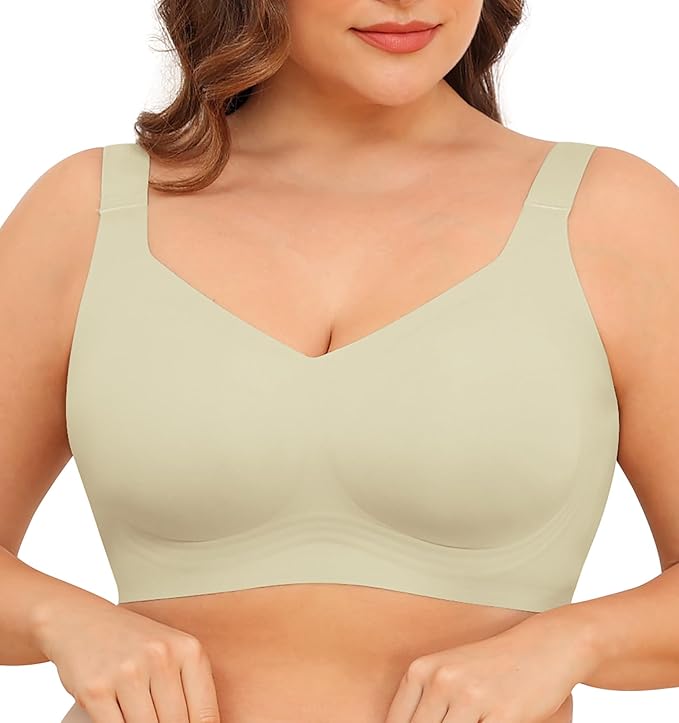
When the cup coverage feels right but the band is uncomfortably firm, compare the roomier sister size. Keep in mind that compression sports bras often feel tighter than everyday bras by design.
Strapless bras
A smaller-band sister size can sometimes feel more secure because a strapless bra relies heavily on the band for support. It should still feel snug rather than painful.
Bralettes
A roomier sister size may feel better in a stretchy pull-on bralette, but going too loose can reduce support and cause the band to roll or ride up.
Top Pick • Max Support
SHEFIT Ultimate Sports Bra
This high-support sports bra lets you adjust both the band and straps, which makes it easier to compare a firmer or roomier fit without guessing.
Best for: high-impact training, strong bounce control and fuller-bust support.
Fit note: when the cups feel secure but the band is too restrictive, compare the larger-band sister size.
Top Pick • Everyday Comfort
Evelyn & Bobbie Beyond Bra
This wireless pull-on style gives smooth everyday coverage without the pressure of an underwire.
Best for: work-from-home days, travel, errands and breaks from underwire.
Fit note: when the band rolls or creeps upward, compare the smaller-band sister size.
🛡️
Full-Coverage Support Bras
A useful next category when your sister-size result improves the band but you still want more containment, side support, or everyday stability.
Best for: everyday support, fuller cups and people comparing nearby band sizes.
Fit note: use your sister-size result as a starting point, then confirm the individual brand chart before ordering.
Affiliate disclosure: As an Amazon Associate, Bra-Calculator.com earns from qualifying purchases. Product availability, sizing and prices can change.
Three Sister-Size Myths That Cause Confusion
“Sister sizes are identical.”
They are close in cup capacity, not identical in fit. Band tension, wire width and strap position can all change.
“You should always wear a sister size.”
Your regular size is usually the best place to start when it fits well. Sister sizes are useful alternatives, not automatic upgrades.
“Sister sizing fixes every fit issue.”
Sister sizing mainly helps with band tension. It cannot rescue a cup that is clearly too small, too large or simply the wrong shape for your body.
When to Check Your Size Again
Measure again whenever several bras suddenly feel different, or after noticeable body changes such as weight fluctuation, pregnancy, postpartum changes, hormonal shifts or menopause. It is also worth checking the fit when you switch brands, because band stretch and cup depth can vary more than the label suggests.
Final fit rule: use sister sizing to fine-tune a known size, not to avoid measuring in the first place.
What to Do Next
When your current bra feels close but not quite right, begin with the calculator above. If the result still does not solve the problem, check your starting size with the Bra Size Calculator, confirm international labels with the Global Bra Size Converter, and work through the exact fit symptom with the Bra Fit Problem Solver.
AmeliaFounder & Bra Fit Specialist · Bra-Calculator.com
Amelia reviews Bra-Calculator.com fit content with a practical focus on measurement logic, sister sizing, band tension, cup-shape differences and real-world fit symptoms. Read her bio and credentials →
Frequently Asked Questions About Sister Sizes
What is a sister size bra?
A sister size changes the band while keeping the cup capacity close to your current size. For example, 34D, 32DD and 36C sit on the same sister-size line.
How do I calculate my sister size quickly?
For a firmer band, move down one band size and up one cup letter. For more room, move up one band size and down one cup letter.
If my band rides up, which sister size should I try?
Try the smaller-band sister size. If a 36C rides up while the cups fit, compare a 34D. The band will feel firmer while the cup capacity stays close.
If my band feels too tight, which sister size should I try?
Try the larger-band sister size. A 34D, for example, becomes a 36C. You gain room around the ribs while keeping the cup capacity close.
Do sister sizes work for US and UK sizing?
Yes. The rule works in both systems, but the cup letters begin to differ around DD, E and F. Use the region converter before ordering from an international brand.
When should I remeasure instead of using a sister size?
Measure again when the cups spill or gape badly, the center gore floats, the wires sit on breast tissue, or several bras in the same size all feel wrong.





6 Comments