The 20 most common bra fit problems stem from three root causes: a band that is too loose, cups that are the wrong size, or a bra style that does not match your breast shape. Studies consistently show that 80% of women wear the wrong bra size. Every single problem in this guide has a specific, actionable fix — and most require nothing more than a size adjustment or a different bra style.
Why Are We Still Suffering in Silence in 2026?
Let’s just say it out loud: bras can be the absolute worst.
You spend $60–$120 on something pretty, bring it home full of hope, and three hours later you’re contorting in a bathroom stall trying to adjust straps that feel like they’re sawing your shoulders in half. Sound familiar?
And the wildest part? Almost 8 out of 10 women are walking around in the wrong size right now — not because we’re clueless about our bodies, but because our bodies change dramatically over the years (pregnancy, breastfeeding, weight shifts, menopause, stress, birth control, plain aging) and the bra industry rarely designs for real breast shapes.
Spoiler: It’s not your fault. It has never been your fault.
This is the guide I wish someone had handed me 15 years ago. All 20 problems, all root causes, all the fixes — including 5 problems most guides completely ignore.
Jump to Any Problem
- 01 — Straps Constantly Falling
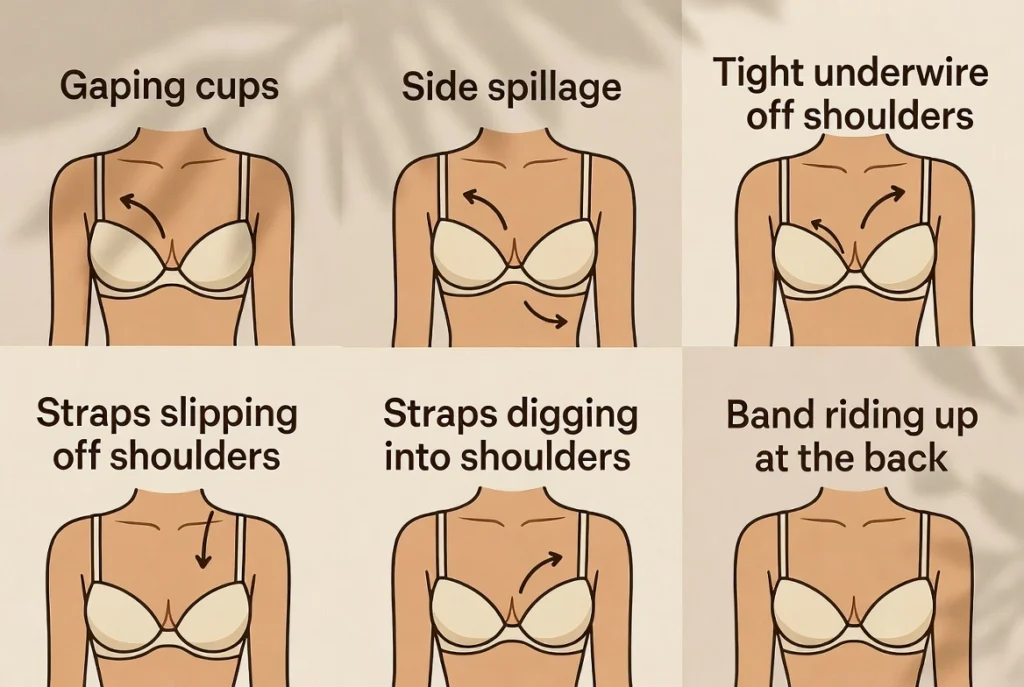
- 02 — Straps Digging Into Shoulders
- 03 — Band Riding Up
- 04 — Gaping / Wrinkled Cups
- 05 — Quad-Boob / Top Spillage
- 06 — Side Spillage / Armpit Bulge
- 07 — Underwire Digging In
- 08 — Center Gore Floating
- 09 — Breast Asymmetry Problems
- 10 — Back Bulge When Wearing a Bra
- 11 — Breasts Look Saggy in a Bra
- 12 — Wire Cuts Under Breast
- 13 — Uniboob / Monoboob
- 14 — Falling Out When Leaning
- 15 — Period-Related Pain
- 16 — Bra Rises When Arms Lift
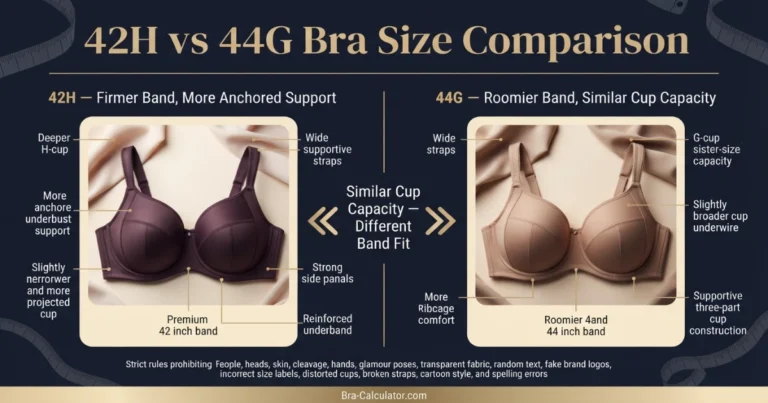
- 17 — Brand Size Variation
- 18 — Lines Under Clothing
- 19 — Clasp Comes Undone
- 20 — Shoulder & Neck Pain
All 20 Bra Fit Problems — Root Causes & Real Fixes
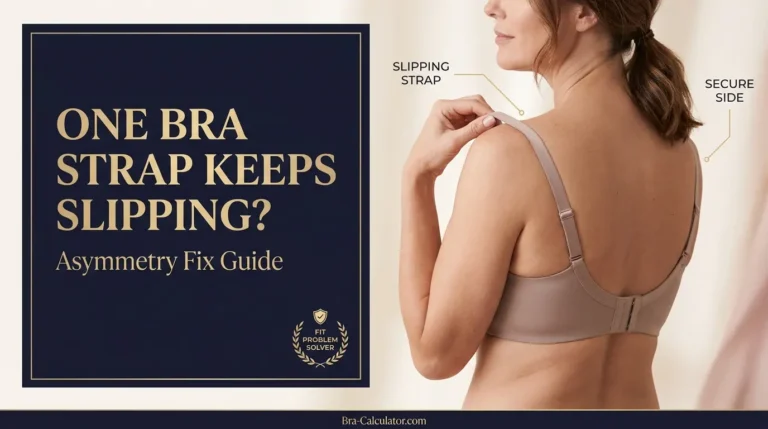
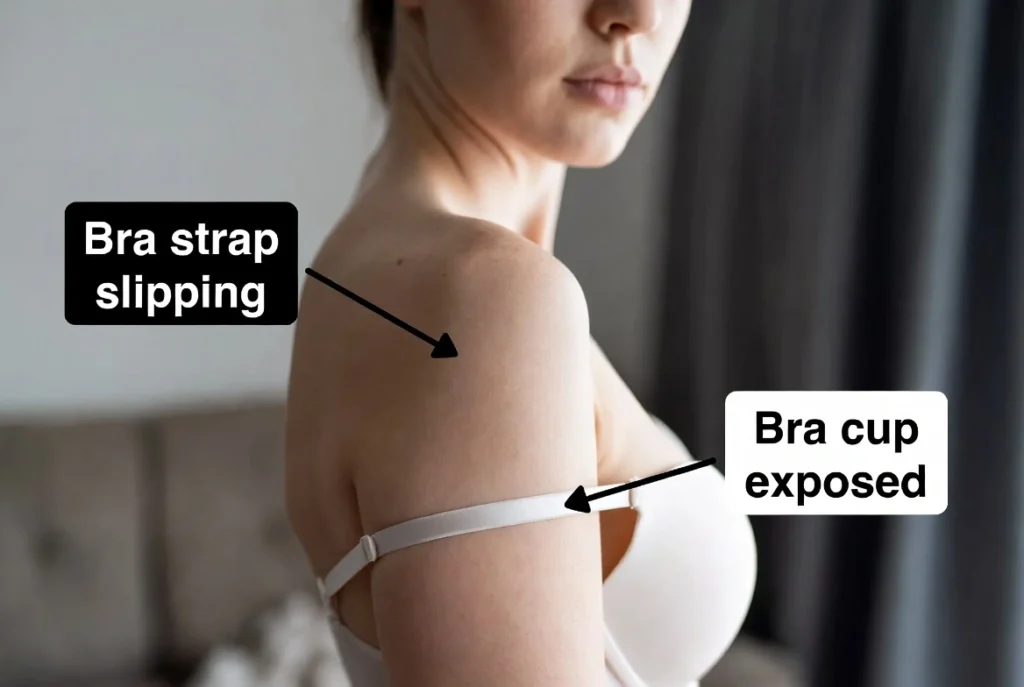
Straps That Won’t Stay Up (The Constant Shoulder Slide)
Very CommonYou’re mid-conversation and you feel a strap drop. You do the casual one-shoulder shrug and it’s back — for about 45 seconds. It’s one of the most common bra complaints, and also one of the most misdiagnosed: most women try tightening the straps further, which only masks the real problem.
- Cups are too large → no tension anchors the strap against the shoulder
- Straps adjusted too loose or fully stretched out from age
- You have narrow, sloping, or asymmetrical shoulders — extremely common
- Wide-set strap placement doesn’t match your shoulder width
- Try one cup size smaller first — this restores strap tension at the source
- If straps are still slipping after sizing down, your shoulder shape needs a different strap position
- Switch to racerback, J-hook convertible, or leotard-back styles where straps sit closer to your neck
- Look for bras with “centre-pull” or “narrow-set” strap placement specifically for sloping shoulders
- Strap extenders that convert any bra to racerback are a quick $5 fix while shopping for the right style
Straps That Dig Into Shoulders (Red Grooves, Indentations)
High DiscomfortThe red, indented shoulder grooves at the end of the day. They look like you’ve been wearing a harness. And by midday they’re already painful. This one is almost always a band problem masquerading as a strap problem.
- Band is too loose → straps carry 80–90% of breast support instead of the band (straps are only meant to carry 10–20%)
- Straps are too narrow for your breast volume and weight
- Bra is simply worn out and the band has lost all elasticity
- Go down a band size — the band should provide 80–90% of your total support, full stop
- When you size down the band, sister size up in the cup to maintain volume (e.g. 36C → 34D)
- Choose wider, cushioned, or load-bearing straps
- Longline bras distribute weight across a larger back surface and dramatically reduce strap load
- Full-bust brands engineer better strap systems for higher weights
Band Riding Up the Back
Very CommonIf the back of your bra is climbing toward your shoulder blades by noon, the band has a clear, unambiguous message: it’s too big. A correctly fitted band stays perfectly horizontal all the way around your torso — front and back at exactly the same height — all day.
- Band is too loose and cannot anchor horizontally → migrates upward with movement
- You’re already on the tightest hook with no more adjustment left — the bra is worn out
- Bra was bought on the tightest hook rather than the loosest
- Drop one band size and sister size up in the cup — your cup volume stays identical
- New bras should always be worn on the loosest hook at first purchase
- Retire any bra already maxed out on the tightest hook
- The lift test: raise both arms above your head — the band should not shift upward at all
Gaping, Wrinkled, or Collapsed Cups
Very CommonFabric wrinkles at the top of the cup, visible air pockets, or cups that collapse forward at the top instead of lying smooth against breast tissue. Looks terrible under clothes — and it’s a clear fit signal.
- Cup volume is simply larger than your breast tissue — most common reason
- Breast shape is teardrop, shallow, or “full on bottom” — upper cup will always appear empty in a standard-cut bra
- The bra style has a closed upper cup that doesn’t match your breast’s projection or fullness distribution
- Drop a cup size and check if the fabric smooths immediately — often that’s all it takes
- Switch to balconette, demi, or half-cup styles
- Molded T-shirt bras work beautifully for shallow and teardrop breast shapes
- If only the very top gapes: try a balconette with an open upper cup
Quad-Boob / Top Spillage (The Double-Boob Effect)
High VisibilityBreast tissue spilling over the top edge of the cup, creating a visible second ridge. The cup cuts across the breast rather than enclosing it. Quad-boob is one of the clearest visual signs that the cup is simply too small — and it ruins fitted shirts, dresses, and activewear.
- Cup is too small — by far the most common cause
- Hormonal water retention has temporarily increased breast volume
- The bra style has a closed, high-cut cup that can’t accommodate your breast height
- You’ve lost weight, shifted breast tissue distribution, or your size has changed since purchase
- Go up one or two cup sizes — DDs, Es, and Fs are just measurements, not scarlet letters
- Try seamed cups or full-coverage styles that encapsulate rather than compress breast tissue
- Avoid ultra-padded push-ups when you’re already at maximum volume in the cup
- For period-related spillage, keep wireless “period bras” in one cup size larger in your rotation
Side Spillage / Armpit Tissue Bulge
High VisibilityThat soft tissue bulging near your armpit that makes sleeveless tops feel impossible? It is almost never fat. It is breast tissue being pushed sideways by a cup that isn’t wide enough or deep enough to fully contain it. The fix is not shapewear. The fix is a better bra.
- Cup too narrow for your breast’s natural root width — tissue has nowhere to go but sideways
- Side panels (wings) too short or too weak to redirect tissue inward and forward
- Wide-set breast shape wearing a centre-gore style that pushes tissue outward
- Look specifically for “high-wing”, “side-support”, or “side-sling” construction
- Size up in the cup — more cup real estate often eliminates the side overflow entirely
- Leotard backs and wide side panels smooth armpit tissue and eliminate visible lines
- When putting on any bra: always scoop and swoop
Underwire Digging Into the Ribcage or Armpit
High DiscomfortIf your underwire feels like it’s performing amateur surgery on your ribcage or breast tissue — stop wearing that bra. This is not a “break it in” situation. It will not get more comfortable. Pain is always diagnostic information, not something to push through.
- Wire is sitting on top of breast tissue instead of encircling it at the chest wall — cup too small
- Wire is too narrow for your breast’s natural root width
- The bra has lost structural integrity and the wire has shifted out of its channel
- Your breast root extends further toward your armpit than the wire can reach
- Go up one or two cup sizes so the wire drops fully onto your chest wall below breast tissue
- Try brands specifically engineered for wider breast roots
- If no underwire sits correctly regardless of size, switch to wireless
Wireless options: ThirdLove Form 360 · True&Co True Body · AnaOno Seamless · Wacoal B-Smooth
Center Gore Floating (Won’t Lie Flat)
ModerateThe center gore — the small panel between the cups — should press flat against your sternum. If it lifts away from your body and floats forward, the bra is misaligned with your breast positioning and shape.
- Cups are pulling the gore forward because they’re too small
- Band is too loose and can’t anchor the gore against the sternum
- Breasts are close-set and push inward against the gore, lifting it off the chest
- Go up a cup size first (most common solution — solves it roughly 70% of the time)
- Go down a band size second (tighter band anchors gore more firmly)
- Switch to a plunge or low-gore style if your breasts are naturally close-set
- Avoid bras with tall, wide gores if your breasts don’t have significant separation
Breast Asymmetry — One Side Doesn’t Fit
Very CommonLet’s normalize this immediately: 90–95% of women have one breast larger than the other. It is completely normal, rarely noticeable to anyone else, and there are practical, affordable solutions that don’t require custom bras.
- Standard bras are designed for identical cups, so there’s always a winner and a loser
- Most women size to the smaller breast — compressing the larger one and causing fit failure on both sides
- Always fit to the larger breast — never compress it
- Use removable cookies or padding in the smaller cup
- Choose stretch-lace or molded stretch cups
- Explore individual cup sizing when asymmetry is significant
“Back Fat” That Only Appears With a Bra On
CommonQuick reality check: it’s almost never new fat. It’s displacement. A tight, narrow band is physically pushing soft back tissue backward and upward, creating bulges that don’t exist without the bra. Fix the band width and construction, and you largely eliminate the visual.
- A wider, taller back panel that distributes pressure across a larger surface area
- Smooth, matte microfiber fabrics rather than rough or narrow elastic
- Longline bra styles that extend down the torso below the natural waist
- Leotard or racerback constructions where the back is broad and seamless
- Make sure the band is sitting in the correct position — horizontally level
Breasts Look Saggy Even in a Bra
ModerateWhen your bra makes you look less lifted than going braless — that’s a fit failure, not a body failure. A correctly fitted bra creates shape and lift regardless of your natural breast position. The fix is almost always about structure and style, not size alone.
- Firmer fabrics, internal side slings, and stronger underwire engineering
- Balconette or push-up styles that lift from below and project tissue forward and up
- Three-part or four-part seamed cups that actively sculpt breast tissue into a forward-projecting shape
- Avoid bras with limp, unstructured fabric — they follow your shape rather than improving it
- Make sure you’re doing the scoop and swoop — failing to pull tissue forward before standing up is the single most overlooked cause of a drooping appearance
Underwire Cutting Into the Underside of the Breast
High DiscomfortPain or redness at the very bottom of your breast where the wire meets your inframammary fold (IMF) — the natural crease beneath your breast. This specific pain pattern has a specific cause, and a specific fix.
- Cup too small → wire can’t drop low enough to sit in the IMF and instead rests on top of it
- Band too tight → the band pulls the wire upward, pressing it onto breast tissue
- Go up a cup size so the wire drops lower and naturally settles into your inframammary fold
- Loosen the band slightly if it’s pulling everything upward
- After putting on the bra, lift your breasts manually into position and check the wire is sitting in the crease — not on it
Uniboob / Monoboob Effect (Especially in Sports Bras)
ModerateThe horizontal shelf effect — where two distinct breasts merge into one continuous mass spanning the entire chest. A classic sports bra failure. And it’s not your body that’s the problem, it’s the construction method of the bra.
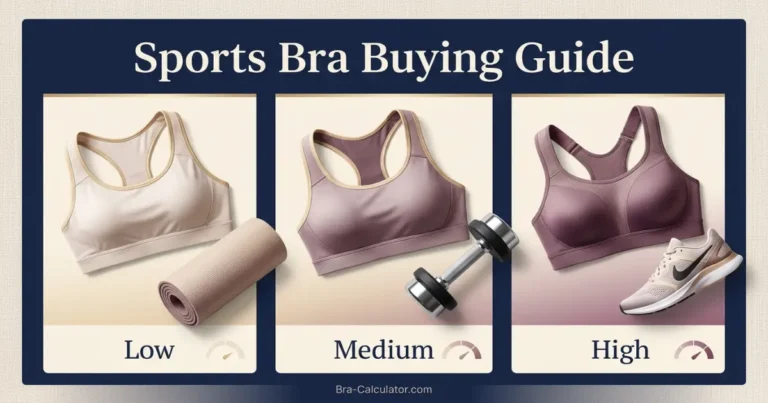
- Compression-only sports bras press both breasts together rather than supporting them individually
- Compression style works fine for small cup sizes but fails for larger ones
- Switch to encapsulation sports bras — individual cups that contain each breast separately
- For cup sizes D and above, look for underwired sports bras where encapsulation is reinforced with a wire
- Combination bras (compression + encapsulation) are the gold standard for high-impact activity above a C cup
Breasts Fall Out When Leaning Forward
ModerateYou bend over to pick something up and your breast makes a break for freedom. Gravity is undefeated — but a well-engineered, well-fitted bra should counter it completely. If yours doesn’t, the cups are too shallow, too small, or the wrong shape for your breast.
- Going up a cup size and switching to full-coverage styling that wraps more tissue
- Balconette styles with strong side-support panels that redirect tissue forward (not just contain it)
- A properly fitted underwire that encircles the complete breast root and holds position when you move
- Check your projection: if you have projected breasts (extend far from the chest wall), look for “projected cup” bras from Freya, Fantasie, or Panache
Everything Hurts Around Your Period
CyclicalThis one is entirely physiological and entirely real. Breast volume can increase by 15–25% in the days before menstruation due to hormonal fluid retention. Your regular bra suddenly feels like a vice. You haven’t changed size — your cycle is temporarily increasing volume.
- Keep 2 dedicated “period bras” in your rotation: stretchy cups, wireless construction, one cup size larger
- Bralettes in a size up work beautifully for the most tender days
- Rotate 5–6 bras daily so elastic retains its stretch longer and nothing is overworked
- Soft-cup wireless options are the most comfortable during breast tenderness
Bra Rises When You Raise Your Arms
Very CommonYou reach for something on a high shelf and your bra lifts entirely with your arms. The cups ride up, the band follows, and suddenly your bra is sitting where your neck should be. This is a band-size failure, but it also has a style component.
- Band is too loose to anchor the bra against your torso under arm-lift tension
- Longline or full-band bra styles anchor more surface area — standard bands can ride on narrow torsos
- Bra is worn out and has no elastic snap left
- Size down one band (and up one cup to maintain volume) — the standard sister-size solution
- The lift test: put on your bra, raise both arms fully — the band should not move at all
- Longline bra styles have a longer band that anchors below the natural waist — dramatically more stable
- Check hook position: you should always start on the loosest hook and still have room — if you’re already on the tightest, retire the bra
Nothing Fits the Same Way Across Brands
FrustratingYou’re a 34D in one brand, a 34DD in another, and a 34C in a third. You’ve measured yourself three times and gotten three different answers. Nothing is wrong with your measuring — this is the bra industry’s dirty secret: there is no universal sizing standard.
- No international sizing standard exists — every brand calibrates differently
- UK, US, EU, AU sizing systems use different cup progression scales (see our international size charts)
- Vanity sizing is rampant — some brands intentionally label larger sizes smaller to reduce sticker shock
- Cup shape, wire width, and band stretch all vary independently of the size printed on the tag
- Learn your measurements, not your “size” — band = snug underbust, cup = difference between bust and band
- Use the bra size calculator as your baseline, then expect to go up or down 1 cup per brand
- Always try before you buy, or choose retailers with free returns
- Find 2–3 brands that consistently work for your shape and buy within them — mix-brand bra shopping is genuinely harder than it should be
Bra Visible Through Clothing (Lumps, Lines, Ridges)
ModerateVisible bra lines through T-shirts, seam ridges showing through dresses, or a visible underwire shadow. These are all style-and-fit problems with specific solutions.
- Seamed cups visible through thin fabrics
- Band sitting incorrectly and creating a horizontal line across the back
- Lace edging or decorative trim creating texture through tops
- Cups with a moulded seam that shows through fine knit or jersey
- Switch to fully moulded, seamless, or smooth T-shirt bra styles for fitted tops
- Microfiber or foam-moulded cups in a single piece create zero visible seam lines
- Make sure your band is sitting correctly — a riding band creates the most obvious back line
- Use nipple covers under bralettes or light wireless styles if coverage is the issue
- Darker bra colours show more through white/light tops — match bra shade to your skin tone, not your outfit
Bra Clasp Keeps Coming Undone
ModerateYour bra unfastens itself at inconvenient moments — or the clasp warps, bends, or catches incorrectly. This is partly a quality issue and partly a fit issue.
- Band too loose → clasp is under constant tension and warps open under movement stress
- Low-quality clasp mechanism, particularly on cheaper bras after several washes
- Clasp has been machine-washed repeatedly without a laundry bag — hooks bend and lose grip
- Size down in the band — a correctly fitted band has just enough tension that the clasp doesn’t fight itself open
- Always fasten the clasp before machine washing (even in a laundry bag) to protect the hooks
- Hand wash or use a delicates mesh bag — this alone dramatically extends clasp life
- If the clasp itself is damaged, a bra alteration service can replace it for $10–$15 on a quality bra worth saving
Chronic Shoulder, Neck, or Upper Back Pain
High ImpactDaily shoulder tension, neck tightness, or upper back pain that gets better on days you don’t wear a bra — or when you take it off at night. This is a medical-level fit problem, and it affects far more women than are aware the bra is the cause.
- Straps carrying too much breast weight (band too loose) — shoulder muscles compensate chronically
- Cup too small — breast tissue is compressed unnaturally, altering posture and shoulder tension
- Straps too narrow for the weight they’re bearing — creates chronic pressure on the trapezius muscles
- Bra is misaligned and pulling the shoulders into a forward-hunched posture all day
- Size down in band so the band — not straps — carries the support load
- Wider, padded, or cushioned straps that spread pressure over a larger shoulder surface
- Correct cup size so breast tissue is supported in its natural position and posture normalizes
- If pain is significant, see a professional bra fitter and mention the pain specifically — they can recommend structured solutions
- Consider physiotherapy alongside the bra fix — months of incorrect support can create muscular patterns that need active work to release
All 20 Problems at a Glance
Can’t remember all 20? Find your symptom on the left, your most likely fix on the right. Save this.
| # | Symptom You’re Experiencing | Most Likely Fix |
|---|---|---|
| 01 | Straps constantly falling off shoulders | Smaller cup or racerback strap style |
| 02 | Straps digging into shoulders / red grooves | Smaller band + wider/padded straps |
| 03 | Band riding up the back | Smaller band (sister size up in cup) |
| 04 | Gaping, wrinkled, or collapsed cups | Smaller cup or shallower-cut style |
| 05 | Quad-boob / spillage over the top of cup | Larger cup size |
| 06 | Side spillage / armpit tissue bulge | Higher wings + larger cup |
| 07 | Underwire digging into ribcage or armpit | Wider wire or larger cup size |
| 08 | Center gore won’t lie flat against sternum | Larger cup or smaller band |
| 09 | One cup fits, other gapes or overfills | Fit larger breast, pad smaller side |
| 10 | Back rolls or bulge appear when bra is on | Wider, taller band + smooth fabric |
| 11 | Breasts look saggy or unsupported in bra | Structured cups + scoop & swoop technique |
| 12 | Underwire cutting underside of breast | Larger cup so wire drops into IMF fold |
| 13 | Monoboob / uniboob in sports bra | Switch to encapsulation sports bra |
| 14 | Breast falls out when leaning forward | Larger cup + full-coverage or balconette |
| 15 | Everything hurts pre-period | Wireless bra one cup size up (“period bra”) |
| 16 | Bra rises when raising arms overhead | Smaller band or longline style |
| 17 | Wrong size in every different brand | Learn measurements, allow ±1 cup per brand |
| 18 | Bra visible under clothing | Seamless moulded cups + correct band position |
| 19 | Clasp keeps coming undone | Smaller band + careful washing |
| 20 | Chronic shoulder, neck or back pain | Smaller band + wider straps so band carries load |
Amazon Bra Styles to Explore for Common Fit Problems
Once measurements and fit symptoms are checked, these style categories can help address the most common support problems in this guide. Choose your confirmed size and review each product’s brand sizing chart before buying.

Wide-Band Full-Coverage Support Bras
- Wider back bands help distribute pressure and improve support anchoring.
- Useful when straps dig in because a soft or loose band is doing too little work.
- Look for secure cups, wider wings and three-row closures.

Side-Support Full-Coverage Bras
- Designed to guide side tissue inward and support fuller cup containment.
- Useful for side spillage, cup overflow and breasts falling forward during movement.
- Prioritize your measured cup size before selecting a support style.

Wireless Comfort & Soft-Band Bras
- Helps reduce rigid wire pressure for sensitive ribcages or tender days.
- Useful when underwire pain or cycle-related discomfort is the main complaint.
- Choose supportive band construction rather than an overly loose bralette.
The Missing Piece Most Guides Skip: Breast Shape Matters as Much as Size
You can be measured perfectly and still hate every bra you try — if the shape of the bra doesn’t match the shape of your breasts. Size gets you in the door. Shape closes the deal.
These are the eight most common breast shapes and the styles that genuinely work for each one:
More Volume Above Nipple Line
✓ Full-coverage · Balconette · Open-top demi
Pendulous / Lower Fullness
✓ Plunge · Seamed full-coverage · Deep cup
Balanced Fullness
✓ Moulded T-shirt · Plunge · Spacer foam
Gradual Slope
✓ Shallow balconette · Wireless · Half-cup
Outward-Pointing Tissue
✓ Plunge · Front-close · Narrow-gore styles
Minimal Center Space
✓ Plunge · Low-gore · Narrow centre panel
Root Extends Sideward
✓ Side-support panels · Wide gore · Balconette
One Side Fuller
✓ Stretch lace · Removable pads · Moulded stretch
How to Measure Yourself Accurately in 2026 (The Method That Actually Works)
Forget the “add 4 inches to your underbust” method from the 1990s. Professional fitters abandoned it decades ago because it produces inaccurate results for most body types. Here is the updated 6-step method used by trained bra specialists today:
Start in your best-fitting non-padded bra, or go completely braless for the most accurate leaning measurement.
Exhale fully and measure firmly just under your breasts. Round down to the nearest even number — this is your band size.
Measure comfortably at the same underbust position. Use this as your comfort cross-check.
Measure around the fullest part of your bust while standing with arms relaxed at your sides. Keep the tape parallel to the floor.
Bend forward 90° at the waist and measure around the fullest point again. This captures breast projection and tissue volume.
Band = snug underbust. Cup = average of standing bust and leaning bust minus band. Each inch equals one cup letter. Use the bra size calculator to handle the maths automatically.
When to Retire Your Bra — Signs It’s Time to Let Go
A bra is not a lifelong companion. Most women keep bras far longer than they should, and worn-out bras silently cause fit problems — problems you’d never link to age because the bra looks fine from the outside.
Average lifespan: Daily wear → 6–9 months. Properly rotated across 5+ bras → 12–18 months.
- You’re on the tightest hook and the band still feels or rides loose
- Elastic is baggy, stretched-out, or has lost its snap-back quality
- Underwire is poking through the fabric channel — this can cause skin injury
- Cups are permanently wrinkled or misshapen even after washing
- The lift test fails: raise arms overhead — band shifts upward at all
- You notice any persistent skin irritation, redness, or pressure marks
- It just doesn’t feel right anymore, even if you can’t pinpoint why
Real Questions Women Actually Ask About Bra Fit
Tightening already-loose straps is treating the symptom, not the cause. Straps fall because cups are too large — when there is excess cup volume, there is no tension to anchor the strap against the shoulder. Try sizing down one cup first. If straps still fall after that, you likely have narrow or sloping shoulders that need a closer-set strap position, such as a racerback or J-hook convertible style.
Pain under the breast from an underwire almost always means the cup is too small. The wire sits on breast tissue rather than on the chest wall below it in the inframammary fold. Go up one or two cup sizes — the wire should drop into the natural crease at the base of your breast and stop hurting immediately. If no underwire sits comfortably regardless of size, switch to a wireless bra.
A correctly fitted bra band should be genuinely snug — you should be able to slide two fingers underneath, but the band should feel secure and must not move when you raise both arms overhead. If it shifts upward or you can pull it more than one inch away from your body, it is too loose. The band should provide 80–90% of your total breast support. Straps provide the remaining 10–20%.
Almost always yes. Breasts are composed primarily of fatty tissue, so they are among the first areas to reflect weight change. Even a 10-pound shift can alter both cup volume and band measurement. Remeasure yourself using the bra size measuring guide after any significant weight change, after pregnancy or breastfeeding, and after starting or stopping hormonal contraception.
Scoop and swoop means leaning forward slightly, reaching into your bra from the side, and physically pulling all breast tissue — including from the armpit and the soft tissue under the arm — fully forward into the cup before standing up straight. Most women skip this step and leave 20–30% of breast tissue outside the cup, which causes a cascade of fit problems including side spillage, underwire poking, and a flattened appearance that are not actually the bra’s fault.
Not automatically — but often yes. Higher-priced bras generally deliver better construction, more durable elastic, better strap engineering, and more accurate sizing across the full cup range. That said, an expensive bra in the wrong size will always perform worse than a lower-priced bra in the correct size. Get the size and shape right first, then invest in quality within those parameters.
Every 6–12 months as a baseline, and immediately after any significant body change: weight gain or loss of 10+ pounds, pregnancy, breastfeeding, hormonal changes, perimenopause, or chest surgery. Your bra size is not a fixed permanent fact — it is a measurement of your body at a specific point in time.
Because there is no universal bra sizing standard. Every brand calibrates differently, cup progressions vary between UK, US, EU and AU sizing systems, and vanity sizing is widespread. Learn your measurements, use them as your baseline, and expect to go up or down one cup size per brand.
6 Non-Negotiable Habits for a Lifetime of Perfect Bra Fit
These six habits separate women who have solved their bra fit permanently from everyone still adjusting in elevator mirrors.
Pull all breast tissue from the underarm and beneath fully into the cup before standing up straight. Every single time you put on a bra. Without exception.
Size is only half the equation. Shape, cut, and construction vary enormously between brands and styles. What works in a balconette may fail in a plunge — even in the same size.
Plus 2 period bras (stretchy/wireless, one cup up) and 2 sports bras. Elastic needs 24–48 hours to fully recover its shape between wears. A bra worn daily fails in half the time.
Hand wash or mesh lingerie bag on cold/gentle, always air dry flat. Never tumble dry. This single habit extends bra lifespan from 6 months to 18 months and saves hundreds annually.
And immediately after any meaningful body change. Your size at 25 is rarely your size at 35, 45, or 55. Breast tissue changes with age, weight, hormones, and life stages.
Sizing varies wildly between brands due to no universal standard. Ignore the number and letter printed inside. If it fits — if the band stays level, the cups contain all tissue, and nothing digs — it’s your size.
You Deserve Better Than “Good Enough”
For years, mild daily discomfort was just part of being a woman — or so we were told. Digging straps, occasional quad-boob, a band that rode up. “That’s just how bras are.” We kept adjusting in bathroom mirrors and getting on with it.
It’s not. That’s not how it has to be.
- You forget you’re wearing one — all day, not just for the first hour
- Your clothes hang and fit better immediately
- Your posture improves naturally because breast weight is properly supported
- Chronic back, neck and shoulder pain can decrease significantly
- Side tissue and back tissue redistribute because nothing is pushing it sideways
- You feel confident rather than constantly self-adjusting
- You stop dreading getting dressed in the morning
All 20 problems in this guide have real solutions. You are not hard to fit. You are not “between sizes”. You are not the problem. The right bra exists for your body — sometimes a few of them — and when you find it, it genuinely does feel like magic.
Find Your Perfect Bra Size Today — Free
Three measurements. 60 seconds. Your band, cup and sister-size starting points — with tools designed to help you shop with more confidence.