Front-Closure Bras for Older Women: How to Choose, Size and Fit One That Truly Supports
- The closure decides how easy the bra is to put on; the band, straps and cups decide how well it supports. Judge them separately.
- Hook-and-loop, zipper and single-clasp closures are the most forgiving for stiff or weak hands.
- Because you cannot tighten a front-closure band over time, the band must fit well the first time you wear it.
- A fuller bust usually needs a wider band, wider straps and either several clasps or a wire.
- Most fit complaints come from three causes: a loose band, a too-small cup, or a center gore that does not sit flat.
- Use the Bra Size Calculator for a starting size, then confirm it against the brand’s own chart.
Why so many women move to a front-closure bra
Nobody thinks about a back clasp until it becomes a daily negotiation. A stiff shoulder, sore fingers, a joint that no longer bends the way it did, or simply a wish to get dressed without a contortion act can turn the first five minutes of the day into a small fight. A front-closure bra ends that fight. You open it like a vest, slide your arms through, bring the sides together and fasten it in front of you, where you can see what your hands are doing.
That visibility matters more than it sounds. Fastening a back hook is a blind, two-handed task that depends on shoulder range. Fastening a front closure is a sighted task done at chest height, which asks far less of the shoulders and often less of the fingers too. Many women who thought they needed help getting dressed find they can manage alone again once the clasp moves to the front.
Find Your Best Bra Match
Answer a few fit questions to get bra styles matched to your support needs, breast shape and everyday preferences.
Question 1 of 5
Why it matches
What to look for
What may not work
Private fit matching: your answers are used only to build the recommendation on this page. No measurements or fit selections are submitted to Bra-Calculator.com.
This tool suggests a starting bra style, not a medical or diagnostic recommendation. Individual brands and bra models can fit differently.
What a front closure genuinely solves
- Reaching behind the back, which is hard with limited shoulder range.
- Fastening something you cannot see.
- The raised clasp ridge under a fitted top, since the back line is usually smoother.
- Dressing help: a caregiver can fasten it from the front, face to face.
What it does not solve by itself
- Support or lift. Those come from the band, straps and cup shape.
- A wrong size. If anything, it makes sizing mistakes more obvious.
- Pressure at the breastbone, if the clasp or center panel is badly placed.
- A band that stretches out, because there is no tighter hook to move to.
Keep that split in mind and the rest of this guide gets easier. Everything you read below treats the closure as one decision and the fit as a different, equally important one.
Which closure suits you? A 20-second picker
Answer three questions and the picker points to the closure style most likely to feel right. Treat it as a sensible starting point, then use the sections that follow to confirm it.
The four front closures, compared in detail
Closures vary by brand and even by style within a brand, so read each product description before ordering.
Single front clasp
EasyLight to moderate supportOne clasp at the center, usually larger and easier to grip than a back hook. It is quick to close and a dependable everyday choice for smaller to medium busts.
Watch for: a clasp that sits hard against the breastbone. A flat, fabric-covered closure is far more comfortable.
Zipper
EasyModerate supportZips up the center like a jacket. It is fast, and it often comes in a seamless, sporty construction that feels light on the skin.
Watch for: a zip pull too small to grip, and a zipper that rubs the skin when you lean forward. A large pull tab and a fabric guard behind the teeth help.
Hook-and-loop (Velcro)
EasiestLight to moderate supportA strip that presses together. It needs the least finger strength, so it is often the first choice when grip is limited or when a caregiver helps with dressing.
Watch for: fastenings that collect lint or lose grip over time. Close it before washing, and replace the bra when it stops holding.
Hook-and-eye front (several clasps)
Needs dexterityModerate to high supportA column of small hooks, like a back closure turned to the front. It gives a more structured, adjustable hold, which is why it is common on bras for a fuller bust.
Watch for: fiddly hooks. Start at the bottom and work up, and try fastening it once while seated before committing.
The trade-off in that chart is the real story: the easiest closures tend to give a lighter hold, and the firmest holds tend to ask more of your fingers. That does not mean you must choose one or the other. A zipper bra with a wide, firm band, or a single-clasp bra with molded cups, can land comfortably in the middle. What it does mean is that if you have a fuller bust and limited grip, the band width and strap design matter even more, because the closure cannot carry the support for you.
A practical hand-ease check before you choose
Instead of guessing which closure you can manage, try this. Tick the everyday tasks that feel awkward right now. The tally nudges you toward a closure style, and the logic is simple: the more small-grip tasks that feel hard, the more you should favor a larger, softer or hook-free fastening. It is a shopping aid built on ordinary tasks, not a health assessment.
If the result leans toward a hook-and-loop or large-clasp style but you still want strong support, look for a hybrid: a wide hook-and-loop panel set over a firm band, or a zipper bra with a stiffer lower band. Those exist across several brands, and they are usually described as “adaptive” or “easy-on” in the product title.
What actually makes a front-closure bra supportive
A front-closure bra supports you the way any bra does, through four parts working together. Learn to read those four parts and you can judge a bra by its construction rather than by its marketing copy.
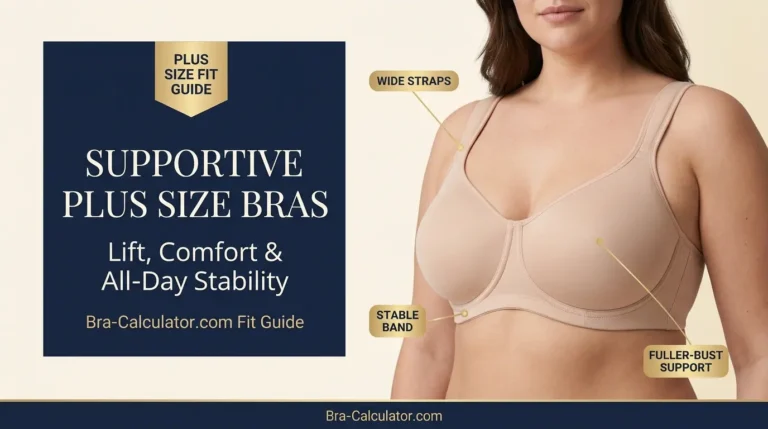
The band does most of the work. It should sit level around the ribs, snug enough that it does not slide, loose enough that you can breathe and eat comfortably. On a fuller bust, a wider band spreads the load across more of the back and ribs.
The straps fine-tune the position of the cups. Wide, padded, adjustable straps are kinder to the shoulders, and they should never be what holds everything up.
The cups shape and contain. Seamless cups reduce rubbing, firmer cups hold a heavier bust, and a stretch-mesh upper edge helps prevent spilling at the top.
The center closure joins the two sides. Its job is to sit flat against the breastbone and stay put.
This is why a lift-focused bra and a front-closure bra are not opposites. If lift is your main concern, our guide to the best lifting bras for sagging breasts over 50 explains what to look for in the band and cups, and almost all of it applies to front-closure designs. For styles built around upright posture, see our overview of posture corrector bras.
How to size a front-closure bra when there are no back hooks
With a back-closure bra you start on the loosest hook and move tighter as the elastic relaxes over months. A front-closure bra gives you no such runway. The band has to be right early, and it has to stay right for as long as the elastic holds. That is why measuring and trying on carefully matters more here than with any other style.
- Get a starting size. Use our free bra size calculator with a snug underbust and a loose full-bust measurement. If your shape has changed with age, the senior bra size calculator accounts for that, and the methodology page shows exactly how results are produced.
- Check the brand’s own chart. Front-closure bands often run differently from back-closure bands. If you are translating between sizing systems, the global bra size converter handles UK, EU and US labels.
- Try it on and test four things. The band sits level and snug with room to breathe. Your bust sits fully inside the cups with no spilling and no gaping. The center closure lies flat. The straps support without pulling.
- Fix a loose band with size, not straps. Tightening straps cannot replace band grip. Use a sister size, below.
The two-finger band test. Fasten the bra, then slide two fingers under the band at the side. You should fit them with a little effort. If you can pull the band away from your body by more than about two inches, or it rides up when you raise your arms, the band is too loose. If you cannot slip two fingers in, or the band leaves deep grooves, it is too tight.
Sister-size ladder for common sizes
A sister size changes the band and the cup together so the cup volume stays about the same: go down a band, go up a cup; go up a band, go down a cup. Find your starting size in the left column and read across to the two nearest alternatives.
| Your starting size | Tighter band (cup goes up) | Looser band (cup goes down) |
|---|---|---|
| 32B | 30C | 34A |
| 32C | 30D | 34B |
| 32D | 30DD | 34C |
| 34B | 32C | 36A |
| 34C | 32D | 36B |
| 34D | 32DD | 36C |
| 36B | 34C | 38A |
| 36C | 34D | 38B |
| 36D | 34DD | 38C |
A worked example
Say your calculator result is 34C, and you order a 34C front-closure bra. It arrives, the cups look right, but the band slides up your back when you lift your arms. That is a loose band. You have two reasonable moves. The sister-size route is 32D: the band is tighter, and the cup volume stays close to your original. The alternative some brands recommend is 32C, which tightens the band but keeps the cup letter, and is worth trying if the 34C cups felt slightly roomy to begin with. Try 32D first if the cups were a good fit; try 32C first if they gaped a little.
Not sure which kind of cup problem you have? The cup gaping guide explains how to tell a cup that is too big from one that is simply the wrong shape. If your bust is on the fuller side and the usual ranges feel limiting, our plus-size bra calculator covers larger bands and cups. For more on how sister sizes behave, use the sister size calculator.
Front closure vs back closure vs pullover
Many readers are really deciding between three styles, not two. Here is how they compare in everyday use.
| Feature | Front closure | Back closure | Pullover (no closure) |
|---|---|---|---|
| Ease of dressing | High; sighted, chest-height task | Lowest with limited reach | Medium; needs overhead arm movement |
| Band adjustability over time | Little to none | Several hook positions | None |
| Smoothness of the back line | Very smooth | Hooks can show through thin fabric | Very smooth |
| Support ceiling for a fuller bust | Good with wide band and firm cups | Highest, thanks to adjustability | Varies; often lighter |
| Dressing with a caregiver | Easy, face to face | Harder; needs access to the back | Hard if shoulders are limited |
| Fit problem to watch | Center panel pressure | Band stretching out | Band riding up |
For many women the honest answer is “front closure for most days, and a well-fitted back-closure bra for occasions when more support or shaping is wanted.” If you only buy one style, the deciding question is usually this: which of the two is the harder problem for you right now, reaching, or supporting a fuller bust? Reaching points to a front closure. Support points to a wider band and firmer cups, which you can find in both styles.
Fabric and construction, decoded
Product pages are full of fabric and construction terms that sound technical but boil down to a handful of practical differences. This table translates the ones you will see most.
| Term | What it means in practice | Good for |
|---|---|---|
| Cotton blend | Soft, breathable, a little less stretch recovery over time | Everyday wear, sensitive skin |
| Modal or jersey | Very soft, drapes gently, light feel | Comfort-first, sleep or lounge |
| Nylon-spandex microfiber | Smooth, quick drying, holds shape | Smooth look under knitwear |
| Power mesh | Firm stretch panel used in bands and side wings | Extra hold without bulk |
| Molded foam cup | Pre-shaped cup with a smooth surface | Shape, no seams showing |
| Seamless knit | Knitted in one piece with few or no seams | Reducing rubbing and irritation |
| Wire-free | Shaping comes from fabric and cup structure | Comfort, medium busts |
| Underwire | A curved wire under each cup adds lift and separation | Fuller busts when fit is exact |
| Padded straps | Cushioned strap surface spreads pressure | Shoulder soreness |
Wire or no wire is the question I hear most. A well-fitted underwire can help a heavier bust, but a wire that sits on breast tissue instead of around it will dig in, and no one should tolerate that. If you have tried wires and they bother you, a wide-band wire-free bra with firm molded cups is a sensible alternative. Our guide to underwire bras that dig in explains how to tell a bad fit from a bad style.
Match the bra to your situation
Find your row and note the features to prioritize. A tick means the feature is worth looking for.
| Your situation | Easy closure | Wide band | Wide straps | Wire or firm cups | Seamless cups |
|---|---|---|---|---|---|
| Stiff or sore hands | ✓ | – | – | – | ✓ |
| Fuller or heavier bust | – | ✓ | ✓ | ✓ | – |
| Sensitive skin | – | – | ✓ | – | ✓ |
| Sore shoulders from straps | – | ✓ | ✓ | – | – |
| Smooth look under knitwear | – | – | – | – | ✓ |
| Someone helps you dress | ✓ | – | – | – | – |
| Sleeping in a bra | ✓ | – | – | – | ✓ |
If you are recovering from surgery, follow your surgeon’s advice on the type of bra and when to wear it, then use this guide for sizing and comfort within those limits. For changes in fullness or position that you want to understand better, the breast ptosis calculator is a helpful reference.
Putting it on, including seated and with a helper
On your own
- Open it and slip your arms through. Hold the bra open in front of you and slide your arms through the straps like a vest.
- Settle the band. Bring it around your ribs so it sits level, just under your bust, not higher at the back.
- Fasten the front. Close the clasp, zipper or hook-and-loop strip. With several hooks, start at the bottom and work up, because the lower hooks anchor the band.
- Scoop and settle. Lean forward slightly and gently settle your bust into each cup so the tissue sits fully inside.
- Adjust the straps last. Tighten or loosen until they support without pulling on your shoulders.
Seated, if standing is tiring
Sit near the edge of a firm chair with your feet flat. Fasten the bra with the sides loosely together, then shrug the straps up onto the shoulders and settle the cups. Many women find this easier than standing because balance is no longer part of the task.
When someone helps you dress
If a family member or caregiver helps, a few small habits make the experience dignified and quick. Ask first, and let the wearer lead as much as she can. Position the bra on her arms before closing anything, then fasten from the front at the bottom, working up. Let her settle the cups herself or guide her hands with a gentle “like this?” instead of doing it for her. Warm hands matter more than most people expect. Keep the fastening clean and the bra on top of the pile so it is the first thing reached for.
How to read a product listing like a fitter
Online listings are written to sell, not to inform, so it helps to know what to scan for. Look for these positive signs and watch for the warning flags.
Green flags
- A stated closure type and a close-up photo of it.
- A band width or “wide band” description, not just “comfortable”.
- A size chart with underbust and bust measurements, not only letters.
- Padded or adjustable straps, with the strap width mentioned.
- A clear return policy and care label information.
Red flags
- One-size-fits-most claims for a bra meant to support.
- No close-up of the closure or the center panel.
- Reviews that say “runs small” or “band loose” repeatedly, with no size guidance from the seller.
- Claims that a bra will lift or reshape you on its own.
- No return option for opened items.
Reviews are most useful when they mention a size and a body description similar to yours. Sort for the reviews that mention the closure, because that is where listings are least informative. If a quick visual reference helps, our breast size comparison and the cup size from photo guide show how cup sizes look in practice, which makes reviews easier to translate.
Symptom, cause, fix
Start from what you feel and work back to the likely cause.
| What you notice | Most likely cause | What to try |
|---|---|---|
| Band rides up your back | Band too loose, or cups too small pulling the band up | Smaller band with sister-size cup. See why a band rides up |
| Tissue spills over the top of the cup | Cup too small or too shallow | Go up a cup, or choose a fuller-coverage style |
| Fabric wrinkles or gapes in the cup | Cup too big, or the wrong shape for your breast | Go down a cup. See the cup gaping guide |
| Center panel digs in or floats off the breastbone | Cups too small, or a panel too narrow or too high | Larger cups or a wider, lower center panel |
| Wire or clasp digs in | Cup size too small, or the wire sits on tissue | See underwire digging in |
| Bulge at the side or underarm | Band too loose or cups too small | See the side bulge fix |
| Straps dig into shoulders | Straps carrying the weight because the band is loose | Fix the band first, then choose wider padded straps |
| Hook-and-loop or zip loosens | Fastening worn or clogged with lint | Clean it, or replace the bra when it stops holding |
If more than one row matches, solve the band first. A correct band often corrects two or three other symptoms at once. And if none of these quite describes it, the bra fit problem solver lets you start from the symptom and narrow it down.
Six myths worth retiring
Plenty of women with full mobility simply prefer them for convenience and a smoother back line.
They can, when the band is wide, the cups are firm and the closure is robust. The weak designs are weak because of the band and cups, not the front opening.
Support comes from band width and cup structure. A wide-band wire-free bra with firm cups can support well.
Straps pulled tight dig into shoulders and tip the band up the back. Lift comes from a snug, level band.
Weight, hormones, activity and age can all change fit. Re-measure when your bras start to feel different.
Good fit should feel secure and comfortable at the same time. If it only works while you are uncomfortable, it does not fit.
Care, rotation and knowing when to replace it
A front-closure bra lasts longest when it is washed gently, rotated and replaced before it loses its band. Because you cannot tighten the band later, the elastic is the part to watch.
- Fasten before washing. Close the clasps, zipper or hook-and-loop strip so they do not snag the fabric or other items. A mesh laundry bag helps.
- Wash gently and air dry. Follow the care label. Heat is hard on elastic and can weaken the fastening.
- Rotate two or three bras. Elastic recovers between wears, so a rotation tends to keep the band firm for longer.
- Watch the band. If it has stretched so far that a correctly sized bra now rides up or feels loose, the band has done its job.
- Check the closure. A zipper that sticks, a hook-and-loop strip that no longer grips, or a bent clasp are all signs to replace it.
- Replace when fit changes, not on a schedule. Re-measure, compare your result with the bra on your body, and let comfort and support decide.
When your shape changes, your bra should too
Breast tissue and body shape change over the years, and so does the best bra for you. A size that fit beautifully a few years ago may no longer do its job. If your weight has changed, our post-weight-loss bra size calculator is a useful check. If you want to see how cup volumes relate to each other, the breast size comparison is a helpful visual.
A practical habit: re-measure whenever your bras start to feel different, and try one nearby sister size at the same time. Small adjustments often fix what feels like a big problem. You can browse every size and cup guide in our bra size guides index.
Your shopping checklist
- I know my starting size from the calculator
- I checked the brand’s own size chart
- The closure is easy for my hands
- The band is wide enough for my bust
- Straps are wide and adjustable
- The center panel sits flat in the photos
- Cups are seamless or soft where I need comfort
- Fabric is soft and breathable
- I ordered my size plus one sister size
- I know the return policy before I order
When you order online, buy your best-guess size and one sister size if you can, so you can compare them side by side at home and return the one that does not fit.
Get a measured starting size in under a minute, then compare front-closure styles in that size.
Calculate my sizeShop front-closure brasAs an Amazon Associate, Bra-Calculator.com may earn from qualifying purchases at no extra cost to you.