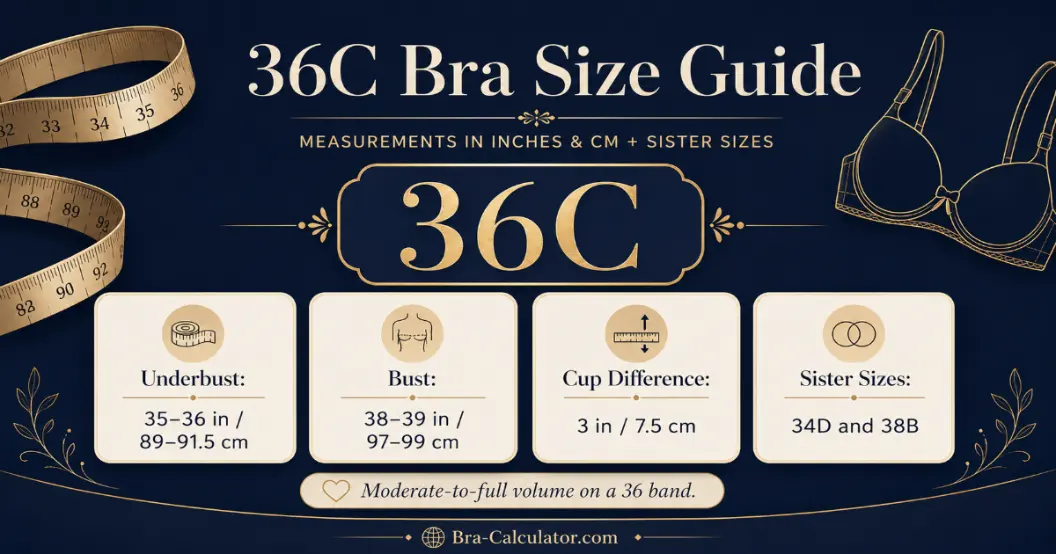
A 36C is a C-cup volume built on a 36 band. A C cup usually represents about a 3-inch or 7.5 cm difference between full bust and underbust. In a direct-fit approach, a common starting range is a 35–36 inch underbust and a 38–39 inch bust. The nearest sister sizes are 34D for a firmer band and 38B for a looser band.
Jump to a Section
36C Bra Size at a Glance
| Attribute | 36C Detail |
|---|---|
| Band label | 36 band; exact snug-underbust range depends on the brand and fitting system |
| Cup difference | Approximately 2 inches or 5 cm |
| General cup description | Moderate cup volume on a wider band |
| Closest sister sizes | 34D and 38B |
| One cup smaller | 36B |
| One cup larger | 36D |
| Common fit issues | Band riding up, top-edge gaping, cup overflow, floating gore, wide-set straps and wire pressure |
| Useful starting styles | T-shirt, balconette, plunge, spacer, side-support and structured wireless bras |
| International equivalents | US 36C · UK 36C · EU 80B · AU/NZ 14B |
What Does a 36C Bra Size Really Mean?
A 36C combines a 36-band frame with C-cup volume. The number affects band length, cup spacing, wire scale and strap placement. The letter describes the difference between the ribcage and the fullest part of the bust.
A C cup is relative to the band. A 36C cup contains more volume than a 34B and less than a 38B because the entire cup is graded with the band. The closest approximate volume matches are 34D and 38B.
36C is widely available, but wide availability can hide a band or shape mismatch. If the band rides up, the cups cut in or the straps slide outward, compare the band, cup volume and construction instead of assuming the discomfort is unavoidable.
Size and shape are separate. A shallow 36C may need a wider, shorter cup, while a projected 36C may need more depth near the wire than a standard molded style provides.
36C Measurements in Inches and CM
Measurement ranges vary because modern direct-fit methods keep the band close to the snug underbust, while older plus-four charts add inches before assigning the band.
| Measurement Method | Typical Snug Underbust | Typical Full Bust | Fit Note |
|---|---|---|---|
| Modern direct-fit approach | About 35–36 in 89–91.5 cm | About 38–39 in 97–99 cm | The band label stays close to the measured ribcage. |
| Legacy plus-four approach | About 31–32 in 79–81 cm | About 34–35 in 86–89 cm | Four inches are added before assigning the 36 band. |
| Brand-specific chart | Varies | Varies | Band stretch, cup width, cup depth and grading can shift the best size. |
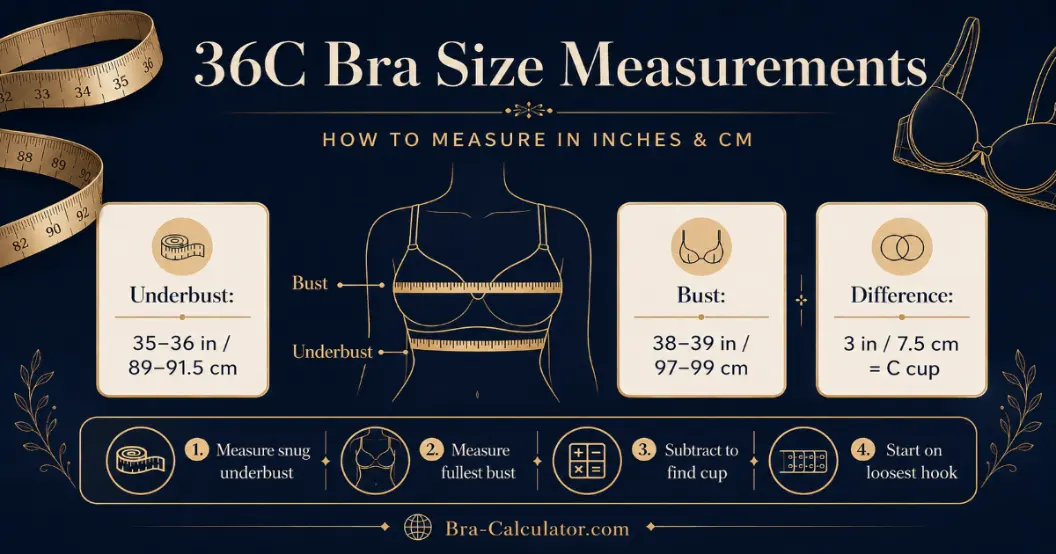
Place the tape directly under the breast root. Keep it level and comfortably firm.
Measure around the fullest point without flattening tissue or lifting the tape.
A larger leaning measurement can reveal projection or softer tissue that needs extra cup depth.
Test 36C alongside 34D, 36D or 38B when the first bra is close but not quite right.
The band should stay level and the tissue should remain inside the cups when you sit, reach and raise your arms.
What Does a 36C Look Like?
36C often creates a balanced, visibly full bust line, but the same volume can look fuller or subtler depending on the frame. On a broader torso it may appear more distributed, while a narrower shoulder line can make the bust look more prominent.
Projection also changes the outline. A projected 36C can show more forward depth, while a shallow 36C may look wider from the front. Wide-set tissue can keep a natural center gap, and bottom-full tissue may leave space at the top of a tall cup.
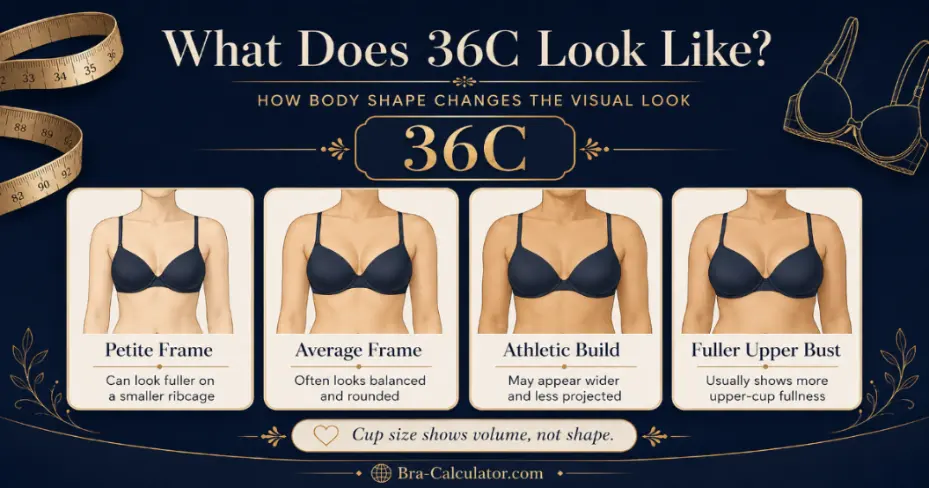
Balanced appearance
36C often looks balanced and visibly rounded, with enough volume for clear shape without automatically appearing very large.
Balanced proportionsMay appear wider
Broader shoulders and pectoral structure can spread the same volume across more chest width.
Check cup widthNeeds depth near the wire
A shallow molded cup may slide downward or flatten tissue despite the correct label.
Try seamed cupsNeeds side guidance
Side-support panels can create a more centered silhouette without forcing the natural placement.
There is no single correct 36C appearance. The label describes approximate garment volume, not a fixed body type or visual standard.
Amazon Bra Picks for 36C
These product types cover three common 36C needs: everyday shaping, wire-free comfort and stable movement support. Confirm current 36C availability before ordering.

Structured Plunge or Push-Up Bra
- Useful when you want more centered lift under lower necklines.
- Firm cups make overflow, gaping and gore placement easier to evaluate.
- Compare 36C with 36D if the cup edge cuts in or the center gore floats after scooping.

Structured Wireless Everyday Bra
- A firm underband can provide relaxed support without an underwire.
- Shaped cups are more useful than a loose stretch-only bralette.
- Ideal for everyday wear, travel and lower-impact comfort.

Encapsulation Sports Bra
- Separate cups help control movement without relying only on compression.
- Useful for checking band stability, bounce and hidden cup pressure.
- Choose the support level according to walking, gym, running or sport needs.
How Breast Shape Changes 36C Fit
A technically correct 36C can still feel wrong when cup height, wire width, center-gore shape or depth does not match the breast.
Try wider, shorter cups
Tall projected cups may gape even when the cup is not technically too large.
Demi or spacerTry deeper cups
Seamed cups can provide more room near the wire than standard shallow molds.
Depth over paddingTry a low gore
A plunge center can reduce pressure when a tall gore sits on breast tissue.
Lower centerTry flexible edges
Stretch lace and adjustable straps adapt more easily than rigid molded foam.
Fit the larger sideIs 36C Considered Average, Small or Large?
36C is widely stocked and often described as moderate-to-full in mainstream retail. That wording is useful for general context, but it does not predict how the size will look on every body.
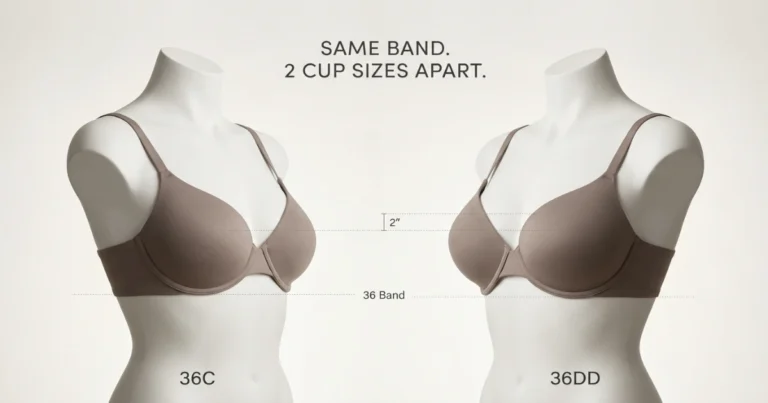
Compared on the same band, 36C has one cup more volume than 36B and one cup less than 36D. Across bands, it has approximately similar cup capacity to 34D and 38B. Those comparisons are more useful than a universal size label.
Fit-first answer: 36C is correct when the band anchors securely, the cups contain the full breast root and the bra remains comfortable during normal movement.
36C Sister Sizes
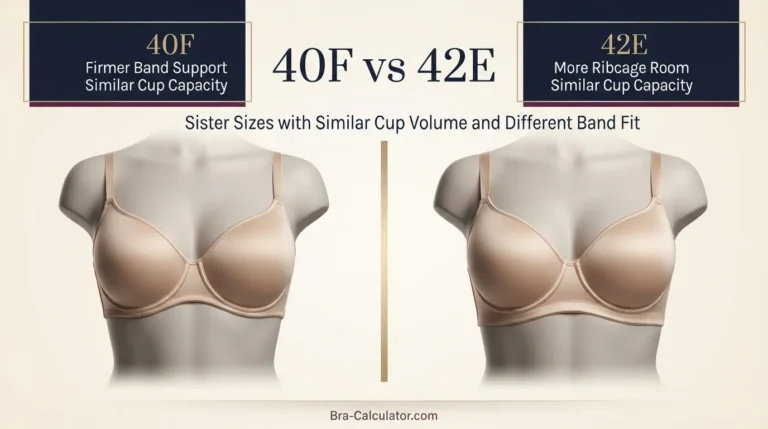
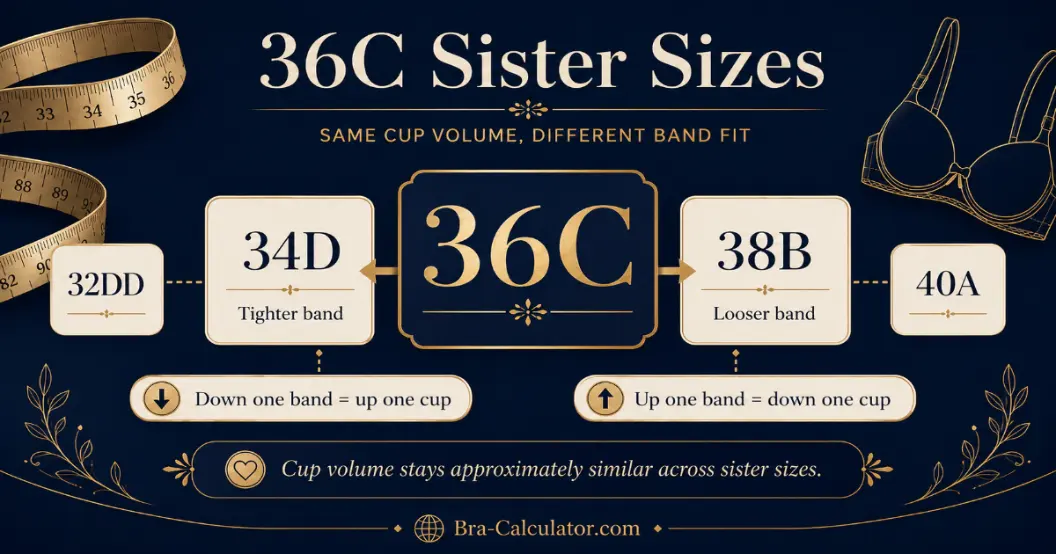
The closest sister sizes are 34D and 38B. Use them when the 36C cups feel close but the band length does not.
34D
Firmer band with similar cup capacity
36C
Reference size
38B
Looser band with similar cup capacity
| Fit Situation | Try | Why |
|---|---|---|
| 36C band rides up | 34D | Shorter band with approximately similar cup capacity. |
| 36C band is genuinely tight | 38B | Longer band with approximately similar cup capacity. |
| 36C cups spill while band fits | 36D | Same band with one cup more room. |
| 36C cups are roomy throughout | 36B or a shorter cup | The cup may be too large or the style may be too tall. |
36C vs Nearby Bra Sizes
- Same 36 band
- One cup more capacity
- About 3-inch cup difference
- Better when 36B cuts in or spills
- Same 36 band
- One cup less capacity
- About 2-inch cup difference
- Try when 36C is roomy throughout
- Same 36 band
- One cup smaller
- Works when the cup edge stays smooth
- May be too small if the gore floats
- Same 36 band
- One cup more capacity
- About 4-inch cup difference
- Try when 36C spills but the band fits
- Longer band
- Similar cup capacity to 34D
- Better when 34 feels restrictive
- May ride up on a smaller torso
- Shorter, firmer band
- Closest tighter sister size
- Useful when 36C rides up
- Frame and wire position may shift
- Shorter band
- Similar cup capacity to 38B
- Usually gives firmer anchoring
- Best when 38B shifts
- Longer band
- Closest looser sister size
- Useful when 36C is truly tight
- May reduce lift if too loose
Which Bra Styles Work Best for 36C?
At 36C, the best bra usually combines a stable 36 band with a cup shape that matches projection, root width and upper-cup fullness.
Creates a smooth outline when the cup height and projection match the breast shape.
Often suits shallow, bottom-full or wide-set shapes because the cup is shorter and more open.
Useful for V-necks and close-set tissue when a tall center gore feels uncomfortable.
Helps guide side tissue forward on a wider frame without forcing artificial cleavage.
Choose a firm underband and shaped cups rather than a loose stretch-only bralette.
Can gape on shallow or bottom-full tissue even when the cup volume is close.
Common Fit Problems in 36C
The band is too loose, stretched or being pulled upward by overtightened straps.
Small or shallow cups can pull the bra forward and make the band feel tighter.
The cup may be too small, too shallow or too closed at the neckline.
The cup may be too large, but it may also be too tall or too rigid for the breast shape.
The cups may lack depth, or the gore may be too high or wide for the tissue placement.
The band may be moving, or the straps may be set too wide for the shoulders.
International Size Conversion for 36C
These are approximate label conversions. Band stretch, wire width and cup construction can still vary by brand.
Use the Global Bra Size Converter and Brand Size Decoder before buying across regions.
Related Tools & Guides for 36C
| Guide / Tool | Why It Helps |
|---|---|
| Bra Size Calculator | Calculate a starting band and cup using measurements. |
| C Cup Size Guide | Understand how C-cup volume changes across band sizes. |
| 34D Bra Size Guide | Useful when 36C cups fit but the band rides up; 34D offers a firmer sister-size band. |
| Sister Size Calculator | Compare 34D, 36C and 38B instantly. |
| Cup Size Visuals | See how cup letters change with band size and body shape. |
| AI Smart Fit Bra Calculator | Diagnose gaping, spillage, floating gore, strap pressure and band movement. |
Frequently Asked Questions
A 36C is a C-cup volume built on a 36 band. A C cup usually reflects about a 3-inch or 7.5 cm difference between full bust and underbust, although the band recommendation varies by brand.
In a direct-fit approach, 36C may start around a 35–36 inch or 89–91.5 cm snug underbust and a 38–39 inch or 97–99 cm full bust.
The closest sister sizes are 34D for a firmer band and 38B for a looser band. They have approximately similar cup capacity.
They have approximately similar cup capacity because they are sister sizes. The main difference is band length and tension.
36C is often described as moderate-to-full in mainstream retail, but it can look fuller or subtler depending on torso width and breast shape.
The cup may be too large, but gaping often means the cup is too tall, rigid or projected. Try a shorter balconette, demi or flexible spacer cup before changing size.
Yes, if the 36 band feels secure and the cup edge cuts in or tissue spills. 36D keeps the same band while adding one cup of capacity.
Yes. Choose a structured wireless bra with a firm underband, shaped cups and adjustable straps rather than relying only on soft stretch fabric.
Find Your Best 36C Fit
Use your measurements, sister sizes, breast shape and real fit symptoms to decide whether 36C, 34D, 38B or 36D gives the cleanest and most supportive result.
Nearby sizes and related guides
- 36B Bra Size: Measurements in Inches & CM + Sister Sizes
- The 36D Bra Size Guide: Measurements, Fit & Sister Sizes
- 34C Bra Size: Measurements in Inches & CM + Sister Sizes
- 38C Bra Size Guide: Measurements, Fit, Sister Sizes & Best Styles
- 38B Bra Size Guide: Measurements, Fit, Sister Sizes & Best Styles
- Best 34D Bra Size Guide: Measurements in Inches & CM + Sister Sizes
- Sister size bra calculator
- All bra size guides and charts
- Bra size calculator