Posture Corrector Bras
for Large Breasts
Real support, real relief — for every size from 80 to 115 cm bust
If you’ve ever come home with your shoulders aching, a headache building behind your eyes, and grooves in your skin where your straps sat all day — you already know the problem. Heavy breasts don’t just feel heavy. They change how you stand, how you breathe, and how you feel by 3 pm.
This guide isn’t about selling you on a magic bra. It’s about helping you understand what actually works, how to check a proper fit before you buy, and which features genuinely make a difference when your bust is on the fuller side. We’ve also included our two top picks for 2025 with honest pros, cons, and tags so you know exactly who each one suits.
Let’s get into it.
Why Heavy Breasts Change Everything About Your Posture
Breast tissue has real mass. For women with larger busts, that mass pulls the torso forward constantly — not dramatically, but steadily, hour after hour. Your postural muscles fight that pull. They tire. And when they tire, your shoulders round, your chin drifts forward, and your upper back curves into a position it was never designed to hold all day.
That’s not a character flaw or a bad habit. It’s physics — and the right bra can change the equation.
What Poor Support Does to Your Body
When a bra puts weight on the straps rather than the band, it loads the trapezius and cervical spine. This tips the head forward and rounds the upper back. Chest muscles tighten. Upper-back muscles elongate. The thoracic spine rotates out of its neutral position. Over years, that pattern becomes structural.
Posture corrector bras interrupt this chain. By using wide, reinforced underbands and cross-back panels, they shift the weight off your shoulders and redistribute it across the rib cage. That single shift can change how your whole back feels by end of day. If you want to understand how a properly fitting bra actually changes support, it starts with the band — not the cups.
“Chronic pain from poor bra support doesn’t just affect your back — it affects how you breathe, how you move, and quietly, how you feel about yourself in clothes.”
The Daily Discomforts You Probably Just Accept
- 😣 Neck stiffness, shoulder burn, and a dull upper-back ache that gets worse as the day goes on — and headaches you can’t quite explain
- 🔴 Red, raw grooves from straps, and tender skin under the breast crease where the band digs in
- 😮💨 That tight, exhausted feeling between the shoulder blades by evening — especially after a desk day or long drive
- ⚡ Tingling or numbness down the arms — often a sign of strap pressure or forward head position compressing nerves
These symptoms get worse when a soft, stretchy bra loses structure mid-day and the band starts to ride up. Even a quick walk in the wrong bra can mean unexpected bounce and hours of strain afterward. You deserve better than “just dealing with it.”
How a Posture Bra Actually Works
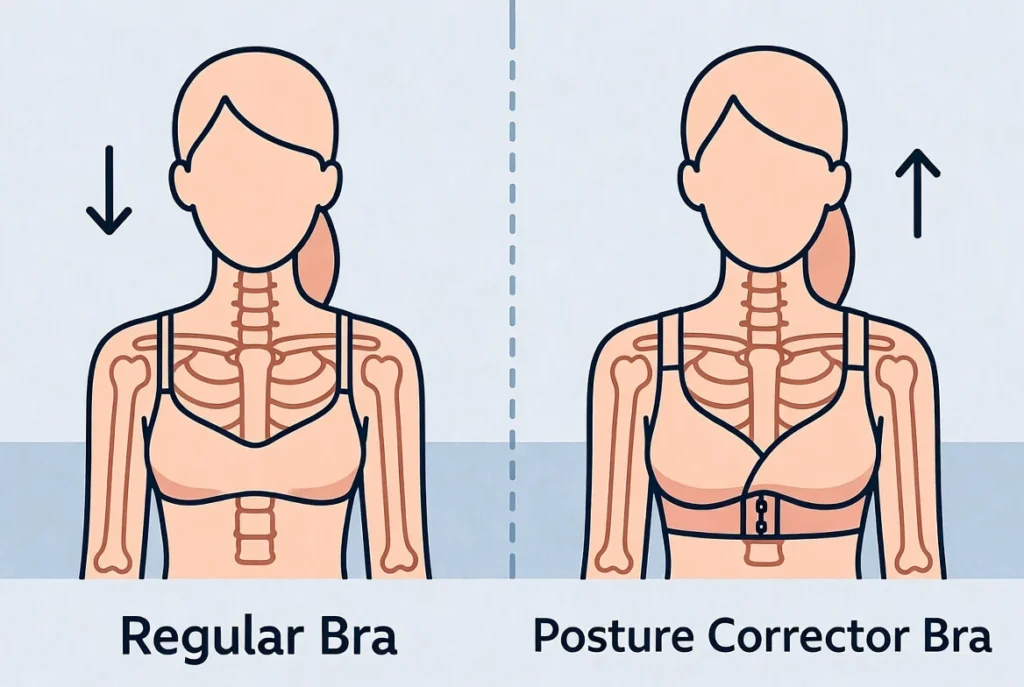
A posture bra isn’t just a bra with extra fabric. It’s engineered differently, with specific zones of tension, wider load-bearing surfaces, and design cues that nudge your body toward a neutral spine — passively, just by wearing it.
Redistributes Weight
Wide underbands and reinforced back panels pull the load off your traps and spread it across the rib cage, reducing pressure on any single point.
Realigns Shoulders
Cross-back or X-back panels gently guide the shoulder blades down and together, cuing a neutral spine without harsh restriction.
Builds Muscle Memory
Consistent wear trains postural muscles to engage properly. Over weeks, many women find improved alignment even after removing the bra.
Opens the Chest
Better lift and chest expansion means deeper breathing, less lung compression, and noticeably more energy through the afternoon slump.
Prevents Long-Term Damage
Proper support reduces cervical strain, thoracic outlet syndrome risk, and the kind of muscle imbalances that become structural over years of unsupported wear.
Boosts Confidence
Steady lift changes how clothes sit and how you move. Walking taller, breathing easier — it’s a surprisingly big shift in everyday confidence.
“The best part isn’t the pain relief — it’s that moment at 4 pm when you realize you haven’t rolled your shoulders all day.”
For best results, combine your posture bra with short movement breaks, light core strengthening, and a properly adjusted chair height. A good bra supports your posture — but your muscles still need to do their part. Think of it as a partnership, not a fix-it-and-forget-it solution.
What Makes a Posture Bra Different from a Regular Bra
The difference isn’t always obvious from a product photo. It’s in the construction details — the width of the band, the cut of the back panel, the shape of the cups. Here’s what to look for, and why each element matters for a full bust specifically.
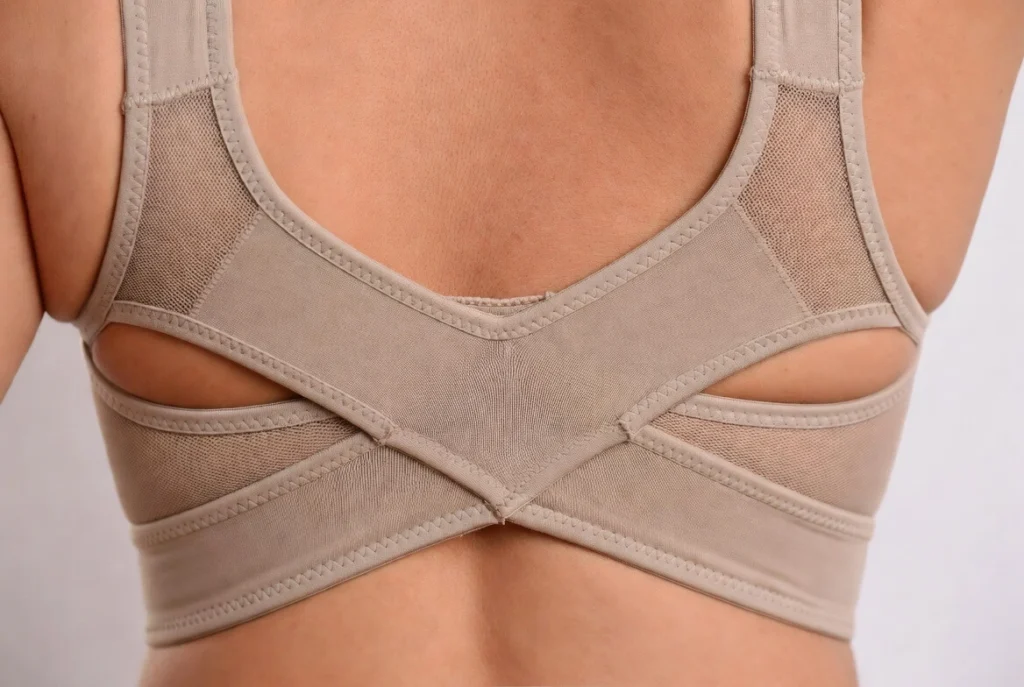
The Back Panel
This is the most important feature. A reinforced back panel — ideally in power mesh or a multi-directional tensile weave — stabilizes the torso and actively resists the forward pull of breast weight. It should be wide enough to cover and support the shoulder blade area, not just bridge between the hook closure and the straps.
Look for mesh zones aligned with the spine and shoulder blades. These provide structured support while still allowing airflow — crucial for long wear in warmer climates.
The Straps
Wide straps mean the load is spread over more surface area — fewer grooves, less pressure on nerves, less end-of-day ache. Padding helps, but width is the real factor. A well-padded 12 mm strap is still a narrow strap. Aim for at least 20–25 mm width in the shoulder portion for a large-cup bra.
Check adjustability range and hardware quality. For heavier busts, you need sliders that lock and hold without slipping mid-day. Soft elastic at the back, slight stretch at the front — that’s the ideal strap tension balance.
The Cups
Full coverage cups keep breast tissue contained at the top and sides, which stabilizes the center of gravity and reduces swinging movement. Molded or contoured shapes lift without hard squeeze. For wire-free styles to work on a large bust, look for internal sling panels or bonded support wings inside the cup itself — without those, the cup won’t hold shape through the day.
If you’re unsure about your cup depth and shape, understanding your bra cup size measurements makes a big difference in choosing the right style for your specific breast projection and root width.
The Closure and Band
Front closures anchor posture at the sternum before you even adjust the straps — this sets the whole alignment from the front. Multiple hook-and-eye rows give you fine control over band tension as the material stretches with wear. The band should do 80–90% of the weight work. If you feel it mainly in your shoulders, the band isn’t doing its job.
| Band Type | Width | Best For | Key Benefit |
|---|---|---|---|
| Wide band | 8–10 cm | D–G cups, everyday wear | Max load share |
| Medium band | 6–7 cm | C–E cups, active use | Mobility + support |
| Longline band | 10–12 cm | H+ cups, lower back support | Full torso anchor |
Our Top 2 Picks for 2025
Tried, compared, and recommended for full-bust women who need genuine posture support

Glamorise Full Figure Plus Size MagicLift Front-Closure Posture Back Bra Wirefree
The gold standard for full-bust posture support. Glamorise’s patented Magic Lift® back panel guides the shoulders back without restriction, while the 10 cm underband takes the majority of the weight load. Available from 34B to 54J — one of the widest size ranges in posture bras.

Champion Womens Women’s Sports Bra, High-Impact, Maximum Support, Breathable, Moisture Wicking
If you need serious support during walks, gym sessions, or just a long day on your feet, the Champion is in a category of its own. The row of front hooks locks you in from sternum to ribcage, eliminating bounce. The wide padded straps have zero dig-in — and women with larger busts consistently call it a life-changer for exercise.
* We may earn a small commission if you purchase through these links — at no extra cost to you. We only recommend products we’d genuinely wear.
How to Find Your Perfect Fit
Here’s the uncomfortable truth: most women — around 70% — are wearing the wrong band size, and it undermines everything else. A posture bra can’t redistribute weight properly if the band is riding up in the back or so tight it’s cutting in. Getting the measurement right is step one. Everything else follows.
Find Your Best Bra Match
Answer a few fit questions to get bra styles matched to your support needs, breast shape and everyday preferences.
Question 1 of 5
Why it matches
What to look for
What may not work
Private fit matching: your answers are used only to build the recommendation on this page. No measurements or fit selections are submitted to Bra-Calculator.com.
This tool suggests a starting bra style, not a medical or diagnostic recommendation. Individual brands and bra models can fit differently.
Measure Correctly — the First Time
Use a soft measuring tape. Stand tall, exhale naturally, and measure your underbust snugly — the tape should be level all the way around and firm, not loose. Write it down in centimeters. Then measure your fullest bust without compressing tissue, tape parallel to the floor. Wear a thin non-padded bra or nothing. These two numbers are your starting point.
Cross-reference both measurements with the specific brand’s size chart — not a generic one. Cup volume varies significantly between brands. A 36E from one label can fit like a 36F from another. If you’ve found a bra that fits well in the past, note that as your “reference fit” and use it as a calibration point. For a detailed guide on reading those numbers properly, see our complete size chart guide.
Quick Fit Checklist Before You Commit
- Band sits firm and level on the loosest hook (tighten as it stretches over time)
- Cups fully encase breast tissue — no spillage at top or sides
- Straps sit flat without digging into the shoulder; you should fit two fingers under them
- Center gore rests flat against the sternum (wired) or lies steady (wire-free)
- Back panel sits level — no riding up, no diagonal pulling
- Range of motion is free: bend, reach, twist without restriction
- No red marks or impressions after 20 minutes of wear
Be prepared to try two or three sizes before finding the right one — especially if you’re new to posture bras. A 95F in one brand might feel like a 100E in another. That’s normal. The sister-size principle exists for exactly this reason — same cup volume, different band-and-cup combinations.
The Movement Test
Before any bra earns a place in your rotation, put it through a movement test. Lift your arms above your head, bend forward, and twist side to side. The band should stay put. The cups shouldn’t collapse or gap. If tissue shifts laterally or bounce is excessive on a simple reach, the support is inadequate for your size and shape.
Check for common bra fit problems like strap groove syndrome, underwire migration, and quad-boob — these are reliable signs that something in the fit equation is off.
Beyond the Bra: Making Your Investment Last
A quality posture bra can run $50–$200. That’s not cheap — so the way you care for it matters. Most bras fail early not because the design is poor, but because they were machine-washed on hot, dried in a tumble dryer, or crammed into a drawer. Here’s how to keep yours working properly.
The Adjustment Period
Start slow. On the first day, wear your posture bra for 30–60 minutes. Add 15–30 minutes every day until you’re comfortable at 2–4 hours. This isn’t excessive caution — it’s letting your postural muscles wake up gradually rather than going from zero to eight hours and waking up sore. Those back muscles haven’t been working this way in a while. Give them time to adapt.
If you feel jabbing pressure or significant chafing, adjust the straps, move to a tighter or looser hook, or try a different cup size. Mild achiness between the shoulder blades as your muscles engage? That’s normal. Sharp pain or tingling? Stop, refit, and if it persists, see a fitter or physio.
Washing
Hand wash in cool water with mild liquid detergent. If machine washing, use a mesh lingerie bag on a gentle cycle. No bleach, no fabric softener — both break down elastic and bonded layers.
Drying
Lay flat on a towel to dry. Reshape the cups while damp. No tumble dryer — heat bends hooks, warps underbands, and accelerates elastic fatigue. Never wring or twist.
Storing
Store flat or folded once, cups nested inside each other. Use dividers or a bra box. Keep away from sunlight and heat, which fade fabric and soften elastic over time.
Rotating
Rotate between at least two or three bras. Daily wear without rest breaks down elastic faster. Rotation also means you can always have one clean and ready.
Recheck strap and band tension every 4–6 weeks — your body changes, and so does the elastic. Most well-cared-for posture bras last 6–12 months of regular wear. When the band has lost its firmness, the cups crease when stored, or straps slip despite being fully tightened, it’s time to replace.
Not Sure About Your Size? Start Here
Accurate measurements are the single biggest factor in finding a posture bra that actually works. Our free calculator walks you through the whole process in under two minutes.
Find My Size →Frequently Asked Questions
Yes — when they fit properly. A well-fitted posture bra redistributes breast weight across the rib cage instead of letting it hang from your shoulders. That shift reduces the load on the trapezius and cervical spine, which is where most of the pain comes from. The key words are “when they fit properly.” A posture bra in the wrong size won’t help and may make things worse. Wide straps, a firm underband, and a cross-back or X-back design are the features that make the real difference for a larger bust.
Prioritize a wide underband (at least 8 cm), full-coverage molded cups, a reinforced back panel in power mesh, wide padded straps with quality adjusters, and breathable moisture-wicking fabric. Bonus features that genuinely help: front closures for sternum anchoring, multiple hook rows for fine-tuning tension, and internal sling panels in the cups for wire-free lift. Avoid anything with narrow straps and a thin band — it won’t hold up for your size.
Measure your underbust firmly (exhale first) and your fullest bust with the tape parallel to the floor. Record both in centimeters and cross-reference with the brand’s own size chart — not a generic one. Every brand sizes slightly differently, especially in cup depth. Your starting size isn’t always your final size — posture bras often require trying one size up in the cup. If in doubt, always size down in band and up in cup.
Yes, if they fit correctly. Start with 30–60 minutes and gradually increase to 2–4 hours daily. Rotate between at least two bras to avoid pressure point buildup. Stop immediately if you experience numbness, tingling, sharp pain, or difficulty breathing — these are signs the fit is wrong, not that posture bras don’t work. Women with shoulder sensitivity post-surgery should see a specialist fitter first.
No — and this is worth saying clearly. A posture bra supports and reminds, but it doesn’t strengthen. For lasting change, combine bra wear with back extension exercises, rows for the upper back, core work, and regular chest stretching. The bra gives your postural muscles a cue; exercise gives them the strength to act on it. If your pain is significant, see a physiotherapist before relying on a bra alone.
Both can work. Underwire gives structured lift and defined shape — ideal for dressier wear or if your breast tissue is projected. High-support wire-free posture bras with internal sling panels or bonded wings feel softer and are better for longer wear or higher-impact activity. The real question is: does the cup hold its shape under movement? Test bounce before committing. If cups collapse or tissue migrates sideways, the support is insufficient regardless of whether there’s a wire.
Hand wash in cool water, use a mesh bag if machine washing, and always air-dry flat. Never tumble dry or wring. Hook the hooks before washing to prevent snags. Rotate between at least two bras so elastic gets rest between wears. Store flat with cups nested, away from heat and sunlight. A well-cared-for bra should last 6–12 months of regular use. Replace it when the band has lost elasticity, straps slip even when fully tightened, or cups no longer hold their shape.
The Bottom Line
The right posture bra won’t fix everything. But for women with a larger bust, it’s often the missing piece between a painful day and a comfortable one. It won’t replace core work or physical therapy, and it won’t matter if it doesn’t fit correctly. But when the fit is right — wide underband, full cups, proper back panel — the difference is real and it’s fast.
Measure properly. Compare size charts. Test for movement. Start with shorter wear and build up. Take care of what you buy. And pair it with at least some targeted back and shoulder strengthening. That combination — practical, unglamorous, and actually effective — is what changes things for the long term.
If you’re still not sure where to start, use our bra fit checker to identify what’s going wrong with your current setup before spending on something new.