34C Bra Size: Measurements, Sister Sizes & Fit Guide
34C combines a 34 band with C-cup volume. Check the measurement range, 32D and 36B sister sizes, nearby cups, and the fit signs that tell you whether 34C is right.

Amelia is a former lingerie buyer and the founder of Bra-Calculator.com. Her fit guides focus on measurement, sister sizing, breast shape and the specific fit symptoms that tell you what to try next. More about Amelia →
On this pageJump straight to the 34C answer you need
Choose the fit signs you notice in the band, cups, center and straps. We’ll turn them into a practical next step for 34C.
Private fit check — your answers stay in your browser and are used only for this on-page guidance. Nothing is stored or submitted.
What Does a 34C Bra Size Mean?
A 34C has two parts: 34 is the band scale and C is the cup volume on that band. The cup letter is relative to the band, so a 34C is not the same cup volume as a 30C or a 38C.
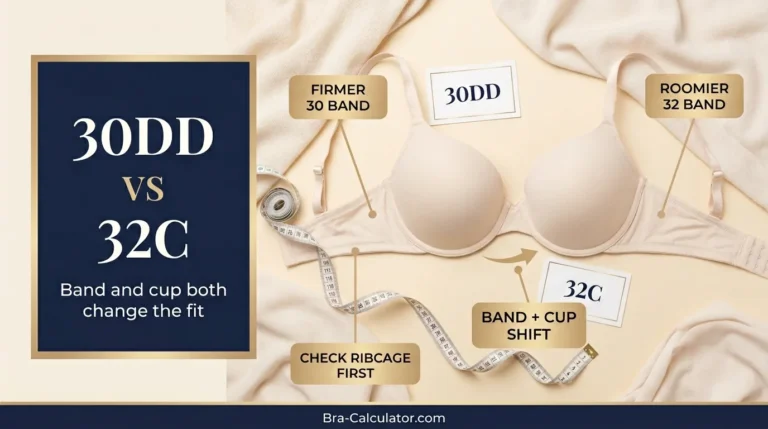
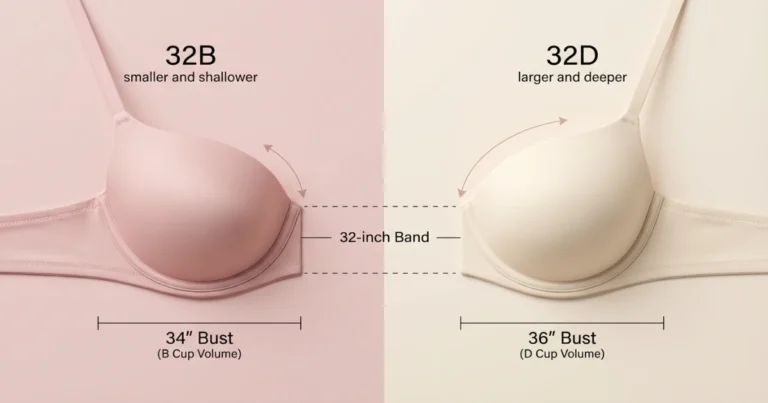
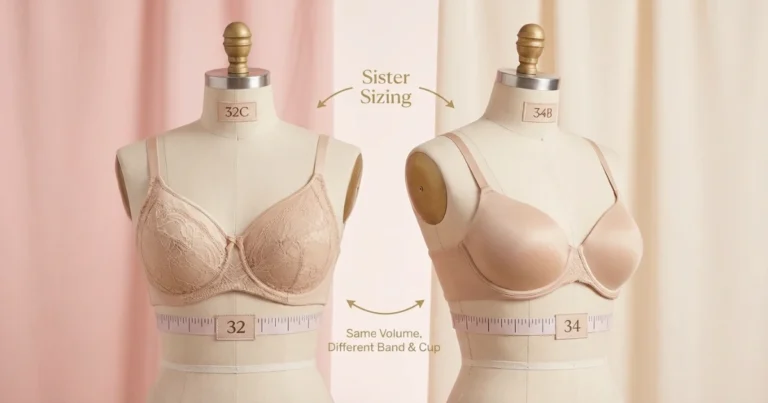
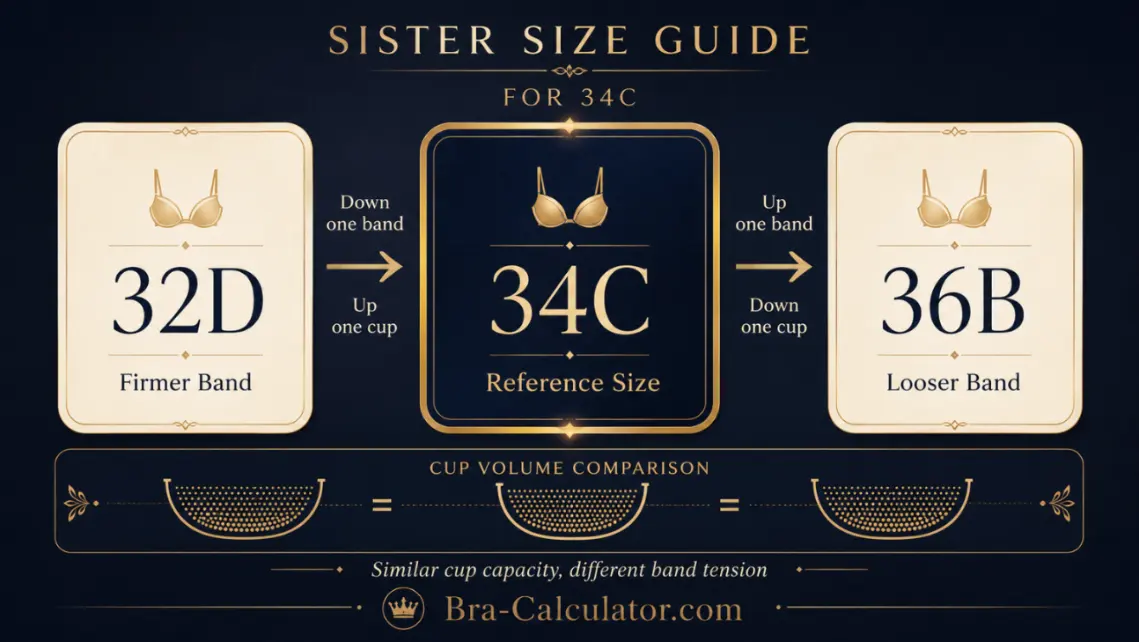
That scaling is also why 32D and 36B are the closest sister sizes to 34C. Going down one band and up one cup keeps roughly similar cup capacity; going up one band and down one cup does the same in the other direction.
34C Bra Size Measurements in Inches and CM
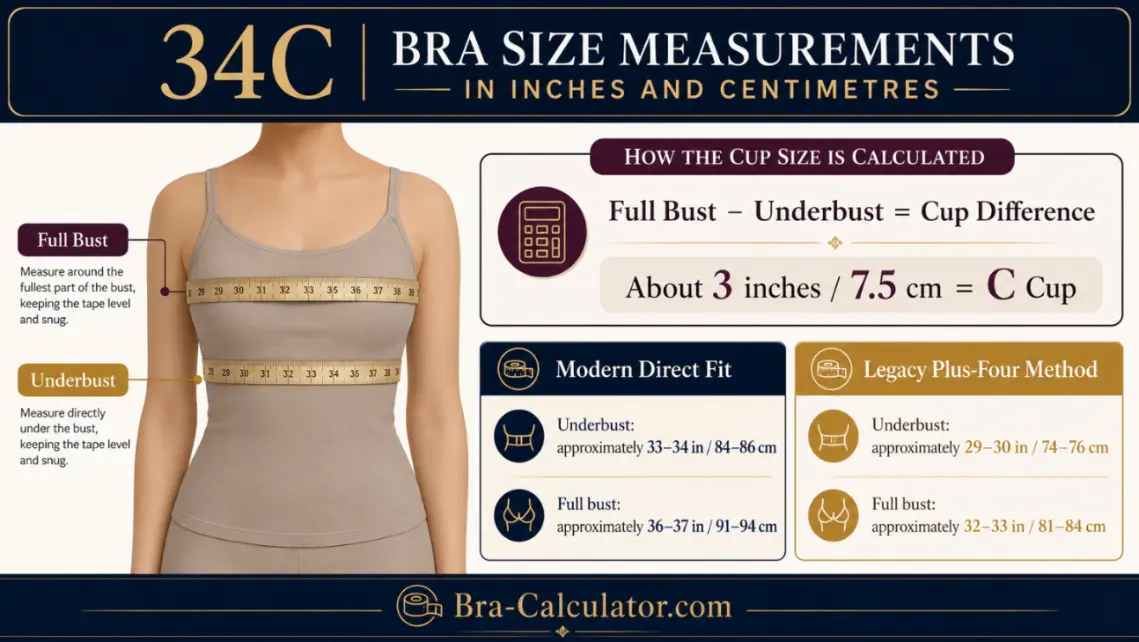
There is no single body-measurement range used by every brand. The numbers below are a practical starting point for a modern direct-fit approach, followed by the label math most size charts use.
| 34C measurement | Inches | Centimeters | What it tells you |
|---|---|---|---|
| Snug underbust, direct-fit starting range | About 33–34 in | About 84–86 cm | Useful starting range for testing a 34 band. |
| Full bust, direct-fit starting range | About 36–37 in | About 91–94 cm | Used with the underbust to estimate cup size. |
| C-cup difference | About 3 in | About 7.5 cm | Common US/UK cup progression reference. |
| Simple 34C label math | 34 band + ~3 in = ~37 in bust | 86 cm band scale + ~7.5 cm | A useful shorthand, not a universal brand rule. |
| Legacy “plus-four” chart | About 29–30 in underbust | About 74–76 cm | Some older charts add about 4 inches before assigning the 34 band. |
How to check whether your measurements point to 34C
- Measure under the bust. Keep the tape level and snug on bare skin.
- Measure the fullest bust point. Keep the tape level and relaxed.
- Use the calculator as the starting point. Do not force the result into a single brand chart.
- Confirm in a real bra. The band should stay level; the cups should contain all tissue; wires should not sit on breast tissue.
What Does a 34C Look Like?
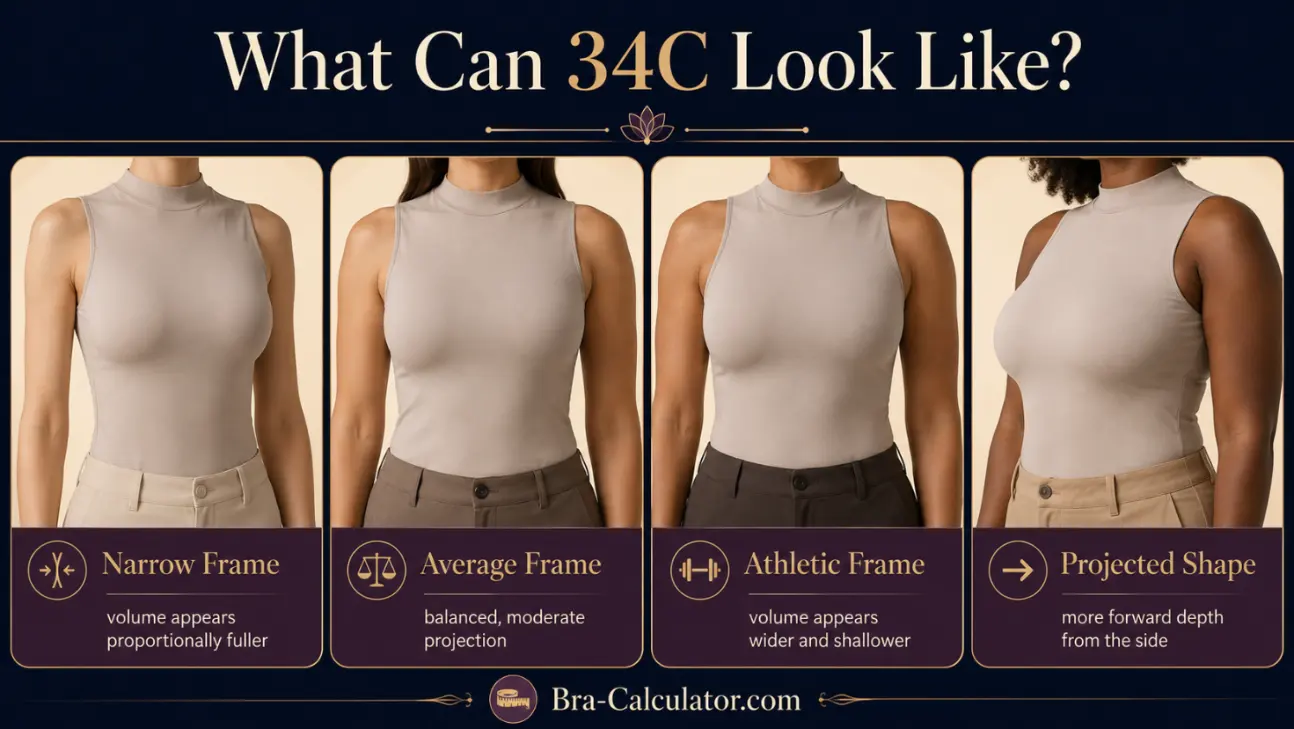
A 34C does not have one fixed appearance. On a narrower torso, the same cup volume can look more prominent; on a broader chest, it can look more spread out. Projection also changes the side profile: a projected 34C carries more depth forward, while a shallow 34C distributes more volume across the chest.
More projected 34C
Usually needs more depth near the wire. A very shallow molded cup can slide down or press tissue outward even when the label is correct.
Shallower 34C
Often fits better in shorter, more open cups. A tall molded cup may gape at the top even when the overall volume is close.
34C Fit Check: What Should You Try Next?
Select the fit problem you notice most. This tool changes one variable at a time so you can test the nearest logical size or shape adjustment.
34C Sister Sizes: 32D and 36B
The closest sister sizes are 32D and 36B. Use sister sizing when the cup capacity of 34C feels close but the band tension is wrong.
| Size | Band change | Cup change | When to try it |
|---|---|---|---|
| 32D | Firmer / shorter | Up one cup | 34C cups fit, but the 34 band rides up or lacks support. |
| 34C | Reference | Reference | Band stays level and cup edges sit smoothly. |
| 36B | Looser / longer | Down one cup | 34C cup volume is right, but the band is genuinely too tight. |
34C vs 34B, 34D, 32D and 36B
Same 34 band; one cup more room than 34B. Try it when 34B cuts in, spills or feels shallow.
Same 34 band; one cup less volume. Try it when a 34C is roomy throughout the whole cup, not just at the top edge.
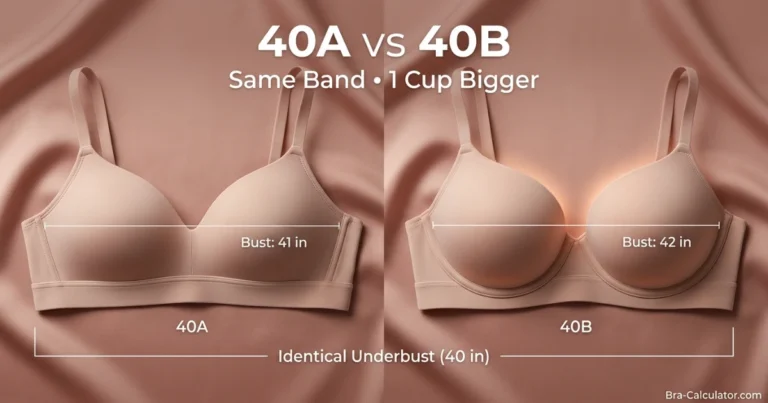
Same 34 band; one cup smaller than 34D.
Same band with one cup more capacity. First size to test when 34C spills and the band already fits.
Longer band with approximately similar cup capacity.
Shorter, firmer band. Best sister-size test when a 34C band rides up.
Shorter band with approximately similar cup capacity.
Longer, looser band. Best sister-size test when 34C is genuinely tight around the ribcage.
For a dedicated same-band comparison, see 34B vs 34C. For band changes, use the Sister Size Calculator to compare 32D, 34C and 36B.
When 34C Is the Right Volume but the Wrong Shape
A bra can be the right nominal size and still fit poorly because the cup shape does not match the breast shape. Before changing sizes, check where the mismatch occurs.
| Fit symptom in 34C | Likely issue | First thing to test |
|---|---|---|
| Top edge gaps, lower cup feels filled | Cup may be too tall or too open at the top | Shorter balconette, demi or stretch-lace 34C |
| Bottom cup wrinkles and bra slides down | Cup may be too shallow for projection | Deeper or seamed 34C before changing band |
| Center gore presses on close-set tissue | Gore may be too tall/wide | Lower plunge 34C |
| Side tissue escapes while cup front looks fine | Wire may be too narrow or cup lacks side support | Wider-wire or side-support 34C |
| Straps dig while band rides up | Band is not anchoring enough | Try 32D if cup capacity is otherwise right |
Best Bra Styles to Try in 34C
Choose the style from the fit problem you are solving rather than from the cup letter alone.
34C Shopping Options by Fit Goal
These are shopping options for different fit goals, not a claim that one product fits every 34C body. Check the current brand chart and return policy before ordering.

Warner’s Cloud 9 Wire-Free Contour Bra
Useful if you want a molded, wire-free everyday bra and need to check whether 34C sits smoothly without top-cup gaping.
View on Amazon Affiliate link
Victoria’s Secret Bombshell Push-Up Bra
Useful when you specifically want push-up shaping. Check the cup edge carefully because added padding changes the usable cup space.
View on Amazon Affiliate link
High-Impact Encapsulation Sports Bra
Look for separate cups, a stable underband and adjustable straps. This makes it easier to judge bounce control without simply compressing the bust.
See 34C options on Amazon Affiliate search link34C International Size Conversion
| Region | Typical 34C equivalent | Note |
|---|---|---|
| United States | 34C | Reference label on this page. |
| United Kingdom | 34C | US and UK are the same at C cup; differences become more important higher in the cup sequence. |
| European Union | 75C | EU band labels use centimeters. |
| France / Spain | 90C | French/Spanish band numbering differs from standard EU labels. |
| Australia / New Zealand | 12C | AU/NZ uses a clothing-style band number. |
| Japan | 75C | Brand construction can differ; confirm the brand chart. |
Buying across regions? Use the Global Bra Size Converter and Brand Size Decoder.
34C Bra Size FAQs
What does a 34C bra size mean?
34C combines a 34 band with C-cup volume. In common US/UK sizing logic, C represents about a 3-inch difference between the band-size value and full-bust value.
What are 34C measurements in inches and centimeters?
A practical direct-fit starting range is about 33–34 inches (84–86 cm) at the snug underbust and 36–37 inches (91–94 cm) at the full bust. Brand charts can shift those ranges.
What is the bust size for a 34C?
Simple label math puts a 34C full bust around 37 inches (about 94 cm), but real body measurements can vary because brands use different band and stretch allowances.
What are the sister sizes of 34C?
32D is the closest tighter sister size and 36B is the closest looser sister size. Use them when 34C cup capacity feels right but the band does not.
Is 34C bigger than 32D?
Not in approximate cup capacity. They are sister sizes. 32D uses a shorter, firmer band; 34C uses a longer band.
Is 34C bigger than 34B?
Yes. The band is the same, but 34C is one cup step larger than 34B.
Is 34C smaller than 34D?
Yes. Both use a 34 band, but 34D adds one cup step. If a 34C spills while the band is secure, 34D is the first nearby size to test.
Is 34C considered big?
There is no universal big-or-small standard. 34C is a mid-range cup on a 34 band, and its appearance depends on frame width, projection and breast shape.
Why does my 34C bra gape at the top?
The cup may be too large, but top gaping can also mean the cup is too tall or too projected. Try a shorter balconette, demi or stretch-lace 34C before assuming you need 34B.
Why does the center gore float in 34C?
The cup may be too small or too shallow, or the gore may be too wide/tall for close-set tissue. If the 34 band is secure, compare 34D with a deeper 34C or a lower plunge shape.
What is 34C in EU, France and Australia?
A typical label conversion is US/UK 34C, EU 75C, France/Spain 90C and AU/NZ 12C. Always check the brand chart before buying.
Was this 34C guide helpful?
Still deciding between 34C and a nearby size?
Calculate your starting size, then use the sister-size and fit checks above to confirm it.
Use the Bra Size Calculator Check Sister SizesSizing varies by brand, fabric, cup construction and fitting method. Use this guide as a fit starting point and confirm against the current brand size chart. Product links may be affiliate links.