32C vs 36C: Why the Same Cup Letter Doesn’t Mean the Same Size (2026 Bra Guide)
Choose the fit signs you notice in the band, cups, center and straps. We’ll turn them into a practical next step for 32C.
Private fit check — your answers stay in your browser and are used only for this on-page guidance. Nothing is stored or submitted.
Quick Answer: Is 36C Bigger Than 32C?
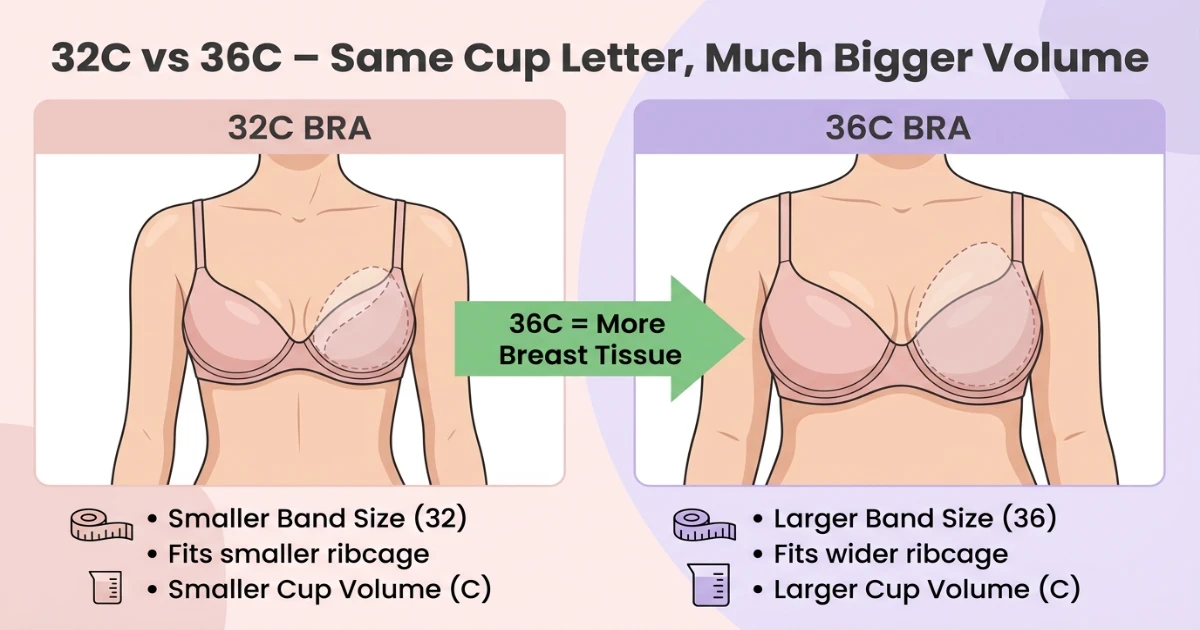
Yes — a 36C bra is significantly larger than a 32C, even though both share the same cup letter. Cup letters are not fixed measurements; they scale proportionally with band size. A C cup on a 36-inch band holds considerably more breast tissue than a C cup on a 32-inch band. The band number sets the foundation, and the cup volume grows with it.
Key Takeaways
- Cup letters are relative to band size, not absolute measurements of breast volume.
- A 36C cup holds more breast volume than a 32C cup, despite sharing the same letter.
- The band number represents your ribcage circumference — it determines how a bra fits and supports your body.
- As band size increases by two inches, cup volume increases by approximately one full cup size worth of tissue.
- Wearing the wrong band size is one of the most common bra fit mistakes — even if the cup letter looks right.
- 32C and 36A are not the same size — sister sizes share volume, but only one band away at a time.
- Most bra support comes from the band, not the straps — choosing the right band size is essential.
- Your actual ribcage measurement should always guide your band size selection first.
Understanding Bra Band Size
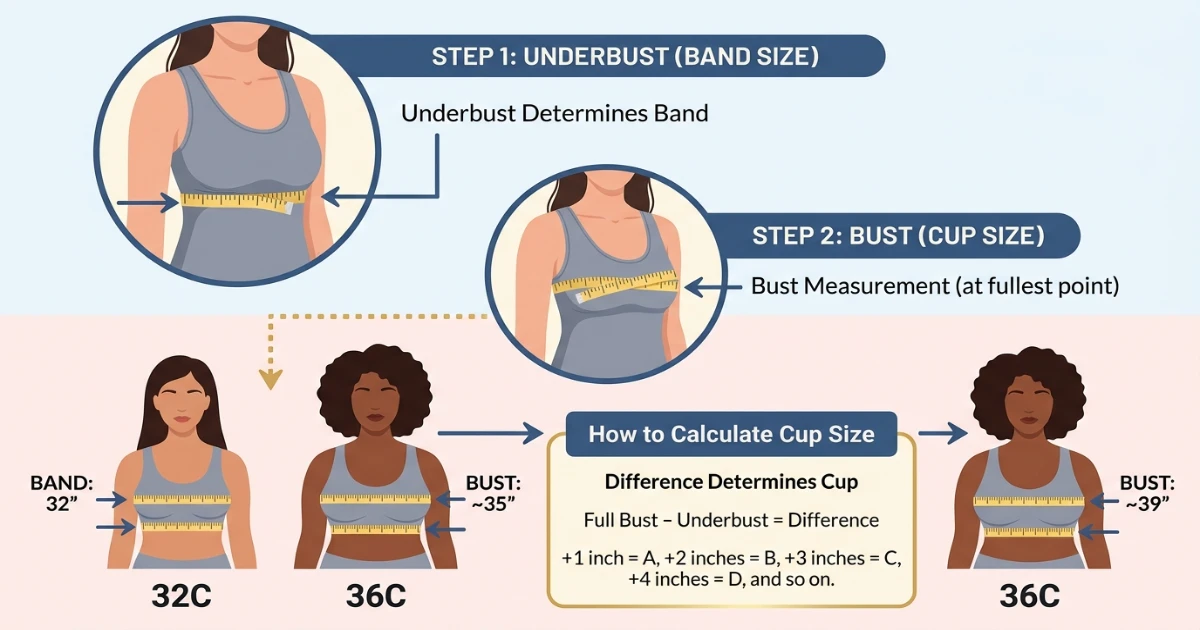
The number in a bra size — the 32 or the 36 — refers to your underbust circumference, measured in inches around your ribcage, just beneath your breasts. This number is the structural foundation of your bra. It determines how the bra wraps your body, distributes weight, and provides the majority of your support throughout the day.
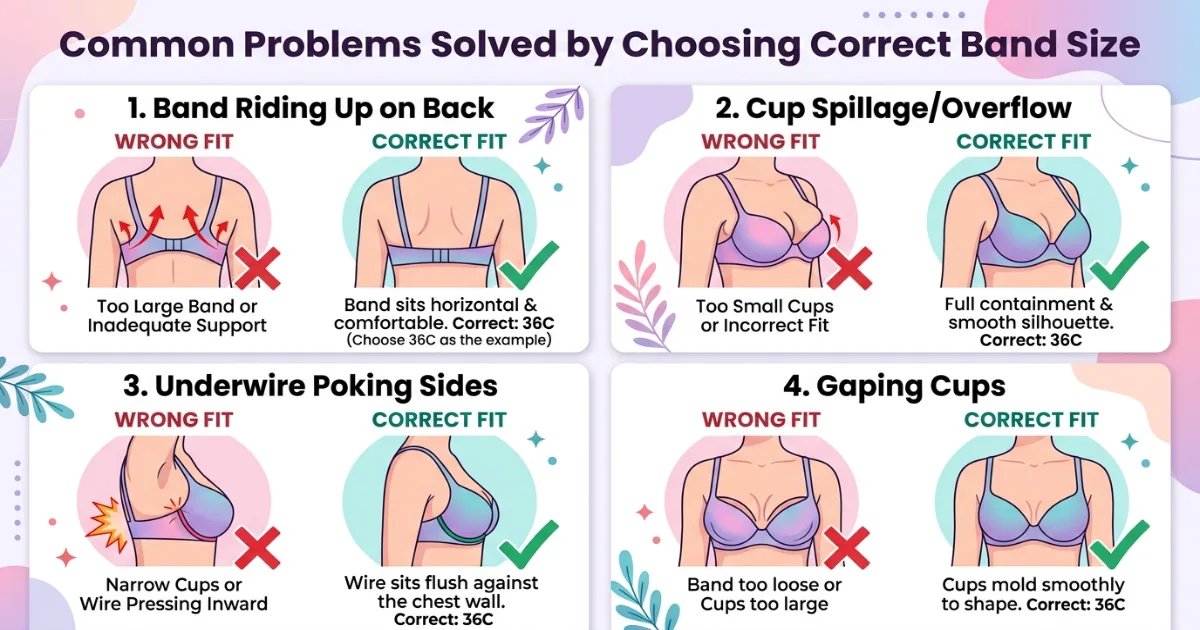
When bra fitters say that “80% of a bra’s support comes from the band,” they mean it literally. A band that is too large rides up the back, fails to anchor the cups, and shifts the weight of your bust onto your shoulder straps — causing neck pain, red marks, and poor posture over time. A band that is too tight creates pressure, discomfort, and can affect circulation.
Getting the band right first — before even thinking about cup letter — is the most important step in bra fitting. Learn how to take an accurate underbust measurement with our bra measurement guide.
Measurement Breakdown: 32C vs 36C
The difference in physical measurements between a 32C and a 36C is substantial. Here is a side-by-side comparison of what each size typically represents in real body measurements:
32C
Underbust: ~32 in / ~81 cm
Bust: ~35 in / ~89 cm
Bust–Underbust Diff: 3 inches (= C cup)
Frame: Petite to slender
36C
Underbust: ~36 in / ~91 cm
Bust: ~39 in / ~99 cm
Bust–Underbust Diff: 3 inches (= C cup)
Frame: Average to fuller
Notice that both sizes share the same 3-inch difference between underbust and bust — which is what defines the C cup. But the actual volume enclosed by that C-cup is far greater on a 36-inch frame than a 32-inch frame, because the entire circumference of the cup is larger.
Think of it like a C-sized lid on a small pot versus a C-sized lid on a large pot — the name is the same, but the container is completely different. View our full bra size charts for more measurements across all sizes.
Cup Volume Scaling: Why the Same Letter Gets Bigger
This is the concept that confuses most people about bra sizing: cup letters do not represent a fixed volume — they represent a ratio. Specifically, they represent the difference in inches between your bust and underbust measurements. A C cup always equals approximately 3 inches of difference. But 3 inches around a 32-inch circumference is a much smaller arc of fabric than 3 inches around a 36-inch circumference.
As band size increases, the physical size of the cup panel — its width, depth, and total volume — increases alongside it. The following visual shows how cup volume grows as band size increases, even with the C cup letter constant:
This is why it is inaccurate to say a C cup is a “medium” or “average” breast size — without specifying the band, the cup letter tells you almost nothing about actual volume. Explore our cup size visual guide to see these differences illustrated in 3D.
Real Fit Differences: How These Sizes Feel on the Body
Understanding measurements is one thing — but how do these two sizes actually feel when you’re wearing them? Here’s what you should expect from each size in practice:
Band Tightness and Ribcage Fit
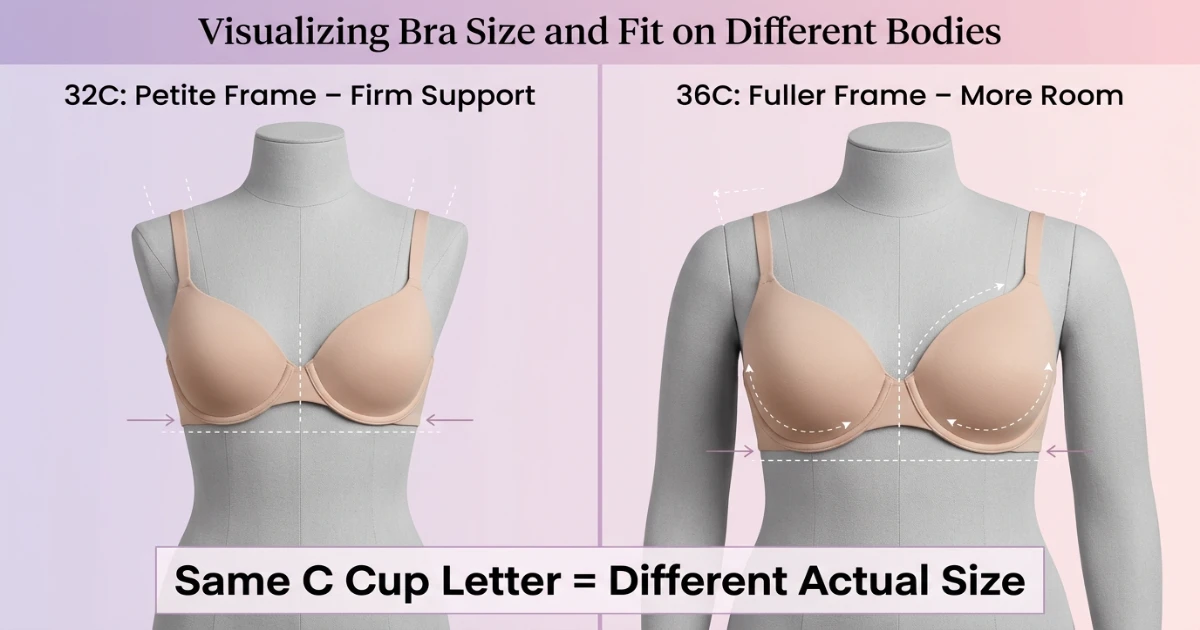
A 32C band sits snugly around a smaller ribcage, providing firm, stable support. If your underbust measures closer to 36 inches and you try on a 32C, the band will feel uncomfortably tight, restrict breathing, and may dig into your sides. Conversely, wearing a 36C on a 32-inch ribcage will cause the band to ride up your back, reducing support and requiring constant readjusting.
Breast Support and Weight Distribution
Because the 36C cup is physically larger, it accommodates more breast tissue before experiencing spillage or gaping. A person with a 36-inch underbust and proportional bust will find that a 36C provides full coverage and encapsulates the breast properly. A 32C on the same person would leave significant breast tissue outside the cup.
Cup Coverage and Silhouette
The 32C provides a sleek, close-fitting silhouette suited to a petite to slim frame. The cup panels are smaller in surface area and work best on narrower-set breasts. The 36C offers broader cup panels and wider underwire spread, designed for a fuller ribcage. Wearing the wrong size in either direction can cause quadraboob, gaping, underwire poking, or side spillage.
Overall Comfort Throughout the Day
Band fit directly controls how comfortable a bra is over 8–12 hours of wear. A 32C on its intended wearer should feel firm but not painful. A 36C on its intended wearer should feel secure and present minimal pressure. If you’re experiencing persistent discomfort, the issue is almost always band size, not cup size. Learn more about common issues in our bra fit problems guide.
Which Size Is Right for You?
Choose 32C if you…
- Measure approximately 30–32 inches around your underbust
- Find 34C or 36C bands feel loose or ride up your back
- Have a petite or slim frame with proportional bust
- Prefer a firmer band with maximum support
- Find that cups on 34B or 34C gape or feel too wide
Choose 36C if you…
- Measure approximately 34–36 inches around your underbust
- Find 32C or 34C bands feel too tight or restricting
- Have a medium to fuller frame with a proportional bust
- Need a longer wire spread to accommodate broader breast root
- Experience spillage from the sides in smaller band sizes
Sister Sizes: Related Sizes That Share Cup Volume
Sister sizing is a tool used by lingerie professionals to find an alternative bra size when your exact size is out of stock, or when you need to adjust band tightness without changing how much breast volume the cup holds. The principle: go up one band size and down one cup letter (or vice versa) to maintain approximately the same cup volume.
32C sister size ladder:
It’s important to note that 32C and 36C are not sister sizes — they are four band sizes apart, which means the cup volume difference is substantial. Sister sizes only shift one step at a time. Jumping from 32C to 36C would mean moving through four band increments, each of which increases cup volume by roughly one cup size. Learn more on our sister sizes explained page, or try our sister size calculator.

Warner’s Cloud 9 Wireless Bra — For Women Who’ve Given Up on Underwire Comfort
- Cloud-soft, wire-free construction eliminates underwire pain completely
- Flexible cup edges move naturally — no digging, no gaps
- Available in B–DDD sizes with true-to-size fit
- Perfect for sensitive days, hormonal changes, or recovery comfort
⚠ Affiliate disclosure: bra-calculator.com may earn a commission at no extra cost to you.
Quick Bra Fit Test: 5 Steps to Check Your Fit Right Now
Put on your current bra on the loosest hook and run through these checks:
- The Band Test: Slide two fingers (no more, no less) under the band at your back. If you can fit more than two fingers easily, the band is too loose. If you can’t fit even one, it’s too tight.
- The Underwire Test: The underwire should lie flat against your ribcage at the center front, and the wire channel should fully encircle your breast tissue — not sit on breast tissue itself.
- The Cup Test: Check for any fabric folding, gaping at the top of the cup, or breast tissue overflowing the cup at the top, sides, or bottom. All breast tissue should sit within the cup.
- The Strap Test: Lift both arms above your head. The bra should not move significantly. Straps should not dig in or slide off. If the band rides up when you raise your arms, the band is too large.
- The Movement Test: Walk, sit, and bend forward. The bra should stay in place, remain comfortable, and offer consistent support throughout movement.
Still unsure about your bra size? Get a precise recommendation in under 2 minutes.
Try Our AI-Powered Bra Size Calculator →32C vs 36C: Full Comparison Table
| Feature | 32C | 36C |
|---|---|---|
| Band Size | 32 inches (~81 cm) | 36 inches (~91 cm) |
| Bust Measurement | ~35 in / ~89 cm | ~39 in / ~99 cm |
| Cup Volume | Smaller C cup volume | Significantly larger C cup volume |
| Frame Type | Petite to slender | Average to fuller |
| Band Support Level | Very firm and snug | Comfortable, moderate tension |
| Cup Coverage Area | Narrower cup panels | Wider, broader cup panels |
| Underwire Width | Narrower wire spread | Wider wire spread |
| Spillage Risk (wrong size) | High if underbust is 34–36 in | High if underbust is 30–32 in |
| Comfort for Target Wearer | Excellent for 30–32 in ribcage | Excellent for 34–36 in ribcage |
| Sister Size (smaller band) | 30D | 34D |
| Sister Size (larger band) | 34B | 38B |
For a complete size comparison across all bands and cups, visit our bra size chart calculator.
People Also Ask: 32C vs 36C FAQ
Is 36C bigger than 32C?
Yes. A 36C is significantly larger than a 32C. Despite sharing the same cup letter, the 36C has a larger band circumference (36 vs 32 inches) and a physically bigger cup with greater breast volume capacity. The cup letter C only tells you the proportion — not the actual size.
Does cup size increase with band size?
Yes. Cup volume increases with every band size increment, even when the cup letter stays the same. As the band grows, the circumference of the cup panel increases, meaning the cup holds more breast tissue. This is why a C cup on a 36 band is much larger than a C cup on a 28 band.
Why does the same cup letter fit so differently on different people?
Because cup letters represent a ratio between underbust and bust — not a fixed volume. A C cup means your bust measures approximately 3 inches more than your underbust. On a 30-inch underbust, this yields a small cup. On a 40-inch underbust, the same C cup would be very large. Same letter, vastly different volume.
Can someone wear 36C instead of 32C?
Only if their ribcage measures around 34–36 inches. Wearing a 36C on a 32-inch ribcage would result in a band that is far too loose, providing minimal support, riding up the back, and shifting breast weight onto the straps. Band size should always match your actual underbust measurement.
What is the sister size of 32C?
The sister sizes of 32C are 30D (tighter band, same cup volume) and 34B (looser band, same cup volume). Sister sizes allow you to adjust band tension while keeping roughly the same amount of breast tissue coverage. Note that 36C is not a sister size of 32C — they differ by four band increments.
Why does band size matter so much in bras?
The band provides approximately 80% of a bra’s total support. It anchors the cups, distributes the weight of the bust, and keeps the bra positioned correctly. A band that doesn’t match your ribcage will cause the bra to migrate, reduce support, and create discomfort — regardless of how well the cup fits.
How do bra cup letters work?
Cup letters represent the difference in inches between your bust measurement and your underbust measurement. AA = less than 1 inch; A = 1 inch; B = 2 inches; C = 3 inches; D = 4 inches; and so on. Because this is a difference measurement, the actual volume the letter represents grows with every increase in band size.
Is 32C a common bra size?
Yes. 32C is one of the most common bra sizes in the US and UK, typically worn by people with petite to average frames and moderate bust proportions. It is widely stocked across most mainstream lingerie retailers and is considered a standard size in many sizing systems.
Does a bigger band mean bigger cups?
Yes, if the cup letter stays the same. A 36C cup is physically larger than a 34C or a 32C because the entire cup panel grows with the band circumference. However, a larger band does not automatically mean a larger cup letter — a 36A has a smaller cup volume than a 32C, for example.
How do you calculate bra size?
Measure your underbust (snug, on exhale) to get your band size. Then measure your bust at its fullest point. Subtract your underbust from your bust — each inch of difference corresponds to a cup letter (1 in = A, 2 in = B, 3 in = C, etc.). Use our AI bra size calculator for an instant, accurate result.
More Bra Size Comparisons to Explore
Understanding how bra sizes relate to each other takes practice. If you found this guide helpful, explore more size comparisons to sharpen your bra fitting knowledge:
Ready to find your perfect size? Our AI-powered calculator uses your measurements to recommend the ideal band and cup — in under 2 minutes.
Find My Bra Size Now →Disclaimer: Bra sizing can vary between brands, countries, and individual manufacturers. The measurements and comparisons in this article are based on standard US sizing conventions. Always try bras on when possible, or consult brand-specific size charts. Our calculator and guides are intended as educational tools, not substitutes for professional bra fitting.