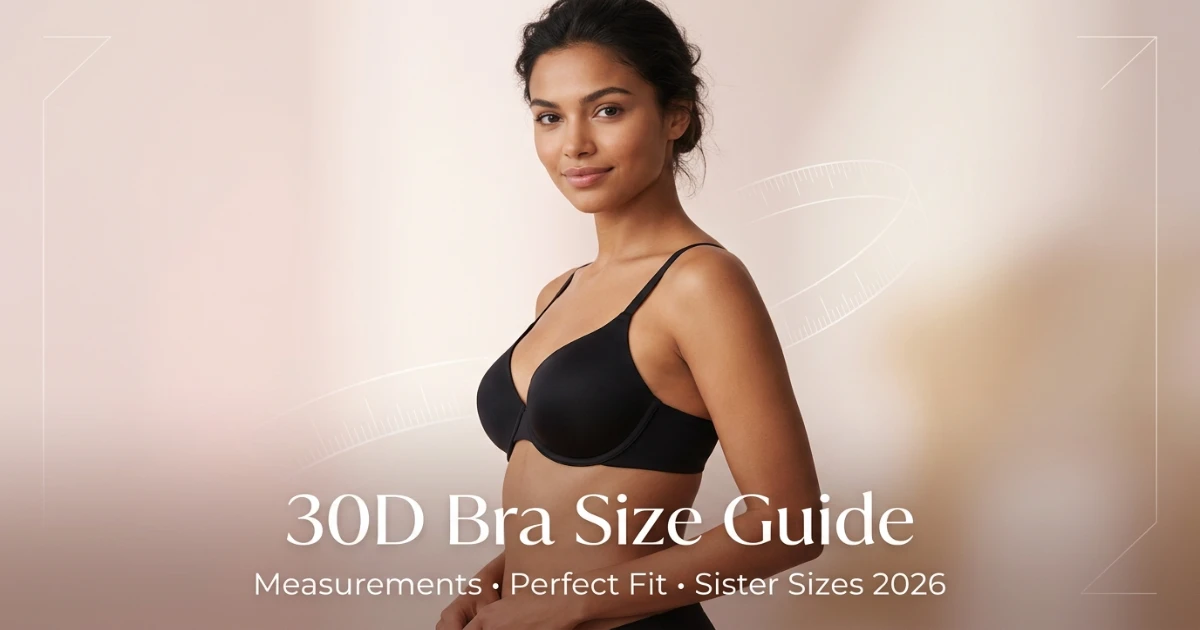
A 30D bra size means your underbust measures approximately 25–26 inches (64–66 cm) and your bust measures 29–30 inches (74–76 cm) — a 4-inch difference that defines the D cup. The number anchors to your ribcage; the letter is a ratio, not a fixed volume. On a narrow frame, a 30D reads as noticeably full and projected.
30D at a Glance
| Attribute | Detail |
|---|---|
| Band Size | 30 inches (underbust 25–26″ / 64–66 cm) |
| Full Bust Measurement | 29–30 inches (74–76 cm) |
| Cup Difference | ~4 inches (~10 cm) — D cup |
| Sister Sizes | 28E (tighter band) · 32C (looser band) |
| US / UK Size | 30D |
| EU Size | 65D |
| AU / NZ Size | 8D |
| S/M/L Equivalent | Small–Medium (brand dependent) |
| Cup Volume Equivalent | Same as 28E and 32C |
What Is a 30D Bra Size?
Breaking down the number and the letter — separately.
Most people wearing a 30D have either been told the size doesn’t exist, or have spent years in a 32C that bags at the band while the cups strain at the seams. The 30D is a precisely defined measurement — and the chronic difficulty in finding it at retail is an inventory problem, not a body problem.
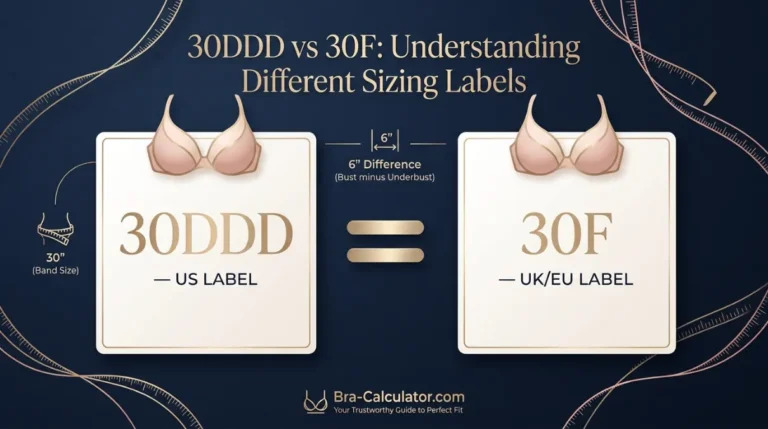
To understand a 30D, the two components must be read separately. The number 30 is your band size — it anchors the entire bra to your ribcage and delivers the structural foundation for all lift and support. A correctly fitting band carries approximately 80% of the bra’s total load. The letter D is your cup size — it represents a four-inch difference between your underbust and full bust measurement. It is not an absolute volume; it is a ratio that scales with band circumference.
This scaling is the critical point. A 30D and a 38D share the same letter, but the 38D holds far more physical tissue — because the same four-inch ratio on a larger circumference produces a larger absolute volume. A 30D on a 25-inch ribcage produces a noticeably full, projected shape that the same letter on a 36-band simply cannot replicate.
The misfitting pattern for 30D is predictable and almost universal: store fitters with 32-band inventory assign a 32C (looser band, identical cup volume) or a 32D (correct band number but wrong cup, too large). If your current bra’s band rides up constantly while the cups feel tight or cause spillage, you are almost certainly a 30D who has been wearing the wrong size for years.
30D Bra Measurements
The precise measurements that define this size — in both inches and centimetres.
Difference = D Cup (~4 in)
Wrap tape snugly around your bare ribcage where the band sits — perfectly level across your back. This is your band number. For a 30D, it should read 25–26 inches (64–66 cm).
Stand naturally and measure around the fullest part of your bust without compressing tissue. Keep the tape level front and back. For a 30D, this reads 29–30 inches (74–76 cm).
Bust minus underbust = cup letter. A 4-inch (≈10 cm) difference = D cup. With a 30 band → you’re a 30D.
A new bra should feel secure on the loosest hook with the band sitting level across your back. If it rides up immediately, the band is too loose — move to sister size 28E before adjusting the cup.
What Does 30D Look Like?
Cup size tells you volume — not shape. Your breast shape changes how any size looks on your body.
The most misunderstood part of bra sizing is expecting one size to look identical on everyone. A 30D looks entirely different depending on your height, muscle mass, and natural breast root shape. Two people can share the exact same 29-inch bust measurement and look like they are wearing completely different sizes.

Victoria’s Secret Bombshell Push-Up Bra — Maximum Lift for 30D
- Adds up to 2 cup sizes of lift on an already full D cup — dramatic definition
- Narrow 30-band anchors padding perfectly flush against the chest wall
- Structured foam channels D cup tissue inward and upward without overflow
- Ideal for low-cut necklines where projection and centre cleavage matter most
Petite Frame
On a narrow, shorter torso, a 30D is strikingly prominent. The small ribcage means D cup volume occupies a large proportion of the chest wall — visibly full and projected, with natural cleavage requiring no enhancement.
Very full appearanceAthletic Build
Pectoral muscle mass and broader shoulders distribute D cup volume across a wider surface. Tissue spreads laterally and can appear less projected despite identical volume. Structured underwire styles with deep cups restore forward projection effectively.
Spreads widerWide-Set Breasts
Volume distributes across a wider base with a gap at the sternum. Plunge bras and balconettes with a wide center gore are particularly important at this cup depth — they frame rather than force tissue inward against its natural placement.
Shallow Shape
Tissue covers a wide surface but lacks forward depth. Even at D cup volume, molded foam can gap at the top if your breast root is wide and flat. Seamed balconettes and half-cups with horizontal underwire construction perform far better.
Gapes at top of cupsYour cup size tells you volume, not shape. And your unique breast shape affects how a bra fits far more than the letter on the tag ever will. Two 30D bodies can look completely different — both are perfectly normal.
Is 30D Considered Large?
On a narrow 30-inch band, a D cup is proportionally significant. The volume that sits compactly on a 36-inch ribcage fans out prominently on a 25-inch frame. Whether 30D reads as “large” is entirely a function of context — but by clinical measurement, D cup tissue is in the upper-moderate range across all band sizes.
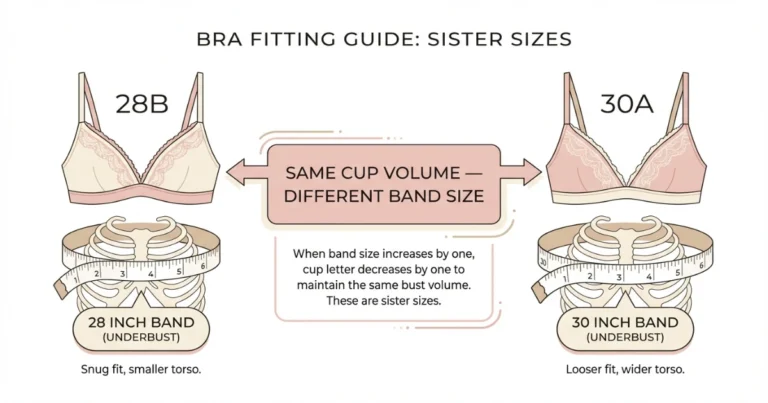
Cup volume scales with band width. A 30D holds the exact same tissue volume as a 28E and a 32C — these are sister sizes. The same letter D on a 36 band holds considerably more physical volume than the D on your 30 band.
A 30D is a genuinely full cup on a narrow frame. On a 25-inch ribcage, it will appear more prominent than a 34D or 36D on a broader body — same letter, very different proportional reality. Neither is wrong; cup letters are ratios, not fixed amounts.
30D Sister Sizes
Same cup volume — different band and letter combinations. Your lifeline when the band is off but the cups fit perfectly.
When the cups feel right but the band does not, sister sizing is the cleanest fix. You can calculate equivalent sizes instantly with the Sister Size Calculator, or read the full Sister Sizes Guide to understand why 28E and 32C can match 30D in cup volume.
Rule: Go up one band = go down one cup letter | Rule: Go down one band = go up one cup letter | Result: Cup volume stays identical
| Smaller Band (tighter) | Same Volume as 30D | Larger Band (looser) |
|---|---|---|
| 28E (28DD UK) | 30D — You | 32C |
| 26F | 30D | 34B |
30D vs Other Sizes
Select a comparison to understand exactly how 30D differs from adjacent sizes.
If you are still stuck between nearby sizes, compare the broader patterns inside our Breast Size Comparison hub. It helps you see how band width, cup depth, and sister sizing change from one label to another.
- Same 30-inch band — identical ribcage fit
- 4-inch cup difference — deeper projection than 30C
- Noticeably more cup volume on the same narrow frame
- If 30D consistently gapes at top, drop back to 30C
- Same 30-inch band anchors both
- 3-inch cup difference — less depth and projection
- Meaningfully less tissue volume than 30D
- If 30C tissue spills over top or sides, you are correctly in 30D
- 4-inch cup projection — full, deep cup volume
- Tissue is contained without overflow at correct size
- If you try 30E, cups will show pooling fabric at top
- 5-inch cup difference — significantly more depth
- Larger cup volume on the same 30-inch ribcage
- 30D spillage over top or armpits = try 30E / 30DD
- Tighter band — superior lift and structural support
- Slightly less absolute cup volume than 32D
- Correct fit for a 25–26 inch ribcage
- 2 inches looser band — designed for a 27–28″ ribcage
- Same D letter but holds slightly more cup volume
- If 30D band is tight only, don’t jump to 32D — try 30E first
- Tighter 30-inch band — better lift, less band movement
- Identical cup volume to 32C — true sister size
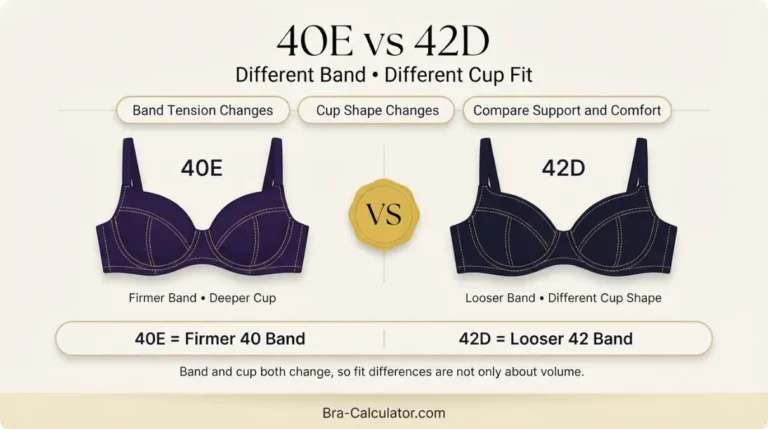
- If 30D band rides up, move to 28E — not 32C — to preserve band support
- 2 inches looser band — designed for a 27–28″ ribcage
- Sister size: exact same cup volume as 30D
- Wearing 32C when 30D is needed = band too loose, support reduced
Best Bra Styles for 30D
What actually works — and one style to skip entirely.

Warner’s Cloud 9 Wireless Bra — Soft Support for D Cup Without Underwire
- Wire-free comfort — no underwire pressure on a narrow 30-inch ribcage
- Deeper flexible cups accommodate D cup volume without gaping or side spillage
- Firm elastic band provides genuine support at this cup depth without metal
- Perfect for extended daily wear, work from home, or low-impact activities
The top choice for 30D. Horizontal underwire lifts from below while the wide-set straps frame the fuller chest. Particularly effective for 30D wearers with wide-set or lower-sitting tissue — lifts without forcing inward.
Seamless molded foam smooths D cup volume under fitted tops without visible seam lines. Look for T-shirt bras with full-depth cups — shallow molded styles will gap or compress at this volume.
At D cup depth, full coverage underwire bras finally earn their keep. They encapsulate all tissue cleanly, prevent side spillage, and provide all-day lift — the style that underperforms at smaller cups becomes genuinely useful at 30D.
Effective but requires a push-up bra designed for D cup depth. Shallow push-up cups will overflow at 30D. Look for styles marketed for C–D cups with deeper angled padding rather than standard foam inserts.
Works well for 30D wearers whose tissue sits closer together. The low center gore accommodates close-set placement naturally. Avoid plunges if your tissue is wide-set — the center gore will float rather than sit flush.
Soft unstructured bralettes lack the cup depth and band firmness to support D cup tissue on a narrow 30-inch frame. You will experience sagging, side migration of tissue, and back bulge within hours of wearing.
Common Fit Problems with 30D
Identify what’s wrong — and what to actually do about it.
The band is too loose to anchor against your ribs. With D cup volume, a loose band creates an enormous support deficit — all weight shifts to shoulder straps, causing neck pain, shoulder grooves, and progressive posture strain over time.
The cup is either too large or wrong for your breast shape. Shallow breast tissue in a deep molded D cup will always produce an air gap — this is a shape mismatch. Also check whether the cup is unnecessarily tall for your tissue projection depth.
Straps are set too far apart for your skeletal shoulder width. At D cup volume, slipping straps cause significant tissue migration throughout the day as the cup loses its positional reference. Tightening alone creates pressure grooves without solving the root issue.
The underwire is too wide for your breast root. At D cup depth this is a common issue — the wire must sit in the inframammary fold and encapsulate all tissue cleanly. Any wire sitting on breast tissue rather than chest wall will cause pain and bruising over time.
The gore is floating away from your sternum. At D cup depth this typically means the cup volume is slightly insufficient, or more commonly that your breast tissue is wide-set and the bra style is wrong — not that the size is wrong.
Overflow at the cup edge or near the armpit means cups are too small for your volume. At D cup depth, armpit spillage is particularly common — the tissue needs to be fully encapsulated by the underwire, which must sit against the chest wall at the side seam.
International Size Conversion
Ordering a European or Australian bra? Your size changes on the label — but your body doesn’t.
Shopping European lingerie? A 65D in France, Germany, or Poland equals your standard 30D. European sizing converts band measurements to centimetres — 30 inches becomes approximately 65 cm. The cup letter D is consistent across most EU markets. An important note for UK shoppers: UK sizing uses DD after D (not E), so the next size up from a UK 30D is a UK 30DD — which equals a US/EU 30E.
At D cup depth, brand fit differences become increasingly significant. Use the Brand Size Decoder and the Global Bra Size Converter to translate 30D accurately across sizing systems. Specialist lingerie brands (Freya, Fantasie, Panache, Natori) typically stock 30D more reliably than mainstream retailers.
Frequently Asked Questions
The questions everyone actually searches — answered directly.
No. A 30D and a 32C are sister sizes — they hold the exact same volume of breast tissue in the cup. The structural difference is the band: 32C features a looser band for a 27–28 inch ribcage, while 30D fits a narrower 25–26 inch torso. Cup capacity is completely identical between them.
Yes — 28E (UK: 28DD) is the direct sister size down from 30D. The cup volume is exactly the same while the band is one size tighter. This is the correct swap if your 30D band rides up your back or feels loose on the tightest hook. Never go up in band to compensate — go down and up in cup instead.
30D is genuinely uncommon in mainstream stores — most retailers don’t stock 30-band bras at all. It is not an unusual body measurement, however. Many women who measure as 30D are incorrectly assigned a 32C or 32D by store fitters simply because their smallest available band starts at 32, not because 30D is an extreme size.
A 30D on a narrow 25–26 inch ribcage looks noticeably full and prominently projected — more visually prominent than the same D cup letter on a 34 or 36-inch frame. The narrow band means D cup tissue occupies a proportionally larger share of the chest wall. On a petite frame, 30D typically reads as a full, well-defined bust.
Yes, but only with the right cup depth. Standard push-up bras designed for A–C cups will overflow at 30D volume. Look specifically for push-up styles labelled for C–D cups with deeper angled foam chambers. The narrow 30 band keeps padding flush against the chest, producing genuine lift — dramatic results are achievable at this size with the right garment.
A 30D typically belongs to someone with a slim, lean-athletic, or petite frame — a ribcage measuring 25–26 inches — carrying a fuller D cup projection of approximately 4 inches above the underbust. Common in lean athletic builds with naturally full breast tissue relative to frame size, and petite adults where tissue volume is proportionally high for ribcage width.
In most bralette and sports bra sizing charts, 30D corresponds to a Small or Small-Medium depending on the brand’s band tightness and cup depth. Because the 30 band is narrow, some brands size the band as XS while the D cup depth requires a Medium equivalent. Always reference the brand’s specific measurement chart rather than relying on S/M/L labelling alone.
Confirm Your True Size
Measurements don’t lie — store fittings often do. Use two quick measurements to get your exact bra size in seconds. No guesswork, no frustration.
Nearby sizes and related guides
- The 30C Bra Size Guide: Measurements, Fit & Sister Sizes
- The 30DD Bra Size Guide: Measurements, Fit & Sister Sizes
- The 28D Bra Size Guide: Measurements, Fit & Sister Sizes
- 32D Bra Size: What It Really Means, How It Fits, and Who It’s For
- The Ultimate 32C Bra Size Guide: Measurements, Fit, Sister Sizes & What It Looks Like (2026)
- The 28DD Bra Size Guide: Measurements, Fit & Sister Sizes
- Sister size bra calculator
- All bra size guides and charts
- Bra size calculator