How to Know If Your Bra Fits: The 10-Step Mirror Test (With Fixes)
If your band creeps up, your straps dig, or you adjust your bra ten times before lunch, here’s the thing to hear first:
This 60-second mirror test checks band, cups, gore and straps — and tells you exactly what to change when something fails.
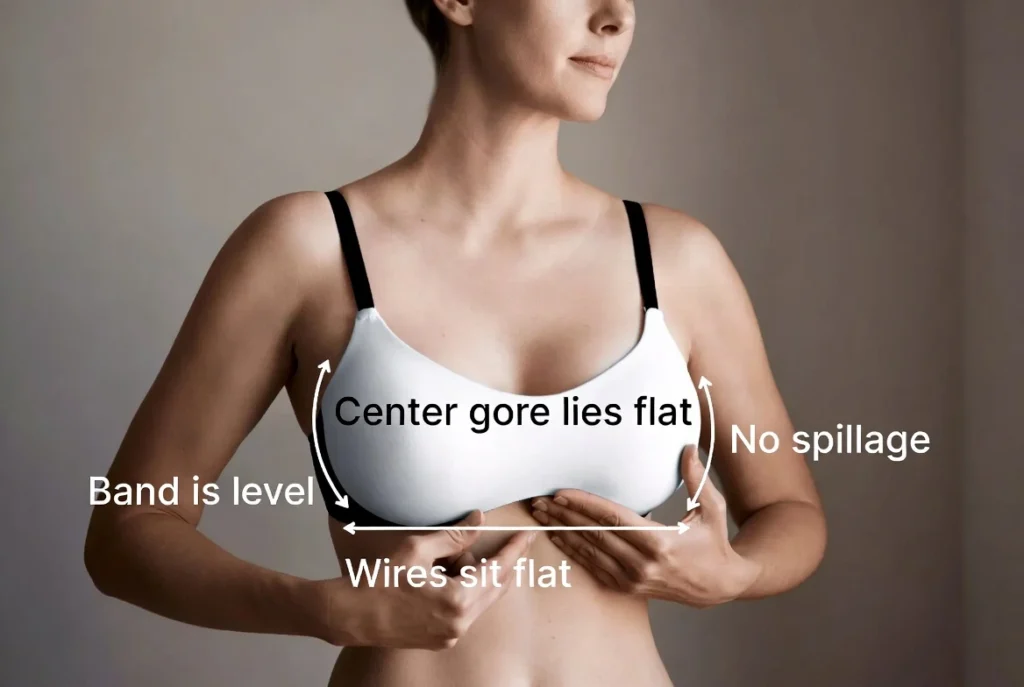
A bra fits when it passes five checks:
- Band: level all the way around, and it stays put when you raise your arms.
- Center gore: lies flat against your breastbone.
- Cups: smooth, with no spillage, gaping or wrinkles.
- Underwire: sits behind all breast tissue, not on it.
- Straps: stay on without digging or doing the lifting.
Fail two or more and you need a different size, style, or both.
The 10-Step Bra Fit Mirror Test
Stand at a mirror in the bra you want to check, on the loosest hook, with shoulders relaxed. Work through each step. Two or more fails = wrong size or style.
Two-Finger Band Test
Slide two fingers under the band at the center back and pull gently.
Raise-Your-Arms Test
Lift both arms straight overhead for three seconds and watch the back band in the mirror.
Scoop & Swoop
Lean forward, reach into each cup, and sweep tissue from under your arm and below the wire forward into the cup. Stand up and look again.
Center Gore Check
Look at the fabric bridge between the cups (the gore).
Strap-Off Test
Slide both straps off your shoulders and let them hang.


Wacoal Back Appeal Underwire Bra
- Wide, smoothing back band designed to stay level.
- Helps with band ride-up and back bulge.
- Choose your corrected band size, not your old one.
As an Amazon Associate we earn from qualifying purchases, at no extra cost to you.
Cup Smoothness Test
Run your hand over both cups and look for wrinkles or a ridge across the top of your breast.
Lean-Forward Gravity Check
Bend forward to about 90° for three seconds.
Side-Spillage Check
Turn sideways with your arms slightly out and check the line from your breast to your underarm.
Breathing Test
Take a full, deep breath in and out.
Profile Test
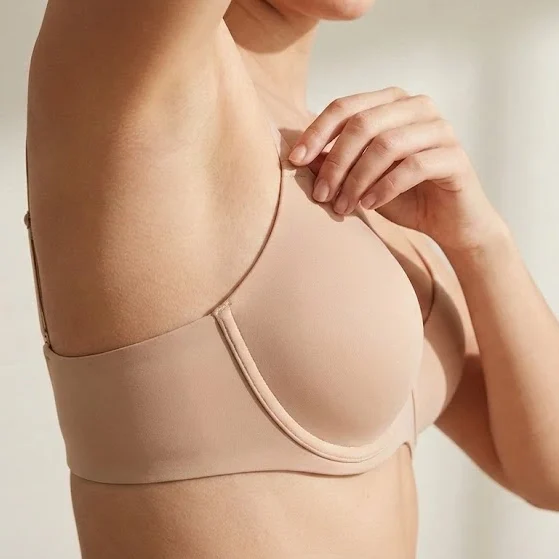
Stand side-on to the mirror and look at your silhouette.
What Your Bra Fit Test Score Means
| Checks failed | Verdict | Next step |
|---|---|---|
| 0–1 | Your bra fits | Rotate your bras and remeasure every 6–12 months. |
| 2–4 | Close, but wrong size or style | Try a sister size or a different cup shape. Diagnose it with the Bra Fit Problem Solver. |
| 5+ | Wrong size | Remeasure and recalculate with the AI Bra Calculator. |
Bra Fit Problems and How to Fix Them
| Problem | Most likely cause | Fix |
|---|---|---|
| Band rides up | Band too big | Down a band, up a cup (sister size) |
| Straps dig in | Band too loose, straps doing the lifting | Firmer band; wider, cushioned straps |
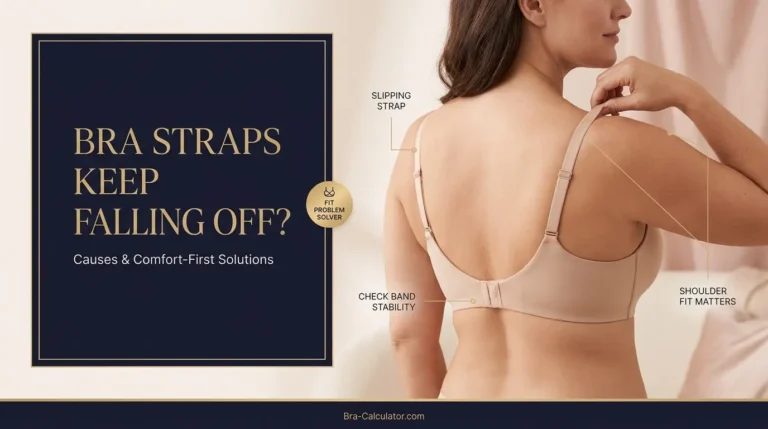
| Straps slip off | Straps set wide, or cup too big | Center-pull or racerback; smaller cup |
| Quad-boob / top spillage | Cup too small | Up one or two cups |
| Gaping at the top | Cup too big, or shape mismatch | Smaller cup, or balconette/plunge |
| Wire pokes the armpit | Wire too wide, or cup too small | Narrower wire or larger cup |
| Pain under the breast | Wire sitting on tissue | Up a cup so the wire sits in the fold |
| Gore floats | Cup too small, or close-set breasts | Larger cup, or a plunge style |
| Tight before your period | Cyclical breast swelling | Keep a stretchy wireless bra in rotation |
Unsure which band-and-cup combinations hold the same volume? The Sister Size Calculator lists them for you.
How Tight Should a Bra Band Be?
A bra band should be firm enough that it stays level when you move, and loose enough that two fingers slide under the back and you can breathe deeply. Buy new bras to fit on the loosest hook, so you can tighten them as the elastic relaxes.

ThirdLove 24/7 Classic T-Shirt Bra
- Half-cup sizes help when you’re between cups.
- Memory foam cups show gaping or spillage clearly.
- A good everyday bra to test a corrected size.
As an Amazon Associate we earn from qualifying purchases, at no extra cost to you.
How a Bra Should Fit: Part-by-Part Guide
Each part of a bra has one job. If you know what “correct” looks like for each part, you can spot a fit problem in seconds.
| Part | Correct fit | Wrong fit | Fix |
|---|---|---|---|
| Band | Level, firm, two fingers fit under the back | Rides up, or you can pull it far from your back | Down a band, up a cup |
| Cups | Smooth, fully filled, edge flush with skin | Spillage, gaping, wrinkles, double-bust ridge | Change cup size or cup shape |
| Center gore | Flat on the breastbone | Floats or digs in | Up a cup, or a lower plunge gore |
| Underwire | Sits in the breast fold, ends behind the tissue at the side | Sits on tissue, pokes the armpit | Up a cup, or a narrower/wider wire |
| Straps | Stay put, one finger fits under them | Dig, leave grooves, slip off | Fix the band first, then adjust or restyle |
| Hooks | Fits firmly on the loosest hook when new | Only fits on the tightest hook | Down a band size |
What a Well-Fitting Bra Feels Like
If you’ve never worn a bra that truly fits, it helps to know what to expect:
- A firm, even hug around your ribcage — secure, never squeezing
- No pressure points under the breast or at the armpit
- Straps you barely notice, with no red grooves at the end of the day
- Posture that feels easier, because your shoulders aren’t carrying the weight
- Freedom to bend, stretch and reach without adjusting
- By evening, you’ve forgotten you’re wearing it
The right bra disappears. The wrong one reminds you it’s there every time you move.
Why Your Bra Size Feels Wrong Even After Measuring
Most women aren’t one fixed size for life. There are five reasons a size that used to fit — or that a calculator gave you — can feel wrong:
| Reason | What happens | What to do |
|---|---|---|
| Brand differences | A 34C in one brand can fit like a 34B or 34D in another | Check each brand’s chart; try your sister size |
| Breast shape | The right volume in the wrong cup shape still gapes or spills | Match the style to your shape (table below) |
| Stretched elastic | An old band loosens, so the bra rides up and loses support | Replace it; don’t size up the band |
| Hormones & cycle | Breasts can swell before your period, in pregnancy, or during menopause | Keep a stretchier bra for those days |
| Weight change | Band and cup can both change with weight gain or loss | Remeasure after any noticeable change |
Understanding sister sizes turns brand-to-brand shopping from guesswork into a system: if the band is wrong but the cup volume feels right, move one band size and adjust the cup the opposite way.
How to Check the Fit of Different Bra Types
| Bra type | Extra fit check | Common mistake |
|---|---|---|
| Sports bra | Jump in place — minimal bounce, band stays down | Buying a size up for comfort, losing support |
| Wireless / bralette | Band stays level; no tissue escapes under the band | Relying on the straps for lift |
| Strapless | Raise arms and twist — the band doesn’t slip | Wearing your usual band; go down one band |
| Push-up | No gap at the top of the cup after scooping | Choosing a bigger cup to fit the padding |
| Nursing | Cups stay flat when clips open; room for fullness changes | Buying before your size stabilizes after birth |
When to Replace a Bra
A bra that once fit can stop fitting. Replace it when:
- It only feels firm on the tightest hook
- The band stretches away from your back with little effort
- Underwire bends, pokes through, or has shifted
- Cups are creased or misshapen after washing
- Straps have lost their stretch and won’t stay adjusted
- It now fails two or more steps of the fit test
Rotate between at least three everyday bras, let each rest a day between wears, and hand wash or use a mesh bag to make the elastic last longer.
Signs Your Bra Doesn’t Fit
- Band rides up by mid-morning
- Red grooves in your shoulders at the end of the day
- Quad-boob or spillage at the top of the cup
- Gaping or wrinkled cups
- Center gore not touching your breastbone
- Underwire digging into your ribs or armpits
- Side spillage toward the armpit
- Adjusting your bra every 20–30 minutes
The Perfect Bra Fit Checklist
- Band level all the way around, even with arms raised
- Gore flat against your breastbone
- Cups smooth, with no spillage or gaps
- Wires sitting behind all breast tissue
- Straps secure without digging
- You can breathe fully
- You forget you’re wearing it by lunchtime
Breast Shape vs Bra Style
If you’re in the right size but a bra still feels wrong, the cause is usually breast shape — not the number on the label.
| Breast shape | Typical fit issue | Best styles |
|---|---|---|
| Full on top | Top edge cuts in | Balconette, stretch-lace top, open-top full coverage |
| Full on bottom | Top of cup gapes | Plunge, seamed 3-part cups |
| Shallow | Cups wrinkle | Shallow balconette, unlined lace, wireless |
| Projected | Spills while gore floats | Deep seamed cups, narrow wires |
| East-west | Tissue drifts outward | Side-support panels, front closure |
| Close-set | Gore digs or floats | Low or narrow-gore plunge |
| Wide-set | Gap in the center | Wide wires, balconette |
| Asymmetrical | One cup gaps | Fit the larger side; removable pads |
For more style matches, see Best Bra Types for Every Breast Shape.
How to Remeasure Your Bra Size at Home
Failing the test? Measure again with a soft tape. Skip the old “add 4 inches” band method — it gives a band that’s too loose.
- Snug underbust: Exhale and measure firmly directly under your breasts. Round to the nearest whole inch — that’s your band.
- Standing bust: Measure loosely around the fullest point, with arms relaxed.
- Leaning bust: Bend forward 90° and measure again. This matters most for fuller or softer breasts.
- Calculate: Average your two bust numbers, then subtract the band. Each inch is one cup.
Example: 30″ underbust, 37″ average bust → 7″ → US 30G / UK 30F.

Warner’s Cloud 9 Wireless Bra
- Wire-free, so nothing presses under the breast.
- Soft cups that give with cyclical swelling.
- A comfort bra to keep in your rotation.
As an Amazon Associate we earn from qualifying purchases, at no extra cost to you.
Bra Fit FAQs
How do I know if my bra band is too big?
Your band is too big if you can pull it more than about an inch from your back, or if it rides up when you raise your arms. Go down one band size and up one cup — for example, 36C to 34D — to keep the same cup volume.
How tight should a bra band be?
Firm enough to stay level when you move, but loose enough that two fingers slide under the back and you can breathe deeply. A new bra should fit on the loosest hook, so you can tighten it as the elastic stretches.
Why does my bra hurt under my breasts?
Pain under the breast usually means the cup is too small, so the underwire sits on breast tissue instead of in the fold beneath it. Going up one cup size normally moves the wire into the right place.
Why do my bra straps keep falling down?
Straps slip when they’re set too wide for your shoulders, when the cup is too big, or when the band has stretched out. Try a center-pull or racerback style, shorten the straps, or go down a cup.
What if one breast is bigger than the other?
Breast asymmetry is very common. Fit the bra to the larger breast, then fill the gap on the smaller side with a removable pad or a stretch-lace cup rather than squeezing the larger side.
Can my bra size change during my period?
Yes. Many women notice breast swelling before their period that can make cups feel up to a size tighter. Keep a stretchy wireless bra in rotation for those days.
How often should I replace my bras?
A bra worn often usually lasts 6–12 months. Replace it when it feels loose on the tightest hook, the underwire pokes through, or the cups lose their shape — and remeasure, since your size may have changed.
Where should the underwire sit?
The underwire should sit in the fold under your breast and end behind the breast tissue at the side, against your ribcage. If it sits on breast tissue or pokes your armpit, the cup is too small or the wire is the wrong width.
How do I know if I need a bigger cup size?
You need a bigger cup if tissue spills over the top or sides, the center gore doesn’t touch your breastbone, the underwire sits on breast tissue, or there’s a ridge across the top of the cup. Go up one cup and keep the same band.
How do I know if my cup is too big?
The cup is too big if it wrinkles, gapes, or collapses when you move, even after you scoop your tissue in. Go down one cup size — or, if the gap is only at the top, try a balconette or plunge style instead.
Is it normal for a new bra to feel tight?
A new bra should feel firm on the loosest hook but never painful. It shouldn’t restrict your breathing or leave deep marks. Elastic relaxes with wear, which is why you move to tighter hooks over time.
Should my bra leave red marks?
Faint marks from the band after a full day can be normal, but deep grooves, welts or pain are not. Deep strap grooves usually mean the band is too loose and the straps are carrying the weight.
How many fingers should fit under a bra strap?
About one finger should slide comfortably under each strap. If straps need to be pulled tight to hold you up, the band is too loose — fix the band before tightening the straps.
The Bottom Line
Your body isn’t hard to fit, and daily discomfort isn’t something you have to accept. Do the ten-step test in front of a mirror. If your bra fails two or more checks, the fix is usually simple: a firmer band, a different cup size, or a style that matches your shape.
Failed Two or More Checks?
Get your correct size, sister sizes and international conversions in under 60 seconds — free.
Find My True Size →Note: Sizing varies by brand and country. This guide follows standard professional fitting checks and isn’t a substitute for an in-person fitting. If you have persistent breast pain, a new lump or skin changes, see a doctor.