34D vs 36C: What’s the Real Difference?
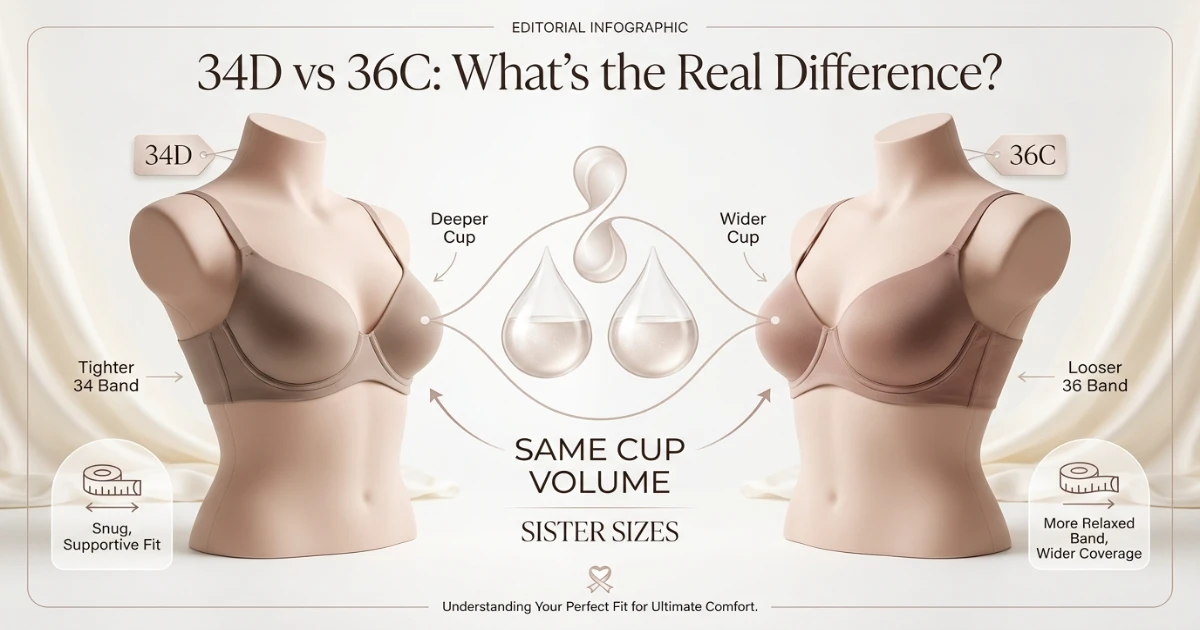
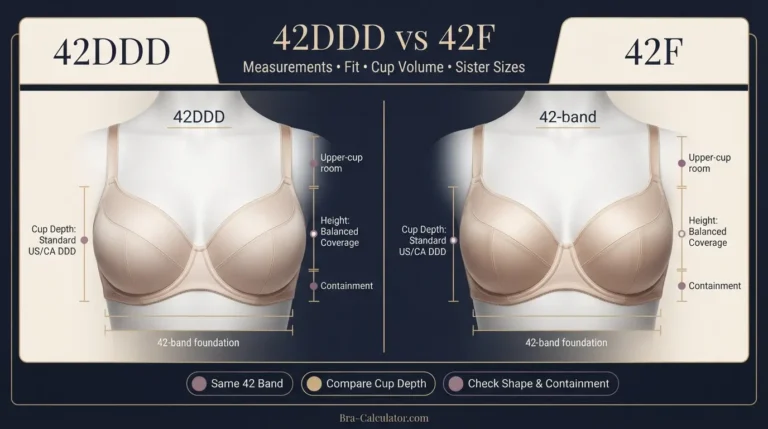
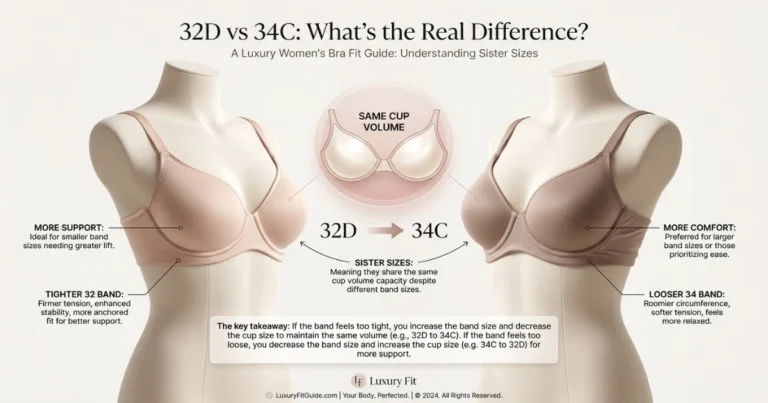
A 34D and a 36C are sister sizes: they are designed to provide a very similar nominal cup volume on different band sizes. The 34D has the firmer, smaller band; the 36C gives more ribcage room. If both look close in the cups, the better choice is usually the one whose band stays level and comfortably secure during normal movement.
⚡ Key Takeaways
- Sister-size volume, different band: 34D and 36C are designed around comparable cup capacity, while band tension and bra geometry change.
- The band provides most of the structural support: If it is too loose, the straps may need more tension and can feel less comfortable over time.
- Your snug underbust is the starting point: Around 31–33 inches commonly points toward a 34 band, while around 33–35 inches often points toward a 36 band. Brand stretch can shift the final choice.
- Cup shape matters beyond volume: Depending on the brand and style, the 36C may scale wider while the 34D may feel deeper or more projected.
- Band ride-up is the clearest signal: If your band creeps up your back by afternoon, the band is too loose — try sizing down.
- New bras should fit on the loosest hook: If you already need the tightest hook for support, the band is probably too large or too stretchy.
- Check out our full bra size comparison guide to explore how dozens of sizes stack up.
Choose the fit signs you notice in the band, cups, center and straps. We’ll turn them into a practical next step for 34D.
Private fit check — your answers stay in your browser and are used only for this on-page guidance. Nothing is stored or submitted.
Why 34D and 36C Are So Often Confused
If you’ve ever grabbed both sizes off the rack, tried them on, and walked out of the fitting room with a shrug and the wrong one — you are not alone. The confusion happens because these two sizes share the same cup volume. That’s the foundation of sister sizing, and once you understand it, a lot of fit mysteries start to untangle.
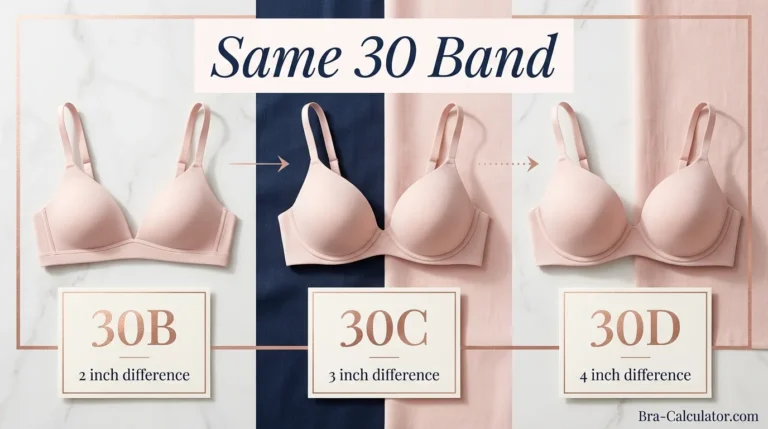
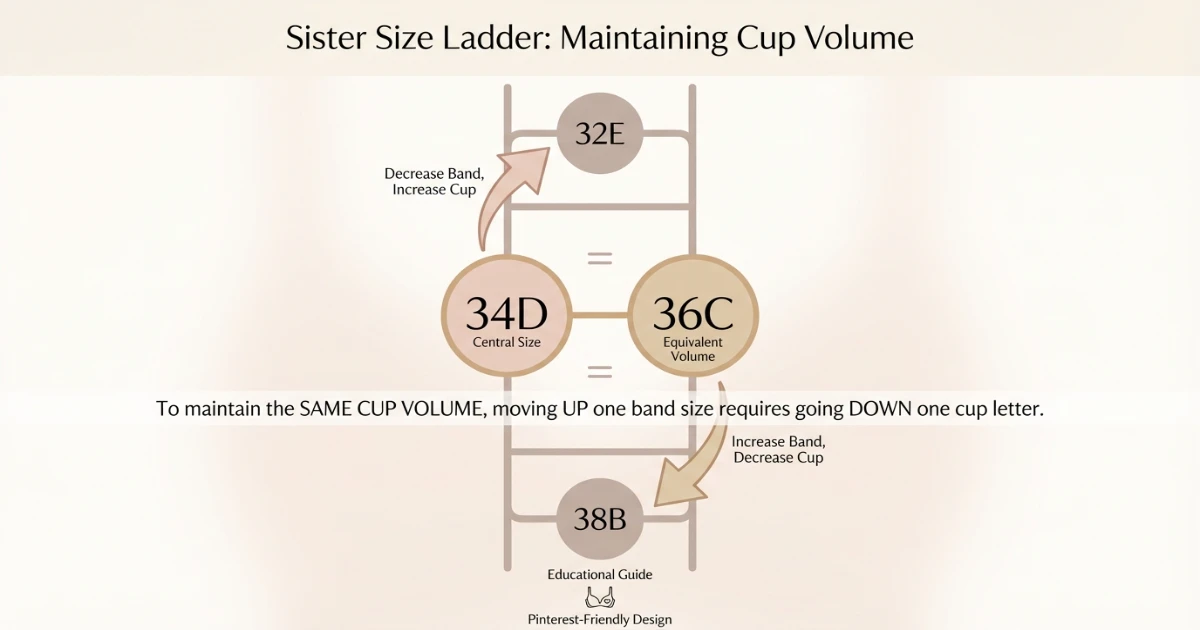
Sister sizes are nearby bra sizes designed to keep cup capacity broadly comparable while changing the band. When the band goes up one standard step, the cup goes down one step; when the band goes down, the cup goes up. That is why 34D, 36C, and 38B belong to the same sister-size chain even though their band tension and geometry differ.
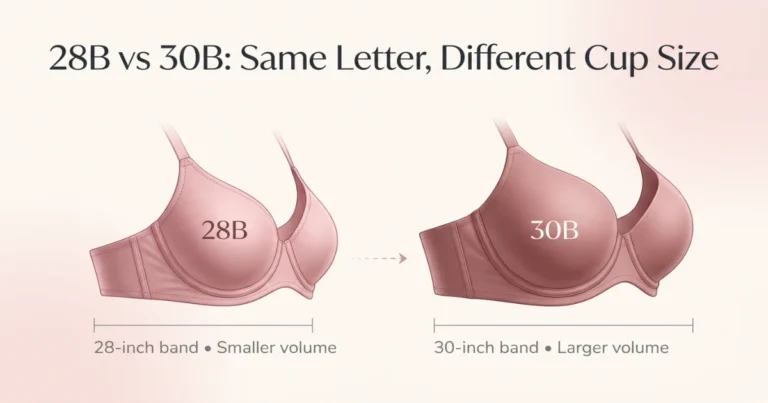
The important part is that comparable cup capacity does not guarantee an identical fit. In the same bra pattern, sister sizes can scale differently in wire width, cup depth, cup height, and strap position. Those changes can matter if you are projected, shallow, close-set, wide-rooted, or narrow-rooted. You can explore these variables in our breast size comparison hub.
34D vs 36C: The Measurement Breakdown
Numbers first, because this is where the decision actually lives.
Underbust (band size)
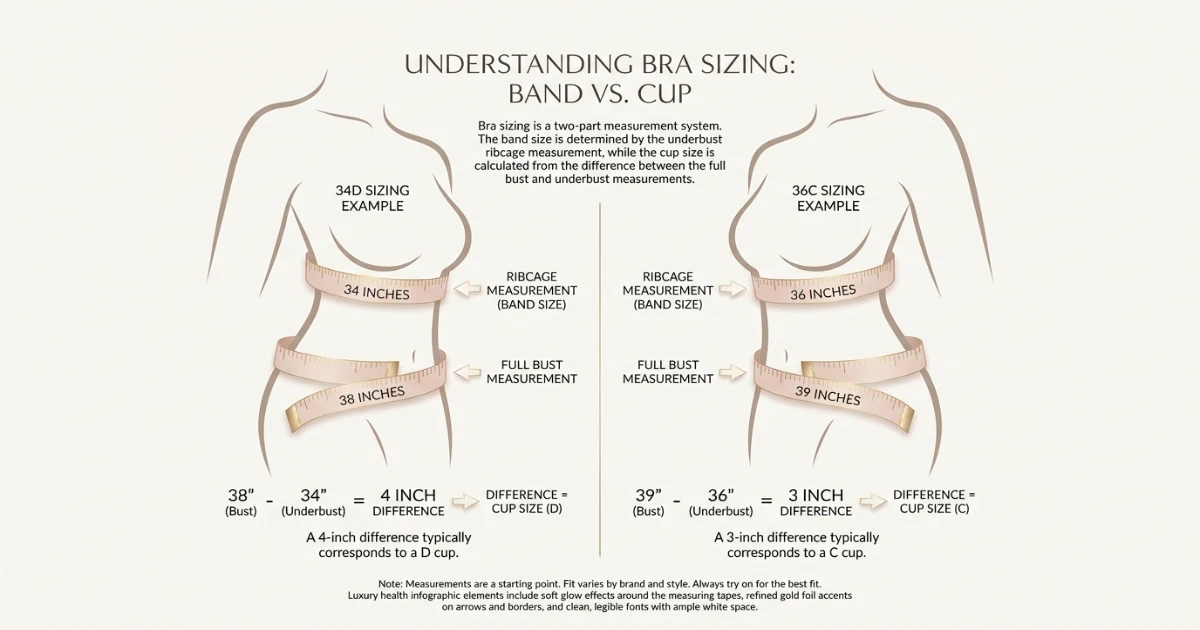
Bra-band formulas vary by brand and fitting method, so the tape measurement is a starting point rather than a universal conversion rule. For this comparison, use your snug underbust as the anchor and then confirm the result by how the band behaves in the same bra style:
- 34 band: a common starting range is roughly 31–33 inches (79–84 cm) snug underbust
- 36 band: a common starting range is roughly 33–35 inches (84–89 cm) snug underbust
If you are near the overlap around 33 inches, test both sizes in the same bra model and start each new bra on the loosest hook. Choose the band that stays level without pinching, riding up, or requiring overtightened straps. Use our underbust measurement guide before you shop.
Bust (cup size)
Cup letters are proportional to band size, so the letter cannot be judged on its own. The bust-to-underbust difference helps estimate cup progression, but the final cup depends on the band you are pairing it with:
- On the same band, moving from C to D adds one cup step.
- When you move from a 34 band to a 36 band and want similar cup capacity, moving from D to C is the sister-size adjustment.
That is why 34D → 36C is a standard sister-size move: one band step larger, one cup step smaller. The cup capacity stays broadly comparable, while band tension, wire position, strap spacing, and cup geometry can feel different.
Fit Differences You Can Actually Feel
Band tension
This is the big one. A properly fitting band should feel snug — not painful, not gasping — on the loosest hook when new. You should be able to slip two fingers underneath, but it shouldn’t slide around when you move. A 34D delivers noticeably more tension than a 36C on the same body.
If a 36C rides up and you keep tightening the straps to regain lift, the band is probably not anchoring firmly enough. The better test is to loosen the straps to a normal setting and see whether the band stays level on its own. If it does not, try the 34D sister size.
Band ride-up
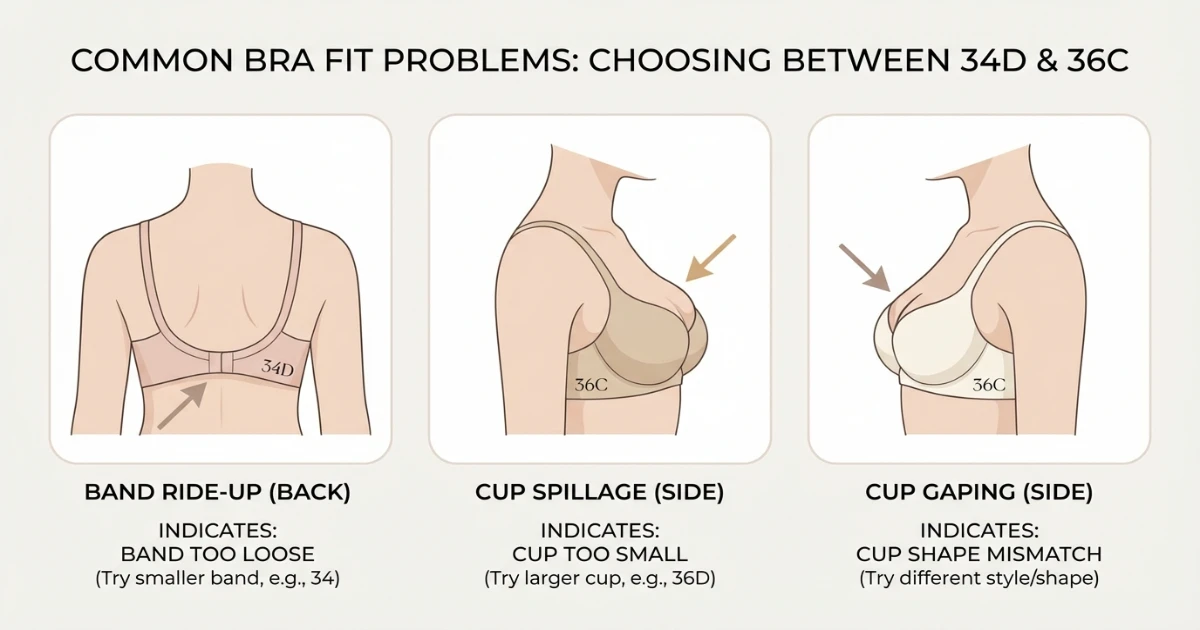
If your band rides up your back by mid-afternoon — so that the back sits higher than the underwire at the front — the band is too loose. This is one of the most reliable signs that you need to try a 34 band instead of a 36. Our band ride-up troubleshooting guide walks through exactly why this happens and how to fix it.
Gore tack and underwire placement
The gore is the center panel between the cups. In a well-fitting bra, the gore should lie flat against your sternum — this is called “gore tack.” In a too-large band, the gore often floats away from your body because the band isn’t pulling the cups inward firmly enough. If you’re in a 36C and the gore pokes away from your chest, a 34D might give you better projection and contact.
Side tissue and migration
Breast tissue doesn’t just sit at the front. Tissue along the sides and underarm area is yours — it belongs in the cups. A snugger 34 band tends to anchor the underwire more firmly, which helps scoop side tissue into the cups. If you’re spilling at the sides or underarm, that’s volume and tissue that’s being left behind, not a sign your cup is too small.
Cup Volume: Are 34D and 36C Really the Same?
In sister-size logic, they are treated as approximately equivalent in cup capacity. Exact volume and shape still vary by brand, wire, fabric, and pattern, which is why the same person can prefer one size in one bra and the other size in another. This is the core idea behind sister sizing.
But here’s where the “same” part gets complicated in real life:
- Cup width: A 36C often scales slightly wider in a given bra pattern. If you are close-set or narrow-rooted, that can change where the wire lands even when capacity is similar.
- Cup depth: A 34D may feel deeper or more projected in some styles. Projected shapes often notice this difference more than shallow shapes do.
- Underwire width: Wire width can change with sister sizing. The correct wire should surround the breast root without sitting on breast tissue or extending uncomfortably far onto the ribcage.
This is why two women with technically identical measurements can both try a 34D and a 36C and come to completely opposite conclusions. See our cup volume comparison tool for more.
| Feature | 34D | 36C |
|---|---|---|
| Band feel | Firm, snug; strong anchor | Looser, more relaxed around the ribcage |
| Support tendency | Firmer anchor if a 34 band matches your ribcage | More relaxed anchor if a 36 band matches your ribcage |
| Cup geometry | May feel narrower/deeper in the same style | May feel wider/shallower in the same style |
| Common starting range | About 31–33″ snug underbust | About 33–35″ snug underbust |
| Best when | The 36 band rides up or needs overtightened straps | The 34 band pinches or feels restrictive in the same style |
| Signs it’s wrong | Band leaves deep red marks; hard to breathe; cup gapes at top | Band rides up; straps dig in; underwire sits on tissue |
Who Should Choose 34D vs Who Should Choose 36C
✓ Choose 34D if…
- Your underbust measures 31–33 inches (snug)
- Your current band rides up your back during the day
- You find yourself tightening straps for support
- Your breasts are projected or narrow-rooted
- The gore on a 36C floats away from your chest
- You need a strapless bra with serious hold
- You feel the 36C underwire sitting on soft side tissue
✓ Choose 36C if…
- Your underbust measures 33–35 inches (snug)
- The 34D band leaves red marks or feels restrictive after an hour
- You have a wider breast root or fuller-on-the-sides shape
- You feel the 34D underwire digging in at the sides
- The 34D cup creates spillage at the top or sides
- You have a history of breathing discomfort in snug bands
- You feel the 34 band is hard to fasten even on the loosest hook
 Best for gore tack & projection
Full-coverage, two-ply seamless cups with underwire — useful for comparing band stability and center-gore contact in nearby sister sizes. Check the live listing for current size and color availability.
Check Price on Amazon → Best for wider ribcage comfort
Smoothing side and back panels with a gentler minimizer cut — a good option if 36C’s wider, more relaxed band is the better call for your ribcage and side tissue.
Check Price on Amazon →As an Amazon Associate, Bra-Calculator.com earns from qualifying purchases. Sizes, colors, and prices shown on Amazon may vary from availability at time of publishing.
How to Decide in 3 Minutes
Work through these in order. Stop as soon as you get a clear answer.
- 1Measure your snug underbust. Around 31–33 inches → start by testing a 34 band. Around 33–35 inches → start by testing a 36 band. Near the overlap, compare both sizes in the same bra. Use our bra size calculator for a full result.
- 2Put on your current bra and check the band level. Stand sideways in a mirror. Is the back of the band level with the front underwire — or riding up toward your shoulder blades?
- 3Use the two-finger test as a comfort check. The band should feel secure without painful pressure and should not pull far away from the body. This is a quick fit clue, not a sizing formula by itself.
- 4Check the gore. Press gently on the center panel between the cups. Does it lie flat against your sternum?
- 5Scoop and swoop, then check cups. Lean forward, scoop all tissue forward. Any overflow at the top or sides? Gaps at the top?
- 6Wear your test bra for 30 minutes. Walk around. Has the band migrated up your back, or are you pulling at the underwire?
- 7Check strap adjustment. If straps are maxed out and you still need more support, that’s a band-too-loose problem, not a strap problem.
Common Fit Mistakes
💡 Pro tip: If the band feels too tight in 34D but you know your underbust is small, the problem may be the style rather than the size. Some brands cut their 34 bands shorter than others. Try the same size in a different brand before sizing up.
Sister Sizes to Test Around 34D / 36C
If neither 34D nor 36C feels quite right, here’s the full sister size ladder centered on these two sizes. Each step up the band comes with one step down in cup letter — same volume, different fit geometry.
The 32DD/E is worth trying if the 34D still rides up despite correct strap adjustment. The 38B is the looser-band direction and is worth testing only when the 36C band is genuinely too firm. Visit our sister size chart for the full interactive version.

People Also Ask

Find Your Perfect Fit — Not Just a Close One
The 34D vs 36C question is really a question about your ribcage, your breast shape, and how you want your bra to feel at 6pm — not just 9am. Use the checklist above, watch your band position throughout the day, and trust the measurement over the label.
Use the Free Bra Size Calculator