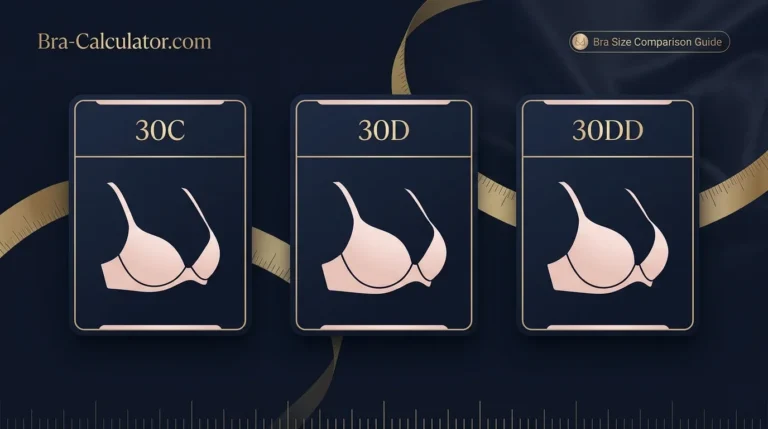
Sister Size Guide for Nursing Bras: Fit Without Guessing

Choose the fit signs you notice in the band, cups, center and straps. We’ll use them to suggest the most useful next step.
Private fit check — your answers stay in your browser and are used only for this on-page guidance. Nothing is stored or submitted.
In this guide
- What a nursing bra sister size really means
- The sister-size rule
- Core sister-size chart
- How to use sister sizes while nursing
- Why sister sizing does not fix engorgement
- Band problem or cup-volume problem?
- Worked nursing fit examples
- Brand and cup-letter differences
- Nursing pads and cup room
- When to remeasure instead
- Asymmetry and one-sided fullness
- Nursing bra examples
- Frequently asked questions
What a Sister Size Means in a Nursing Bra
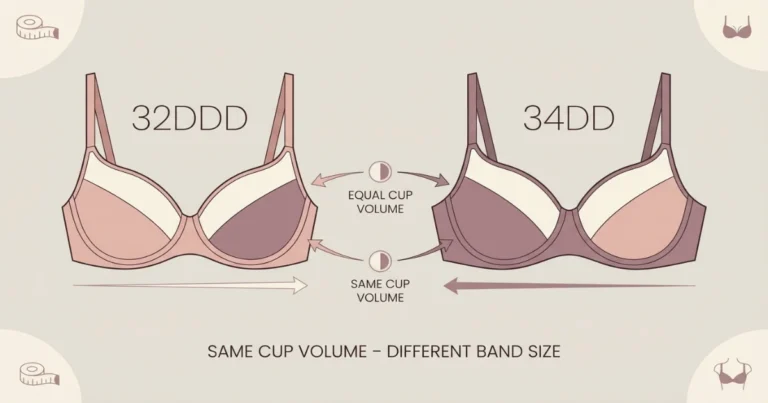
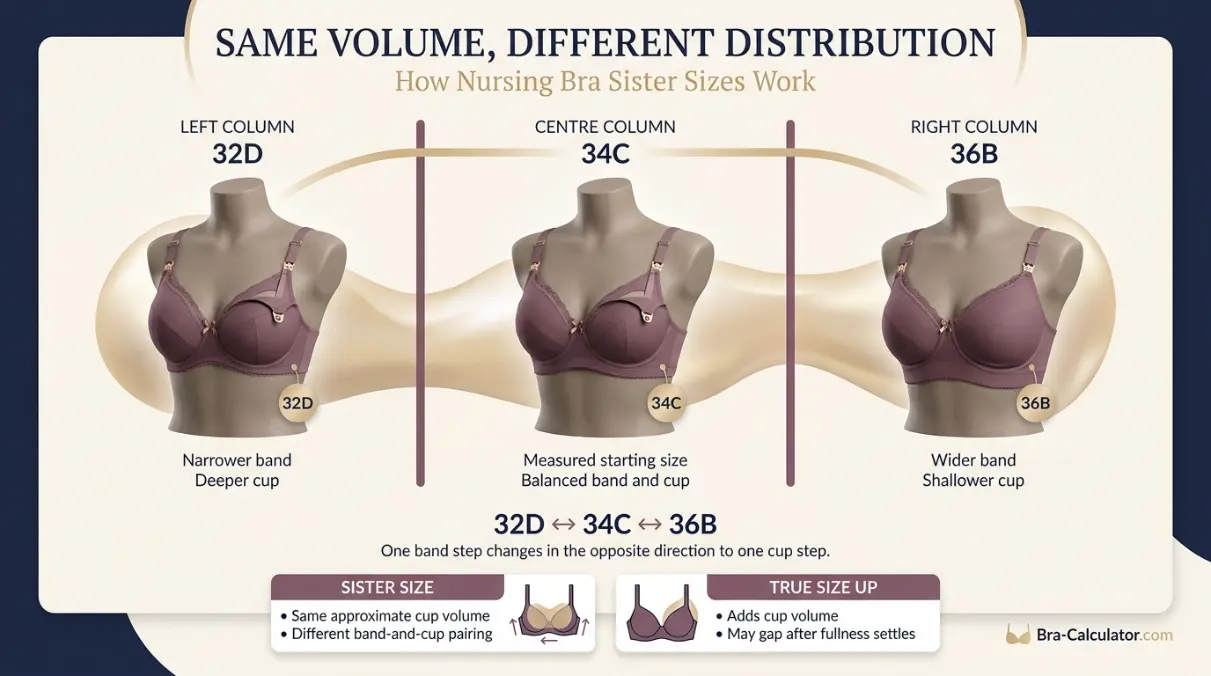
A sister size is a nearby bra size with a different band number and cup letter but approximately the same cup capacity. The classic example is 34C, 32D and 36B. The labels look different, yet they are designed to hold a similar breast volume while the band length changes.
That distinction matters during nursing because a lot of fit complaints happen at the same time: ribs may still be settling postpartum, breast fullness can vary through the day, nursing pads add bulk, and different bras stretch differently. Sister sizing is useful only when you separate those variables instead of treating every tight feeling as “I need a bigger bra.”
The simplest way to think about it is this: sister sizing changes the frame around roughly the same cup volume. It is a band-fit tool first.
The Golden Rule: Move the Band and Cup in Opposite Directions
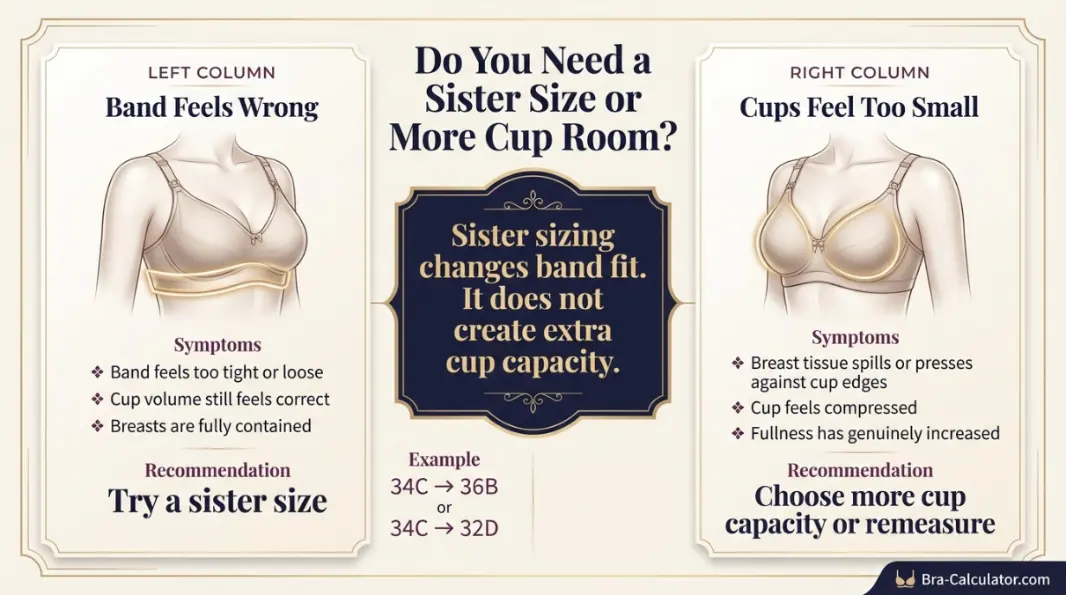
34C → 36B
34C → 32D
In common US and UK band sizing, the nearest band step usually changes by two inches: 32 → 34 → 36 → 38. When you move one band step, move one cup step in the opposite direction to stay in the same sister-size family.
Core Sister Size Chart for Common Nursing Bra Sizes
| Starting size | Firmer-band sister | Roomier-band sister | Use it when… |
|---|---|---|---|
| 32B | 30C | 34A | The B-cup volume feels right but the band does not. |
| 32C | 30D | 34B | You need a different ribcage fit without adding cup capacity. |
| 34B | 32C | 36A | The cups already contain breast tissue comfortably. |
| 34C | 32D | 36B | Classic sister-size example for band troubleshooting. |
| 34D | 32DD | 36C | Your D cup fits but the 34 band is the problem. |
| 36C | 34D | 38B | You want a firmer or roomier anchor with similar cup room. |
| 36D | 34DD | 38C | The cup volume is right but the band tension is not. |
| 38C | 36D | 40B | You need to change band length, not breast volume. |
For DD+ sizes, do not guess the next letter unless you know the system. For example, sister-size cup labels can differ between US and UK brands even when the underlying cup step is equivalent. That is why the calculator is safer for larger cup ranges.
How Sister Sizing Actually Helps During Nursing
Nursing makes sister sizing useful in a narrower, more practical way than the old advice on this page suggested. The goal is not to own one “full-breast size” and one “empty-breast size” that magically hold the same volume. If breast volume truly changes enough to make the cup too small, you need more cup room. Sister sizing cannot create that room.
Where it can help is when the cup already fits and the band becomes the part you want to fine-tune. That can happen after pregnancy as ribcage measurements settle, when a specific nursing bra runs firm, when a long-line band feels restrictive, or when you move between a stretchier wireless bra and a more structured band-and-cup style.
Sister sizing makes sense when…
- The cups contain your breast tissue without persistent spilling or empty space.
- The band alone feels too tight or rides up because it is too loose.
- You are between two band tensions in the same style.
- A brand is known to feel firmer or stretchier than the one you usually wear.
- Your ribcage fit has changed but your approximate cup volume has not.
It is probably the wrong tool when…
- You have visible cup spillage before a feed.
- The cup is being pushed away from the chest by fullness.
- Nursing pads make the cup edge cut in.
- Both the band and cups feel wrong.
- You are repeatedly changing sister sizes because your baseline size itself is outdated.
Why Sister Sizing Does Not Fix True Engorgement
This is the most important correction to the previous version of this guide. Engorgement means the breasts are overly full and can feel hard, tight and painful. If your 34C cups are genuinely too small because your breasts are fuller, moving to 36B does not add meaningful cup capacity—it keeps you in roughly the same volume family while loosening the band.
That may make the ribcage feel less restricted, but it does not solve a cup-volume shortage. In that situation, a larger cup on the same band, a more flexible nursing bra, or a fresh measurement is more logical. If the breast is painful, hot, red or associated with fever or worsening symptoms, treat that as a health question rather than a bra-math problem.
Band Problem or Cup-Volume Problem? Diagnose This First
| What you notice | Most likely issue | Best first move |
|---|---|---|
| Cups fit, but band digs into the ribcage | Band may be too firm | Try one sister size up: larger band, smaller cup step. |
| Cups fit, but band rides up or feels loose on the tightest hook | Band may be too loose | Try one sister size down: smaller band, larger cup step. |
| Band feels fine, but breast tissue spills over the cup | Not enough cup volume or wrong cup shape | Increase cup capacity or try a deeper/stretchier cup. Do not sister size first. |
| Band feels fine, but cups gape after feeds | Temporary fullness change or shape mismatch | Try stretch lace, removable inserts or a more forgiving cup before changing the band. |
| Both band and cups feel too tight | Baseline size may be too small | Remeasure. A sister size preserves volume and will not correct both problems. |
| Fit swings sharply across the day | Nursing-related volume change | Use a flexible nursing style and size for the fuller state without pressure. |
Worked Examples: Using Sister Sizes Without Overcorrecting
Example 1: 34C cups fit, but the band feels too firm
You like the cup depth and there is no spilling, but by midday the 34 band feels uncomfortably firm around the ribs. Try 36B. You gain band length while keeping cup capacity in the same neighborhood. If 36B feels comfortable and the cups still fit, sister sizing did exactly what it is meant to do.
Example 2: 34C band fits, but the cups are too small before a feed
This is not a sister-size problem. A 36B gives you a roomier band but approximately the same cup volume. If the 34 band already feels correct, keep the band and add cup room or choose a nursing bra with more stretch. The exact next size depends on the brand and sizing system.
Example 3: 36D cups fit, but the band rides up
Try 34DD. The smaller band gives a firmer anchor while the cup capacity stays close. This is especially useful if the 36 band is already on its tightest hook and still feels unstable.
Example 4: Your regular size changed after several postpartum months
If you started postpartum in 36D but now 34DD consistently feels better every day, that is no longer just an occasional sister-size workaround. It is evidence that your practical everyday band may have changed. Remeasure and treat the better-fitting size as a new baseline instead of mentally labeling it as a temporary alternative forever.
Brand-to-Brand Variation: Why Sister Sizes Are a Starting Point, Not a Guarantee
Equivalent cup volume does not mean two bras will feel identical. A nursing bra with a very stretchy seamless band can feel looser than a structured full-bust nursing bra with the same number on the label. Wire width, cup depth, gore height, strap placement, elastic recovery and fabric stretch all affect the result.
Cup lettering also changes by sizing system. UK brands typically progress through DD, E, F, FF, G and GG, while US brands may use DD, DDD/F, G, H and other sequences. That matters because “go up one cup” means one step in that brand’s actual sequence, not simply the next alphabet letter.
For this reason, use sister sizing most confidently within the same brand and style. When changing brands, start with your current size family, then use the brand chart and try-on feedback to refine.
Nursing Pads Can Change Cup Fit—but They Do Not Change Sister-Size Math
Nursing pads take up physical space inside the cup. Thin disposable pads may make very little difference; thicker reusable pads can make a close-fitting cup feel noticeably snugger. The right response depends on what changes.
If the band still feels correct but the cup edge starts cutting in with pads, you need a little more cup room or a more flexible cup—not a looser band by default. If both the pads and a firm band are making the bra uncomfortable, then you may need to address both variables rather than expecting one sister-size move to solve everything.
Removable foam inserts can also affect the equation. Some seamless nursing bras let you remove their inserts, which can free up a small amount of cup space without changing size at all.
When to Stop Sister Sizing and Remeasure
Sister sizing works best as a fine-tuning tool. It becomes less useful when you are using it to avoid admitting that your baseline size has changed.
Remeasure if both band and cup feel wrong
A sister size keeps approximately the same cup capacity, so it cannot solve a true change in both ribcage fit and breast volume.
Remeasure if the “alternative” is now your everyday bra
If you reach for the same sister size every morning for weeks because it fits better, that size may simply be your current starting point.
Remeasure after a meaningful postpartum change
Changes in feeding frequency, weaning, weight or ribcage recovery can all make an older measurement less useful.
Remeasure before buying several structured bras
A quick check is cheaper than ordering a full wardrobe around a size family that is still changing.
Sister Sizing and Breast Asymmetry While Nursing
It is common for one breast to be somewhat larger than the other, and nursing can make that difference more obvious at certain times. Sister sizing does not solve asymmetry because it changes the band for both breasts while keeping similar overall cup capacity.
Fit the larger or fuller side first so that breast tissue is not compressed. Then use removable padding, a flexible upper cup or an adjustable insert on the smaller side if needed. A stretch-lace cup often handles asymmetry more gracefully than a rigid molded cup.
If one-sided fullness is new, painful, hot, red or accompanied by fever or feeling unwell, that is outside normal bra troubleshooting and deserves appropriate clinical or lactation advice.
Nursing Bra Examples for Sister-Size and Band-Fit Troubleshooting
These are examples of three different construction approaches: a structured full-bust underwire, a non-wired cup-sized full-bust bra, and a stretchy seamless nursing bra. They are useful for understanding why the same size can behave differently across construction types. Product details and availability can change, so check the current listing and size chart before ordering.

Elomi Molly Nursing Bra
Elomi currently lists Molly as a banded underwire nursing bra with three-piece cups, side support, stretch lace at the top cup and an internal nursing sling. That makes band tension and cup shape easier to diagnose separately than in a very stretchy alpha-sized bra.
Check before buying: An underwire should surround breast tissue without localized pressure. If fullness or tenderness changes the fit, recheck before wearing it for long periods.
View Options on AmazonAffiliate link · Availability and price can change
Panache Sophie Nursing Bra
Current retailer listings still show Sophie as a non-wired, unlined nursing bra in UK cup sizing with drop-down cups and multiple hook positions. A cup-sized design can be useful if you want clearer band-and-cup adjustments without moving to a seamless alpha size.
Check before buying: Confirm UK-to-US cup conversion and live stock before ordering. Above DD, cup letters are not interchangeable between systems.
View Options on AmazonAffiliate link · Availability and price can change
Bravado Designs Body Silk Seamless Nursing Bra
Bravado currently describes Body Silk as soft, seamless and wire-free with 360-degree stretch and knit-in support zones. Its adaptive construction shows why some nursing bras handle day-to-day fullness changes through fabric stretch rather than traditional sister sizing.
Check before buying: Use Bravado’s newest size chart; the current range includes Full Cup and Extended Cup options, and some listings are marked final sale.
View Options on AmazonAffiliate link · Availability and price can changeKey Takeaways
- A sister size changes band length while keeping approximately the same cup capacity.
- Use it when the cup volume is already close and the band is the part that needs adjustment.
- Do not use sister sizing as a substitute for more cup room during true engorgement or obvious spillage.
- For a roomier band, go up one band and down one cup step; for a firmer band, do the opposite.
- Above DD, follow the cup sequence of the same brand or sizing system instead of guessing letters.
- If both band and cups feel wrong—or the sister size has become your everyday size—remeasure.
📐 Want the exact sister sizes for your current bra?
Frequently Asked Questions
- What is a sister size in a nursing bra?
- A sister size is a nearby band-and-cup combination with approximately the same cup capacity. Move the band and cup in opposite directions: larger band + smaller cup step, or smaller band + larger cup step.
- Can sister sizing fix nursing engorgement?
- Not if you genuinely need more cup volume. Sister sizing keeps cup capacity roughly similar, so it is best for a band-fit issue. If cups are spilling because you are fuller, add cup room or use a more flexible bra.
- What is the sister size of 34C?
- The nearest sister sizes are 32D for a firmer band and 36B for a roomier band.
- Should I sister size up if my nursing bra band feels tight?
- If the cups fit and only the band is too firm, yes: move to the next larger band and one cup step smaller. If the cups are also tight, remeasure or add cup capacity instead.
- Do sister sizes fit exactly the same?
- No. Cup capacity may be similar, but band tension, wire width, cup depth, strap placement and overall support can feel different.
- Can I use a sister size in a different brand?
- Use it as a starting point. Brand construction and cup-letter systems vary, so check the new brand’s chart and fit rather than assuming the label will transfer perfectly.
- Do nursing pads affect which size I need?
- They can. Pads take up space inside the cup. If the band still fits but the cup becomes too tight, choose more cup capacity or a stretchier cup instead of automatically changing the band.
- When should I remeasure instead of sister sizing?
- Remeasure when both band and cups feel wrong, when postpartum changes have been substantial, or when the sister size has become the bra you consistently prefer.
- Does sister sizing help with breast asymmetry?
- Not directly. Fit the larger side first, then use removable padding or a flexible cup on the smaller side if needed.
Editorial Sources & Review Notes
This revision separates ordinary sister-size fitting from true nursing-related breast-volume changes. The previous version incorrectly presented sister sizing as a way to accommodate engorgement while preserving the same cup volume.
- Bravissimo: Bra Sister Sizes — equivalent cup-volume principle and band/cup adjustment direction.
- NHS: Mastitis — guidance to avoid tight, restrictive bras or clothing that put pressure on the breasts.
- Elomi: Molly Nursing Bra — current structured nursing-bra construction and fit features.
- Bravado Designs: Body Silk Seamless Nursing Bra — current 360-degree stretch construction and size-range information.
Amelia
Founder & CEO of Bra-Calculator.com, former lingerie buyer and bra fit specialist. Amelia reviews fit guidance for practical sizing logic, garment construction and clear separation between bra-fitting advice and medical care.
Read Amelia’s bio & editorial methodology →This page provides general garment-fit and shopping information, not medical diagnosis or individualized lactation care. Seek qualified medical or lactation support for persistent pain, a hot or red area, fever, worsening breast symptoms, wound concerns or other health questions. As an Amazon Associate, Bra-Calculator.com earns from qualifying purchases.