30D vs 30DDD: What Is the Difference on the Same 30 Band?
30DDD is 2 cup sizes larger than 30D on the same 30 band. Both fit a snug underbust of about 29–31 inches, but 30D suits a full bust of about 34 inches and 30DDD about 36 inches. 30DD sits between them, so if one is too small and the other too big, try 30DD first. The band feels the same; only cup depth changes.
Jump to a Section
30D vs 30DDD at a Glance
| Attribute | 30D | 30DDD |
|---|---|---|
| Band (snug underbust) | 30 (29–31 in / 74–79 cm) | 30 (29–31 in / 74–79 cm) |
| Full bust | about 34 in (86 cm) | about 36 in (91 cm) |
| Cup difference | 4 in (10.2 cm) | 6 in (15.2 cm) |
| Cup volume | Moderate-to-full cup on a petite band | Full-bust cup on a petite band |
| Estimated weight per breast | about 0.76 lb (346 g) | about 1.06 lb (482 g) |
| Sister sizes | 28DD · 32C | 28G · 32DD |
| UK · EU · AU | 30D · 65D · 8D | 30E · 65F · 8E |
| Relationship | Same band, 30DDD is 2 cup steps larger | Same band, 30DDD is 2 cup steps larger |
What 30D and 30DDD Actually Mean
30D and 30DDD share the 30 band, so the part of the bra that carries most of the weight is identical. The only change is the cup letter, and each letter represents about one inch of full bust over the band. 30DDD is therefore 2 inches deeper in the cup than 30D. That sounds small, but on the body it decides whether the cup edge lies flat or cuts in, and whether the wire sits behind the breast tissue or on it.
The band number is your snug underbust rounded to the nearest even inch, with nothing added. That is the method our bra size calculator uses and the one explained on our methodology page. Older charts add 4 or 5 inches to the underbust, which pushes people into a band that is too loose and a cup that is too small; if your current size came from one of those charts, both 30D and 30DDD may be different from what you actually need.
30D sits on a petite band that many high-street stores do not stock, so specialist and online brands matter. 30DDD sits on the same band. That context matters as much as the letter, because it decides which brands make your size and how much support the band has to provide.
Why 30D and 30DDD Are Often Confused
30D and 30DDD get mixed up because the band is identical and the letters are adjacent (or nearly). Many people try one, feel it is not quite right, and are not sure whether the cup or the band is the problem. A second reason is brand variation: one label’s 30D can fit like another label’s 30DDD, especially in moulded cups. The fix is to judge by fit signs rather than the letter on the tag.
30D vs 30DDD Measurements in Inches and CM
Read the table as starting points, not limits. If your underbust is 30 inches exactly, a 30 band is the natural starting size; at 31 inches you are between 30 and 32, and the firmer band usually supports better.
| Measurement | 30D | 30DDD |
|---|---|---|
| Snug underbust (in) | 29–31 | 29–31 |
| Snug underbust (cm) | 74–79 | 74–79 |
| Full bust (in) | 33.5–34.5 | 35.5–36.5 |
| Full bust (cm) | 85–88 | 90–93 |
| Full bust minus band | 4 in | 6 in |
Wrap the tape directly under the breasts, level and firm, after breathing out normally. Round to the nearest even number: that is your band.
Standing, then leaning forward at 90 degrees. If the two differ by more than an inch, use the average.
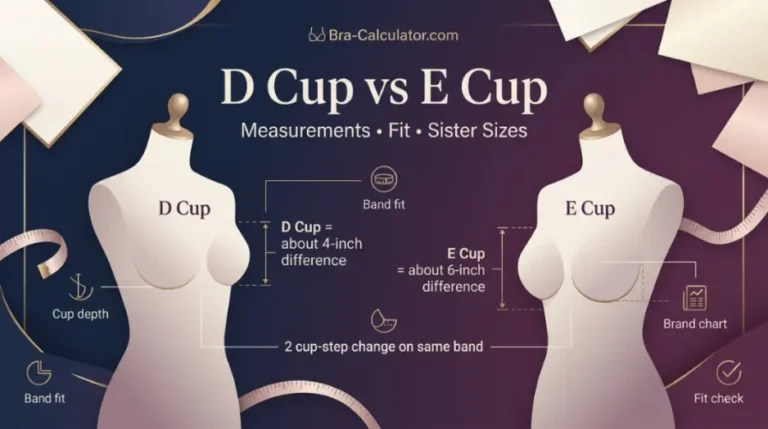
Full bust minus band gives your cup: about 4 in for 30D and 6 in for 30DDD.
Whichever size your numbers land on is the one to try first, then confirm with the fit test below.
30D vs 30DDD Measurement Visual

How Much Bigger Is 30DDD Than 30D?
Cup volume depends on band and cup together. We group sizes by volume: sister sizes share a group, and each step up adds roughly 18% more volume and weight. On that scale 30D is in group 2 and 30DDD in group 4, 2 steps apart.
Using the model from our breast weight calculator, a breast that fits 30D is estimated at about 0.76 lb (346 g) and one that fits 30DDD at about 1.06 lb (482 g). That difference is all cup depth: the band does not change, so the extra weight sits on the same band and straps. These are estimates for comparing sizes, not medical measurements.
Rule of thumb: same band, next cup letter = one volume step. Next band up, same letter = one volume step. That is why 32C and 30D feel the same in the cup.
What 30D and 30DDD Feel Like Day to Day
Band: Identical. If the band feels right in one, it will feel right in the other.
Cup edge: In 30D, a cup that is too small cuts in at the top or creates a double line under clothes. In 30DDD, a cup that is too big wrinkles or gapes when you lean back.
Centre gore: If the gore floats away from your sternum in 30D, the cups are not deep enough and 30DDD is worth trying.
Wires: Wires on 30DDD are slightly wider. If 30D wires sit on tissue under the arm, that extra width usually fixes it.
Straps: Straps should not change much; if you are tightening them to make either size work, check the band first.
For a full walk-through of these signs, see how to know if a bra fits and our bra fit problems hub.
What Happens When the Cup Is Too Small or Too Large
When 30D is too small
The cup edge cuts into the breast at the top or sides, creating a visible line under T-shirts. Tissue may escape under the arm, the wire can sit on breast tissue instead of behind it, and the centre gore lifts away from the sternum. Many people also feel the wire pressing at the side of the breast by the end of the day. These are signs to try a deeper cup, such as 30DDD.
When 30DDD is too large
The fabric wrinkles or folds, the top edge gapes when you lean back, and the cup can collapse slightly under a fitted top. The straps may slide because they have no tissue to rest against. Gaping is sometimes a shape issue rather than a size issue: a fuller-on-bottom shape can gape in a full-coverage cup that fits well in a balconette, so try a different style before dropping a size.
How 30D and 30DDD Look on the Body
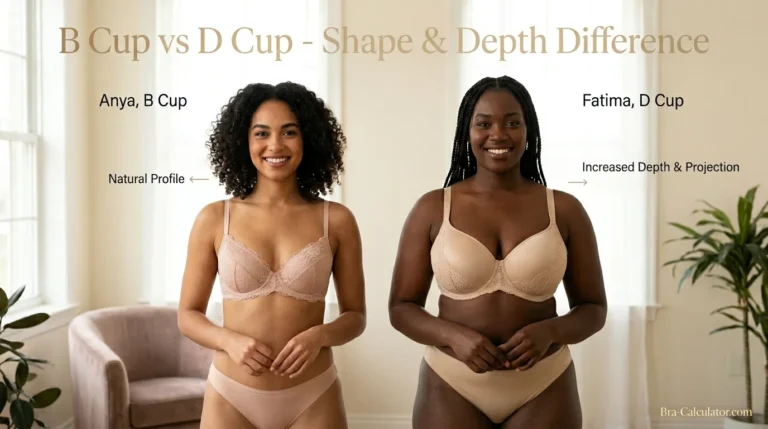
On the body, the difference between 30D and 30DDD is subtle in clothing but clear in the fit: the right one gives a smooth line under a T-shirt, with no bulge at the top edge and no empty space at the bottom. Visual guides can help you calibrate what each cup looks like across bands; see cup size visuals. Remember that photos only show shape, not fit, and two people in the same size can look very different.
Should You Choose 30D or 30DDD?
- Your full bust is closer to 34 inches
- 30DDD cups wrinkle or gape
- The band stays level and firm on the loosest hook
- Your full bust is closer to 36 inches
- 30D cups cut in, spill or the gore floats
- You want more cup room
Still between the two? Order both if the retailer offers free returns, wear each around the house for an hour with the tags on, and keep the one that passes the fit test below. You can also check alternatives with the sister size calculator.
How Breast Shape Changes 30D vs 30DDD Fit
Two people with the same measurements can need different sizes because tissue is distributed differently. Use these shape notes alongside the numbers. Our breast shapes guide explains each in detail.
Tissue sits forward
Choose the deeper cup if in doubt; seamed cups usually beat shallow moulded cups. 30DDD often suits projected shapes better.
Deep cupsTissue spreads wide
Shallow, open moulded cups and wider wires work well. 30D can feel better if the deeper cup wrinkles at the bottom.
Open cupsMore tissue above
Stretch-lace upper cups or balconettes stop cutting in at the top edge in 30D.
Stretch topsMore tissue below
Plunge and balconette cups with a deep lower section hold tissue without gaping above.
Deep baseSpace between breasts
A wider gore and wires that reach the side matter more than the letter.
Wide goreLittle space between
A low, narrow plunge gore stops the centre digging or floating.
Plunge gore30D and 30DDD Sister Sizes
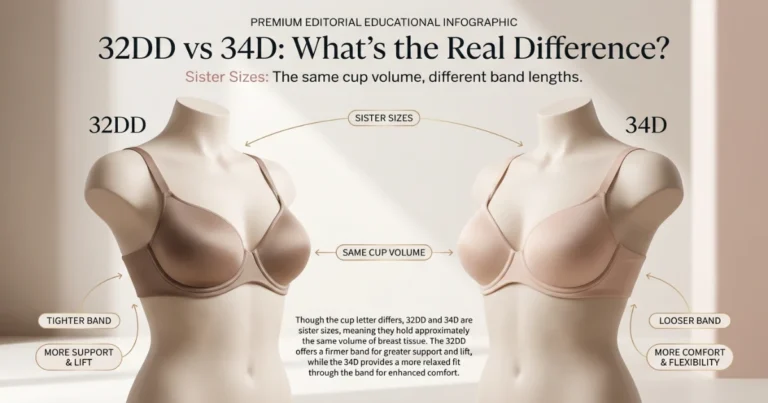
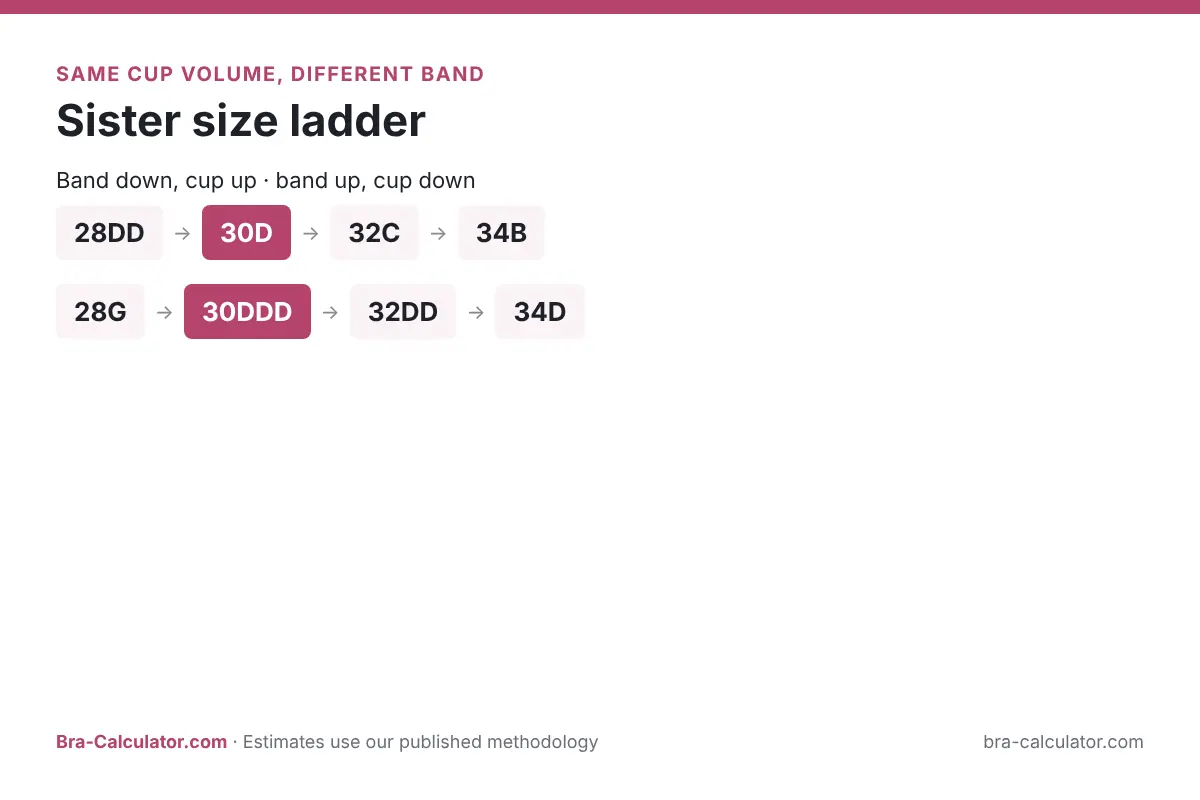
Sister sizes keep the same cup volume on a different band: one band down, one cup up, or the reverse. Use them to fix band fit only. If your band is right but the cups are wrong, stay on your band and change the letter.
| Size | Tighter band | Looser band |
|---|---|---|
| 30D | 28DD | 32C |
| 30DDD | 28G | 32DD |
30D and 30DDD Sister Size Ladder
5-Step Fit Test: 30D or 30DDD?
A new bra should fit on the loosest hook so you can tighten it as the elastic relaxes.
Lean forward and bring tissue from under the arm into the cup.
Level all round, firm, with two fingers fitting underneath. If it rides up, the band is too big.
The centre should sit flat on your sternum and the wires behind all breast tissue.
No cutting in (try 30DDD) and no gaping (try 30D or a different style).
Common Fit Mistakes With 30D and 30DDD
People in 30D often move to 32D when the cups are tight, which loosens the band and barely changes the cup.
If the straps are doing the work, the band is too loose.
Brands vary by up to a cup, especially above D.
Charts that add inches to the underbust push you into a loose band.
When to Size Up or Down
Signs you need a bigger cup than 30D
- Double line at the top edge of the cup
- Wire sitting on breast tissue at the side
- Centre gore not touching your sternum
- Tissue escaping under the arm when you lift your arms
Signs you need a smaller cup than 30DDD
- Wrinkles or folds in the cup fabric
- Top edge standing away from the breast
- Wires extending past the breast root toward the armpit
- Straps slipping even when shortened
Signs the band is wrong
- Band rides up at the back: go down a band and up a cup
- Band digs or leaves deep marks on the loosest hook: go up a band and down a cup
How to Decide Between 30D and 30DDD in 3 Minutes
Fasten on the loosest hook. If it rides up, the band is too big; if it digs, it is too small.
Look for cutting in (too small) or wrinkling and gaping (too big).
The gore should sit flat and the wires should sit behind all tissue. If all three pass, you have your size.
Still not sure? Measure again with the bra size calculator; it uses your real underbust with no inches added and shows your sister sizes in every system.
Best Bra Styles for 30D and 30DDD
Smooth moulded cups for a seamless look; best when the cup depth matches your shape.
Open top edge suits full-on-bottom shapes and stops top-edge cutting.
Low gore for close-set breasts and lower necklines.
Side slings bring tissue forward.
Separate cups control movement better than compression crops.
Too little structure at this volume.
Product ideas: best bras for a large bust, underwire vs wireless.
30D and 30DDD in Other Countries
EU, French and Japanese bands are in centimetres and step by 5. Above DD the cup letters also diverge, so always check the brand’s chart. Convert any size with the bra size converter or the international bra size chart.
30D vs 30DDD: Full Comparison
| 30D | 30DDD | |
|---|---|---|
| Band | 30 | 30 |
| Underbust | 29–31 in | 29–31 in |
| Full bust | ≈34 in | ≈36 in |
| Cup difference | 4 in | 6 in |
| Weight per breast (est.) | 0.76 lb | 1.06 lb |
| Sister sizes | 28DD, 32C | 28G, 32DD |
| UK / EU | 30D / 65D | 30E / 65F |
| Best if | Band same, smaller cup | Band same, more cup room |
Frequently Asked Questions
No. They share a band but 30DDD has 2 more cup steps.
30DDD holds more volume.
28DD (tighter band) and 32C (looser band).
28G (tighter band) and 32DD (looser band).
30D is UK 30D and EU 65D; 30DDD is UK 30E and EU 65F.
About 29–31 inches (74–79 cm) snug, with no inches added.
About 0.76 lb (346 g) per breast as an estimate.
Choose by the band first: the firmer band that stays level usually wins. Then adjust the cup letter on that band.
Find Your Best Fit
Measure once to see whether 30D, 30DDD or a sister size is your best starting point.