32DDD vs 34DD: Sister Size Comparison Explained (2026 Bra Fit Guide)
Everything you need to know about band size, cup volume, support differences, and which size actually fits your body best — including your complete measuring guide.
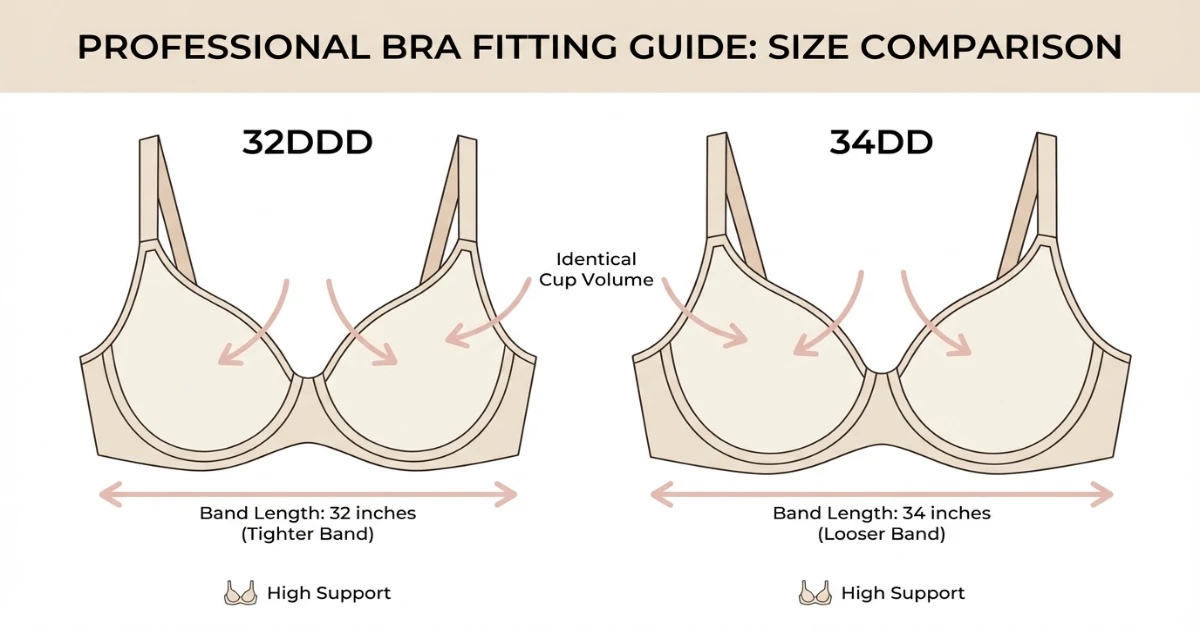
Yes, 32DDD and 34DD are sister sizes — they hold an equivalent cup volume. However, the 32DDD has a firmer, shorter band that provides more lift and support, while the 34DD offers a looser, longer band. Your rib cage measurement determines which band size actually fits you correctly.
Choose the fit signs you notice in the band, cups, center and straps. We’ll turn them into a practical next step for 32DDD.
Private fit check — your answers stay in your browser and are used only for this on-page guidance. Nothing is stored or submitted.
Key Takeaways
- 32DDD and 34DD are official sister sizes — the breast tissue volume is mathematically identical.
- Going from a 32 to a 34 band increases the band circumference by approximately 2 inches, reducing compression and support.
- Cup volume stays equal across sister sizes only when both band and cup change together.
- Your underbust measurement is the single most important factor in choosing the correct band size.
- A band that is too loose can cause the bra to ride up in back, reduce lift, and accelerate wear.
- The 32DDD is ideal for people with a snug underbust measurement of 28–30 inches; the 34DD suits an underbust of 30–32 inches.
What Does 32DDD Mean?
A 32DDD bra has a band size of 32 and a cup size of DDD (also written as F in UK sizing and several European standards). The band number — 32 — refers to the circumference of the band in inches when the bra is fastened on its loosest hook. The cup letters indicate how many inches of difference exist between your underbust and full bust measurements.
In a 32DDD, the cup difference is approximately 5 inches (A=1″, B=2″, C=3″, D=4″, DD=5″ — making DDD a 6-inch difference in most US sizing systems, though conventions vary slightly by brand). The 32 band is one of the smaller band sizes available in mainstream retail, and it wraps snugly around the rib cage. It is best suited for people with a narrower torso.
This size is often hard to find in high-street stores but is stocked reliably by specialist best bras for large busts retailers. It is also commonly cross-referenced when helping people use a bra size chart calculator after their first proper fitting.
- Band Size
- 32 inches (snug, firm fit)
- Cup Letter
- DDD / F (UK & EU)
- Cup Difference
- ~5–6 inches over underbust
- Ideal Underbust
- 28–30 inches (measured snugly)
- Support Level
- High — band does most of the work
- Band Size
- 34 inches (more relaxed fit)
- Cup Letter
- DD / E (UK & EU)
- Cup Difference
- ~5 inches over underbust
- Ideal Underbust
- 30–32 inches (measured snugly)
- Support Level
- Moderate-high — wider band, less tension
What Does 34DD Mean?
A 34DD bra has a band size of 34 and a DD cup. This is one of the most widely stocked sizes in mainstream and department store lingerie departments, making it far easier to find than the 32DDD. The 34 band sits two inches larger than a 32 band, meaning it encircles the rib cage with noticeably less compression.
The DD cup in a 34 band represents a 5-inch difference between the underbust and the fullest part of the bust. Because the band is wider, the underwire sits further apart on the chest wall, meaning the cups are also spaced differently — something that can subtly alter how the bra fits around the breast tissue on the sides and underneath.
Understanding cup projection alongside band size is valuable here. You can explore that further with the projection depth analyzer, which maps how deep and forward a cup sits — important when comparing these two closely related sizes.
Are 32DDD and 34DD Sister Sizes?
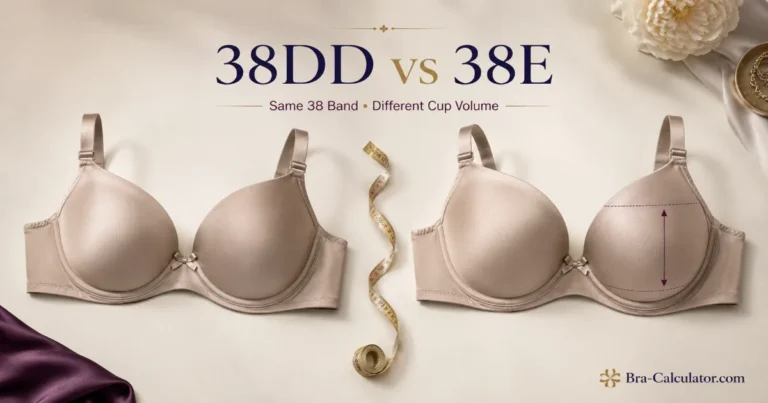
Yes, definitively. 32DDD and 34DD are sister sizes in standard US bra sizing. This means that if you were to scoop and fit the breast tissue correctly into both bras, the volume of fabric in each cup would be equivalent. The sister size relationship works because as the band size increases by one step (2 inches), the cup letter decreases by one step — and the net volume held by the cup stays the same.
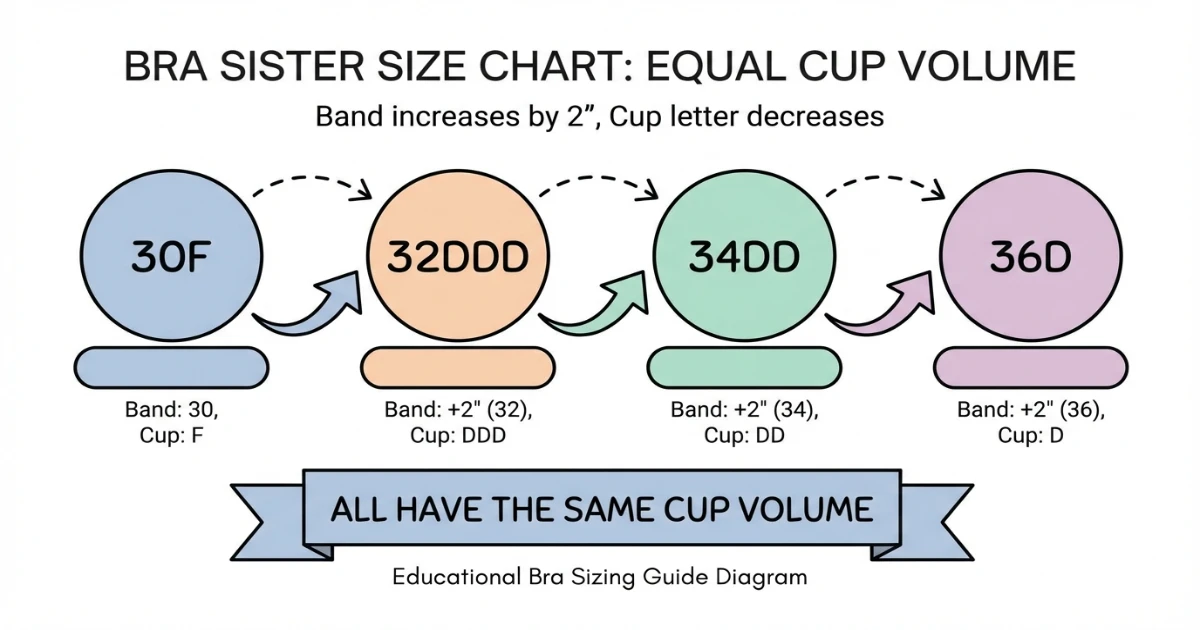
This concept is central to the sister size guide on this site, and there is also a dedicated sister size bra calculator you can use to find your full range of equivalent sizes across all bands.
Band Size Difference: How 2 Inches Changes Everything
The difference between a 32 and a 34 band may sound small — just two inches — but in terms of how a bra functions on the body, it is significant. The band provides 70–80% of a bra’s support. When the band is the right size, it sits parallel to the ground all the way around, stays in place through movement, and keeps the underwire flat against the sternum.
| Feature | 32DDD | 34DD |
|---|---|---|
| Band circumference | ~32 inches | ~34 inches |
| Band tension | High — snug, minimal give | Moderate — more room |
| Lift and support | Maximum from band alone | Slightly lower; straps compensate |
| Underwire width | Narrower spacing | Slightly wider spacing |
| Band longevity | Shorter band elastics last longer under tension | Slightly faster stretch-out possible |
| Starting hook | Loosest hook (room to tighten as band stretches) | Loosest hook (same principle) |
| Cup volume | Equivalent — same breast volume fits both | |
When a person wears a 34DD instead of their correct 32DDD, the band stretches around the back and the bra frequently rides up. You can read a detailed breakdown of this problem in the bra band rides up in back article, which covers exactly why this happens and how to fix it.
Cup Volume Comparison: Equal but Not Identical in Fit
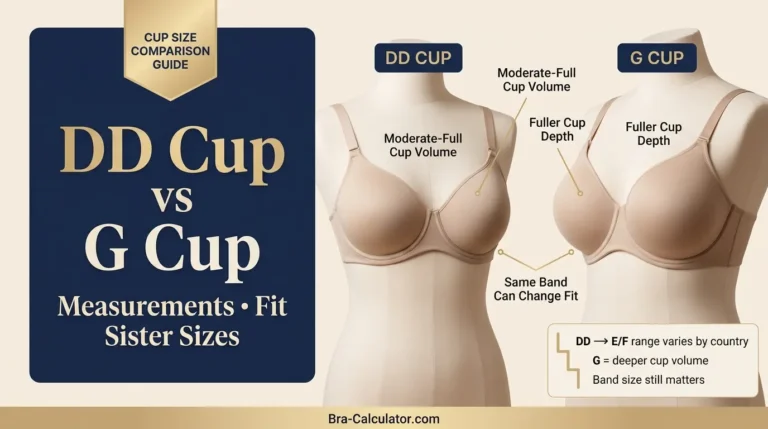
As established, 32DDD and 34DD contain the same mathematical cup volume. In practice, though, the physical shape of the cup is subtly different. A 32DDD cup is narrower and often slightly deeper (more projected) to accommodate breast tissue that sits on a smaller chest wall. A 34DD cup is wider and may feel shallower for someone whose breast tissue is the same volume but sits on a broader ribcage.
This distinction matters most for people with narrow-based or full-on-top breast shapes. A narrow-based breast that fills a 32DDD cup may overflow or gap in a 34DD, even though the volumes are “equal”, because the wider cup base does not contain the tissue in the same way. Use the breast shape identifier to understand your shape before deciding between these two sizes.
| Cup Attribute | 32DDD | 34DD |
|---|---|---|
| Cup volume | Equal | Equal |
| Cup depth (projection) | Often deeper | Often shallower |
| Cup base width | Narrower | Wider |
| Best for breast root width | Narrower roots | Medium to wider roots |
| Side panel coverage | More contained on smaller frame | Wider underarm panel |
Visual Fit Differences: What to Look For
Seeing a bra on the body tells you everything. Here are the visual signs that separate a well-fitting 32DDD from a well-fitting 34DD — and the warning signals that indicate you have the wrong size.
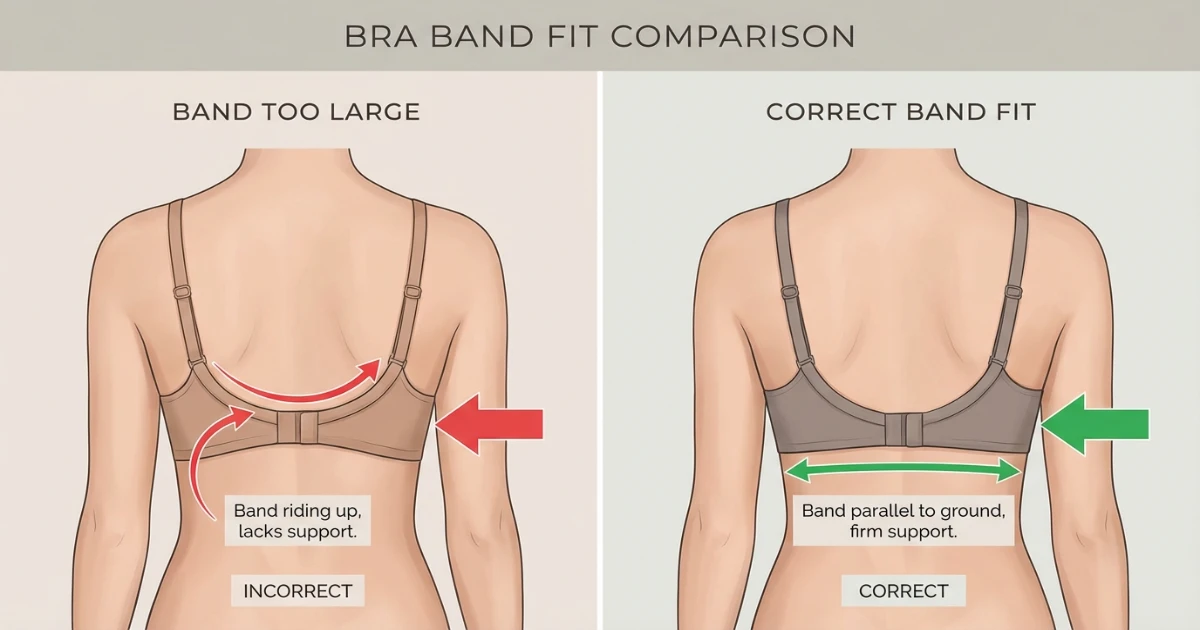
Signs of a Correctly Fitting 32DDD
- Band sits completely parallel to the ground — no riding up at the back
- You can fit exactly two fingers under the band, but no more
- Underwire lies flat against the sternum and wraps around the full breast root
- Cups contain all breast tissue with no overflow or gaping
- Straps sit comfortably — neither digging in nor falling off the shoulders
Signs of a Correctly Fitting 34DD
- Band still stays level, with slightly more give than a 32 band
- Wider underwire frame matches the broader spacing of the breast roots
- Cups feel full but not overflowing — no quadra-boob bulge above the cup
- Straps need minimal adjustment to stay in place
For a comprehensive overview of the most common fitting issues across all sizes, the bra fit problems guide and the bra fit problem solver both provide visual descriptions and targeted fixes.
Who Should Wear 32DDD?
The 32DDD is the right choice when your body measurements align with a narrower rib cage and a larger cup volume. Here is who benefits most from this size:
32DDD Is Ideal If You…
- Measure 28–30 inches snugly around your underbust
- Have a petite or narrow frame with a fuller bust
- Find that 34 bands consistently ride up no matter how you adjust
- Need maximum support from the band, especially during activity
- Have narrow-rooted breast tissue that gapes in wider cups
- Prefer bras with more compression and structure
Reconsider 32DDD If You…
- Measure 30–32 inches underbust — the 34 may be more comfortable
- Find the band uncomfortably tight even on the loosest hook
- Have wider-spaced breasts or broader breast roots
- Experience persistent rib-cage discomfort after wearing
- Are postpartum or have recently lost or gained weight
People who have recently experienced bra size changes after pregnancy or who are using a post weight loss bra size calculator often find they move between the 32 and 34 band as their bodies change — both tools can help you track which band is currently the best fit.
Who Should Wear 34DD?
The 34DD is one of the most widely available bra sizes in mainstream retail, and for good reason — it suits a large proportion of people with medium frames and a fuller cup. Here is who this size works best for:
34DD Is Ideal If You…
- Measure 30–32 inches snugly around your underbust
- Have a medium frame and a DD cup volume
- Find 32 bands feel uncomfortably constrictive around the rib cage
- Need wider underwire spacing to match your breast root width
- Want a greater variety of styles and brands to choose from
- Prefer a slightly more relaxed feel through the day
Reconsider 34DD If You…
- Measure under 30 inches underbust — a 32 will give better support
- Notice the band rides up to your shoulder blades by afternoon
- Have narrower breast roots that lose containment in the wider cup
- Find straps doing all the lifting while the band just hangs there
- Regularly need to tighten to the last hook after just a few wears
Common Fit Problems When Mixing Up These Sizes
Wearing the wrong sister size — even one that has equivalent cup volume — creates a predictable set of fit problems. Here is what to look out for:
| Fit Problem | Likely Cause | Fix |
|---|---|---|
| Band riding up in back | Band too large — wearing 34DD when 32DDD is needed | Size down to 32, size up the cup to DDD |
| Red marks under the breast or on ribs | Band too small — 32DDD too tight for a 32–34″ underbust | Try 34DD for more comfort |
| Quadra-boob / cup overflow | Cup too small relative to breast volume | Size up the cup — from DD to DDD/F |
| Gaping cups at the top | Cup too large or too wide for narrow breast roots | Try 32DDD for deeper, narrower cup projection |
| Underwire sitting on breast tissue | Underwire too wide or too narrow for your breast root | Use the how to know bra fits guide to check wire placement |
| Straps digging in or falling off | Straps compensating for poor band support | Re-evaluate band size first before adjusting straps |
How to Measure Your Bra Size Correctly
Accurate measurements are the only reliable way to determine whether you belong in a 32DDD, a 34DD, or a different size entirely. Follow these steps with a flexible measuring tape for the most accurate result.
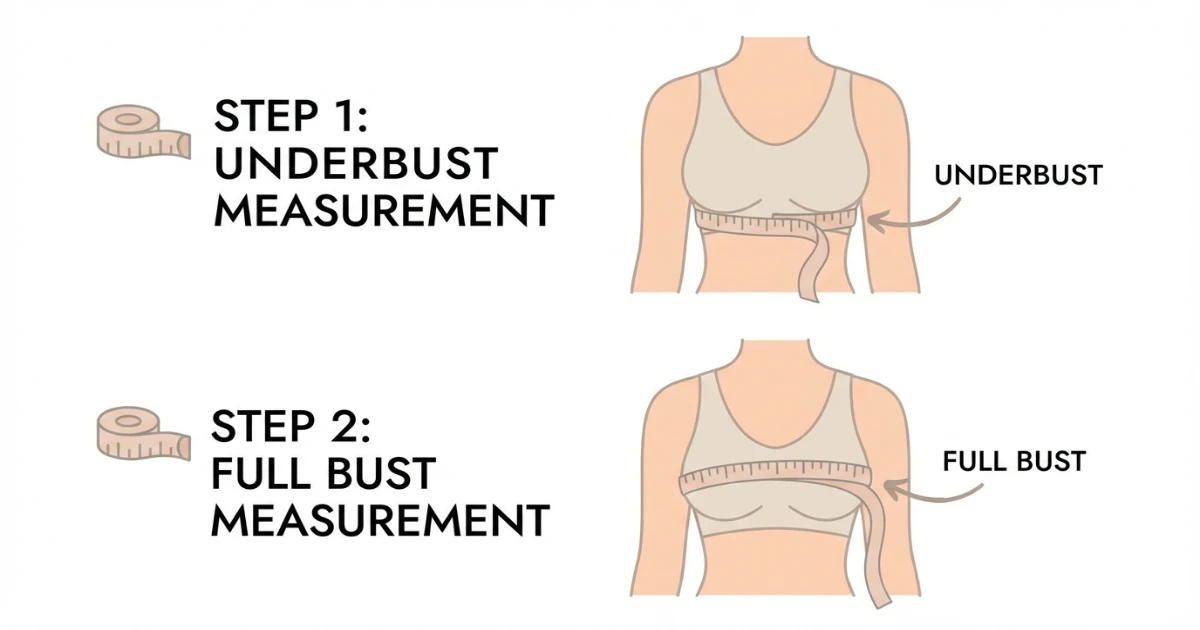
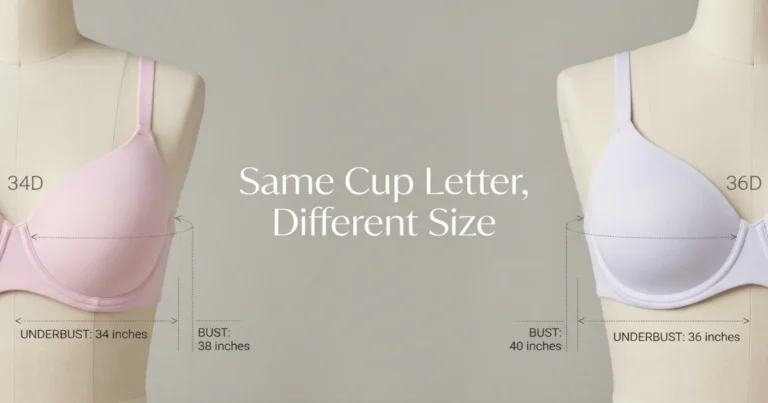
- Underbust measurement: Wrap the tape snugly (not tightly) around your rib cage, directly under your breasts. Stand upright, exhale normally, and read the measurement in inches. This is your band size — if the number is even, that is your band; if it is odd, round to the nearest even number.
- Full bust measurement: Lean forward slightly at about 45 degrees and wrap the tape loosely around the fullest part of your breasts. The slight lean ensures you capture all projecting tissue. Note this measurement.
- Calculate the difference: Subtract the underbust from the full bust. Each inch of difference corresponds to one cup letter (1″=A, 2″=B, 3″=C, 4″=D, 5″=DD, 6″=DDD/F).
- Check sister sizes: If your calculated size is a 34DD but the band feels loose, try a 32DDD. If your 32DDD band feels too tight, try a 34DD.
- Try the band test: With your bra fastened on the loosest hook, you should be able to slide two fingers comfortably under the band — but the band should not easily pull away more than an inch.
For a complete visual and instructional breakdown, visit the how to measure guide, or enter your measurements directly into the bra size chart calculator for an instant result.
Best Bra Styles for 32DDD and 34DD
Both sizes benefit from structured support, but style choices can differ based on what fits best for each frame.
Best Styles for 32DDD
- Balconette bras: Provide great projection support for a narrower frame. The cut lifts and rounds the silhouette without adding width.
- Plunge bras with firm bands: Keep the smaller band doing the lifting while giving a flattering neckline.
- Full-coverage underwire: Ideal for all-day wear; look for a narrow underwire width specifically designed for smaller bands. See full coverage bras for DD+ for style options.
- Sports bras: A 32 band offers excellent motion control — use our sports bra calculator to find the right compression level for your activity.
- Minimizers: Available in 32DDD through specialist brands — see the minimizer bras for large busts guide for curated options.
Best Styles for 34DD
- T-shirt bras: The 34DD is one of the easiest sizes to find in seamless, moulded-cup t-shirt styles from mainstream brands.
- Wireless bras: A 34 band can provide adequate support wirelessly for many people — explore wireless bras for larger busts for options in this size range.
- Nursing and maternity: Most maternity and nursing ranges are well-stocked in 34DD — see the maternity bra size calculator to check whether your size has changed during pregnancy.
- Strapless: A 34 band offers a reasonable base for strapless styles. The strapless bra size calculator can help you identify the best fit for your frame.
- Comfort and sleep bras: Relaxed band makes 34DD great for gentle sleep bras. Check out large bust sleep bras for style picks.
Final Verdict: 32DDD vs 34DD
The core message is simple: 32DDD and 34DD are sister sizes that hold equal breast volume, but they are not interchangeable for everyone. The most important factor in your decision is your actual underbust measurement. If you measure 28–30 inches underbust, the 32DDD will give you a firmer, more supportive fit that keeps the band where it belongs. If you measure 30–32 inches, the 34DD will feel more comfortable throughout the day without sacrificing much in the way of lift and containment.
If you are right on the border — approximately 30 inches — try both and pay close attention to where the band sits after a full day of wear. The size that stays level all the way around, does not require constant strap adjustment, and still allows two fingers under the band is your correct size. When in doubt, size down in the band and up in the cup — this is the single most consistent recommendation from professional bra fitters worldwide.
Use the sister size bra calculator or the main bra size calculator to cross-check your measurements and explore your full sister size range before you shop.