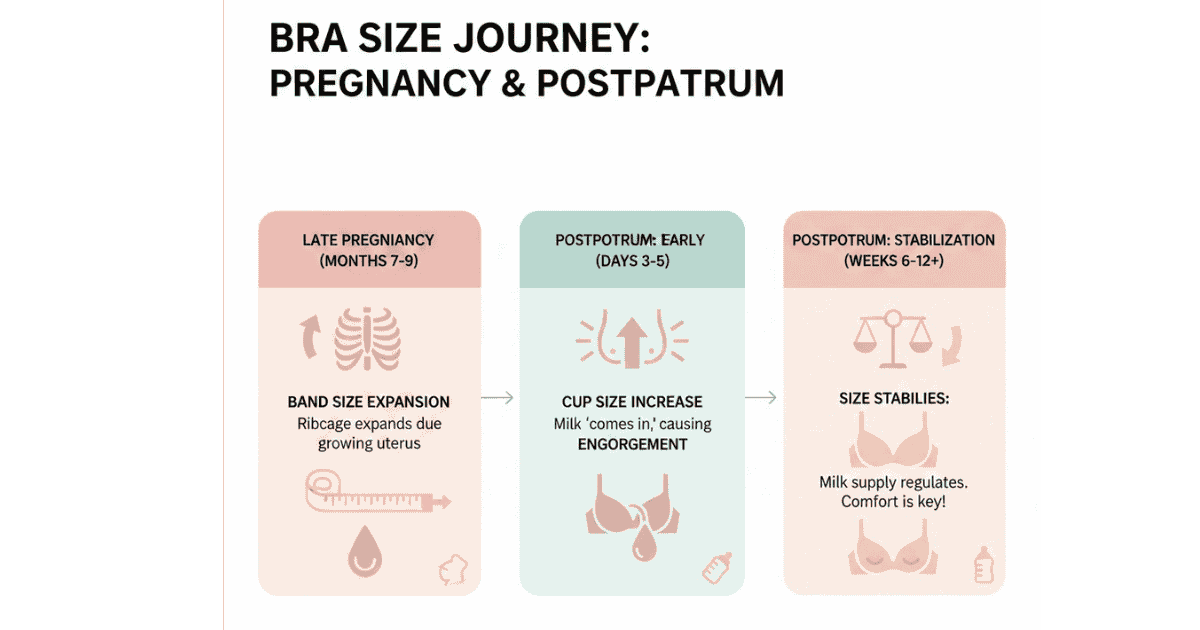
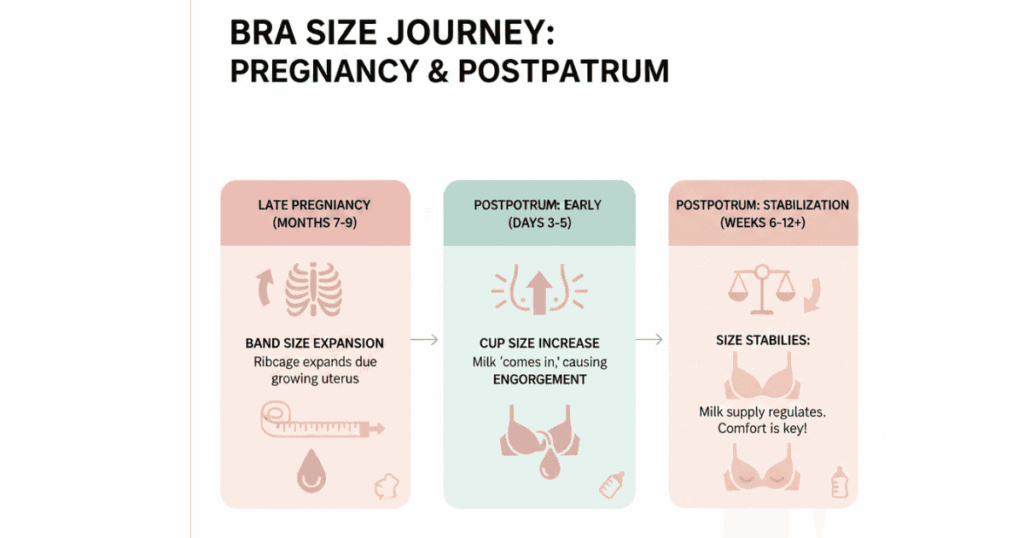
During pregnancy, most women increase by 1–3 cup sizes and 1–2 band sizes as breasts grow and the ribcage expands by 5–10 cm. Cup growth peaks in the first trimester; band size increases most in the second and third trimester. After birth, cup size peaks during engorgement then typically settles 1 cup above pre-pregnancy once milk supply regulates at 6–12 weeks postpartum.
To provide specific action, the guide on Bra Size After Pregnancy details when to measure, how to size, and fit check.
Pregnancy Bra Size: Key Facts at a Glance
| Average cup size increase (total pregnancy) | 1–3 cup sizes |
| Average band size increase (total pregnancy) | 1–2 band sizes |
| Ribcage expansion (underbust) | +5–10 cm by 3rd trimester |
| Biggest cup growth stage | First trimester (weeks 1–12) |
| Biggest band change stage | Second & third trimester |
| Peak size change (postpartum) | Days 2–5 (milk “coming in”) |
| When size stabilizes postpartum | 6–12 weeks after birth |
| How often to re-measure | Every 4–6 weeks during pregnancy |
| Bra type recommended (1st trimester) | Wireless, soft-cup, seamless |
| Bra type recommended (postpartum) | Nursing bra with drop-down cups |
| Can wrong bra cause clogged ducts? | Yes — tight bands & stiff underwires |
| Bras needed in total (pregnancy + postpartum) | 4–5 across all stages |
How Pregnancy Changes Your Bra Size — Trimester by Trimester
Pregnancy bra size is not static. Hormonal surges, breast tissue proliferation, fat redistribution, and ribcage expansion create a continually shifting fit from week 4 through postpartum weaning. Understanding what changes at each stage prevents poor support, blocked ducts, and shoulder strain — and helps you spend on the right bra at the right time.
Cup Growth Begins — Band Stays Close to Baseline
Estrogen and progesterone surge, causing ductal and lobular proliferation. Most women gain 1–2 cup sizes within the first 12 weeks. Band measurement typically increases by 0–2 cm only. Sensitivity and tenderness are highest here — even soft seams can irritate. Switch from underwired bras to wireless, seamless, or soft-cup maternity bras as early as week 6 if needed. Size asymmetry (one breast larger than the other) is common and normal.
Ribcage Expands — Band Size Jumps
Cup growth slows but band measurement climbs as the uterus grows upward, pushing the ribcage outward. Expect +3–7 cm on the underbust. This shifts your band size even if cups appear stable. Look for bras with multi-row hook closures (4+ hooks), stretch side panels, and stay-put sliders. A soft sleep bra helps with nighttime discomfort. Re-measure monthly — a band that fit in week 14 is often too tight by week 22.
Maximum Support Demand — Both Band & Cup Can Climb
Both band and cup size may increase again. A lactating bust is approximately 33% heavier than its non-lactating equivalent — wide straps, tall wings, and 4–6 hook rows become essential. Colostrum leakage can begin any time after week 28, so bras with absorbent liner pockets or easy-insert cup pads are practical. Re-measure every 2–4 weeks. Consider buying one or two nursing bras at weeks 36–38 as a baseline for postpartum use.
Engorgement Peak, Then Gradual Stabilization
Breast size peaks on days 2–5 postpartum as milk transitions from colostrum to mature milk. Cup size can jump 1–3 sizes above late-pregnancy size during engorgement. By weeks 6–12, milk supply regulates and size settles — usually 1 cup above pre-pregnancy baseline in nursing mothers. Size asymmetry is often more pronounced during this phase. Measure every 2 weeks. Wireless nursing bras with drop-down cups are the only recommended style until supply stabilizes.
Sizing Tip: Always measure at mid-day when breasts are naturally fuller, and before a feed rather than after — this gives the size that must be accommodated throughout the day.
Pregnancy Bra Size Change Chart (Trimester-by-Trimester)
Use this chart as a planning reference — not a guarantee. Individual hormonal response, weight gain, and body composition all affect actual size changes.
| Stage | Band Change | Cup Change | Cup Progression | Best Style |
|---|---|---|---|---|
| Pre-Pregnancy Baseline | — | — | Your usual size | Everyday / underwired |
| 1st Trimester (Wks 1–12) | +0–2 cm | +1–2 cups | A→C · B→D · C→DD | Wireless, seamless, soft-cup |
| 2nd Trimester (Wks 13–26) | +3–7 cm | +0–1 cup | C→DD · D→E · DD→F | Multi-hook band, sleep bra |
| 3rd Trimester (Wks 27–40) | +5–10 cm | +1–2 cups | DD→F · E→G · F→H | Wide strap, tall wing, 4+ hooks |
| Postpartum Engorgement (Wks 1–2) | Minor fluctuation | +1–3 cups (peak) | F→H+ · varies widely | Wireless nursing, drop-cup |
| Milk Regulation (Wks 6–12) | Returning near pre-pregnancy | Settling | ~1 cup above baseline | Flexible cup nursing bra |
| Established Breastfeeding (3 mo+) | Minor daily ± | Minor daily ± | Depends on supply | Comfort-access nursing bra |
| After Weaning | Near pre-pregnancy | Near pre-pregnancy or slightly fuller | Usually within 1 cup of original | Regular lightly lined bra |
Cup Size Conversion During Pregnancy (Bust–Band Difference)
| Difference (inches) | US Cup | UK Cup | EU Cup | AU Cup |
|---|---|---|---|---|
| 1 in | A | A | A | A |
| 2 in | B | B | B | B |
| 3 in | C | C | C | C |
| 4 in | D | D | D | D |
| 5 in | DD | DD/E | E | DD |
| 6 in | DDD/F | E | F | E |
| 7 in | G | F | G | F |
| 8 in | H | FF | H | FF |
| 9 in | I | G | I | G |
| 10 in | J | GG | J | GG |
UK Labelling Note: UK brands label DD as E, DDD as F, and DDDD as G. Check which cup labelling system the brand uses before ordering. Use our full international size chart →
How to Measure Your Bra Size During Pregnancy (Step-by-Step)
Standard measuring rules still apply during pregnancy, with a few adaptations for swelling and tissue tenderness. Measure mid-day, in a non-padded wireless bra or no bra, standing in a natural posture.
Gather Your Tools
Use a soft, flexible measuring tape, a notepad, and a mirror for alignment. Wear a non-padded nursing bra or measure with no bra. Measure mid-day (when breasts are naturally fuller). During pregnancy, use the larger of your mid-day and evening readings for sizing.
Measure Your Band (Underbust)
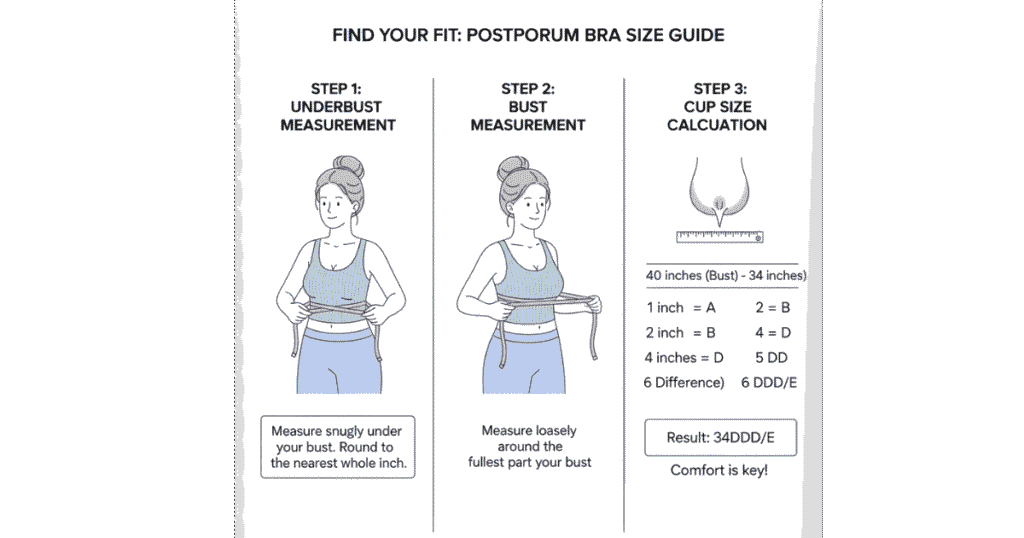
Wrap the tape snugly around your ribcage directly beneath the bust, parallel to the floor. Exhale normally. Round down to the nearest whole number. Convert to band size: 27–28 in = 30 band; 29–30 in = 32 band; 31–32 in = 34 band, in 2-inch increments. Repeat for confirmation — re-measure if readings differ by more than 1 cm.
Measure Your Bust (Overbust)
Place the tape across the fullest point of your bust — typically at nipple level — keeping it level across your back. Do not press into tissue. Round to the nearest whole number. Always measure before a feed (fuller) for daytime bra sizing. Log the date, trimester, and time of day alongside each reading.
Calculate Your Cup Size
Subtract your band measurement from your bust measurement. Each inch of difference = one cup size: 1 in = A · 2 in = B · 3 in = C · 4 in = D · 5 in = DD · 6 in = DDD/F · 7 in = G · 8 in = H. Example: 35 in bust − 30 in band = 5 in = 30DD. Cross-check using our bra size calculator.
Perform the Fit Check
Start on the loosest hook. Check: (1) Band — firm, level, does not ride up. (2) Cups — contain all tissue, no spillage or gaping. (3) Straps — flat on shoulders, not digging or slipping. Move, bend, and lift arms — nothing should shift, pinch, or chafe. If any element fails, try a sister size before going up a full size.
Re-Measure on Schedule
Set a reminder to re-measure every 4–6 weeks during pregnancy and every 2 weeks for the first 8 weeks postpartum. Key re-measure triggers: straps digging, band leaving marks, cup overflow or gaping, underwire poking, or general mid-day discomfort. Some women shift a cup size in under three weeks — don’t wait.
Sister Size First: Before buying a completely new size, try a sister size — same cup volume, different band. If your 34D cups gape, try 32DD. If the 34D band is too tight, try 36C. Find your sister sizes here →
Types of Maternity & Nursing Bras: Which Do You Need and When?
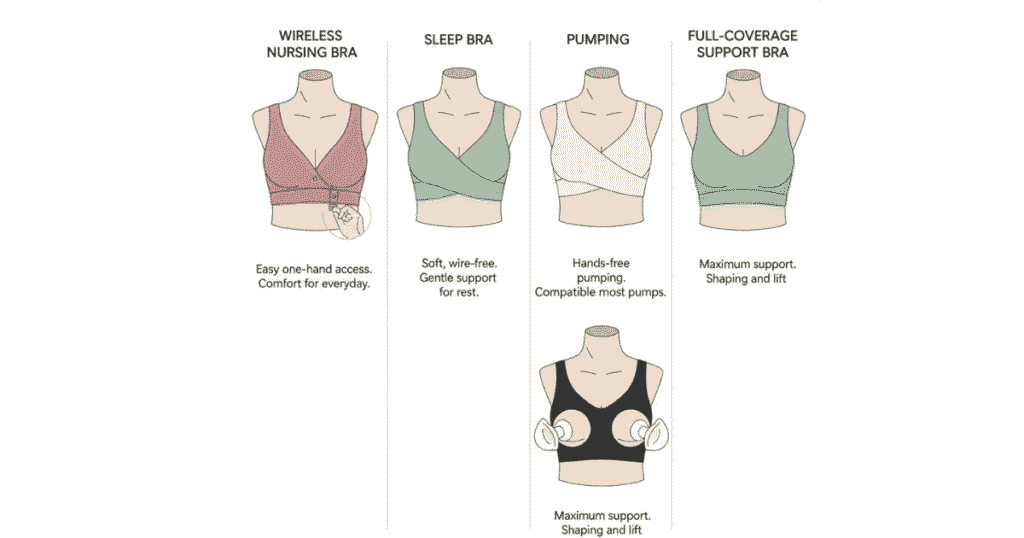
🌙 Sleep Bra
Best for: All trimesters & postpartum nights
- Soft stretch-knit — no pressure points
- Manages overnight leaks
- Does not ride up or twist
- Not enough support for daytime use
🤱 Wireless Nursing Bra
Best for: Postpartum weeks 1–12 (essential)
- Drop-down or fold-away cups
- One-hand clip access
- No duct compression risk
- Less lift for larger cup sizes
💪 Maternity Sports Bra
Best for: Low-to-moderate activity, 2nd & 3rd trimester
- Light compression reduces bounce
- Moisture-wicking fabric
- Wide underband for support
- High compression can impair ducts
👔 Underwired Nursing Bra
Best for: 12+ weeks postpartum only
- Best lift for larger cup sizes
- Better silhouette under clothes
- Wire must sit behind breast tissue only
- Higher duct-compression risk if poorly fitted
Maternity Bra vs Nursing Bra: What Is the Difference?
| Feature | Maternity Bra | Nursing Bra |
|---|---|---|
| Primary purpose | Comfort & support during pregnancy | Feeding access + support postpartum |
| Cup opening | No — fixed cup | Yes — drop-down, fold-away, or clip |
| Wire type | Usually wireless | Wireless (early) or flexible wire (later) |
| Stretch factor | High — accommodates weekly changes | Moderate — designed for stable supply size |
| When to start wearing | Week 6–8 of pregnancy | Before due date or at birth |
| Pad/liner pocket | Sometimes | Usually yes (for breast pads) |
| Best for night use | Soft maternity / sleep bra | Soft nursing / sleep nursing bra |
Find Your Best Bra Match
Answer a few fit questions to get bra styles matched to your support needs, breast shape and everyday preferences.
Question 1 of 5
Why it matches
What to look for
What may not work
Private fit matching: your answers are used only to build the recommendation on this page. No measurements or fit selections are submitted to Bra-Calculator.com.
This tool suggests a starting bra style, not a medical or diagnostic recommendation. Individual brands and bra models can fit differently.
Best Maternity & Nursing Bras: Our Top Picks
Selected for adjustability, fabric quality, and fit across rapidly changing sizes. Replace links with your preferred products.
Bravado Designs Body Silk Seamless Nursing Bra
The most recommended maternity-to-nursing bra by lactation consultants. Seamless knit adapts through all trimesters and postpartum — fits XS–4XL.
- Seamless stretch fabric — no pressure points
- Convertible clip for nursing access
- Fits 30–46 band, A–J cup range
- Wire-free — safe for all pregnancy stages
- Machine washable
💰 Mid-range · Available on Amazon Prime
Check Price on Amazon →Kindred Bravely French Terry Racerback Sleep & Lounge Nursing Bra
#1 best-selling sleep nursing bra on Amazon. Soft French terry, no underwire, pull-aside cups for effortless night feeds.
- Ultra-soft French terry cotton blend
- Pull-aside cups — no clasp needed
- Removable pads for leak coverage
- Available XS–3XL
- Recommended from 2nd trimester onwards
💰 Budget-friendly · Ships free with Prime
Check Price on Amazon →Cake Maternity Cotton Candy Nursing Sports Bra
Wire-free low-to-moderate impact support for pregnancy and nursing. Designed for walking, yoga, and light exercise — clip-down cups for mid-workout nursing access.
- Wire-free for duct safety during exercise
- Moisture-wicking jersey fabric
- Clip-down cups for nursing access
- Wide padded straps — reduces shoulder pressure
- Sizes: 32–42 band, B–G cup
💰 Mid-range · Specialist maternity brand
Check Price on Amazon →Hotmilk Lingerie Allure Underwire Nursing Bra
Purpose-built for larger cup sizes (D–J UK) who need real structure post-engorgement. Use only after milk supply stabilizes at 12+ weeks postpartum.
- Available up to J cup (UK sizing)
- Flexible underwire — lower duct-compression risk
- Padded adjustable straps for weight distribution
- Full coverage cup for DD+ projection
- Recommended: 12+ weeks postpartum only
💰 Premium · Specialist lingerie brand
Check Price on Amazon →Common Pregnancy Bra Sizing Mistakes (And How to Avoid Them)
| Mistake | Why It’s a Problem | Fix |
|---|---|---|
| Buying a full set in 1st trimester | You’ll outgrow them within weeks | Buy 2 bras at a time; re-shop each trimester |
| Keeping pre-pregnancy band size | Ribcage expands; old band = constriction | Re-measure underbust every 4–6 weeks |
| Going up only in cup, not band | Misses ribcage expansion entirely | Always measure band and cup independently |
| Wearing underwire in 3rd trimester | Wire can press on shifting milk ducts | Switch to wire-free by week 28 at the latest |
| Sizing based on post-feed measurements | Bra will be too small mid-day when fuller | Measure when full (before feed) for daily sizing |
| Ignoring cup overflow | Leads to skin chafing and quad-boob | If cups spill at all, go up one cup immediately |
| Buying on the tightest hook | No room to adjust as band elastic relaxes | Always buy fitting on the loosest hook |
| Skipping nursing bra before birth | Scramble during early engorgement | Buy 2 wireless nursing bras at weeks 36–38 |
| Wearing late-pregnancy size postpartum | Too small at peak engorgement days 3–5 | Size up 1–2 cups post-birth; re-measure at week 6 |
| Prioritising style over support | Thin straps cause shoulder and back strain | Function first: wide straps, multi-hook bands, stretch cups |
Why Proper Bra Fit Matters During Pregnancy and Breastfeeding
Back Pain, Posture, and Shoulder Strain
An improperly fitting maternity bra forces straps to carry weight the band should support. A correctly fitted band carries 80% of breast weight; straps carry the remaining 20%. If straps are bearing the load, the band is too loose. Tight straps dig grooves into shoulder tissue and aggravate upper back muscles already strained by postural changes in pregnancy.
Blocked Ducts and Mastitis Risk
Tight underwires, stiff cups, or a constrictive band can press on milk ducts and lobules, restricting milk flow. This creates localised blockages that can escalate to mastitis — a painful breast infection sometimes requiring antibiotics. The bra should feel firm but never restrictive; no part should leave a red mark or indent on breast tissue after removal.
Engorgement Management
During postpartum engorgement, breasts can increase dramatically within hours. A rigid cup with no stretch capacity causes intense pressure and pain. Stretch knit cups, deep U-shaped gore, and generous side slings accommodate engorgement fluctuations without adding compression. Never sleep in an underwired bra during the early postpartum weeks.
📋 Key Takeaways: Pregnancy Bra Sizing
- Expect 1–3 cup sizes and 1–2 band sizes of change across the full pregnancy and nursing journey
- Re-measure every 4–6 weeks during pregnancy and every 2 weeks in the first 8 weeks postpartum
- Always buy bras on the loosest hook to allow for elastic wear and further size changes
- Use wireless or soft-cup bras from the first trimester; avoid stiff underwires until supply stabilizes at 12+ weeks post-birth
- Tight bras can cause clogged ducts, mastitis, and back pain — discomfort is always a signal to reassess size
- Build a rotation of 4–5 bras: 2 everyday nursing, 1 sleep, 1 sports/active, 1 spare
- Cup size typically settles 1 cup above pre-pregnancy once breastfeeding supply regulates
- After weaning, wait 2–4 weeks then re-measure for your post-nursing baseline