Molded Cup vs Seamed Cup Bras: Shape, Support and Which Fits You
In a molded cup vs seamed cup comparison, the difference is how the cup is built. A molded cup is one piece of foam heat-formed into a fixed shape. It is seamless and invisible under T-shirts, but it only fits breasts that match its dome, and it often gapes on shallow tissue or cuts into projected tissue. A seamed cup is sewn from several panels, which lets the maker shape projection, lift and centring precisely. It fits more breast shapes, gives better lift and support in fuller cups (DD and up), and is cooler, but the seams may show under thin fabric.
Jump to a Section
Molded vs Seamed at a Glance
| Feature | Molded cup | Seamed cup |
|---|---|---|
| How it is made | One piece of foam heat-pressed into a dome | 2–4 fabric panels sewn together |
| Look under clothes | Seamless, smooth, invisible | Seams may show under thin knits |
| Shape fit | Only fits breasts that match the dome | Fits a wide range of shapes |
| Support in fuller cups | Moderate | High: panels lift and project |
| Breathability | Lower (closed foam) unless spacer | Higher, especially unlined |
| Adds size? | A little (foam thickness) | No, if unlined |
| Best sizes | AA–DD most widely | D–K and up |
| Hides nipples? | Yes | Unlined: no; lined seamed: yes |
How Each Cup Is Made
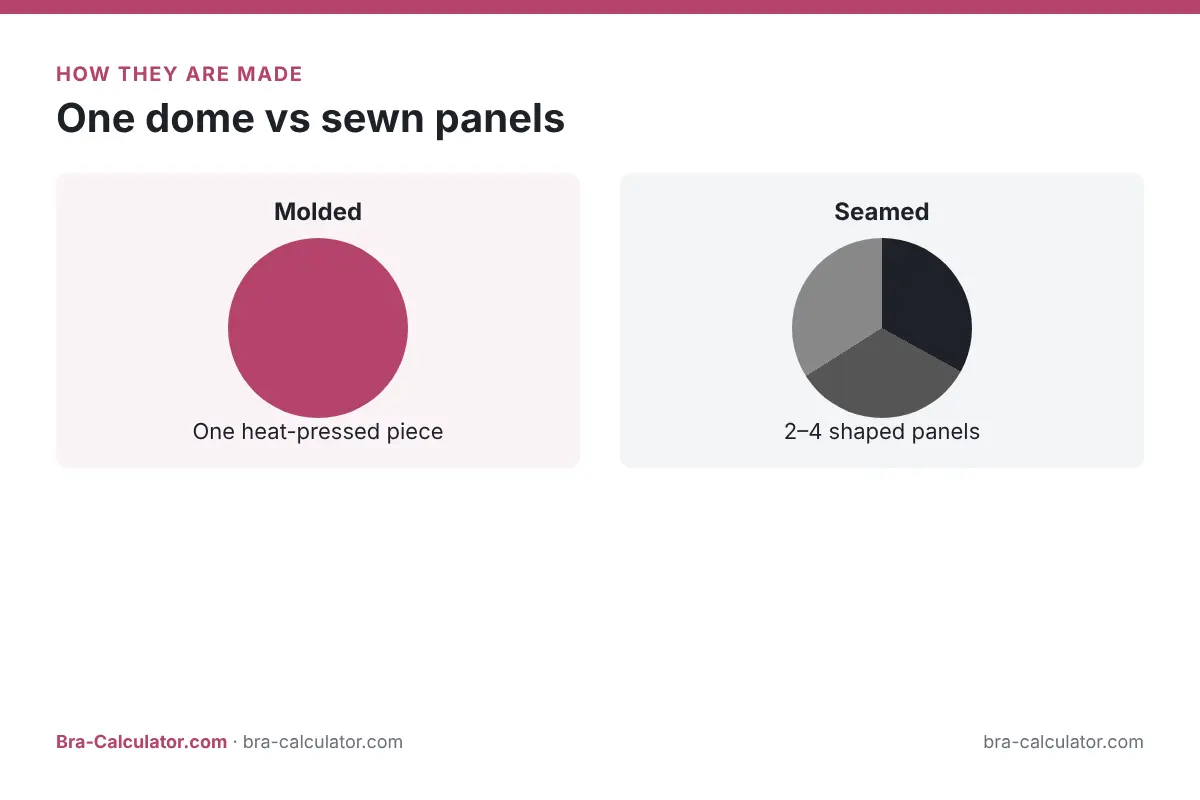
A molded cup starts as a flat sheet of foam (often polyurethane) that is heated and pressed between two shaped moulds. The result is a fixed, seamless dome, which is why molded bras are also called contour or T-shirt bras. Because the shape is set at the factory, every breast that goes into that cup is asked to take the same shape. If yours matches, it looks perfect. If it does not, you see gaps or overflow.
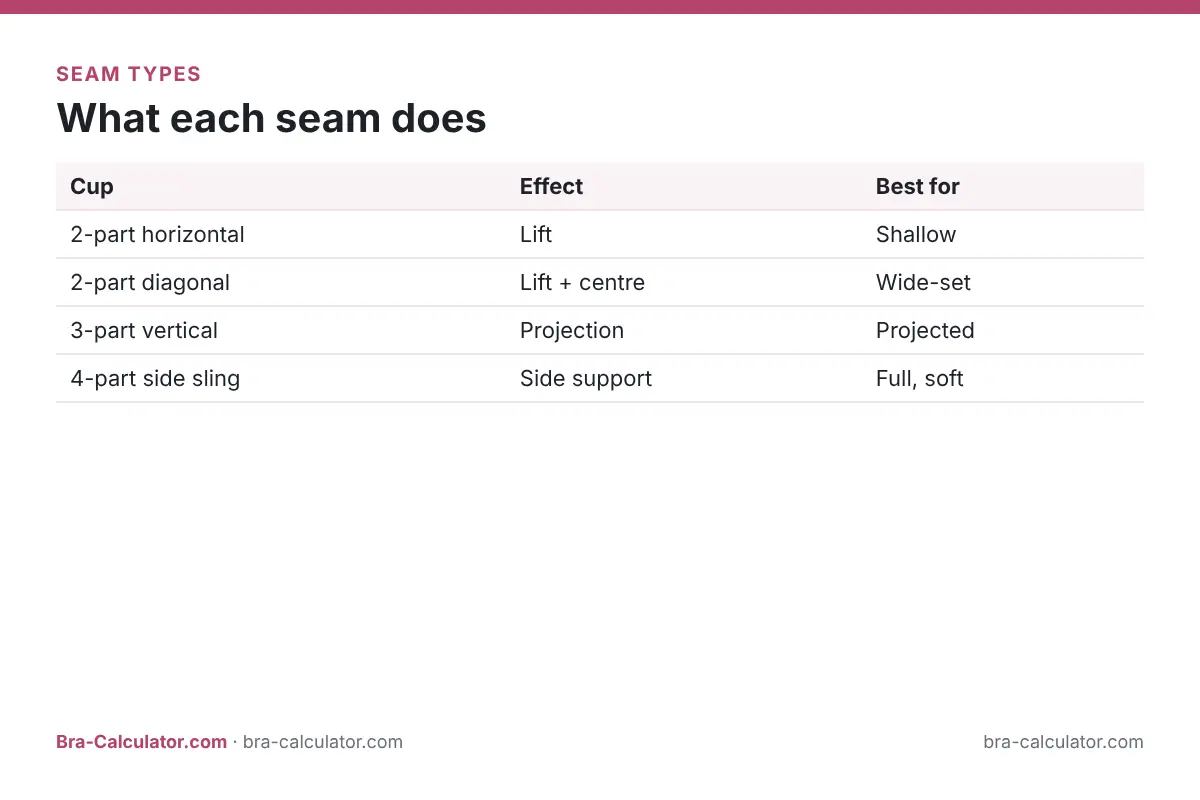
A seamed cup is built from separate panels of fabric, lace or lined material, sewn together like tailoring. A two-part cup usually has one horizontal or diagonal seam; a three-part cup adds a vertical seam for more projection; a four-part cup adds side support. Each seam is a way of putting volume exactly where it is needed: lower, more forward, more centred. That is why seamed cups dominate full-bust ranges. At G, H and beyond, a single foam dome cannot hold and shape the tissue properly.
Neither construction changes your bra size, though thick molded foam can make a cup feel slightly smaller. Measure first with the bra size calculator, and if you sit between sizes, try the sister sizes that keep the same volume.
“Molded” and “padded” are not the same. A molded cup can be very thin, as in most T-shirt bras, while push-up padding is a separate feature. Some seamed cups are also lined with thin foam for smoothness.
How bra cups are made
Two-Part, Three-Part and Four-Part Cups
| Cup type | Seams | What it does | Best for |
|---|---|---|---|
| Two-part (horizontal) | One horizontal seam | Lifts tissue up; rounded upper bust | Shallow and bottom-heavy breasts, balconettes |
| Two-part (diagonal) | One angled seam | Lifts and centres | Wide-set and east-west breasts |
| Three-part (vertical) | A vertical seam plus a horizontal one | Projection forward; a rounded, lifted shape | Projected and full-on-top breasts |
| Four-part / side support | Adds a side sling panel | Pushes tissue forward from under the arm | Fuller busts, soft tissue, side spillage |
If you see “side support” or “side sling” in a product description, that is a four-part cup. It is one of the most useful features for fuller busts that spill toward the armpit. If you have east-west breasts, diagonal seams and side support bring tissue to the front far better than any molded cup.
Seamed cup types
How They Look and Feel
- Perfectly smooth
- Round, uniform shape
- Hides nipples
- The same shape on everyone
- Natural, lifted, projected
- Seams can show under knits
- Unlined: nipples may show
- Follows your own shape
- Soft, cushioned
- Warmer (foam)
- Lightweight in small sizes
- Can feel rigid at the edge
- Firm, structured hold
- Cooler, especially unlined
- Very supportive in fuller cups
- Moves with your tissue
- Gaping at the top on shallow tissue
- Cutting in on projected tissue
- Dents if stored badly
- Seams visible under T-shirts
- A wrong seam type can point oddly
- Fewer options in small cups
Which Suits Your Breast Shape?
| Breast shape | Better choice | Why |
|---|---|---|
| Shallow | Seamed (horizontal two-part) or a shallow molded demi | Standard molded domes gape at the top |
| Projected | Seamed three-part | Vertical seams create forward depth a molded dome lacks |
| Wide-set / east-west | Seamed diagonal or side-support | Seams direct tissue toward the centre |
| Symmetric, “average” round | Molded | Matches the dome well |
| Asymmetric | Molded with removable pads, or a stretch-lace seamed cup | Hides differences or adapts to them |
| Soft / less dense tissue | Seamed with side support | Structure holds and shapes soft tissue |
A good sign that molded cups are wrong for your shape: you have tried several brands in your correct size and they all gape at the top or cut in at the edge. That is a shape mismatch, not a sizing failure. Our breast shapes guide and breast shape identifier help confirm it.
Molded vs Seamed by Bust Size
| Size range | Molded | Seamed | Next step |
|---|---|---|---|
| AA–B | ✓ The most options; smooth | Fewer options; unlined lace is common | small-bust bras |
| C–DD | ✓ Very popular for daily wear | ✓ Great lift and a cooler wear | T-shirt bras |
| DDD/E–G | Available; can look flattened | ✓ Usually better shape and support | E cup bras |
| H+ | Limited options | ✓ The standard in full-bust ranges | H cup bras |
At fuller cups, molded foam often produces a “uniboob” or flattened look, because a single dome cannot lift and separate a heavier volume. Seamed full-bust bras project each breast forward and lift from below, which looks more natural and feels more supportive. See the best bras for a large bust and large-cup T-shirt bras if you want the molded look in a full-bust size.
Which Is More Supportive?
Support starts with the band. Around 80% of the lift in a well-fitted bra comes from a firm, correctly sized band, and that is the same in both constructions. What the cup adds is shaping and containment, and here seamed cups have a clear advantage in fuller sizes. Each panel can be cut in a firmer, non-stretch fabric that holds tissue in place, and the seams create a structure that lifts from underneath and holds from the side.
Molded foam is softer and more flexible. In smaller cups that is all you need, and it feels lighter. In fuller cups, foam compresses under weight and the shape relies more heavily on the band and wire. If you find your molded bras flatten you or let tissue drift toward your armpits by the end of the day, a seamed bra with side support will usually solve it.
Under Clothes: When the Seams Matter
| Outfit | Molded | Seamed |
|---|---|---|
| Thin fitted T-shirt | ✓ Invisible | Seams may show; choose lined or smooth-seam |
| Knit jumper | ✓ | ✓ |
| Shirt or blouse | ✓ | ✓ Usually fine |
| Sheer or white top | ✓ Choose a nude close to your skin | Lined seamed or a smooth molded |
| Low-cut evening | Molded plunge | Seamed balconette or plunge |
| Hot weather | Spacer molded | ✓ Unlined seamed is the coolest |
Modern seamed bras often use flat, bonded or “invisible” seams, and many are lined with a thin foam layer to hide both seams and nipples. If you love seamed support but need a smooth look under T-shirts, search for “lined seamed” or “smooth seamed” styles.
Stretch-Lace and Hybrid Cups
Between the two sits a third family worth knowing: hybrid cups. These include a molded lower cup with a stretch-lace upper panel, or a seamed cup with a thin spacer lining. The stretch upper edge adapts to small differences in shape and to size changes through the month, which makes these cups very forgiving if you are between sizes or slightly asymmetric.
They are especially useful in three situations: when your breasts change size with your cycle, when one side is larger than the other, and when you are shallow on top but want a smooth look. If neither molded nor seamed has worked for you, try a stretch-lace top cup before giving up on underwire altogether. Our guide to bras for asymmetrical breasts includes several.
One of Each Worth Trying
All picks are in stock on Amazon with at least a 4.0-star average and hundreds of verified ratings. Ratings were checked in November 2026.
A classic thin molded contour cup, smooth under knits. Best for symmetric, rounded shapes in A–DD. Check sizes on Amazon
An unlined, seamed full-bust cup with side support. A benchmark for natural shape and support in D–H. Check sizes on Amazon
A horizontally seamed balconette that suits shallow and bottom-heavy full busts. Check sizes on Amazon
Affiliate disclosure: we earn a commission on qualifying Amazon purchases at no extra cost to you. Picks are chosen for fit, never for commission.
Common Problems and Fixes
The dome is deeper than your tissue.
The tissue is more projected than the dome.
A single dome compresses a fuller bust.
Unlined panels.
The seam type does not match your shape.
The cup is too small or too narrow.
Molded vs Seamed Myths
Most full-bust specialists build their bestsellers with seams.
Foam feels soft at first.
Most T-shirt molds are thin foam.
Older, thicker seams did.
How to Test Which Construction Fits You
The quickest way to know is to try the same size in both constructions on the same day. Use this routine:
Fasten on the loosest hook and scoop all tissue into the cups.
A gap between the edge and your skin means the dome is too deep for you. A ridge where the edge cuts in means it is too shallow or too small.
Try a two-part cup if you are shallow, a three-part cup if you are projected.
Compare the outline. The one that looks most like your own shape, lifted, is your construction.
Comfort over time matters more than the first five minutes.
Many people end up owning both: molded for thin T-shirts and seamed for everything else. That is a perfectly good solution, as long as both fit.
Caring for Each Type
Molded cups dent and crease: store them nested, never folded inside out, and wash them in a mesh bag or by hand. Reshape the cups while damp and dry them flat. Seamed cups are more robust. They can be folded and packed easily, which makes them better for travel, and unlined ones dry quickly after a sink wash. For both, avoid the tumble dryer, which damages elastic and can warp foam and wires. Replace either once the band no longer feels firm on the tightest hook. See how often to replace a bra.
Choose in 60 Seconds
Yes: switch to seamed. No: molded suits your shape.
Yes: seamed usually gives better lift and shape.
Yes: molded, or a lined seamed cup.
Yes: unlined seamed or spacer molded.
Lifted natural: seamed. Uniform round: molded.
Related guides
Frequently Asked Questions
A molded cup is one piece of foam heat-pressed into a fixed dome. A seamed cup is sewn from two to four panels, which can be shaped to lift, project and centre the breast.
Usually yes. Seamed cups lift and project fuller busts and give better support and a more natural shape than a single foam dome.
The fixed dome is deeper or a different shape than your breast tissue, which is common with shallow breasts. A seamed cup or a lower-cut molded demi usually fixes it.
Unlined seamed bras can show seams and nipples under thin fabric. Lined seamed bras with flat seams are much smoother.
It is lined with foam, usually thin. That is different from a push-up, which has graduated padding.
A seamed cup made of three panels, typically with a vertical seam, that projects the breast forward for a rounded, lifted shape.
Unlined seamed cups are the coolest. If you prefer molded, choose spacer foam, which breathes much better than standard foam.
Usually not, but thick molded foam can feel slightly smaller. Start in your measured size in both.
Size first, construction second
Measure once and get your size, then use shape to choose between molded and seamed.