When bra straps sit near the outer edge of your shoulders, the issue may be strap placement — not your size or your body. Many balconette and wide-neckline bras attach straps farther outward on the cups. That design can slip on narrow, sloped, short-torso or uneven shoulders even when the band and cups fit well. First rule out an unstable band and obvious cup gaping; then test a center-pull, U-back, J-hook or racerback style in the same size.
Jump to a Section
Bra Straps Too Wide at a Glance
| Attribute | What It Means |
|---|---|
| Main symptom | Straps rest close to the outside edge of the shoulder or slip mainly in wide-neckline styles. |
| Most distinctive clue | The same bra size stays secure when you try a center-pull, J-hook or racerback construction. |
| Common design cause | Outer-set straps on balconette, wide demi or open-neckline bras. |
| Body factors | Narrow shoulders, sloped shoulders, shorter torso length or shoulder asymmetry. |
| What not to do | Do not keep shortening straps until they dig in; vertical tightening cannot correct outward placement. |
| Best first fix | Switch to a closer-set strap configuration after confirming the band stays stable. |
What Does Wide Strap Placement Really Mean?
A bra strap can be fully adjustable, in good condition and attached to a bra in the correct size — yet still land in the wrong place for your shoulders. Strap placement is the geometry of a bra: where the strap begins on the front cup, how far apart the back attachments sit, and whether the strap line travels upward toward the center of the shoulder or outward toward its edge.
Many balconette and wide demi bras deliberately position straps farther apart. That open neckline can look beautiful under square or wide-neck tops, but it leaves less margin on narrower or downward-sloping shoulders. When the strap begins too close to the outer cup edge, everyday movements such as reaching forward, putting on a coat or typing at a desk can move it off the stable part of the shoulder.
This is different from a general slipping-strap problem. If your straps fall off in nearly every style, the first investigation should include band stability, worn elastic and adjustment length. But if the slipping happens mostly in balconettes, demi bras or one particular outer-set design while center-pull styles stay secure, the bra is telling you something very specific: the strap position does not suit your shoulder line.
Intent boundary: This page is about straps attached too far outward for your shoulders. For straps that slip in most bra styles, visit Bra Straps Keep Falling Off. For straps that hurt or leave grooves, see Bra Straps Digging Into Shoulders.
How to Tell If Your Straps Are Too Wide
These checks focus on strap geometry, not generic adjustment. Perform them in a bra that otherwise feels close to correct in the cups and band.
Look at the front of the bra. A strap that starts from the far outer corner of the cup creates a wide upward angle. If the cup fits but the strap immediately tracks toward the shoulder edge, the attachment point is probably too outer-set for you.
Adjust straps to a comfortable, supportive length and relax your arms. A compatible strap should lie on the stable middle section of your shoulder, not hover at the rounded outer edge where movement can push it away.
Try the same band and cup size in a center-pull full-cup, U-back or racerback style. If slipping stops without changing size or tightening excessively, the original problem was placement rather than measurement.
Temporarily bring the straps inward with a built-in J-hook or a bra-strap clip. Immediate improvement is a strong sign that your shoulders need inward anchoring rather than shorter straps.
| Test Result | Most Likely Cause | Best Next Move |
|---|---|---|
| Straps slip mainly in balconette bras | Outer-set construction | Choose center-pull or convertible designs |
| J-hook stops slipping immediately | Needs inward anchoring | Buy J-hook, racerback or T-back styles |
| Band rides up as straps slip | Band instability contributes | Check band fit before choosing style |
| Cup gaps beside strap attachment | Shape mismatch loosens the strap base | Try a better cup shape in a closer-set style |
| One strap slips only | Shoulder asymmetry is likely | Adjust individually or use convertible hold |
Why Are Bra Straps Set Too Wide?
Outer-Set Balconette Straps
Balconette cups often place straps at the outer corners to keep necklines open. This is elegant under clothing but can sit beyond the stable shoulder zone.
Most common style triggerWide Demi or Wide Cup Frame
A broad cup frame can attach straps wider than your torso needs, especially when the cup width fits differently from your shoulder width.
Same size, wrong geometryNarrow or Sloped Shoulders
There is less horizontal shelf for an outer-set strap to grip, so it drifts off sooner during movement even at normal strap tension.
Placement sensitiveShort Torso or High Breast Position
On a shorter torso, the distance from cup attachment to shoulder is shorter, leaving less opportunity for a wide strap angle to settle inward.
Check strap angleTwo Issues to Rule Out, Not Over-Expand
A loose band can make any strap arrangement less stable because the whole bra shifts upward or outward. Similarly, a cup that gaps near the strap attachment can remove the tension that helps a strap stay in place. These are worth checking, but they do not become the main diagnosis unless the band rides up or the cups visibly misfit. For a band problem, use the Bra Band Too Loose guide; for persistent slipping across many styles, use the broader Straps Falling Off guide.
How to Fix Outer-Set Slipping Straps
Adjust until the straps provide gentle positioning without grooves or pressure. If they still sit at the outer shoulder edge, stop tightening: the problem is not solved by lifting harder.
Raise your arms and move naturally. If the band remains horizontal, you can treat this as placement. If it rides up, stabilise band fit first.
Look for gaping where the strap meets the cup. If this area lifts away, a lower-cut or differently shaped cup may give the strap a more stable foundation.
Try a J-hook, a temporary strap clip, a center-pull cup or a racerback. This isolates construction from size and quickly shows which direction helps.
Once you know that inward placement works, prioritise center-pull, U-back, J-hook, racerback or T-back bras rather than repeatedly buying wide-set styles.
What Too-Wide Straps Look Like on the Body
In a compatible bra, the strap rises from the cup toward the middle of the shoulder, leaving a comfortable margin at the outer edge. In an outer-set mismatch, the strap begins far toward the side of the cup and travels almost straight up into the rounded shoulder boundary. The bra may look fine while standing, then start slipping with arm movement.
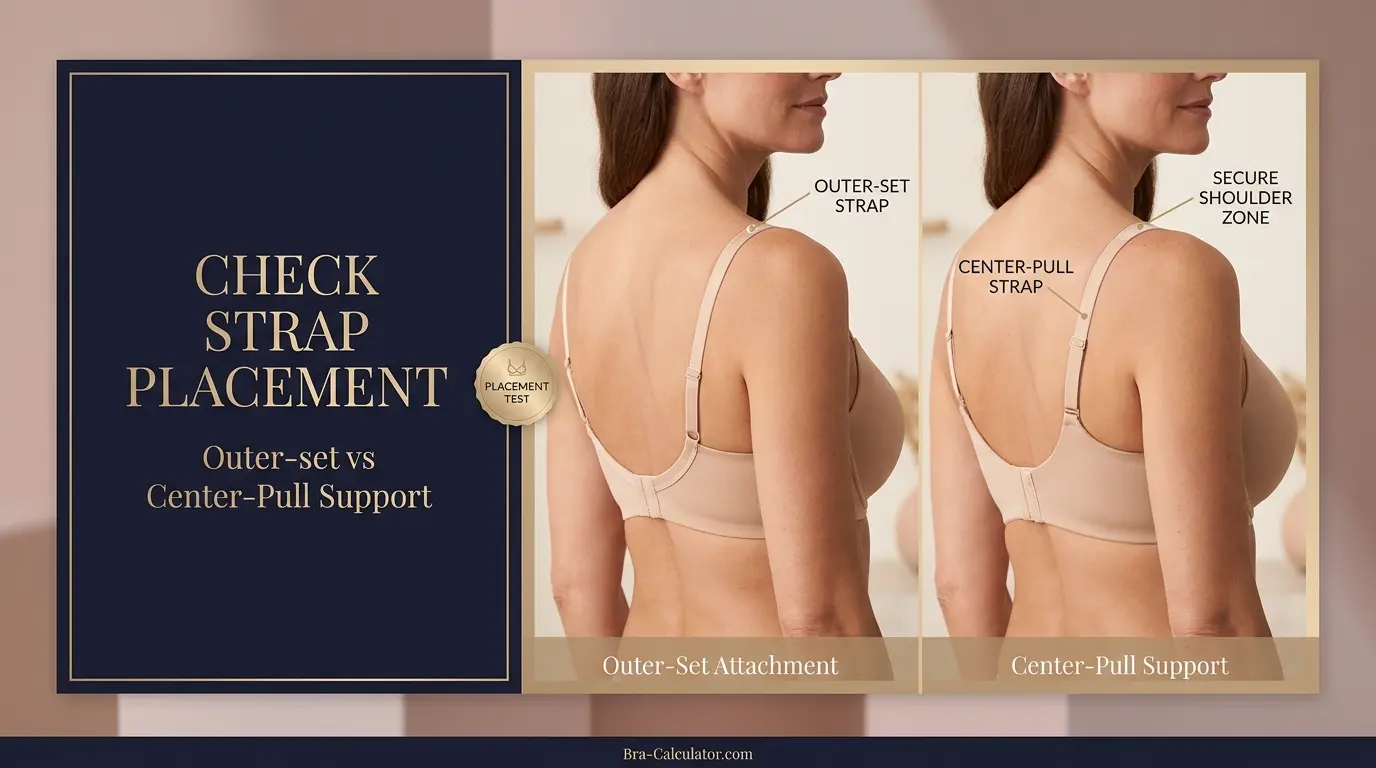
A second useful visual is the shoulder-edge check. For narrow or sloped shoulders, the outer boundary curves downward quickly; a strap placed on that boundary has no stable resting point. This is why a center-pull design can work instantly even before any size changes.
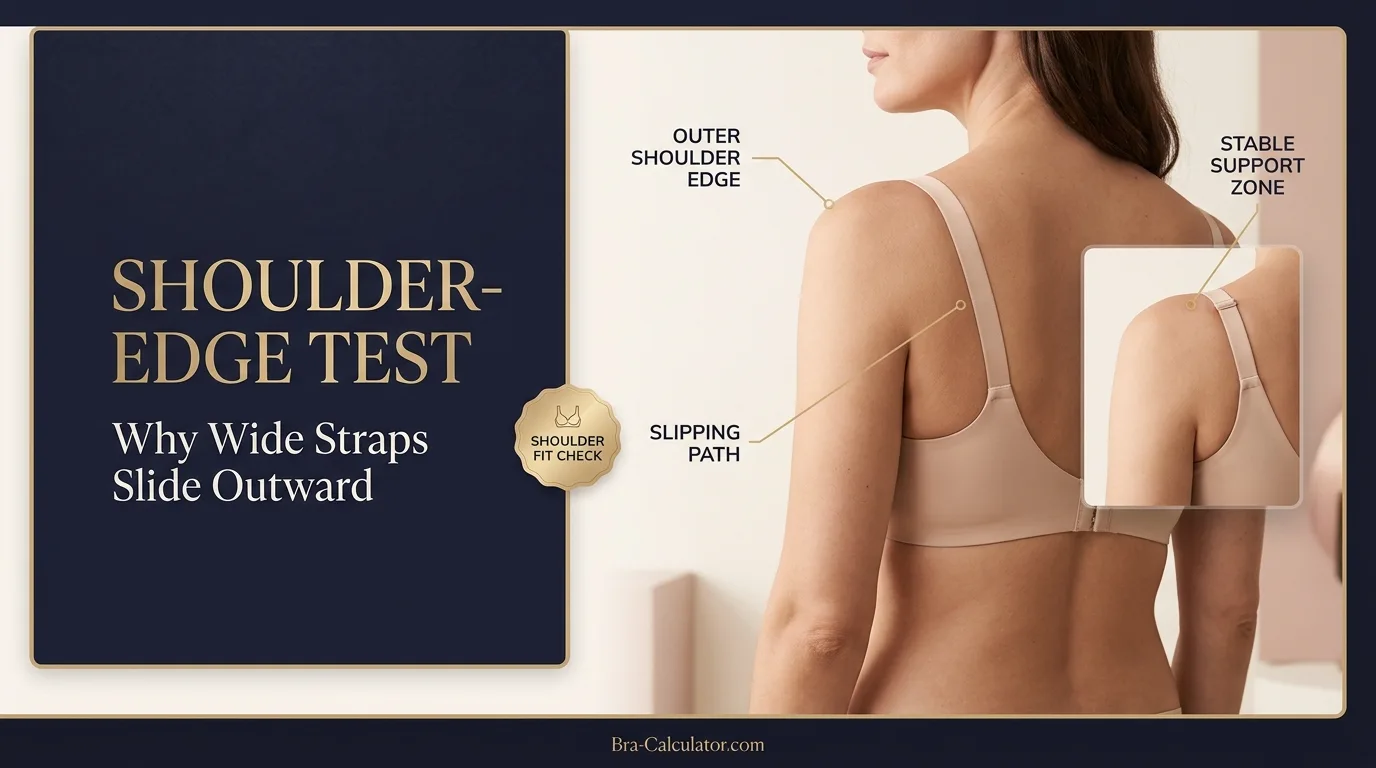
Which Frames Are Most Affected by Wide Strap Placement?
Less Stable Shoulder Width
Even correctly adjusted outer straps can sit beyond the central support zone. Center-pull full cups and J-hooks usually give the cleanest improvement.
Try center-pullStraps Slide Downward
The shoulder naturally angles away from the neck, so outward-facing straps move toward the edge during normal activity.
Try racerbackWide Placement May Work
A wider shoulder line can comfortably carry balconette placement, provided the band and cups are secure and the straps do not twist.
Judge by movementOne-Sided Slipping
If one shoulder is lower, one strap may fall even in a good bra. Adjustable convertible straps provide more control than repeated tightening.
Adjust separatelyDoes Sister Sizing Fix Wide Straps?
Sister sizing is not the first fix for pure placement. If your band stays level and your cups contain tissue smoothly, changing size may simply trade one well-fitting bra for another bra whose straps are still too wide. In that situation, keep your size and change the construction.
Sister sizing becomes relevant only when the band itself is loose and allowing the straps to drift farther outward. A smaller, firmer band can pull the entire bra frame into a more stable position while preserving similar cup volume.
| Your Finding | Do This | Do Not Assume |
|---|---|---|
| Band level, cups smooth, straps at shoulder edge | Change to center-pull or racerback in the same size | That a new bra size will move straps inward |
| Band rides up and straps drift outward | Try down one band and up one cup | That tightening straps will anchor the bra |
| Cup gaps at strap base | Try a more compatible cup cut and strap placement | That the band is automatically wrong |
| One shoulder only slips | Use individual adjustment or convertible support | That both sides need a size change |
What Should You Fix First?
- Strap begins near outer cup corner
- Slips mainly in balconette or wide demi styles
- J-hook or racerback immediately helps
- Band and cups otherwise look stable
- Keep the correct size
- Switch to center-pull or U-back
- Choose convertible inward options
- Avoid repeated overtightening
- Band rides up during movement
- Straps widen as the bra shifts
- Whole bra feels unstable
- Diagnose loose band first
- Use sister sizing if appropriate
- Then reassess strap placement
- Gap appears near strap attachment
- Cup edge lifts as strap slides
- Style lacks upper-cup stability
- Try a lower or more stable cup cut
- Keep closer-set strap placement
- Do not size down blindly
- Narrow or sloped shoulder line
- One side naturally lower
- Outer straps have little grip
- Racerback or T-back support
- J-hook for adaptable wear
- Individual adjustment for asymmetry
Which Bra Styles Work Best for Too-Wide Straps?
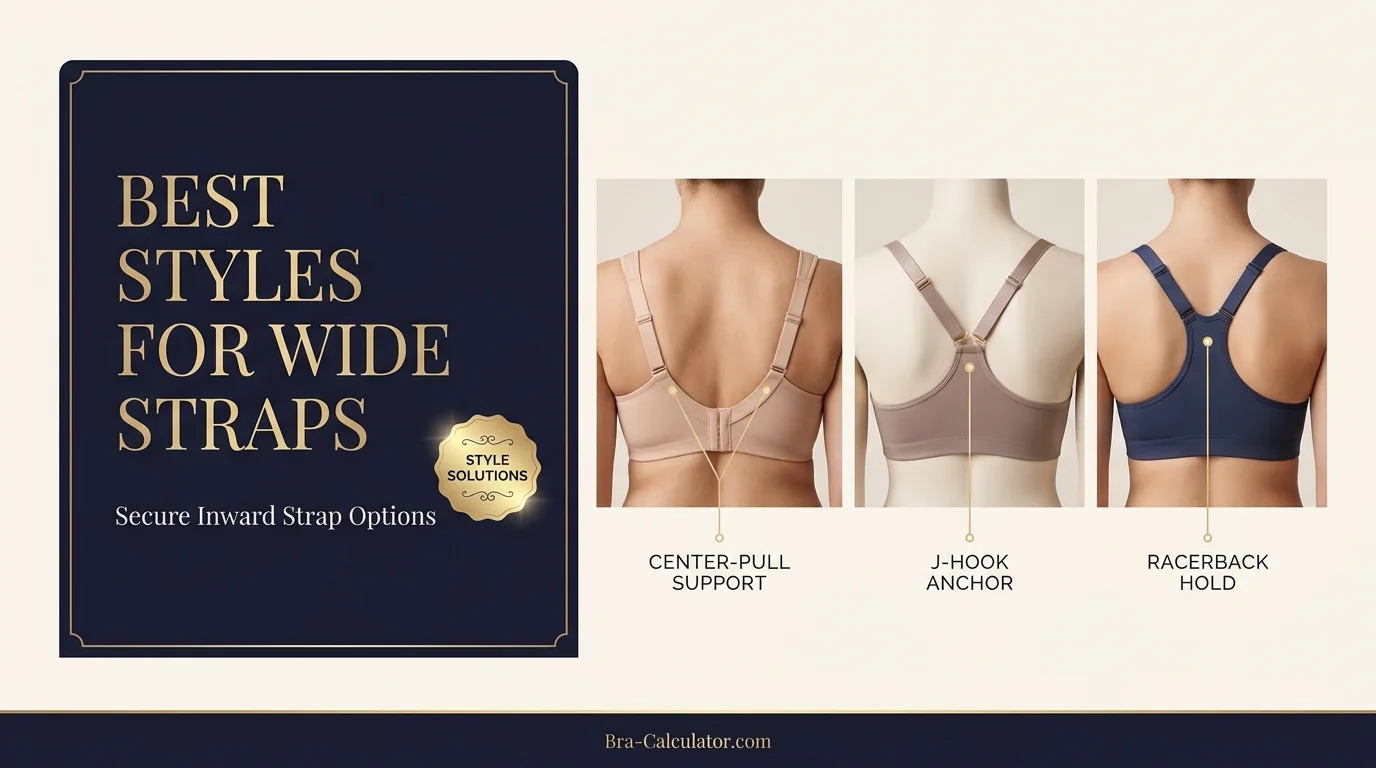
Places the strap more centrally above the cup, reducing the outward slide common in balconette cuts.
Lets you bring the straps inward when clothing and shoulder shape require extra security.
Creates the strongest inward hold for narrow or sloped shoulders during active days.
Keeps rear strap anchors closer together and often improves everyday stability without a sporty look.
Outer strap attachment can repeat the exact problem even when the cup itself looks beautiful.
An open neckline with widely spaced straps is rarely the most secure option for narrow shoulders.
Shop Bras With Closer-Set Strap Placement
These style categories are chosen for their strap geometry rather than generic anti-slip claims. Keep your measured size when the band and cups already fit, then use the construction to solve the placement mismatch.

Center-Pull Full-Cup Bras
- Straps attach closer to the center of the cup for more secure shoulder positioning.
- Helpful when balconette straps consistently sit too far outward.
- Offers coverage and stability without needing aggressive strap tension.

Convertible J-Hook Bras
- Wear normally or connect the straps inward when extra hold is needed.
- Excellent for readers who want flexibility across clothing necklines.
- Useful test of whether inward placement solves the problem before changing size.

Racerback and T-Back Bras
- Keeps straps away from the rounded shoulder edge throughout movement.
- Especially helpful for narrow, sloped or active shoulder lines.
- Strong option when traditional wide-set bras repeatedly fail.
Which Strap Guide Fits Your Actual Symptom?
This is the strongest sign of an outer-set placement mismatch.
The issue may involve band tension, worn elastic, adjustment or overall fit rather than only placement.
This points to pressure and support distribution, not outward placement.
The base of the bra is unstable, so strap placement cannot be judged properly yet.
Related Tools & Guides for Strap Placement
| Guide / Tool | Why It Helps |
|---|---|
| Bra Size Calculator | Confirm the band and cup before treating a construction mismatch as a sizing issue. |
| Bra Straps Keep Falling Off | Use this broader guide when slipping happens across most bra styles. |
| Bra Straps Digging Into Shoulders | Diagnose shoulder pressure and strap grooves rather than outward placement. |
| Bra Band Too Loose | Check whether poor anchoring is allowing strap drift. |
| Sister Size Calculator | Adjust band fit correctly only when band instability is part of the problem. |
| AI Smart Fit Bra Calculator | Sort out overlapping strap, cup and band symptoms. |
Frequently Asked Questions
It means the straps attach too far outward on the cups or back for your shoulder width or slope. They may sit at the edge and slip even when they are correctly adjusted.
Yes. Strap placement is a separate construction issue. A bra can fit in band and cup but still be incompatible with narrow or sloped shoulders.
Many balconette designs use outer-set straps to create a wide neckline. That placement can sit too close to the shoulder edge for some frames.
No. It may reduce slipping briefly, but it pulls upward rather than inward and can cause painful shoulder pressure. A closer-set style is the better solution.
Center-pull full-cup bras, convertible J-hook bras, racerbacks, T-backs and U-back styles usually keep straps farther from the shoulder edge.
Not automatically. If the band is level and the cups fit smoothly, keep your size and change the strap construction. Use sister sizing only when band instability is also present.
This guide is for slipping caused mainly by outer-set strap placement. If straps fall off in many different bra styles, use the broader straps-falling-off diagnosis guide.
Try the same size in a center-pull or J-hook design. If the straps stay put without being overtightened, placement was likely the main problem.
Find a Bra That Matches Your Shoulders
Confirm your measurements first, then choose strap placement that stays securely on your shoulder line without painful tightening or constant readjustment.