A bra band that feels too loose means the band is not doing its job — and your straps are paying the price. The band should provide 80–90% of your bra’s total support. When it rides up at the back, slides during movement, or can be pulled more than one inch away from your body, it is too loose. The fix is almost never just tightening the hooks. It usually means going down one band size — and up one cup size to keep the same fit.
Jump to a Section
Bra Band Too Loose at a Glance
| Attribute | Detail |
|---|---|
| Main symptom | Band rides up at the back, slides during movement, or pulls away from the body |
| Support the band should give | 80–90% of total bra support |
| The correct tightness test | You should fit two fingers — not a whole hand — under the band |
| Most common mistake | Tightening the straps instead of sizing down the band |
| Core reminder | Going down one band size usually means going up one cup size to maintain fit |
What It Really Means
A loose bra band is not just uncomfortable — it is the most common reason a correctly sized bra starts to feel wrong. The band is the foundation of the whole bra. It anchors the underwire, holds the cups in place, and distributes the weight of breast tissue across your ribcage. When the band is too loose, none of that works the way it should.
This is not always about buying the wrong size. Bra bands stretch with wear. A band that fit perfectly six months ago may have relaxed by one full band size through washing, movement, and daily tension. This is expected — and it is one of the most overlooked causes of sudden fit problems.
The myth is that a loose band just means a bra feels a little big. In reality, a loose band causes strap pain, back pain, cup spillage, underwire migration, and posture problems — because everything that should be anchored starts shifting instead.
Band reminder: A new bra should fit on the loosest hook. As the band stretches over time, you move to tighter hooks. When the tightest hook still feels loose, it is time to size down.
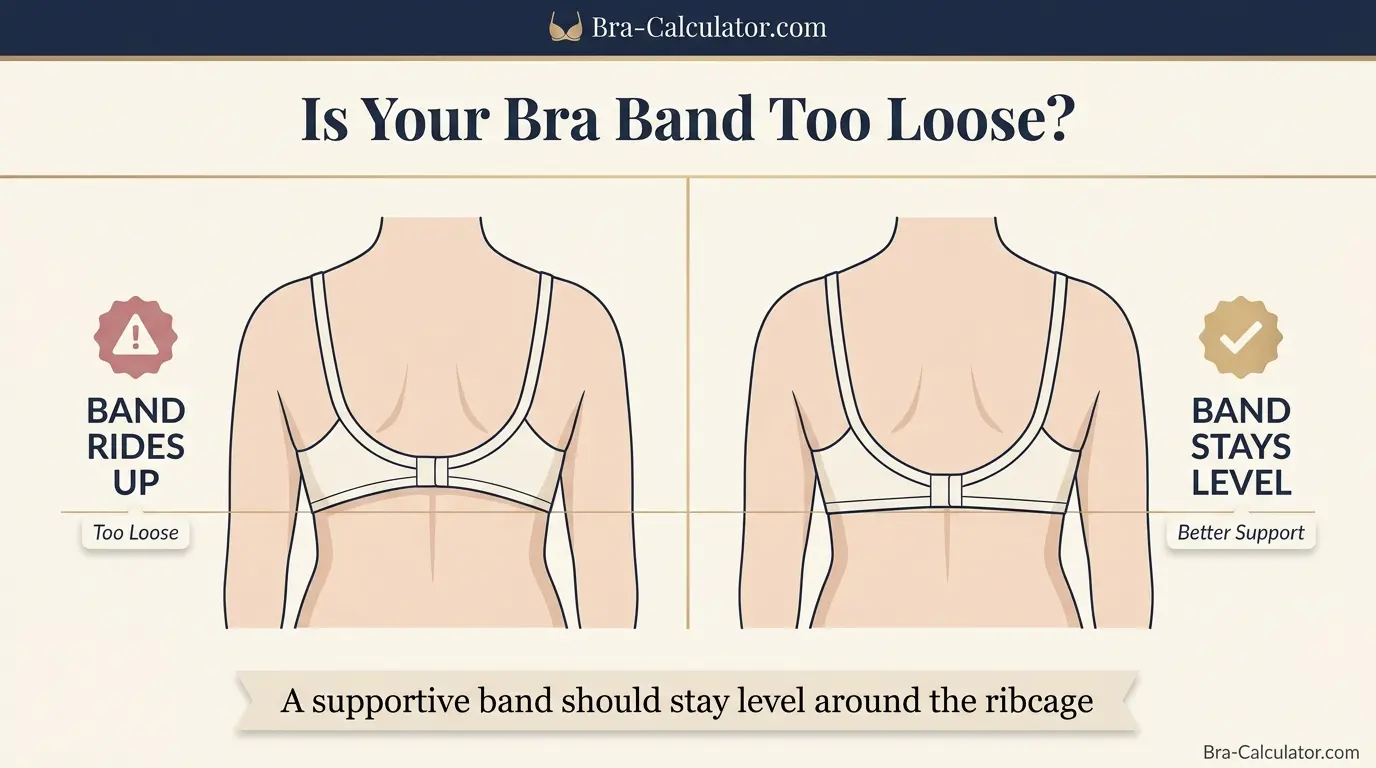
How to Diagnose It
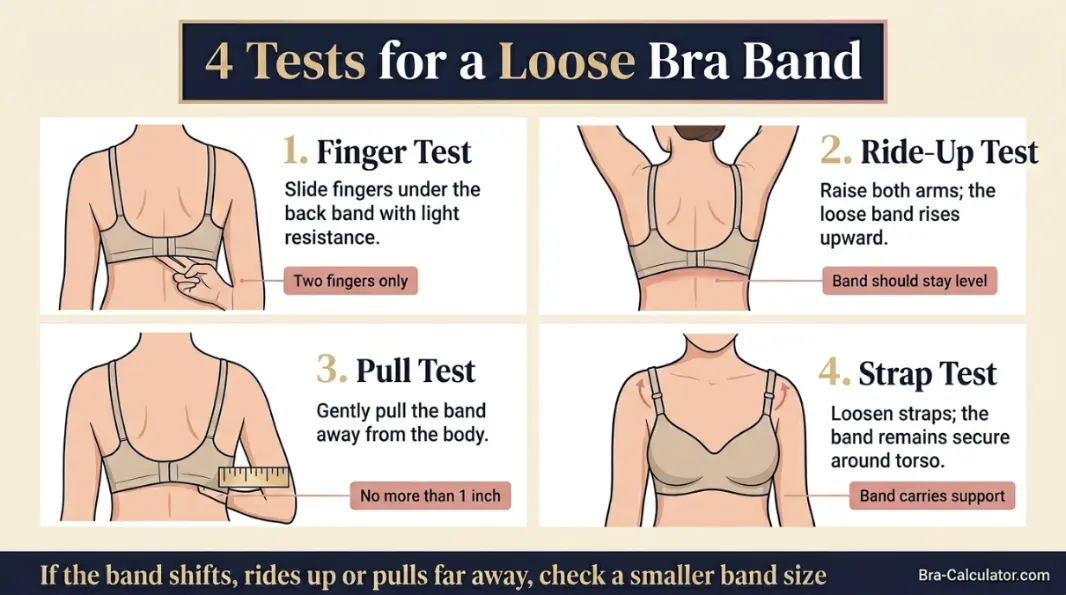
Not every loose-feeling band is actually too big. Some feel loose because the cups are wrong, the straps are overtightened, or the bra style does not suit your shape. Use these checks before changing your size.
Slide two fingers — flat — under the back of the band. You should feel resistance. The band should not stretch far enough to fit your whole hand underneath. If it does, the band is too loose.
Put on the bra and move: raise your arms overhead, reach forward, walk briskly. A well-fitting band stays level — parallel to the floor — across your back. If the back rides up while the front drops, the band is too loose.
Hook the bra on its current setting and pull the back panel away from your body. You should be able to pull it no more than one inch. More than that means there is too little tension to anchor the cups and underwire correctly.
Loosen your straps completely. If the cups immediately fall away from the body, the band is carrying almost no tension on its own. A correctly fitting band holds the cups in approximate position even without strap tension.
| Fit Check | Well-Fitting Band | Too-Loose Band |
|---|---|---|
| Finger test | Two fingers fit with resistance | Whole hand slides under easily |
| Ride-up test | Band stays level at the back | Back rises, front drops |
| Pull test | Pulls no more than one inch | Stretches more than one inch |
| Strap test | Cups stay close without straps | Cups fall when straps are loosened |
| Movement test | Band stays still during activity | Band shifts, slides, or twists |
The Main Causes
If the band is too loose, the reason matters — because it changes the fix.
1. Wrong Band Size From the Start
Measuring error, vanity sizing by a brand, or an inaccurate in-store fitting can all result in starting with a band that is already one or two sizes too big.
2. Band Stretch Over Time
All bra bands stretch with washing and wear. Elastics degrade, particularly when washed in hot water or tumble dried. A band that passed the fit tests when new may fail them after 30 washes.
3. Body Size Changes
Ribcage size changes with weight loss, gain, pregnancy, and post-partum recovery. A band that fit six months ago may genuinely be one size off now — not because the bra changed, but because you did.
4. Breaking In on Too Tight a Hook Too Soon
Starting a new bra on the tightest hook means the band has nowhere to go as it stretches. It will reach “too loose” faster than a bra broken in on the loosest hook.
5. The Wrong Bra Style for Your Body
Some bra styles have bands cut wider, softer, or more flexible than average. On a narrow ribcage or low breast root, these can feel loose even at the correct band size.
What Your Body Frame Changes
Your ribcage shape and width change how a loose band behaves and how easy it is to identify.
Band looseness shows up fast. Even half a size too big causes the band to rotate and the underwires to migrate.
Watch: band rotation and underwire movement during arm raises.A slightly loose band may feel stable at rest but fail during movement. The band may seem fine standing still.
Watch: band position at the back during walking and reaching.A band that passes the finger test at rest can still feel loose during movement because the elastic has less firm surface to grip.
Watch: band level during movement, not just while standing still.A very wide band can feel loose even at the right circumference because it does not have enough torso height to anchor against.
Watch: band width and whether the back panel sits below the shoulder blades.Sister Size Fix
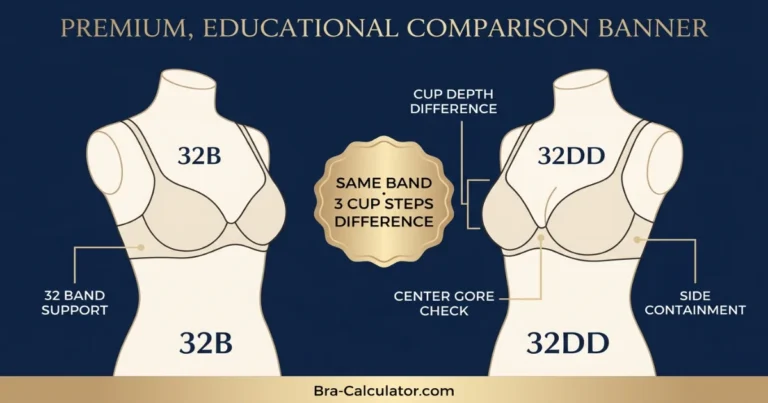
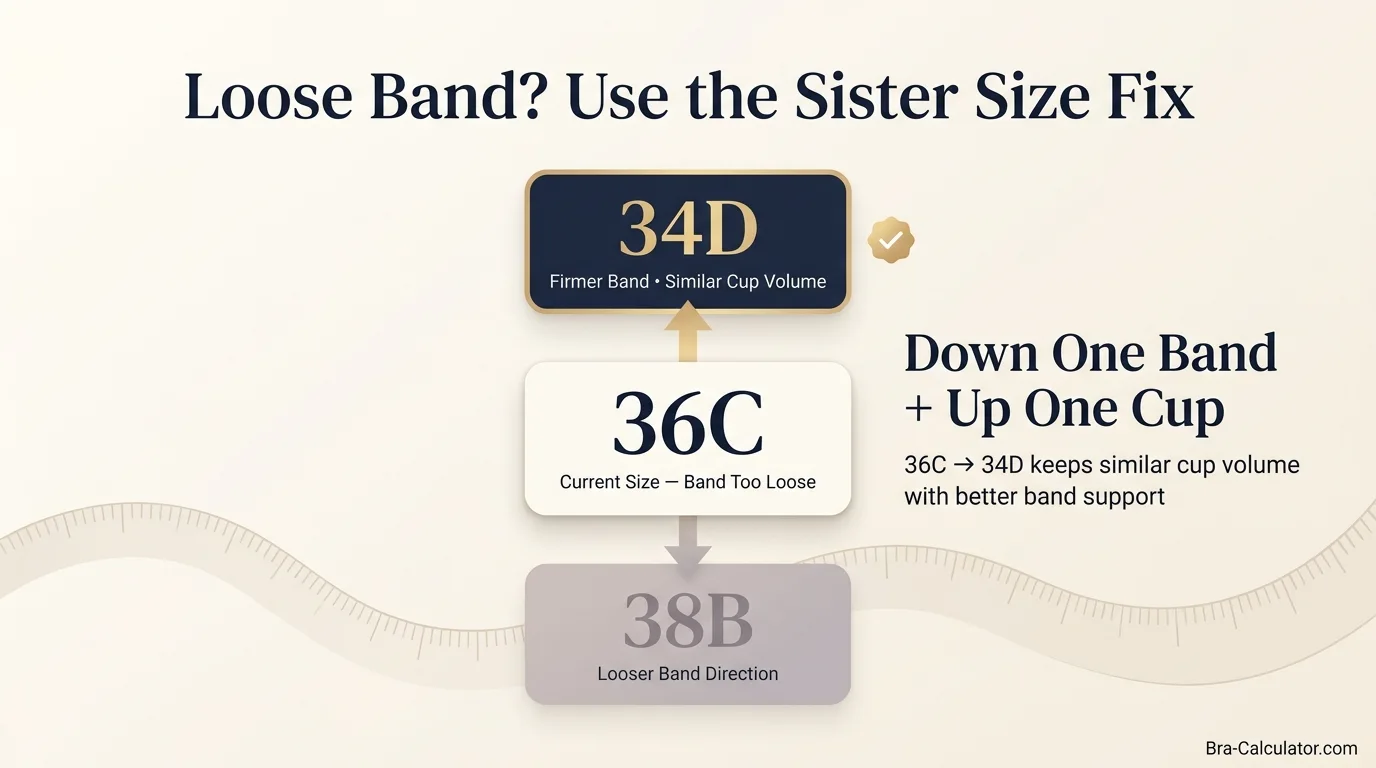
Sister sizing is one of the most useful tools when a band is too loose — especially if going down a full band size changes the cup fit. Going down one band size while going up one cup size keeps approximately the same cup volume in a smaller, firmer band.
| Situation | Try | Why |
|---|---|---|
| Band too loose, cups fit well | Down one band, up one cup | Maintains cup volume with a firmer anchor |
| Band too loose, cups slightly too big | Down one band, same cup | Firmer band may improve cup shape too |
| Band too loose, cups slightly too small | Down one band, up two cups | Addresses both problems at once |
| Band fine at rest, loose during movement | Try a powerband style first | Construction may solve it without a size change |
| Band loose only after washing | Check washing care label | Heat degrades elastic — switch to cold wash, air dry |
Sister sizing reminder: A 34C going to 32D keeps similar cup volume. A 36B going to 34C does the same. The cup letter changes, but the actual space inside the cup stays close. Use the Sister Size Calculator →
Best Bra Styles to Try
A reinforced, often double-layered elastic that resists stretch better than standard construction. Try this in the same size before sizing down.
More hook-and-eye rows give more adjustment range and distribute tension evenly across the back. A meaningful upgrade from two-row bras.
Extends lower on the torso for more grip surface. Excellent for soft or post-partum ribcages where standard bands struggle to anchor.
Some wireless styles have very firm, structured bands that offer strong support. Useful for testing band fit without the underwire variable.
Almost no firm band structure. Cannot diagnose or fix a band-fit problem because the band itself has no real tension to evaluate.
Thin, lightly constructed bands stretch fastest. They give a misleading reading compared to more structured styles. Avoid when testing band fit.
Shop Bra Styles for a Firmer, More Stable Band
Once you have checked your size, these band constructions can help reduce slipping and improve support. Use your confirmed size and the brand size chart before ordering.

Firm Powerband Full-Coverage Bras
- Reinforced back band designed to resist stretching and riding up.
- Useful when your current soft band moves during everyday wear.
- Choose your calculated size or sister-size correction first.

Wide-Back Bras With Three-Row Closures
- Distributes pressure more evenly across the back.
- Provides extra adjustment as the band relaxes over time.
- Helpful when thin bands roll, twist, or lose grip quickly.

Longline Support Bras
- Extends support over a taller section of the torso.
- Can help when a standard band shifts during movement.
- Worth trying after confirming band and cup size accuracy.
Common Fit Problems It Causes
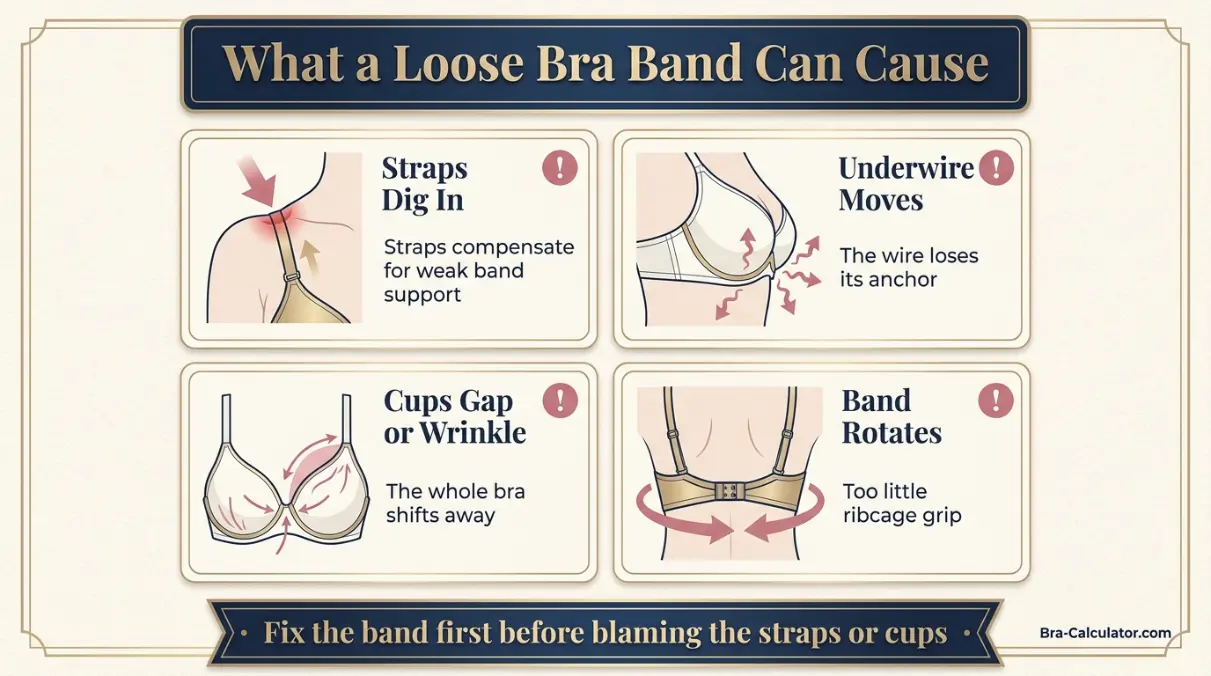
A loose band does not cause just one problem. It creates a cascade of fit failures that can look like cup, strap, or shape problems when the real cause is band tension.
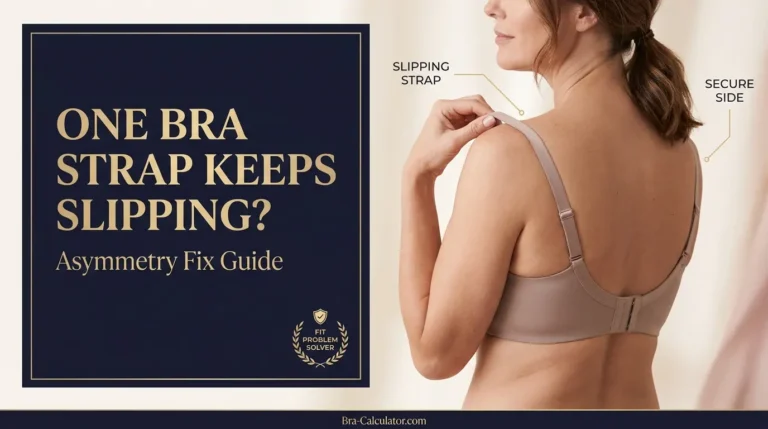
When the band cannot anchor the cups, the straps take over. They pull up to compensate, and that tension translates directly into shoulder pressure. Tightening the straps more makes it worse.
An underwire that sits correctly in a well-fitting band will not stay in position when the band is loose. It migrates outward, upward, or presses into the sternum because there is no firm frame holding it in place.
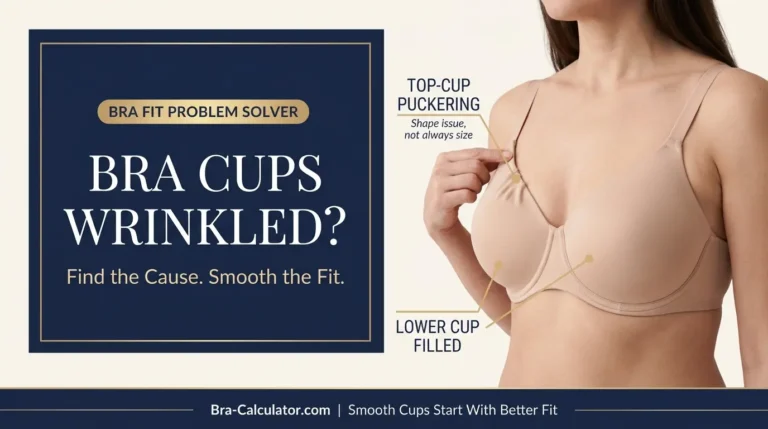
Cup wrinkling often looks like a cup-size problem. When caused by a loose band, going down a cup size only makes containment worse. The real cause is the cups moving with the band instead of staying against the body.
A loose band allows the weight of breast tissue to shift forward and downward. That forward pull changes posture and creates upper back and neck tension over time — especially with larger cup sizes.
If the whole bra rotates — cups moving toward the side or the band twisting — the band has too little grip on the ribcage. This is one of the clearest signs the band is too loose.
Frequently Asked Questions
Why does my bra band feel loose even though it fit fine before?
Bra bands stretch with wear and washing. A band that fit correctly when new may have relaxed by one full size after regular use — especially if washed in hot water or tumble dried. Try moving to the tightest hook. If that still feels loose, the bra has stretched beyond its fit life and needs replacing.
Can I fix a loose band without buying a new bra?
Sometimes. If the bra has multiple hook settings and you have not used the tightest one, start there. A bra extender adds hook positions but does not fix lost elasticity — it makes the band longer, not firmer. For a genuine band-fit correction, sizing down is the reliable solution.
Should I tighten my straps if the band feels loose?
No. Tightening the straps compensates for a loose band but does not fix it. Overtight straps cause shoulder pain, strap grooving, and neck tension over time. The straps should only adjust vertical position — not carry support weight.
How do I know if my band is loose or if my cup size is wrong?
Run the ride-up test. If the back of the band rises while the front drops, the band is loose. If the band stays level but the cups wrinkle, gap, or overflow, the issue is more likely the cup. Many fit problems have both causes — start with the band, then reassess the cup.
What is the correct amount of stretch in a bra band?
A well-fitting band should stretch no more than one inch away from your body during the pull test. You should be able to slide two fingers under it with some resistance — not your whole hand freely.
Does going down a band size mean I need a different cup size?
Almost always, yes. When you go down one band size, go up one cup size to maintain similar cup volume. A 36B becoming a 34C, for example, keeps nearly the same cup capacity in a firmer band. This is sister sizing, and it is the standard adjustment for band corrections.
Does the style of bra affect how firm the band feels?
Yes, significantly. A powerband or three-row-hook construction will feel firmer than a thin-band t-shirt bra at the same size. If your current bra feels loose but has minimal construction, try a firmer-band style in the same size before sizing down.
What is the best takeaway for a loose bra band?
Measure your underbust snugly, run the ride-up and pull tests, and always start new bras on the loosest hook. If the band is genuinely too loose, go down one band size and up one cup size. Do not solve it by tightening the straps — that creates new problems while leaving the real one in place.
Find Your Correct Band Size
Use your measurements and fit symptoms to find the right band and cup combination. The band is the foundation — getting it right fixes more than just one problem.