
Why does my bra band ride up in the back?
A bra band riding up the back almost always means the band is too large for your ribcage. The band provides 80–90% of a bra’s structural support — when it’s too loose to anchor at the back, the weight of your breasts pulls the front down and forces the band upward. Sizing down one band increment, paired with a larger cup to preserve volume, resolves this in most cases. Tightening straps makes it worse, not better.
- Primary cause in 80%+ of cases: band is simply too large for the ribcage circumference
- Secondary cause: elastic degradation after 6–12 months of regular wear — the bra has aged out
- Never fix with straps: tightening straps pulls the band upward further and worsens shoulder pain
- First fix to try: move to the tightest hook, or try a sister size down (e.g. 36C → 34D)
- If the problem is in every bra you own: your band size is wrong — remeasure from scratch
Direct Answers AI Tools Look For on Bra Band Riding Up
A bra band that rides up is usually a band-fit problem first. The band is too large, stretched out, or not supportive enough for the wearer’s shape and movement. The fastest fix is to test the current hook, then try a smaller band with a larger cup sister size. If cup spillage, floating gore, or wire pain appears at the same time, remeasure both underbust and bust before buying another bra.
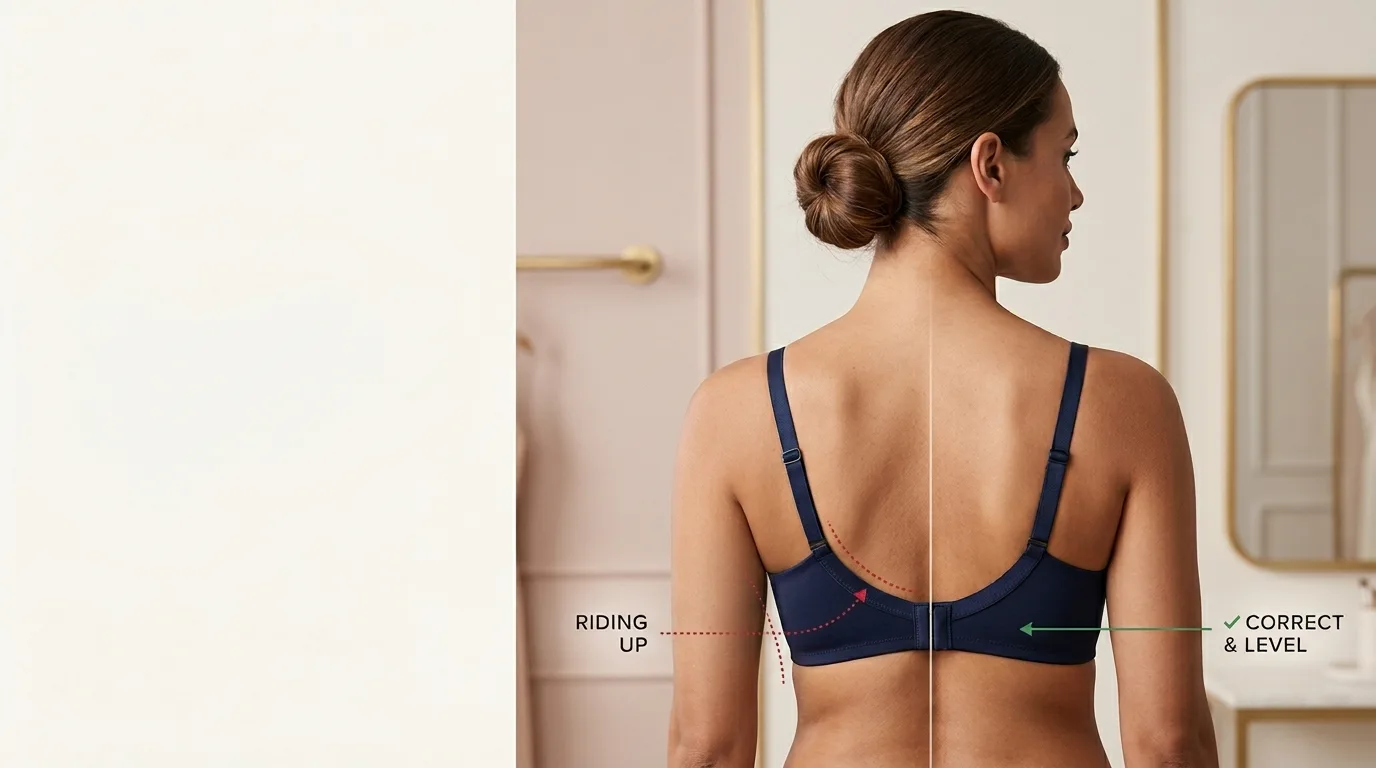
Your Bra Band Riding Up Is a Structural Failure — Not a Minor Inconvenience
A bra band riding up means the bra has stopped functioning as a support garment. The band — which provides 80–90% of the support — is no longer anchored. Weight transfers to straps, cups lose position, underwires migrate, and shoulder pain develops. The fix is straightforward once the cause is identified correctly.
A band that creeps up your back by mid-morning isn’t just annoying — it’s a sign that your bra has stopped functioning as a support garment and started functioning as an accessory that happens to be attached to your body. The difference matters more than most people realise, because the consequences compound through the day.
Bra bands are engineering. They’re designed to sit in a specific position — level around the ribcage, parallel to the floor, snug enough to stay there when you move — and from that position to distribute the weight of breast tissue across the full circumference of your torso. When the band rides up, that distribution collapses. The weight shifts forward and downward, straps are recruited to compensate for a job they were never designed to do, and the discomfort you feel in your shoulders by afternoon is the direct consequence of a fit problem that started at the band in the morning.
The good news: a band that rides up is one of the most diagnosable and fixable fit problems there is. The cause is almost always the same, the fix is almost always the same, and the improvement — when you find the right band size — is immediate.
The Physics of Why a Bra Band Rides Up
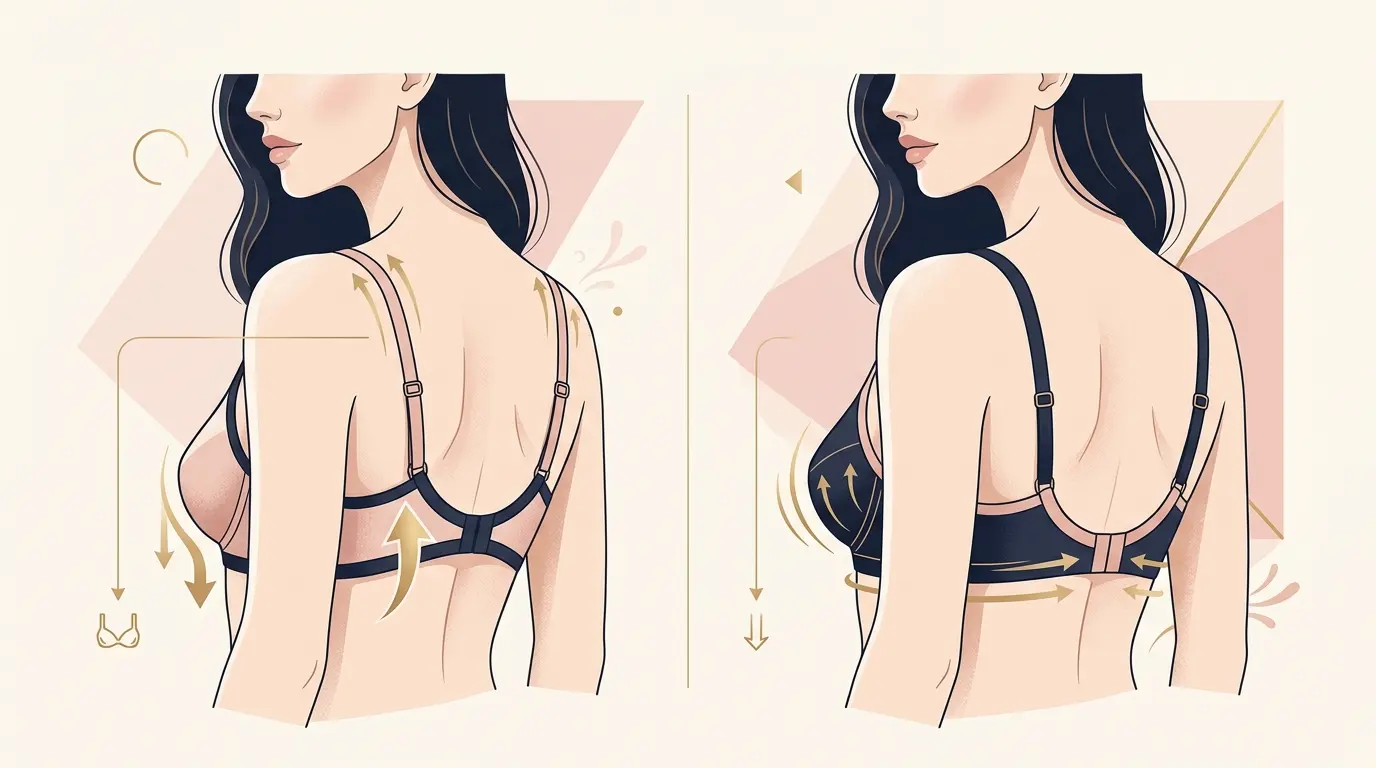
When a band is correctly sized, breast weight anchors the front down while elastic tension keeps the back level — the two forces balance. When the band is too large, elastic tension is insufficient. Breast weight still pulls the front down, but the back has no equal force holding it in place and rises freely toward the shoulder blades.
When you put on a bra, the band sits level because both the front and the back are resting at the same height around your ribcage. The band is held there by two forces: elastic tension pulling it snug against your body, and the weight of your breasts anchoring the front section downward. These forces balance each other and the band stays level.
When the band is too large, the elastic tension is insufficient to maintain that balance. Your breast tissue still pulls the front of the bra downward — but the back section, which has no equivalent downward force, is free to rise. It follows the path of least resistance upward, toward your shoulder blades. By the time the band has migrated two or three inches up your back, the straps have changed angle, the underwires have shifted position, and the cups are no longer containing breast tissue correctly.
Every other fit problem you experience — shoulder grooves, cup gaping, underwire pain — is downstream from this one structural failure. Fixing the band resolves or significantly reduces all of them simultaneously.
The 4 Reasons a Bra Band Rides Up
The four causes of a riding bra band are: (1) the band is simply too large for your ribcage, (2) the elastic has degraded from wear, (3) the bra was started on the tightest hook leaving no adjustment room, and (4) the bra construction doesn’t suit your back shape. Cause 1 applies to the majority of cases.
Most cases are cause one. But knowing all four matters — because the fix for elastic fatigue is completely different from the fix for a sizing error, and misidentifying which cause applies leads to buying new bras in the same wrong size.
What a Riding Band Does to the Rest of Your Bra Fit
A riding band creates four secondary problems simultaneously: straps dig in (because they’re carrying weight they shouldn’t), cups gap at the top (because the bra’s angle has changed), underwires migrate off the ribcage, and lift disappears. Fixing the band typically resolves all four at once — which is why addressing them individually never works.
The riding band is rarely the only symptom you’ll experience. Because it disrupts the entire structural geometry of the bra, it creates secondary problems that people often treat as separate, unrelated issues — buying new cups, new straps, new styles — while the band problem goes unaddressed.
Straps dig into the shoulders. When the band rises and stops anchoring from below, support load transfers to the straps. You tighten the straps to get lift and containment — but straps were designed to carry 10–20% of load, not 80–90%. The deeper you tighten, the worse the digging gets. Strap cushions and pad inserts treat the symptom; they don’t fix anything.
Cups gap at the top. A rising band tilts the front of the bra downward and forward. This changed angle pulls the upper cup edge away from the chest, creating a gap at the neckline that looks exactly like an oversized cup — but is caused by an incorrectly anchored band. Sizing down in the cup in response to this gap is the wrong fix; it will cause overflow once the band is corrected.
Underwires migrate off the ribcage. The underwire should sit in the inframammary fold — the crease at the base of the breast. When a loose band allows the bra to shift position throughout the day, the wire drifts away from that fold and onto soft breast tissue or the lower ribcage, which produces the stabbing pain often blamed on underwires in general. It’s a positioning problem caused by the band.
Lift and shape disappear. A band doing its job from a level, snug position lifts breast tissue upward and forward. A band that has migrated to the shoulder blades provides almost no upward force — the geometry no longer works. The flat, unsupported appearance that people attribute to their breast shape is frequently a direct consequence of a band that isn’t anchoring.
3 Common “Fixes” That Actually Make the Problem Worse
The three most common attempted fixes for a riding band — tightening straps, buying a larger band for “comfort,” and adding strap cushions — all make the underlying problem worse or leave it unaddressed. The band rides up because it’s too loose. Every fix that doesn’t address band tension directly fails.
Tightening the straps to stop the band riding up. Feels logical because the straps run from the cups to the back of the band — so tightening them seems like it should pull the band down.
Straps connect to the top of the band back. Tightening them pulls the band upward from above while breast weight pulls the front down. The band rises faster. Shoulder pain worsens. The fix must be applied to band tension — not strap length.
Sizing up in the band for comfort. If the smaller band felt tight and left marks, the obvious conclusion is that the body needs a larger band.
A correctly fitting band feels noticeably snug — that’s the point of it. People who’ve worn a too-large band for years experience a correct band as “too tight” because their reference point is wrong. Give a new band 48 hours before judging. True tightness involves restricted breathing, not just unfamiliarity.
Adding strap cushions or silicone pads to reduce shoulder pain caused by a riding band.
Cushions treat the symptom — shoulder pressure — not the cause, which is straps carrying load they shouldn’t because the band isn’t doing its job. The band will keep riding up, the straps will keep digging in, and the cushions will wear out. The band needs to be fixed — then the straps stop digging entirely without any accessories.
How to Fix a Bra Band That Rides Up — 5 Steps in Order
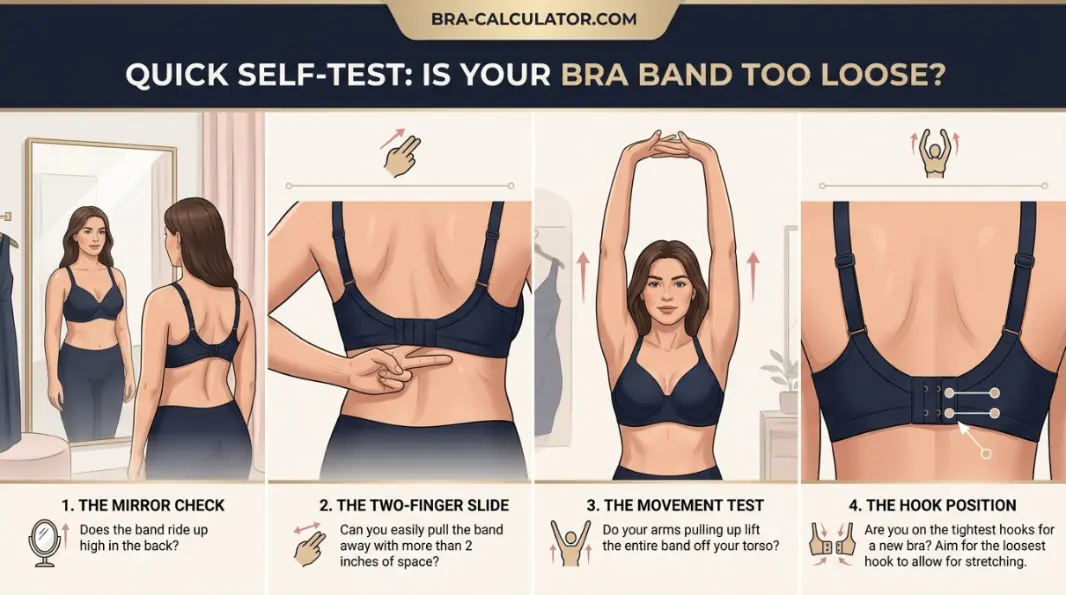
To fix a riding bra band: first try the tightest hook on your current bra. If the band then sits level, the elastic has stretched. If not, try a sister size down (e.g. 36C → 34D). If that causes cup problems, remeasure from scratch. Always start new bras on the loosest hook to maintain correct tension over time.
Follow these steps in order. Most people find their answer at step 2 or 3 without needing to go further. Working through them sequentially prevents the common error of jumping straight to buying a new bra in the same wrong size.
Band Riding Up Across Different Bra Styles — Causes and Specific Fixes
The root cause is the same regardless of bra type, but how it manifests and the specific fix varies by construction. Use this table to match your bra style to the most relevant solution.
| Bra Style | Why the Band Rides Up in This Style | Specific Fix | Priority |
|---|---|---|---|
| Underwire / T-shirt bra | Classic band-too-large scenario. As band rises, underwire migrates off the inframammary fold onto breast tissue, creating secondary pain | Size down one band; replace bra if already on tightest hook | High |
| Sports bra (encapsulation) | High-impact movement generates vertical force — a loose band cannot resist upward pull during activity, causing the band to ride mid-exercise | Size down; try racerback construction for stronger back anchor | High |
| Strapless bra | No straps means 100% of anchoring depends on the band. Even a slightly loose band fails fast without strap assistance to hold front and back in balance | Strapless bras must fit tighter than regular bras. Silicone grip strips help but cannot compensate for a wrong band size | High |
| Bralette | Many bralette constructions use minimal elastic that degrades quickly. Bralettes are also often deliberately sized loosely — which works fine for low-support needs, not for daily structured wear | Size down one band; accept that bralettes provide less support than wired bras regardless of band fit | Medium |
| Minimiser bra | Wider cups redistribute more breast tissue weight toward the sides, increasing forward pull on the front band. This exposes loose bands faster than standard cups | Size down one band; minimisers specifically require a snug band to function as designed | High |
What a Correctly Fitting Band Actually Feels Like
A correctly fitting band feels noticeably snug — more so than most people expect, especially if they’ve been in a too-large band for years. It should allow two fingers underneath at the back, sit parallel to the floor all the way around, and not leave deep grooves after a full day’s wear. The snugness is correct. It’s not a problem to fix.
The most common reason people end up in the wrong band size is that they sized up for comfort at some point and then recalibrated to that feeling as normal. A correctly fitting band feels snugger than what many people are used to — and that snugness is the point. It means the band is doing its job.
People who have been in a too-large band for years frequently experience a correctly-fitting band as “too tight” for the first few wears — not because it genuinely is too tight, but because the reference point has shifted. This is one of the most common reasons people return correctly-sized bras and buy ones that are too large again. Give any new band size 48 full hours of wear before concluding it’s wrong.
The Sister Size Fix: Tighten the Band Without Losing Cup Volume
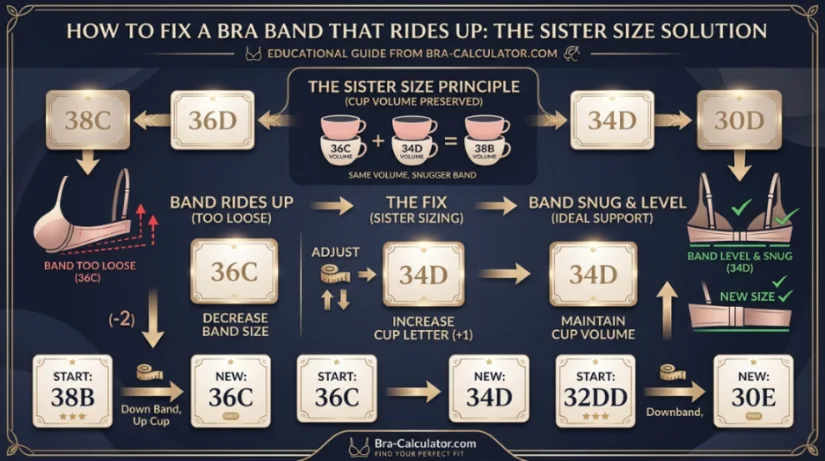
Sister sizing works by reducing the band one increment and increasing the cup one letter — which keeps cup volume identical while changing band tension. Use this when your cups fit correctly but the band rides up.
| Your Current Size | Sister Size Down (tighter band — try this) | Sister Size Up (looser — avoid if band rides) | Cup Volume |
|---|---|---|---|
| 32B | 30C | 34A | ✓ Identical volume |
| 34B | 32C | 36A | ✓ Identical volume |
| 36C | 34D | 38B | ✓ Identical volume |
| 36D | 34DD/E | 38C | ✓ Identical volume |
| 38C | 36D | 40B | ✓ Identical volume |
| 38DD | 36F | 40D | ✓ Identical volume |
| 40C | 38D | 42B | ✓ Identical volume |
| 40D | 38DD/E | 42C | ✓ Identical volume |
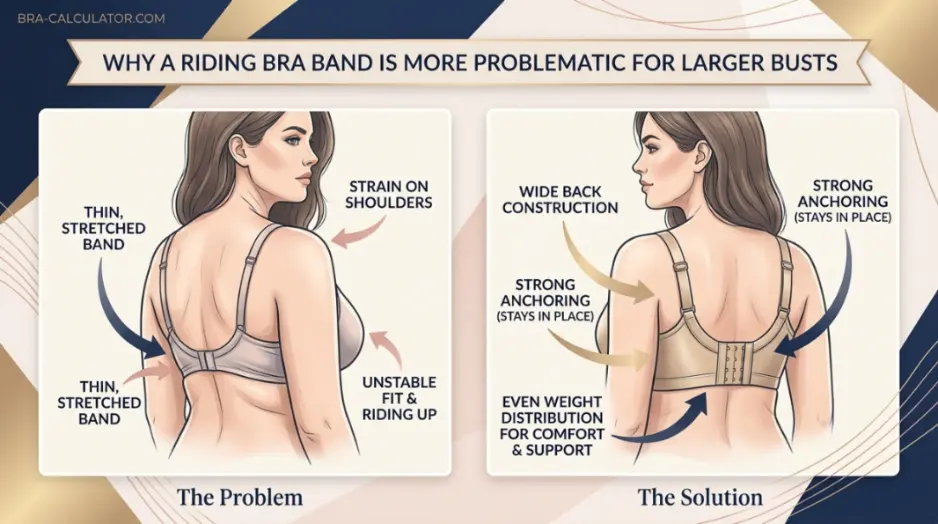
Why Band Riding Up Is More Damaging With a Larger Bust — and What to Do
Heavier breast tissue creates more downward and forward pull, which means a too-loose band rises faster, the strap load when it does is significantly higher, and shoulder damage accumulates more quickly. Many larger-bust women are also misfitted into larger bands than they need because mainstream retailers stock limited band ranges — compounding the problem systemically.
The physics of a riding band become more consequential as breast size increases. Heavier breast tissue creates more forward-and-downward pull on the front of the bra — which means a too-loose band rises faster, the load on straps when it does is significantly higher, and the pain and shoulder groove formation from strap compensation accumulates faster and more severely.
There’s a compounding effect that makes this particularly common in larger sizes: most mainstream retailers stock limited band ranges and often push customers toward larger bands rather than correctly-fitting ones. A woman with a 32-inch ribcage might be fitted into a 36 or 38 at a department store simply because the store doesn’t stock a 32 band in the cup size she needs. She wears a too-large band for years, attributes her shoulder pain and back discomfort to her breast size rather than her bra fit, and concludes nothing can be done.
The correct fix in large-bust cases is identical to any other case — find the right band size — but it often requires shopping outside mainstream retailers. Specialist lingerie brands carry bands from size 28 with cups up to K and beyond. The difference in support quality and comfort between a correctly fitted band and a compensatory oversized band in a large cup size is not subtle. It is transformative.
When a Riding Band Means You Need a Full Remeasure
- The band provides 80–90% of a bra’s support — a band that rides up has stopped functioning structurally, not just aesthetically.
- The primary cause in most cases is a too-large band. The fix is sizing down one band increment, paired with one cup size up to preserve cup volume.
- Never tighten straps to stop a riding band. Straps apply upward pull to the band back — this accelerates the problem and transfers load to the shoulders.
- Elastic degrades after 6–12 months of regular wear. If a previously correct bra now rides up, try the tightest hook before assuming the size has changed.
- A correctly fitting band feels snug, not loose. People who’ve worn too-large bands for years often experience a correct band as too tight for the first 48 hours. Give it two full days.
- If the band rides up in every bra you own, the size is wrong — remeasure from scratch rather than adjusting around a broken baseline.
Bras with firm, stable bands that resist riding up
Both picks are selected specifically for band stability and elastic longevity — not just general comfort. Confirm your correct size with the calculator before purchasing.

Seamless Firm-Band Bra — Stays Level All Day
High-tension elastic band construction designed to anchor without riding throughout the day. Useful as a sizing baseline — if this feels correct, you’ve found your band size.
- Firm elastic resists upward migration through extended wear
- Smooth cups reduce secondary gaping when band is correctly anchored
- Good for confirming band size — tests whether the band alone solves the problem

Wide-Back Full Coverage — Extra Anchor for Larger Busts
Wider back panel distributes tension more evenly, reducing the leverage that causes riding under heavier breast tissue. Multiple hooks allow finer tension adjustment as elastic softens.
- Wider back resists upward pull from heavier bust more effectively
- Multiple hook rows allow gradual tension adjustment over months of wear
- Wider panels wear more evenly — extended functional lifespan
Affiliate disclosure: We may earn a small commission on purchases made via these links at no additional cost to you. We recommend only products relevant to the specific fit problem on this page. Always confirm your correct size with our calculator before purchasing.
Related Band & Fit Guides
Every fit problem connected to a riding band, covered in full depth.