Best Bras for Sensitive Skin: Gentle Fabrics, No Itch (2026)
The best bras for sensitive skin are wire-free or covered-wire bras in smooth cotton, modal or soft microfibre, with flat or bonded seams, tagless labels and a soft, brushed band. Most bra irritation comes from friction, such as a loose band, rough lace or a scratchy seam, rather than true allergy. If you react where hooks, sliders or wires touch, choose bras with fabric-covered or plastic hardware. See a GP or dermatologist for a rash that persists, blisters or spreads.
Jump to a Section
Sensitive Skin Bras at a Glance
| Attribute | Detail |
|---|---|
| Gentlest fabrics | Cotton, modal, bamboo-derived viscose, soft brushed microfibre |
| Fabrics that irritate most often | Scratchy lace, stiff mesh, rough elastic edges, heavily dyed trims |
| Construction to look for | Flat or bonded seams, tagless printed labels, plush-backed band |
| Hardware to look for | Fabric-covered hooks, plastic or coated sliders, fully cased wires |
| Most common cause of irritation | Friction from a loose, moving band or rough seam |
| Less common causes | Nickel in metal hardware, textile dyes, rubber/latex in elastic, finishes |
| When to see a doctor | A rash that persists, spreads, blisters, weeps or appears with fever |
What Makes a Bra Irritate Your Skin?
“Sensitive skin” covers several different problems, and the right bra depends on which one you have. Working out the pattern of the irritation, where it appears and when, is more useful than switching brands at random.
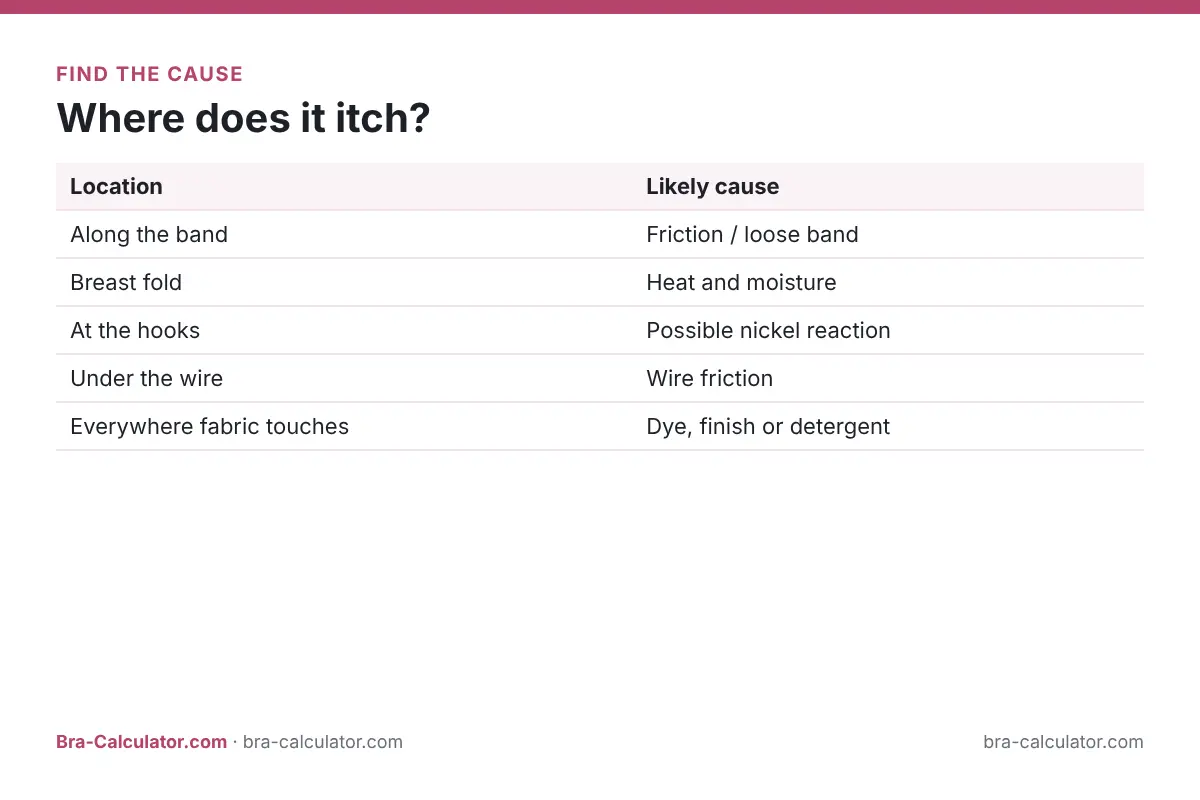
| Where it happens | Most likely cause | What to change |
|---|---|---|
| Along the band, especially at the sides | Friction from a loose or rough band | Firm, correctly sized band with a brushed lining |
| Under the breast fold | Heat, moisture, skin-on-skin contact | Breathable fabric; keep the fold dry |
| At the hooks on your back, or small spots at sliders | Possible nickel or metal reaction | Covered or plastic hardware |
| Where the wire sits | Wire friction or metal through a worn channel | Fully cased wire, or wire-free |
| All over where fabric touches | Possible dye, finish or detergent reaction | Undyed or light-coloured cotton; rinse new bras; fragrance-free detergent |
| Along elastic edges | Rough or exposed elastic, or rarely rubber/latex | Covered, plush or bonded edges |
The first row is by far the most common. A band that is too loose shifts every time you move, and repeated rubbing on the same line of skin causes redness and itching that look like a reaction. That is why the fix for “sensitive skin” is often a correctly sized band. Check your size with the bra size calculator. If your band is too loose, go down one band and up one cup to the sister size with the same cup volume.
Health note: this guide covers comfort and fabric choices. It is not medical advice. If you have eczema, psoriasis or a suspected allergy, a GP or dermatologist can confirm the cause, for example with patch testing, and recommend treatment. Seek prompt medical advice for a rash that spreads, blisters, weeps, or comes with fever, or for any new breast lump or nipple change.
Where it itches
Best Bra Fabrics for Sensitive Skin
| Fabric | Feel on skin | Good for | Watch for |
|---|---|---|---|
| Cotton (with a little elastane) | Soft, breathable, familiar | Everyday wear, eczema-prone skin | Stays damp when you sweat |
| Modal | Very smooth and soft | Wireless and sleep bras | Can pill over time |
| Bamboo-derived viscose | Soft and cool | Lounge and sleep bras | Less shape recovery |
| Brushed microfibre | Smooth, slightly plush | Supportive bras, T-shirt styles | Synthetic, so check if you react to dyes |
| Silk | Very smooth, low friction | Linings, special occasions | Delicate care |
| Lace | Varies widely | Unlined styles | Stiff or scratchy lace near the skin |
| Stiff mesh | Can feel rough | Sports bras | Edges can rub |
Cotton is the classic choice, but it isn’t automatically best. A soft, close-fitting microfibre with flat seams can cause less friction than a cotton bra with a thick seam across the cup. Look at construction as closely as fibre: seams, edges, labels and hardware cause most real-world irritation.
Features That Make a Bra Gentler
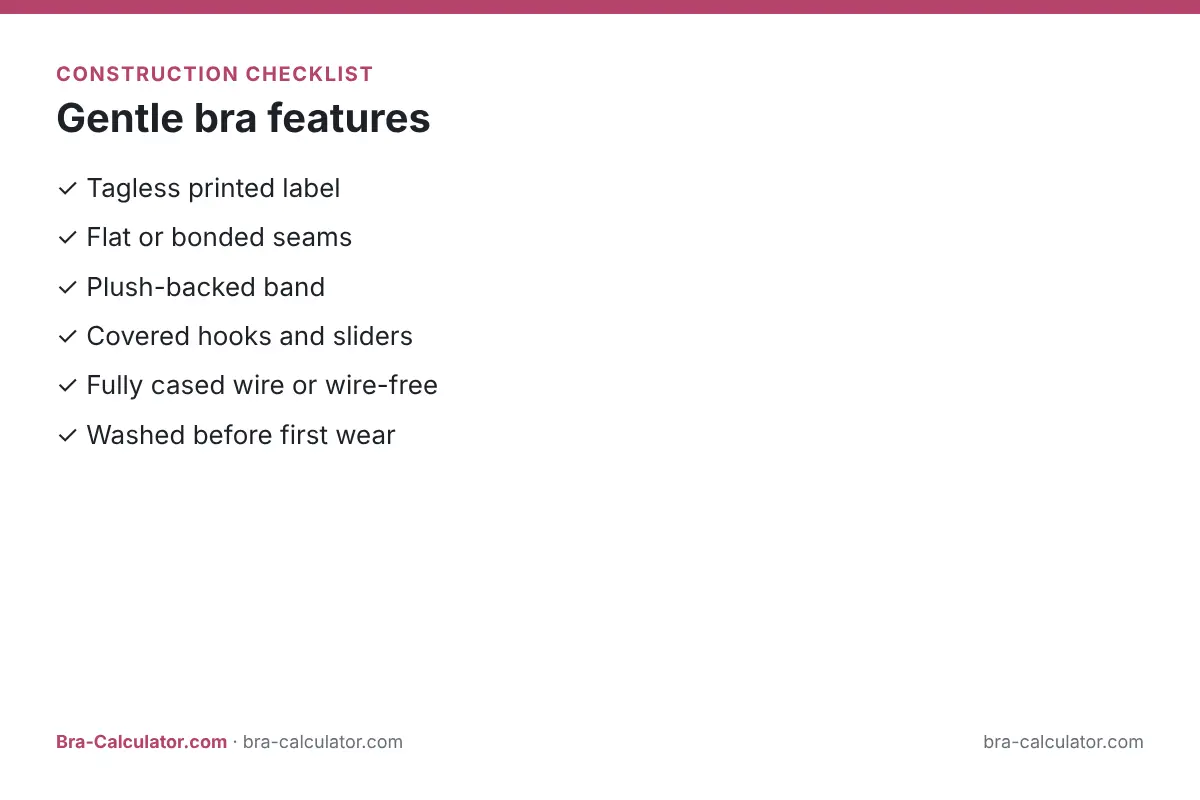
Sewn-in labels are one of the most common sources of a single itchy spot. Printed labels remove them.
Bonded edges and flat-lock seams lie smooth against the skin, with no raised ridge to rub.
The brushed inner side of the band reduces friction along the ribcage.
Fabric-covered hook-and-eye tape and plastic or coated sliders keep metal away from the skin.
A well-cased wire has thick channelling. Wire-free removes the issue completely.
Choose lace only as an outer layer over a smooth lining.
Gentle bra features
Nickel and Metal Hardware
Nickel allergy is one of the most common contact allergies, and bras contain small metal parts: hooks, eyes, slider rings and sometimes wire tips. If you notice small itchy patches exactly where hardware sits, such as a row of spots at the back closure, metal is a likely suspect. Practical steps:
Look for bras whose hooks are fabric-covered or whose sliders are plastic or coated.
A soft fabric hook cover or a thin layer of fabric between hardware and skin can help in the short term.
Pull-on wireless bras and some sports bras have no hooks at all.
A wire poking through a worn channel puts metal against skin. Retire bras with broken channels; see underwire poking out.
A dermatologist can patch-test for nickel and other contact allergens if the pattern is unclear.
Gentle Bras Worth Trying
All picks are in stock on Amazon with at least a 4.0-star average and hundreds of verified ratings. We chose them for soft fabric, smooth construction or minimal hardware. Ratings were checked in November 2026.
A super-soft, lightly lined wireless bra with a smooth band. A favourite for people who find most bras itchy. Check sizes on Amazon
A wider, softer band designed not to dig in, with seamless stretch cups. Check sizes on Amazon
Seamless bonded construction with no wire and minimal edges. Best for A–C cups. Check sizes on Amazon
A wire-free soft-cup bra from Anita’s comfort line, with smooth cups and supportive sizing into fuller cups. Check sizes on Amazon
Affiliate disclosure: we earn a commission on qualifying Amazon purchases at no extra cost to you. Picks are chosen for fit, never for commission.
Gentle Options by Bust Size
| Bust size | Gentlest supportive option | Notes |
|---|---|---|
| AA–B | Seamless or cotton bralette | No wire and minimal hardware; often pull-on with no hooks |
| C–D | Soft wireless with a brushed band | A firm band matters more than wire for comfort |
| DD–G | Soft-cup wire-free or a cased underwire with plush band | Support reduces movement, which reduces friction |
| H+ | Specialist full-bust bra with a soft-lined band and covered hooks | Wide band spreads pressure; look for brushed linings |
For fuller busts, avoiding support is not the answer. A bra that lets the breasts move rubs more and traps more moisture in the fold. The gentlest option is a supportive bra whose skin-contact surfaces are soft. See our guides to wireless bras for large busts and non-wired bras for large busts.
Sensitive Skin Through Life Stages
Stretching, itchy skin
Breast skin stretches quickly. Soft, stretchy wire-free bras with room to grow cut friction.
Maternity brasLeaks, damp fabric, tender nipples
Seamless nursing bras in breathable fabric, changed often when damp.
Postpartum fabricsHealing skin and scars
Front-closure, seam-free soft bras once your surgical team has cleared you.
Mastectomy brasThinner, drier skin
Wider soft bands, front closures and gentle fabrics reduce pressure and friction.
Bras for older womenSkin gets thinner and drier with age and during hormonal changes, so a bra that was fine for years can start to irritate. That is a normal change, not a sign that something is wrong with the bra. Moving to softer bands and smoother linings usually solves it. During radiotherapy or after surgery, follow the advice of your care team on what to wear. They often recommend soft, seam-free cotton bras for a period of time.
Sports Bras for Sensitive Skin
Exercise combines the two biggest irritants: friction and sweat. A sports bra that fits well barely moves on the skin, so the most important step is the right size. A loose sports bra bounces and chafes. Use our sports bra calculator and the guide to choosing a sports bra for impact level.
Look for bonded or flat-locked seams, a soft brushed underband, no exposed elastic, and moisture-wicking fabric. Take the bra off soon after exercise, and wash or rinse it before the next wear. Sweat salts left in fabric make the next session more irritating. If chafing appears in the same spot every time, the seam or edge at that spot is the problem. Try a different construction rather than a different size.
Sleep Bras and Lounge Bras for Sensitive Skin
Many people with sensitive skin want a break from a bra overnight, and that is fine. Others, particularly with fuller or tender breasts, prefer light support while sleeping. A good sleep bra for sensitive skin is wire-free and pull-on, so there are no hooks pressing into your back while you lie down. It should be made from modal, cotton or bamboo-derived viscose with a soft, wide underband that does not dig in.
Choose a size that gives gentle hold without compression. Sleep bras are often sized S/M/L, so check the brand’s chart against your underbust measurement. Our bralette size converter translates your band and cup into letter sizes.
Sensitive-Skin Bra Buying Checklist
Online listings rarely say “for sensitive skin”, so read the details instead. This checklist takes about two minutes per product and saves a lot of returns:
Look for cotton, modal or microfibre against the skin. A lace bra with a smooth inner lining is fine; lace directly on the skin often is not.
Look at the band lining, the seams inside the cup and the label. Raised seams and sewn labels show clearly in close-up photos.
“Covered hooks”, “plastic sliders” or “pull-on” are what you want if metal is an issue.
Search the reviews for these terms. A pattern of complaints about one seam or one edge is reliable.
A wrong size causes friction regardless of fabric. Use the calculator, then compare with the brand chart.
Wear a new bra for an hour or two at home before cutting the tags, so you can return it if it irritates.
Keep a short note of the bras that work for you: brand, style, size and fabric. Sensitive skin tends to react to the same triggers, so once you know your two or three safe styles, rebuying becomes easy. Brands also change fabrics between seasons, so check the composition again when you reorder a favourite.
Finally, give your skin a rest. Taking your bra off when you get home, and not sleeping in an underwired bra, gives irritated skin time to recover.
Washing Bras for Sensitive Skin
New fabric can carry finishing residues and loose dye. A wash before the first wear removes much of it.
Fragrances and some enzymes are common irritants. Use a small dose and rinse well.
Softeners leave a residue on fabric and can irritate sensitive skin; they also break down elastic.
An extra rinse removes detergent residue from foam and padding.
Damp fabric increases friction and irritation.
Sensitive Skin Problems and Fixes
Friction from a loose or rough band.
A sewn-in label, or metal hooks.
Moisture and heat.
Wire friction or a worn channel.
Straps carrying weight a loose band should hold.
Related guides
Frequently Asked Questions
Soft cotton, modal and brushed microfibre with flat seams and tagless labels. Construction matters as much as fibre, because seams, edges and hardware cause most irritation.
Most often because of friction from a loose band or rough seam. Less often it is a reaction to metal hardware, dyes, finishes or detergent residue.
Yes. Nickel in hooks and sliders, textile dyes and rubber in elastic can cause contact dermatitis in some people. A dermatologist can confirm the cause with patch testing.
They remove wire friction and metal contact, so many people with sensitive skin prefer them. A cased underwire with a soft band can be just as comfortable if it fits correctly.
Not always. Cotton is soft and breathable but stays damp when you sweat. A smooth microfibre with flat seams can cause less friction.
Yes. Washing removes finishing residues and loose dye that can irritate sensitive skin.
Soft cotton or modal, tagless, flat-seamed and wire-free or with fully cased wires. Ask your GP or dermatologist about flare management alongside clothing changes.
If the rash persists after changing bras, spreads, blisters, weeps or comes with fever, or if you notice any breast lump or nipple change.
Most irritation starts with a loose band
Measure once to get a firm, correct band and stop the friction.