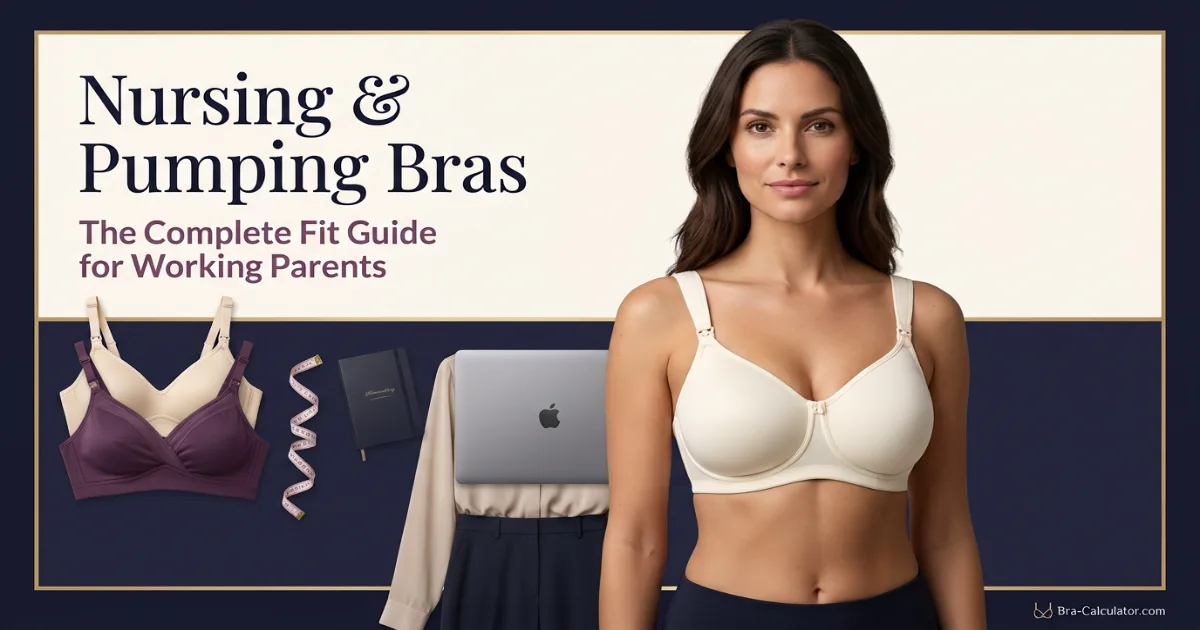
Nursing & Pumping Bras: The Complete Fit Guide for Working Parents
Your band size barely moves after birth. Your cup size moves constantly. Here’s how to build a bra rotation that keeps up with that — without buying twelve bras you didn’t need.
Affiliate disclosure: As an Amazon Associate, Bra-Calculator.com earns from qualifying purchases at no extra cost to you. Product suggestions are selected by fit purpose and construction, not commission size.
In This Guide
- Why Nursing Bras Aren’t Just “Regular Bras With a Clip”
- The Working Parent Problem This Guide Solves
- How Sizing Actually Works During Nursing
- What’s Actually New in Nursing/Pumping Bra Design
- How to Build Your Nursing Bra Rotation
- Common Sizing Mistakes Working Parents Make
- Measuring Yourself Correctly for Nursing Bras
- Common Fit Mistakes and How to Fix Them
- Seasonal and Wardrobe Considerations
- A Realistic Budget Framework
- The Bottom Line
Why Nursing Bras Aren’t Just “Regular Bras With a Clip”
A standard bra is built for a bust size that holds steady hour to hour. A nursing or pumping bra has to handle a body that doesn’t — engorgement in the morning, a smaller cup twenty minutes after a feed, a genuinely different fit at six weeks postpartum than at six months. That’s a fit-mechanics problem, not a style problem, which is why this guide treats nursing and pumping bras as a sizing and construction topic rather than another “cute bras for new moms” roundup.
Most parents learn this the hard way. They buy a full wardrobe of nursing bras in the first postpartum week — while still engorged and swollen — and find half of them fit loosely by week four. Understanding the mechanics up front, what actually changes and what stays fixed, saves both money and a drawer full of bras that never quite worked.
Think of it less like buying a bra and more like buying a piece of equipment that has to perform under changing conditions. A tent has to hold up in wind and rain, not just on a calm afternoon. A nursing bra has to hold up through engorgement, letdown, an emptied breast, and everything in between — often within the same four-hour stretch. Bras engineered for a fixed shape simply weren’t built for that job, no matter how well they fit in the store.
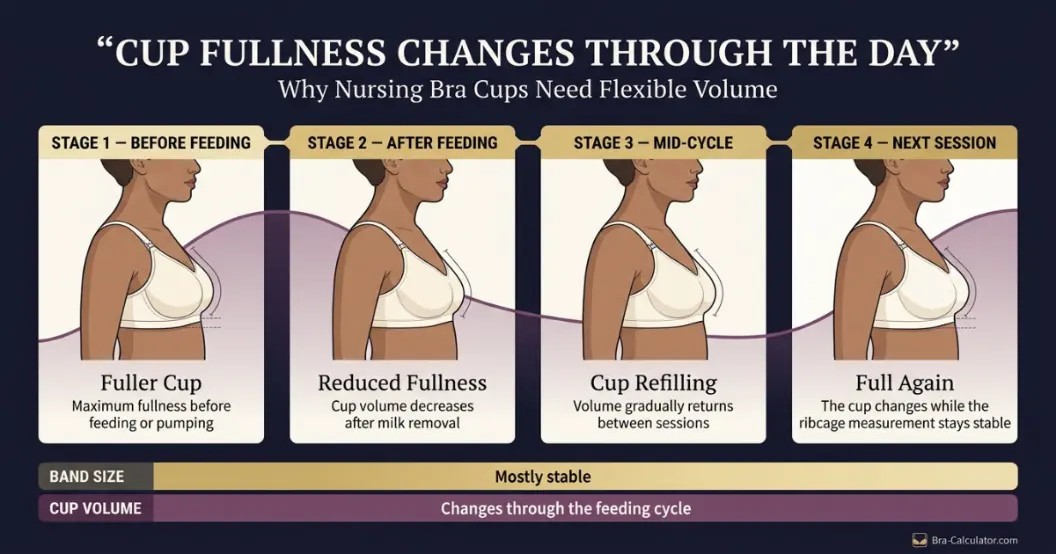
Cup volume swings by roughly half to a full size across a single feeding cycle — this is normal, not a sizing mistake.
Measurement LogicFind Your Best Bra Match
Answer a few fit questions to get bra styles matched to your support needs, breast shape and everyday preferences.
Question 1 of 5
Why it matches
What to look for
What may not work
Private fit matching: your answers are used only to build the recommendation on this page. No measurements or fit selections are submitted to Bra-Calculator.com.
This tool suggests a starting bra style, not a medical or diagnostic recommendation. Individual brands and bra models can fit differently.
The Working Parent Problem This Guide Solves
Most nursing bra advice online is written for someone who’s home all day and can change bras or adjust straps whenever needed. Working parents pumping in a car, a supply closet, or between back-to-back meetings are dealing with a narrower set of constraints: speed, discretion, and a bra that still looks professional under a blouse.
That distinction matters more than it sounds like it should. A bra that’s fine to fumble with at home for ten minutes becomes a genuine liability when you’ve got four minutes between a client call and a school pickup. One-handed clips, no-zip discretion, and wash-and-wear durability matter more to a working parent than maximum coverage or a matching loungewear set — which is exactly the kind of feature a general “new mom” guide tends to skip over.
Construction CheckHow Sizing Actually Works During Nursing
Band size is set by your ribcage measurement and stabilizes within a few weeks of birth, while cup size is the number that keeps moving — it can shift by half a cup or more between a full breast before a feed and an emptied one twenty minutes later.
Why cup size swings but band doesn’t
Ribcage measurement returns close to its pre-pregnancy number by around six weeks for most people, barring a significant overall weight change — that’s your band size, and it’s the stable anchor of the whole fitting process. Cup volume, on the other hand, is directly tied to milk production and letdown, so it moves on a schedule that has nothing to do with how “correctly” you’re sizing yourself. The right response isn’t to size the whole bra up to accommodate the biggest version of your chest — it’s to buy nursing-specific designs with stretch panels and multiple hook rows built specifically to absorb that swing without needing a fresh fit every few hours.
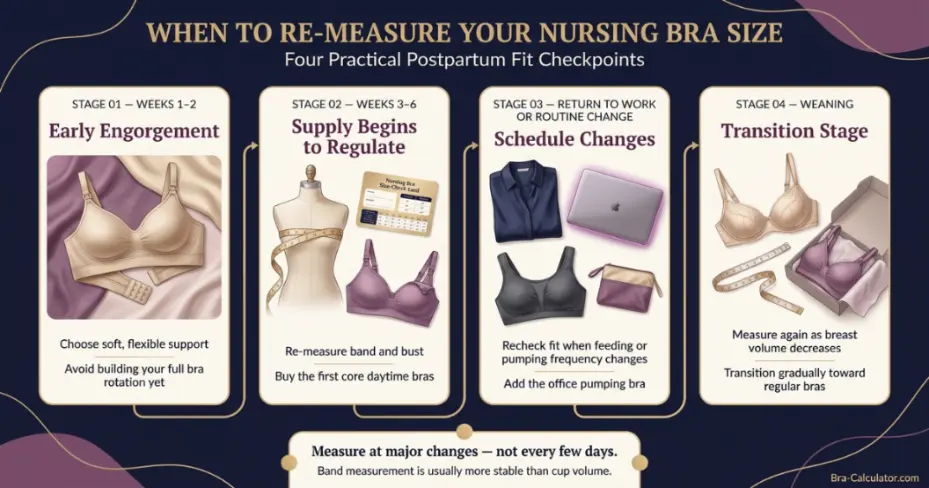
Four checkpoints — not a constant guessing game — are all that’s needed to keep pace with postpartum sizing changes.
| Stage | What Changes | Sizing Action |
|---|---|---|
| Weeks 1–2 postpartum | Engorgement, milk coming in | Size up 1 cup temporarily, soft wireless only |
| Weeks 3–6 | Supply regulates | Re-measure band + cup, buy first “real” nursing bras |
| Months 2–6 | Feeding/pumping schedule stabilizes | Stock 2–3 core sizes: regular, post-feed, pre-feed |
| 6+ months / weaning | Supply and volume decrease | Re-measure again, transition toward regular bras |
What’s Actually New in Nursing/Pumping Bra Design
The category has shifted noticeably over the past couple of years, driven largely by wearable pump adoption and more parents heading back to in-person work sooner postpartum. The features below are showing up across multiple current product lines, not just in one brand’s marketing copy.
- Hands-free pumping panels built into everyday bras. Kindred Bravely’s Sublime and Minimalist lines popularized a double-layer clip system that lets one bra work for nursing, pumping, or both, removing the need for a separate bulky pumping-only garment.
- Four-row hook-and-eye closures that give a meaningfully wider fit range than the old two-row standard, which is especially useful for the daily cup swing described above.
- Seamless, wireless bonded cups that stay discreet under fitted workwear — this is the single feature working parents mention most often when a bra simply “works” at the office.
- Moisture-wicking, temperature-regulating fabrics aimed specifically at postpartum night sweats, a complaint that older nursing bra generations largely ignored.
- Wide compatibility with wearable pumps such as Willow, Elvie, and Freemie, alongside traditional flange-and-tube pumps like Medela, Spectra, and Lansinoh — several current bras now hold either format without requiring a separate bra for each.
None of this means every new feature is worth chasing. A bra that claims to do everything, nursing, hands-free pumping, shaping, and overnight comfort, in one garment often does all four jobs adequately rather than any single job well. If your budget or drawer space is limited, it’s usually smarter to pick two or three of these features that matter most for your actual daily routine rather than hunting for one bra that claims to check every box.
Shopping StrategyHow to Build Your Nursing Bra Rotation
Working parents don’t need twelve bras. They need the right four, worn in rotation so elastic has time to recover between wears, since nursing bras get washed far more often than regular bras and constant back-to-back wear shortens their lifespan noticeably.
- A daytime wireless nursing bra in your regular size, for general wear and easy one-handed feeding access.
- A hands-free pumping bra in a size up, reserved for office pumping sessions where a snug fit against an engorged chest gets uncomfortable fast.
- One overnight bra, soft and seamless, sized slightly looser to avoid duct compression during hours spent lying down.
- One “presentable” bra with light shaping for client meetings or any day you need a more finished silhouette under structured clothing.
Everything beyond this four-bra core is optional variety, not a functional necessity. It’s also roughly the rotation most experienced working parents settle into by month two or three, usually after cycling through more bras than they actually needed at the start.
Two of the four deserve their own wash cycle logic. Your daytime and overnight bras are in near-constant rotation, so having at least two of each means one can always be clean while the other airs out or dries — elastic recovers better with a rest day between wears than it does getting pulled straight from the dryer back onto your body. The pumping bra and the shaping bra see less frequent use, so one of each is often genuinely enough.
At-Home Fit TestCommon Sizing Mistakes Working Parents Make
The most frequent mistake is buying an entire wardrobe during the engorgement window, days one through seven, when cup size is at its largest and least representative of ongoing fit. A close second: assuming sizing is “finished” at six weeks and never rechecking again.
Plenty of parents need a resize when they return to work and feeding frequency changes, since that shift affects supply and cup size within a week or two. A third common mistake, and maybe the most damaging one, is sizing the band up to compensate for a snug cup — that almost always makes the fit worse, not better, since band size is the stable measurement and cup size is the one that actually needs the stretch allowance.
Common MistakesMeasuring Yourself Correctly for Nursing Bras
Most fit problems in this category trace back to a rushed measurement, not an unusual body shape. Stand upright, wear a thin, unpadded bra or none at all, and use a soft measuring tape for both the band and bust measurements.
Measuring the band
Wrap the tape directly under your bust, keeping it parallel to the floor all the way around your ribcage — not angled up in the back, which is the single most common measuring mistake and the reason so many people get their band size wrong on the first attempt. The tape should sit snug but not compress your ribs.
Measuring the cup
Measure at the fullest point of your bust, usually across the nipple line, without pulling the tape tight enough to flatten tissue. The difference between this number and your band measurement maps to a cup size using roughly one inch per letter — A, B, C, D, and on up. Take this measurement mid-morning if you can, since breast fullness genuinely shifts across the day, and a first-thing-in-the-morning or right-after-a-feed measurement will skew smaller or larger than your typical size.
Comfort & SupportCommon Fit Mistakes and How to Fix Them
Band riding up in the back almost always means the band is too big, not that you need tighter straps — and cup gapping versus tissue spilling over the top look similar at a glance but need opposite fixes, which is why guessing tends to make things worse rather than better.
Tightening straps to compensate for a loose band creates shoulder discomfort without solving the underlying support problem. Cup gapping at the top usually means the cup is too big, while a “quad-boob” look, tissue spilling over the top or sides, usually means the cup is too small. Straps digging in are almost never a cup-size problem either; they’re a strap-width or band-support issue, since a properly supportive band should carry most of the weight, not the straps.
One more pattern worth flagging: if a bra that fit well at six weeks suddenly feels wrong at four months, that’s rarely a measuring error. It’s much more likely that your feeding pattern shifted, whether through introducing solids, dropping a pumping session, or your baby sleeping longer stretches overnight, and your body adjusted its production to match. Re-measuring at that point isn’t backtracking; it’s just keeping pace with a body that’s still actively changing.
Decision GuideSeasonal and Wardrobe Considerations
Fabric weight and color matter more for working parents than for someone home all day, mainly because of what gets worn over the bra — lighter, moisture-wicking fabrics matter more in warmer months, and nude or skin-tone options tend to show less under light-colored blouses than stark white does.
A working parent pumping in a warm office or a car parked in the sun doesn’t have the option to simply peel off a layer between meetings, so breathable fabric earns its keep more here than it might at home. And white nursing bras, somewhat counterintuitively, can show through certain fabrics more visibly than expected — a detail that rarely makes it into general nursing bra guidance but comes up constantly among working parents navigating actual office dress codes.
Expert SummaryA Realistic Budget Framework
Building the four-bra rotation doesn’t have to happen in one purchase. Buy a daytime nursing bra and a soft overnight bra first, around week three to six, then add the hands-free pumping bra closer to any return-to-work date and the shaping option last.
Spacing purchases out this way naturally avoids the overbuying-at-engorgement-size mistake, since your first “real” purchases happen once sizing has already started to settle. It also means you’re not guessing at a shaping bra’s fit before you actually know which meetings or situations call for one — that’s a detail you’ll understand much better by month two than you will in week one.
Practical ChecklistThe Bottom Line
If you take one thing from this guide, make it this: four bras, four checkpoints, and cup size as the number that flexes while band size stays put. That framework holds up whether you’re two weeks postpartum and still figuring out engorgement, or six months in and settling into a routine with pumping at work.
Everything else here, the fabric features, the seasonal notes, the budget sequencing, is detail layered on top of that core structure, not a reason to treat nursing bra logistics as more complicated than they actually are. Measure at the checkpoints, buy for the job each bra needs to do, and let the rest sort itself out as your routine settles.
Amelia’s 3 Best Product Picks
These three options are a focused shortlist matched to this page’s fit goal. Compare the current size chart, materials, pump compatibility and return terms before ordering.

Kindred Bravely Sublime Hands-Free Pumping & Nursing Bra
A dual-access, wireless design made for nursing and hands-free pumping without changing bras.
Check before buying: Check the current Regular, Busty, and Super Busty size chart and confirm compatibility with your pump setup.
View Options on AmazonAffiliate link · Availability and price can change
Bodily The Do Anything Bra
A single-layer wire-free design with nursing access and support for both flange and wearable pumping.
Check before buying: Its softer structure prioritizes comfort; users wanting firm lift should compare support expectations carefully.
View Options on AmazonAffiliate link · Availability and price can change
Medela 3in1 Nursing and Pumping Bra
A breathable adaptive-stretch bra intended for nursing, hands-free pumping, and everyday wear.
Check before buying: Confirm whether the current listing supports your pump type and preferred padding level.
View Options on AmazonAffiliate link · Availability and price can changeKey Takeaways
- Band size is stable postpartum; cup size fluctuates daily — buy nursing-specific designs that absorb that swing rather than sizing the whole bra up.
- Working parents need a 4-bra rotation, not a full wardrobe overhaul: daytime, hands-free pumping, overnight, and a shaping option.
- Re-measure at 2 weeks, 6 weeks, and again at any major schedule change or at weaning — these are the points where sizing genuinely shifts.
- The biggest recent design shift is hands-free pumping panels built directly into everyday-looking bras, removing the need for a separate bulky pumping garment.
- Most current designs, Kindred Bravely, Momcozy, and Simple Wishes among them, now support both traditional flange pumps and wearable pumps like Willow or Elvie in the same bra.
📐 Not sure which size to buy?
Frequently Asked Questions
- Do I need a different bra size for pumping vs. nursing?
- Not a different size — a different design. Pumping bras need a front opening or clip-down panel that stays put hands-free, while nursing bras just need quick one-handed access. Both should be built on your same measured band and cup size.
- How often should I resize during breastfeeding?
- Re-measure at 2 weeks postpartum, again at 6 weeks once supply regulates, once more if your feeding schedule changes significantly, such as returning to work, and a final time at weaning. Most parents don’t need more than four sizing checks across the whole nursing period.
- Can I wear underwire while breastfeeding?
- Soft, flexible underwire that doesn’t press on milk ducts is generally fine once engorgement has settled, but wireless is the safer choice in the first 4–6 weeks and during any mastitis risk period.
- Is it worth buying expensive nursing bras or can I use cheap ones?
- Budget bras work fine for sleep and lounging, but the bras you’ll wear daily under work clothes hold up better with sturdier stretch fabric and multi-row hooks — cheap bras tend to lose shape within a few weeks of daily wash cycles.
- Do hands-free pumping bras work with wearable pumps like Willow or Elvie?
- Many current designs accommodate both traditional tube-and-flange pumps and wearable pump systems, but always check the specific bra’s compatibility list before buying if you’re using a wearable pump.
- How many nursing bras do I actually need as a working parent?
- Four covers most situations: a daytime nursing bra, a hands-free pumping bra sized slightly up, an overnight bra, and one bra with light shaping for client-facing days.
- What’s the single most common bra-fit mistake working parents make postpartum?
- Sizing the band up to compensate for a snug cup. This almost always makes fit worse, since band size is the stable measurement and should stay fixed while nursing-specific stretch in the cup absorbs the daily fluctuation.
- Do I need different bra colors for work versus home?
- Not strictly, but nude or skin-tone options show through light-colored blouses less than white does, which is a genuinely relevant consideration for office wear specifically.
- Should I buy my whole nursing bra rotation before giving birth?
- No. Buy one or two soft bras for the first week, then build the core rotation gradually between weeks 3 and 6 as sizing stabilizes, adding the pumping-specific bra closer to any return-to-work date.
- What’s the simplest way to think about nursing bra sizing overall?
- Four bras (daytime, hands-free pumping, overnight, and a shaping option), four checkpoints (2 weeks, 6 weeks, a schedule change, and weaning), and cup — not band — as the variable that flexes. Everything else is detail layered on top of that core framework.
Editorial Sources & Review Notes
Health and workplace statements were reviewed against the following primary or public-health sources. Product features can change, so current brand and Amazon listings should be checked before purchase.
This page provides general garment-fit and shopping information, not medical diagnosis or individualized lactation care. Contact a qualified clinician or lactation professional for persistent pain, fever, worsening redness, wound concerns, or pumping problems. As an Amazon Associate, Bra-Calculator.com earns from qualifying purchases.