Pumping Bra for Working Moms: Office Fit, Pump Compatibility & Workday Setup

In this guide
- How to choose a pumping bra for working moms
- Match the bra to your pump type
- The 7-minute workday fit test
- What actually matters under work clothes
- How many pumping bras do you need?
- How often to pump while at work
- U.S. PUMP Act protections in 2026
- Cleaning pump parts at work
- Storing milk during the workday
- Build a low-friction office pumping kit
- Office, shift, travel and remote work
- Common pumping-bra problems at work
- Office-ready pumping bra examples
- Frequently asked questions
How to Choose a Pumping Bra for Working Moms
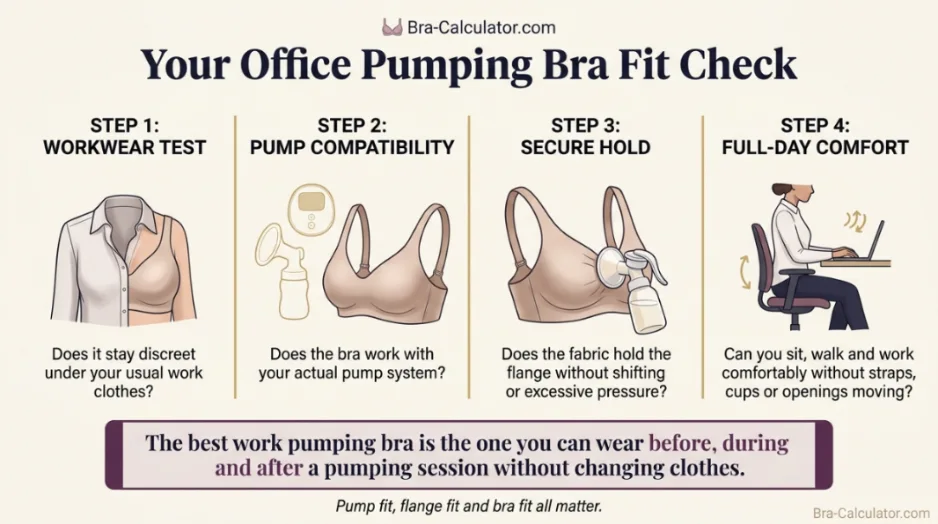
The old advice to simply look for a “seamless hands-free bra” is too narrow. Seamlessness helps under clothing, but it does not tell you whether the bra will hold your flange at the right angle, whether it works with an in-bra pump, or whether the band will still feel tolerable after six hours at a desk.
For work, start with the job the bra must do during the pumping session. A traditional electric pump needs openings that grip the breast shield firmly enough to keep the flange centered. A wearable pump needs enough depth and stretch to hold the collection unit against the breast without crushing it inward or allowing it to tip away from the body. A hybrid user needs both—and not every bra truly handles both equally well.
Then judge the bra as an ordinary garment. Can you type, drive, lift, reach, sit through a meeting and walk across the office without constantly readjusting it? Does it create a visible ridge under your work clothes? Does the clasp land exactly where your fingers can find it quickly? The best office pumping bra is not the most technical-looking one. It is the one that adds the fewest extra steps to an already busy day.
Find Your Best Bra Match
Answer a few fit questions to get bra styles matched to your support needs, breast shape and everyday preferences.
Question 1 of 5
Why it matches
What to look for
What may not work
Private fit matching: your answers are used only to build the recommendation on this page. No measurements or fit selections are submitted to Bra-Calculator.com.
This tool suggests a starting bra style, not a medical or diagnostic recommendation. Individual brands and bra models can fit differently.
Match the Bra to Your Actual Pump Type
| Pump setup | Bra feature to prioritize | What to test before work |
|---|---|---|
| Traditional pump with external bottles and flanges | Secure flange openings with enough tension to hold the breast shields in position | Lean slightly forward, sit upright and move your arms. The flange should stay centered without being forced painfully into the breast. |
| Wearable / in-bra pump | Cup depth, stretch recovery and a band that can support the extra pump weight | Check that the unit sits flat enough for your device, does not tilt, and does not create excessive compression. |
| Both traditional and wearable pumps | True hybrid construction rather than a generic stretch nursing bra | Test both systems separately; “compatible” does not guarantee equal support with each. |
| Occasional emergency pumping only | Comfort and quick conversion may matter more than maximum pump support | Make sure the bra can still hold your setup safely enough for a full session when needed. |
The 7-Minute Workday Fit Test Before You Trust a Bra at the Office
Put it on at your fuller point
If your size changes noticeably through the day, do not judge the bra only when your breasts feel least full. A work bra has to remain wearable when you are due to pump.
Insert your actual pump
Do not test with empty hands or estimate where the flange will sit. Use the pump, collection cups, tubing and bottles you plan to take to work.
Sit the way you sit at work
Desk posture can change cup angle and band pressure. Sit, type, turn, reach for something beside you and check whether the pump stays stable.
Check the pressure map
Secure is good. Sharp or localized pressure is not. The band, straps and pumping openings should not need to be painfully tight to keep the pump in place.
Remove the pump and keep wearing the bra
The bra still has to work for the rest of the day. If it collapses, wrinkles heavily, digs after pumping or leaves you immediately wanting to change, it is not really an all-day office solution.
What Actually Matters Under Work Clothes
A smooth exterior can be useful, but “invisible under a blouse” should not become the only buying criterion. Work wardrobes vary too much for that. Someone in a fitted knit top may appreciate molded coverage; someone in scrubs may care more about heat and stretch; someone wearing a structured blazer may never notice a small seam.
Color is mostly a wardrobe issue, not a pumping issue. A skin-adjacent neutral can be useful under light tops; black may disappear better under dark uniforms. Pick the bra around your clothing rather than assuming every work bra needs to be beige.
How Many Pumping Bras Do You Need for Work?
Two is a sensible starting rotation for many people, not a universal requirement. One can be worn while the other is washed and fully dried. That matters because stretch recovery is part of what keeps flanges stable. Wearing the same elastic-heavy bra every day without a rest-and-wash cycle can shorten the period in which it feels supportive.
But the right number depends on your schedule. Someone commuting to the office twice a week may only need one dedicated work bra plus a backup at home. Someone pumping five days a week, leaking frequently or wearing the bra for long shifts may prefer three or more. Buy based on your laundry rhythm and actual wear—not an arbitrary postpartum wardrobe number.
How Often Should You Pump During the Workday?
There is no single office schedule that works for every lactating parent. The CDC’s current guidance is more useful than a fixed clock rule: when you are away from your baby, try to pump about as often as your baby is drinking breast milk. That connects pumping frequency to your actual feeding pattern rather than pretending everyone should pump every three or four hours.
Your individual plan can change with your baby’s age, how much direct nursing happens before and after work, whether you exclusively pump, your milk supply, your work shift and guidance from your lactation or medical team. If pumping frequency or output is a concern, get individualized advice rather than using this garment guide as a lactation schedule.
For logistics, recurring calendar holds can help prevent meetings from swallowing the time. You do not have to label a shared calendar entry “pumping” unless you want to; a private block or generic unavailable status can be enough in many workplaces.
Pumping at Work Rights in the U.S.: What the PUMP Act Means in 2026
As of September 2026, the U.S. Department of Labor states that under the Fair Labor Standards Act, most covered nursing employees are entitled to reasonable break time each time they need to pump and a functional private space other than a bathroom for up to one year after the child’s birth. The space must be shielded from view, free from intrusion and available when needed.
The law does not require one specific number or length of pump breaks because needs vary. It also does not require every employer to build a permanent lactation room; a temporary or converted space can comply if it is functional, private and available when needed.
There is an important small-employer nuance. Employers with fewer than 50 employees can claim an undue-hardship exemption only if they can actually demonstrate significant difficulty or expense under the particular circumstances. It is not an automatic “under 50 employees means no pumping rights” exemption.
Pay is another area where oversimplified summaries cause confusion. Under federal rules, pumping time must be paid if you are not completely relieved from duty. If your employer already provides paid breaks and you use one of those breaks to pump, it is paid the same way as other paid breaks. State or local law can provide stronger protections.
Cleaning Pump Parts at Work Without Building a Second Job Around It
Office pumping logistics often fail at the sink, not at the bra. The CDC recommends cleaning pump parts that come into contact with breast or breast milk after every use. The practical workflow is: store the milk safely, separate the parts that contacted milk, clean them as soon as possible, allow them to air-dry thoroughly, and store the dry pieces in a clean protected area.
The popular “fridge hack” deserves careful wording. CDC guidance says that if thorough washing is not possible after every session, you can rinse pump parts—or wipe off milk residue when rinsing is not possible—and refrigerate them in a sealed bag for a few hours. But refrigeration does not stop bacterial growth, and CDC notes that this method has not been proven equivalent to washing after every use. Thorough cleaning after every use remains the preferred approach, especially for infants under 2 months, babies born prematurely or babies with weakened immune systems.
A small dedicated wash basin and bottle brush can make a shared office kitchen easier to manage. Keep cleaned pieces protected from splash and food debris, and follow your pump manufacturer’s instructions for parts that can be steamed, boiled or placed in a dishwasher.
Storing Pumped Milk During the Workday
The CDC treats expressed breast milk as food, not a biohazard. It can be stored alongside other foods in a refrigerator appropriate for food storage. If a refrigerator is unavailable, freshly expressed milk can be transported in an insulated cooler with frozen ice packs for up to 24 hours. Label containers clearly and keep your cooler or storage bag identifiable.
This is where a good work routine helps more than a complicated product list. Decide before your first day back whether your normal path is refrigerator, cooler, or a combination. Know where clean containers live, where used parts go, and how the milk travels home. Fewer decisions during a busy workday means fewer forgotten pieces.
Build a Low-Friction Office Pumping Kit
A reliable pumping bra works best as one part of a small repeatable system. The goal is not to own every accessory; it is to remove the failure points that can wreck a session.
- Your tested pumping bra plus a backup if your work pattern justifies one.
- Your pump and the right power setup—charger, batteries or power bank if applicable.
- A complete second set of critical small parts if losing one valve, membrane or connector would otherwise end the session.
- Clean milk containers or storage bags.
- A clean bag or container for dry pump parts.
- Cooling plan: office refrigerator access or an insulated cooler with frozen ice packs.
- Simple cleanup supplies that match CDC and manufacturer guidance.
If you have a secure desk or locker, keeping backup parts at work can be more useful than carrying a second full pump every day. For travel-heavy roles, the opposite may be true: one compact kit that always stays with you is easier to audit before leaving home.
Office, Shift, Travel and Remote Work Need Different Pumping-Bra Priorities
| Work pattern | What matters most | Useful bra direction |
|---|---|---|
| Desk / office work | Fast setup, comfortable seated wear, predictable silhouette under normal tops | Hybrid pump-and-nurse bra or polished contour pumping bra |
| Healthcare / shift work | Breathability, long-wear comfort, reliable access during narrow breaks | Stretch seamless style with secure pump hold and minimal hardware bulk |
| Travel / field work | Compatibility across variable spaces, fewer clothing changes, simple packing | All-day hybrid bra that works with the pump you travel with |
| Physical job / uniform | Movement stability and compatibility under required clothing or protective equipment | Supportive style tested through job-specific movement before return |
| Remote work | Comfort and schedule discipline more than visual discretion | The most comfortable compatible bra; office-polish may be unnecessary |
Remote work can look easier on paper, but the absence of a physical lactation room does not automatically protect time. It is easy to keep working through a pump session, move a meeting into the gap or delay pumping because you are “already at home.” The bra can simplify setup, but calendar boundaries still matter.
Common Pumping-Bra Problems at Work—and What They Usually Mean
Flange slips downward
The opening may not have enough recovery, the bra may be too loose, or bottle weight may be pulling the shield out of position. Tightening straps to the point of discomfort is not a good fix.
Wearable pump tips outward
The cup may lack depth or the band may not be supporting the pump’s weight. Check the pump manufacturer’s fit instructions and try a style built specifically for in-bra units.
Bra looks smooth but pumping hurts
Workwear appearance does not prove pumping fit. Recheck flange size, suction settings and localized pressure rather than assuming the bra is correct because it looks good.
Band feels fine in the morning but digs before pumping
Daily fullness changes may exceed what the band/cup combination tolerates. A more flexible cup or current-size reassessment can be more useful than simply sizing the band up.
Hands-free hold has weakened after months of use
Elastic recovery and pumping openings can loosen with repeated wear and washing. Compare the bra against a newer one before assuming your pump suddenly became harder to stabilize.
Changing bras takes longer than pumping setup
Your “pumping bra” may be functioning like equipment rather than clothing. For office use, consider an all-day hybrid design unless a dedicated bustier gives you substantially better pumping performance.
Office-Ready Pumping Bra Examples
These are fit-goal examples, not a claim that one model is best for everyone. Product construction and current availability were checked against official brand pages on September 8, 2026. Keep your actual pump, breast size, work clothes and return options in the decision.

Kindred Bravely Signature Sublime Contour Hands-Free Pumping & Nursing Bra
Kindred Bravely currently describes this as a seamless double-layer pump-and-nurse T-shirt bra with molded cups, fixed padding, wireless support and compatibility with both named standard and wearable pumps.
Check before buying: Contour cups give a smoother workwear silhouette but are less forgiving when breast volume is changing quickly. Use the current Regular/Busty size chart rather than a remembered alpha size.
View Options on AmazonAffiliate link · Availability and price can change
Simple Wishes SuperMom Silhouette Hands-Free Pumping & Nursing Bra
Simple Wishes currently lists four-way stretch, wire-free knit-in support zones, one-touch nursing access, hands-free pumping and support for traditional as well as wearable pumps.
Check before buying: The line is offered with different padding choices. Pick padding for the workwear silhouette you want, then test the pump seal and cup room at your fuller point.
View Options on AmazonAffiliate link · Availability and price can change
Bodily The Do Anything Bra
Bodily currently describes this as a single-layer, wire-free 4-in-1 pumping and nursing bra designed to feel more like a regular bra, with clip-down access, flange and wearable-pump support, and front sliders for fit adjustment.
Check before buying: The softer minimalist construction prioritizes flexibility and low bulk. If you need firm shaping for a fuller bust, compare its support level against a more structured option.
View Options on AmazonAffiliate link · Availability and price can change
Medela 3in1 Nursing and Pumping Bra
Medela currently lists this lightweight Adaptive Stretch design for nursing, electric breast pumps and in-bra pumping, with medium-to-high support intended to help hold bottles and in-bra pumps in place.
Check before buying: Medela says it fits most breast shields and in-bra pumps, but “most” is not the same as every setup. Verify compatibility with your specific pump and size.
View Options on AmazonAffiliate link · Availability and price can change📐 Not sure where to start with your current postpartum size?
Use the Bra Size Calculator before comparing pumping-bra size charts →
Frequently Asked Questions
- What is the best type of pumping bra for working moms?
- Choose one you can wear comfortably for the full workday, that securely holds your actual pump setup and works under your normal clothing. For many office workers that means a hybrid pumping-and-nursing bra rather than a bustier that must be put on only for pumping.
- Does a pumping bra have to work with both standard flanges and wearable pumps?
- No. It only needs to work with the pump or pumps you use. If you alternate between a traditional flange system and an in-bra wearable, choose a true hybrid and test both setups before relying on it at work.
- How tight should a hands-free pumping bra be?
- Secure enough to keep the pump centered, but not painfully tight. You should not need aggressive strap tension or localized breast compression to stop a flange from slipping.
- How often should I pump at work?
- CDC guidance says to try to pump about as often as your baby normally drinks breast milk while you are apart. Your actual schedule may vary with your baby’s age, your feeding pattern, milk supply and individualized lactation advice.
- What are my federal rights to pump at work in the U.S.?
- Most covered nursing employees have the right to reasonable break time each time they need to pump and a functional private space other than a bathroom that is shielded from view and free from intrusion, for up to one year after the child’s birth. Limited exemptions exist, and state or local law can be more protective.
- Are pumping breaks paid?
- Under federal rules, pumping time must be paid if you are not completely relieved from duty. Existing paid breaks remain paid when used to pump, and state or local laws may require additional compensation.
- How many pumping bras should I buy for work?
- Two is a practical starting rotation for many people, but it is not a rule. Start with one tested style, then add another based on your office days, laundry schedule, leakage and how quickly the bra dries.
- Can breast milk go in the office refrigerator?
- Yes. CDC guidance says expressed breast milk is food and can be stored alongside other foods in a refrigerator suitable for food storage. A cooler with frozen ice packs is another option when a refrigerator is unavailable.
- Can I use the fridge hack for pump parts at work?
- CDC prefers cleaning pump parts after every use. If washing is not possible, CDC discusses rinsing or wiping residue and refrigerating parts for a few hours, but refrigeration does not stop bacterial growth and is not proven equivalent to washing.
- Is a contour pumping bra better for office clothing?
- It can be if you want a smoother silhouette under fitted tops, but molded cups are less forgiving of volume changes. A stretch seamless style may be the better fit if your breast size is still fluctuating.
Editorial Sources & Review Notes
Workplace, pumping-frequency, cleaning and storage statements were updated against current U.S. government guidance. Product construction was checked against official brand pages on September 8, 2026.
- U.S. Department of Labor: FLSA Protections to Pump at Work — current federal break-time and space protections; page revised January 2026.
- U.S. Department of Labor: Employer Responsibilities — break frequency, compensation, space requirements and limited undue-hardship exemption.
- CDC: Pumping Breast Milk — pump about as often as your baby drinks while you are apart.
- CDC: How to Clean and Sanitize Breast Pumps — cleaning after use and current guidance on refrigerated pump parts.
- CDC: Breast Milk Storage and Preparation — milk storage and handling.
- Kindred Bravely: Signature Sublime Contour Hands-Free Pumping & Nursing Bra.
- Simple Wishes: SuperMom Silhouette Hands-Free Pumping & Nursing Bra.
- Bodily: The Do Anything Bra.
- Medela: 3in1 Nursing and Pumping Bra.
Amelia
Founder & CEO of Bra-Calculator.com, former lingerie buyer and bra fit specialist. Amelia reviews fit guidance for practical sizing logic, garment construction and clear separation between bra-fitting advice, lactation guidance and employment-law information.
Read Amelia’s bio & editorial methodology →This page provides general garment-fit, pumping-logistics and workplace information. It is not medical, lactation or legal advice. Seek qualified medical or lactation support for persistent breast pain, injury, fever, worsening redness, pump-related trauma, supply concerns or other health questions. Workplace rights can vary by coverage, occupation, state and local law; use current Department of Labor resources for employment-specific guidance. As an Amazon Associate, Bra-Calculator.com earns from qualifying purchases.