Wireless Nursing Bras for Petite & Small Busts
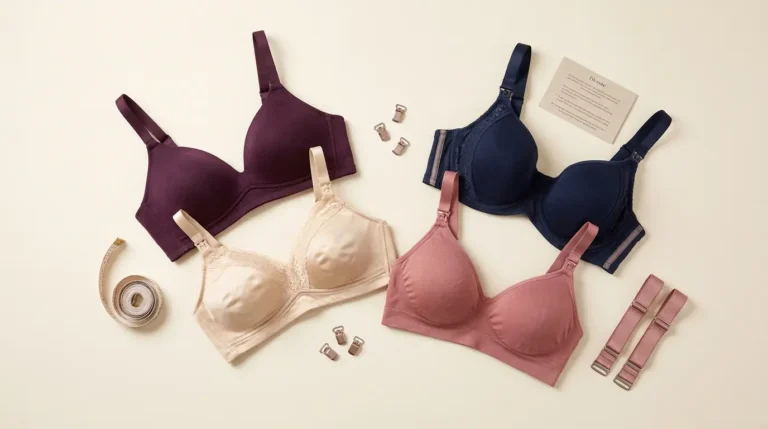
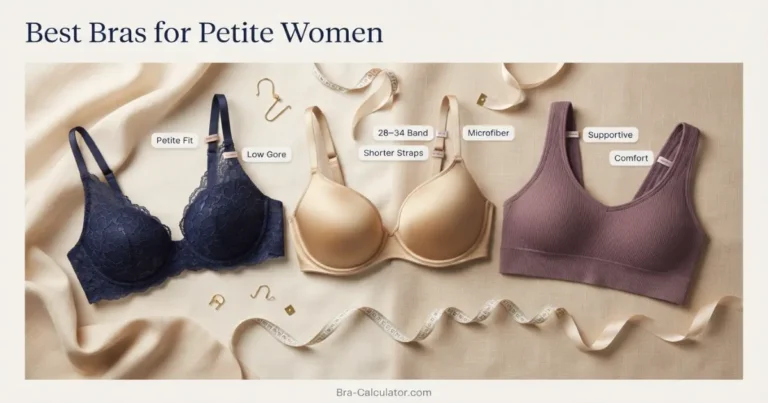
A petite frame can make nursing-bra shopping surprisingly awkward: the band may feel loose while the straps are already shortened all the way, cups can sit too high under the arms, and “small” alpha sizing may still be patterned for a longer or broader torso. This guide separates those fit problems so you can shop for the part that actually needs to be smaller.

Bra-Calculator.com fit editor. This update separates petite-frame fit from small-cup and small-band sizing, and product details were rechecked against current manufacturer/retailer information.
In this guide
First: “Petite” Is Not a Bra Size
The older version of this guide treated petite nursing-bra fit too much like a simple 28–30-band problem. That is not reliable enough. Petite describes body proportions; it does not tell us your underbust or cup volume. A person who is 5’1″ can wear a 32B, 34A, 30DD or many other sizes. Likewise, someone with a small bust can have an average or larger ribcage.
That distinction matters because nursing bras add another variable: soft cups are designed to stretch through fullness changes. Stretch is useful postpartum, but on a shorter or narrower frame it can also mean more fabric, taller sides and longer straps than you actually need.
Petite frame
Usually points to vertical and proportional issues: shorter torso, narrower shoulders, cups sitting high under the arm, or straps that remain long at their shortest setting.
Small bust
Usually points to lower breast volume, but not necessarily a tiny band. Cup shape matters: a shallow cup can fit beautifully where a deeper cup in the same nominal size wrinkles.
Small band
Means a smaller underbust measurement. This is the situation where actual 28–30 band availability becomes important. Many mainstream nursing styles still do not cover every small-band/small-cup combination.
Narrow shoulders
Can cause slipping or a too-wide strap position even when band and cup volume are otherwise correct. Convertible or closer-set straps can help.
What to Look for in Wireless Nursing Bras for Petite Busts
Wireless does not mean shapeless. A well-chosen nursing bra can feel soft while still controlling the band, centering the cups and keeping straps in a useful position. For petite and smaller-bust shoppers, the following features are usually more meaningful than marketing labels.
| Feature | Why it matters | What to check before buying |
|---|---|---|
| Multi-column hook-and-eye band | Lets you fine-tune firmness as your ribcage and breast fullness change. | Check the actual band range, not only S/M/L labels. |
| Fully adjustable straps | Shorter torsos often need more shortening than standard fixed-front straps allow. | Look closely at how much of the strap is truly adjustable. |
| Moderate cup height | Very tall cups can rub the underarm or show above petite necklines. | Compare cup edge height in model photos and reviews. |
| Removable light inserts | Can smooth nursing pads and prevent a soft cup from looking collapsed between feeds. | Prefer light shaping, not rigid push-up foam. |
| Stretch with recovery | Useful for fullness changes, but the fabric must return to shape rather than staying baggy. | Check material blend and recent fit reviews. |
| One-hand nursing clips | Good access matters more when a small bra shifts easily during feeding. | Open/close the clip repeatedly during the return window. |
A 60-Second Petite Nursing Bra Fit Check
Try the bra on with your normal nursing pads if you use them. Then stand naturally, raise both arms and sit down. Those three positions reveal most of the problems that are easy to miss while staring straight into a mirror.
A nursing bra should feel secure without creating a hard pressure line. Your breast size can change through the day, particularly earlier in lactation, so a soft wireless style usually needs some tolerance for fluctuation. The goal is not maximum compression; it is stable support with room for normal changes.
Why a Small-Bust Nursing Bra Can Gap Even in the “Right” Size
Top-edge gapping is often blamed on the cup being too large, but several different problems can create the same visual result. If the band is loose, the entire front can float away from the body. If the straps are too long, the cup is not being held where the pattern expects it to sit. And if your breast shape is relatively shallow, a deep rounded cup may remain empty at the apex even when its nominal volume looks correct on a size chart.
Timing matters too. A bra that looks fuller immediately before a feed can look looser afterward. That is one reason stretch-knit nursing bras are popular: they can tolerate change better than rigid molded cups. But a very elastic bra with a loose band may simply stretch everywhere, which feels comfortable at first and then becomes unstable.
Do Small Busts Need Padding in a Nursing Bra?
Not necessarily, but light shaping can be practical. Thin removable inserts can disguise nursing-pad edges, add a smoother line under fitted tops and keep a soft stretch cup from folding inward. This is a different job from push-up padding. You do not need extra volume to make the bra fit; you need a cup that follows your shape.
If removable pads bunch in the wash or shift after nursing, take them out and see whether the cup still lies smoothly. Some people prefer an unpadded double-layer knit because it conforms more naturally. Others like molded or removable light inserts because they give a cleaner T-shirt silhouette. Neither is universally better.
When to Buy and When to Remeasure Postpartum
Breast and ribcage measurements can change during pregnancy, after birth and as feeding patterns settle. That makes a very precise, rigid bra purchase risky too early. A flexible wireless bra can be useful during periods of change, but it still needs a band that anchors correctly.
Remeasure when the bra behaves differently, not just because a calendar date has passed. If the band begins riding up, cups start compressing or wrinkling, straps no longer stay adjusted, or you find yourself using a different hook position every few days, take new measurements and compare them with the current size chart.
Current Wireless Nursing Bra Examples Worth Comparing
These are real current products, not fictional “petite” models. The important caveat is that none should be treated as a guaranteed 28A/30A solution. Current size ranges vary by cup group and region, which is exactly why this page now evaluates construction and fit use-case rather than claiming every “small” option is genuinely petite-proportioned.

Bravado Designs Body Silk Seamless Nursing Bra
Seamless, wireless construction with 360° stretch, molded cups, removable inserts and one-hand nursing clips. Current retailer size data shows coverage into some 30-band fuller-cup combinations, while smaller cup combinations commonly begin around 32.
- Good for: soft everyday wear, changing fullness, smoother T-shirt shape.
- Watch for: do not assume every 30-band cup combination exists.

Cake Maternity Rock Candy Wireless Nursing Bra
Cake currently describes Rock Candy as a wire-free, padded seamless nursing style for B–G cups. Its published chart begins at a 32 band, so it is more relevant to petite/short-torso shoppers who fit 32+ than to someone who specifically needs a true 28–30 small-band size.
- Good for: B–G cup range, padded seamless feel, everyday nursing.
- Watch for: smallest published band is 32 in the current chart.

Kindred Bravely Simply Sublime Nursing Bra
Kindred Bravely currently lists regular B–D, Busty E–H and Super Busty I–K fit groups, with wireless support, removable padding, adjustable straps, hook-and-eye closure and clip-down nursing access. The included extender can add band room when needed, but it cannot make an oversized band smaller.
- Good for: soft seamless wear, light removable shaping, wearable-pump compatibility.
- Watch for: alpha sizing can hide band/cup compromises, so use the brand chart.
Which Style Fits Which Petite-Bust Problem?
Common Shopping Mistakes to Avoid
Do not buy solely from your pre-pregnancy bra size. Your current underbust and bust measurements are more useful. Also avoid assuming that an XS alpha size equals a 28 or 30 band; alpha sizing can combine several band/cup combinations into one stretchy garment.
Do not tighten straps to compensate for a loose band. That can pull the cups upward, create shoulder pressure and make the bra look smaller without actually anchoring it.
Do not size down until the cup compresses just to eliminate wrinkles. Wrinkles can be a shape mismatch. A flatter, shallower cup may fit better than a smaller but deeper cup.
Do not treat “wireless” as automatically safer or better-fitting. Comfort depends on pressure distribution, fit and your individual needs. If you have breast pain, redness, fever, wounds or persistent feeding/pumping concerns, garment advice is not a substitute for clinical or lactation support.
What This Means for a True 28–30 Band + Small Cup
This is the group most likely to feel underserved. Current mainstream nursing lines often offer either small alpha sizes that effectively begin around 32 for B/C cups, or 30-band options only in fuller cup groups. If you wear something like 28A, 28B, 30A or 30B, do not let a generic “petite-friendly” label convince you that the band will anchor correctly.
Your best strategy is to check exact size-chart mapping before ordering, prioritize retailers with straightforward returns, and compare band measurements rather than only alpha labels. A stretchy crossover nursing bralette can sometimes work for very small bust volume, but it may trade away the precise back-band anchoring of a hook-and-eye style.
Key Takeaways
- Petite, small bust and small band are different fit traits. Identify which one is causing the problem.
- A secure band and enough strap-shortening range usually matter more than the word “petite” on a product page.
- Light removable padding can be useful for shape and nursing-pad coverage; it is not the same as push-up padding.
- Current mainstream nursing bras still have limited true 28–30 small-cup coverage, so verify exact size mapping before buying.
- Stretch is useful postpartum, but too much stretch with a loose band can create instability instead of comfort.
Frequently Asked Questions
What should a petite person look for in a wireless nursing bra?
Does a small bust automatically need a 28 or 30 band?
Why does my nursing bra gap at the top?
Should I choose padded or unpadded if I have a small bust?
Are Bravado Body Silk, Cake Rock Candy and Kindred Bravely Simply Sublime true petite bras?
When should I remeasure postpartum?
Editorial Sources & Product Verification
This guide provides general garment-fit and shopping information, not medical diagnosis or individualized lactation care. Seek qualified medical or lactation support for persistent pain, fever, worsening redness, wounds or feeding/pumping concerns. As an Amazon Associate, Bra-Calculator.com earns from qualifying purchases.
Editorial update: September 7, 2026. Product availability, sizing and retailer listings can change after publication.