Maternity Underwear Size Guide
Amelia B. · Bra Fit Specialist · Build around flexible construction for measurements that keep changing, compare under-bump and over-bump rises honestly, and resist the urge to buy your whole maternity wardrobe in one order.
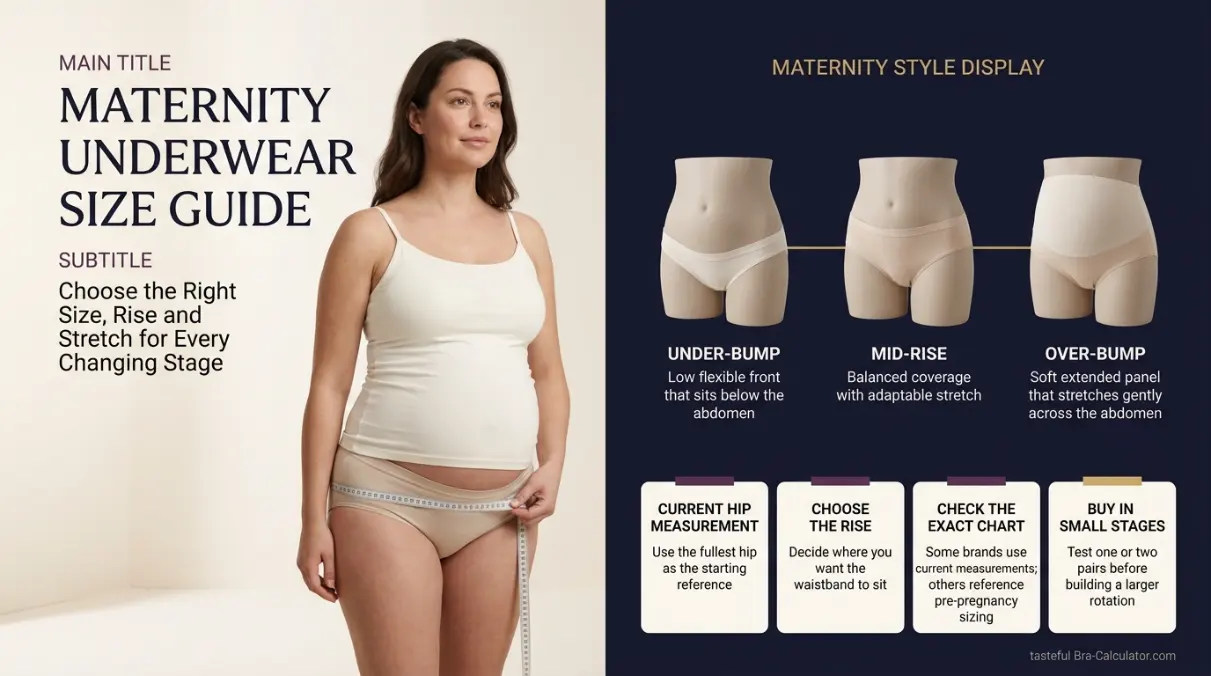
Start from your current full-hip measurement and the brand’s own maternity chart — not your pre-pregnancy size out of habit. Pick under-bump styles if you want a low, flexible band, or over-bump/high-rise if you’d rather have coverage across the abdomen. Remeasure the moment fit changes, and buy in small batches, not a nine-month supply.
In This Guide
- Why ordinary size rules may need adjustment
- Under-bump underwear
- Over-bump and high-rise underwear
- Postpartum comfort
- Fabric and seam choices
- How many sizes should you buy ahead?
- Inclusive fit and uncertainty
- Product verification
- A staged buying plan for changing measurements
- At-home fit test
- Common mistakes
- Product-page checklist
- Amazon product comparisons
- Frequently asked questions
Why ordinary size rules may need adjustment
Most fit frustration during pregnancy isn’t about a bad measurement — it’s about applying a rule that was never designed for a body that’s actively changing. Some maternity brands size to your pre-pregnancy number, others publish current waist and hip ranges. There’s no universal shortcut here; you genuinely have to check the exact chart each time.
The full hip stays a reasonably stable reference through most of pregnancy, while the natural waist becomes less useful as the abdomen changes shape. A good maternity product page will tell you exactly where the waistband is meant to sit — if it doesn’t say, that’s a signal to look elsewhere or read reviews first.
maternity-underwear-size-guide-hero.webp to replace this fallback.Under-bump underwear
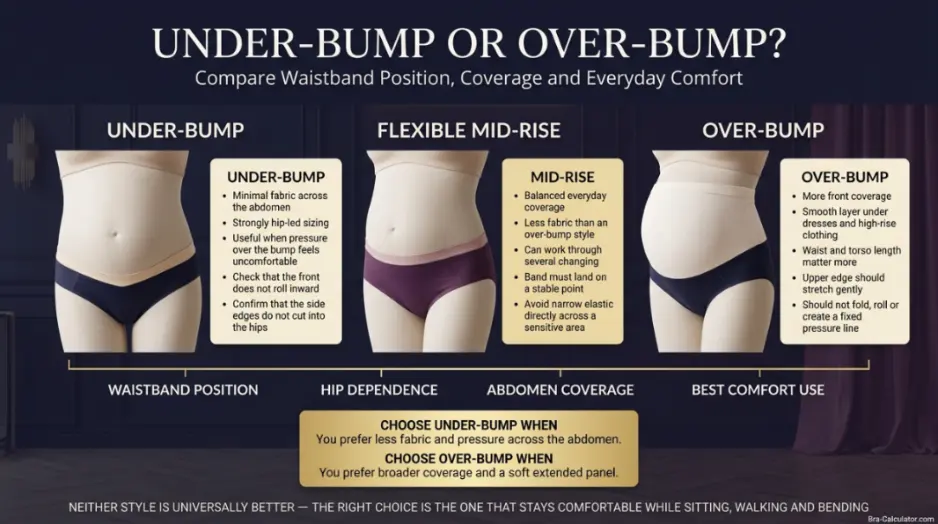
Under-bump styles use a low, flexible waistband that sits below the abdomen rather than across it — a relief for anyone who finds fabric pressure on the bump uncomfortable. Because the band sits lower than the natural waist, hip fit does most of the work here, so measure accordingly.
Check three things specifically: the front shouldn’t roll inward under the bump, the sides shouldn’t cut at the hip, and the back coverage should stay in place when you sit down — not just when you’re standing in front of a mirror.
Over-bump and high-rise underwear
These give you broader front coverage and tend to feel more secure under dresses or higher-rise maternity clothing. The upper edge needs to stretch gently rather than sit as a fixed pressure line — torso length and fabric recovery are what decide whether that band stays put or folds over by the afternoon.
Postpartum comfort
Comfort needs shift again after birth, and not in a predictable direction. Some people want a high, soft waistband; others want a low band that avoids a tender area entirely. Follow your healthcare provider’s recovery guidance first, and choose underwear that never creates painful pressure — this is one place where “just push through it” is the wrong instinct.
Remeasure rather than assuming your pregnancy size — or your pre-pregnancy size — still applies. We’re covering sizing and comfort here, not medical recovery, so loop in your provider for anything beyond fit.
maternity-underwear-rise-comparison.webp to replace this fallback.Fabric and seam choices
Soft stretch cotton
The reliable everyday pick — breathable, with elastic that’s usually covered to avoid a sharp pressure line.
Seamless stretch
Cuts down on bulky seams and flexes with small week-to-week changes, provided the recovery holds up wash after wash.
Supportive panels
Some styles add gentle support panels. Stick to the charted size here — a panel that feels restrictive isn’t “working,” it’s just uncomfortable.
How many sizes should you buy ahead?
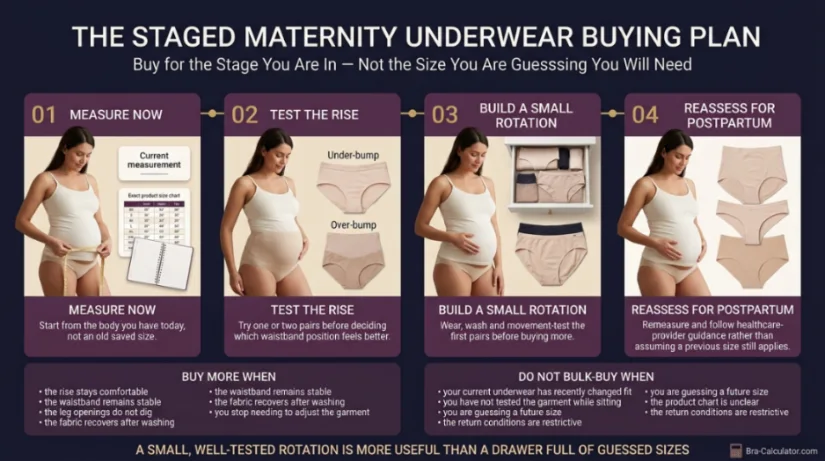
Resist stocking up far in advance — measurements and preferences shift in ways that are genuinely hard to predict from week 14. Buy one or two pairs, live in them through a wash cycle and some real movement, and only then expand the rotation once you know the rise and fabric actually work for you.
Inclusive fit and uncertainty
Underwear sizing isn’t standardized across brands, and maternity lines make that worse, not better. A Medium at one label can mean a different waist-and-hip range than a Medium at another, and even products sharing a size chart can wear differently once rise, gusset width and fabric recovery are factored in. We treat every size as a starting point here, never a fixed verdict on your body.
We use what we call the Bra-Calculator Hip-First Method across every guide on this site: for most everyday and maternity panties, the fullest hip gets the deciding vote, because that’s the measurement that determines whether the garment clears your widest point comfortably. The waist becomes a secondary check — more important for high-rise and over-bump styles, less important for low-rise and under-bump ones.
Always check your current measurements against the chart on the exact product you’re considering, especially with maternity lines, which get updated and re-cut more often than standard collections. A five-minute chart check beats guessing from a pre-pregnancy pair or a size conversion pulled off a random listing.
Product verification
Check the exact product chart
Don’t assume every line from one brand shares a chart. Confirm whether you’re looking at everyday, maternity, postpartum or period-specific construction before you order.
Read the fabric description
High-stretch seamless fabric behaves nothing like firm cotton or a lace trim with narrow elastic. Stretch percentage and recovery quietly decide the outcome when you’re between two sizes.
Use the return policy
When two sizes both seem plausible, order both if the retailer allows hygienic returns. Try them over clean, close-fitting underwear and follow the seller’s conditions exactly.
A staged buying plan for changing measurements
Buy for the current stage
Start with a small rotation that fits now. Everybody’s timeline is different, so buying a full later-pregnancy wardrobe off an early measurement is a common way to waste money.
Choose the rise deliberately
Under-bump reduces fabric over the abdomen; over-bump adds coverage and gentle support. Neither is objectively better — it’s a comfort call, not a fit correction.
Recheck pressure when seated
A waistband that feels fine standing can fold or press once you sit. Test real movement, not a mirror pose, before you cut any tags.
Plan for postpartum flexibility
Soft, high-recovery fabric and non-abrasive seams matter more here than trying to forecast an exact future size.
For postpartum period underwear specifically, follow the product’s hip guidance and size up if a below-waist style or general tenderness makes the standard fit feel restrictive.
maternity-underwear-staged-buying-plan.webp to replace this fallback.How to confirm the result after delivery
Treat the recommended size as a hypothesis, not a verdict — movement, pressure and stability over a real few minutes are what actually confirm it.
Check pressure and stability
The band should stay where the style is designed to sit — no sharp pressure line, no folding over, no sliding down that needs constant tugging back into place. A faint, temporary impression from close-fitting elastic is normal; pain, numbness or a deep mark that lingers is not a fit win, whatever the label says.
Walk, sit and lift one knee
Leg edges should track the body without cutting into the hip crease or gaping open. If they dig while the waist feels loose, look at the opening shape or hip room first — an all-over smaller size usually makes this worse, not better.
Look for calm fabric
The back should stay in place through a few minutes of ordinary movement. Constant wedging or bunching points to a coverage or seat-shape mismatch, not a size problem you can fix by going up or down alone.
Confirm placement, not just width
The gusset should sit where it’s meant to, not get dragged forward or back. Poor placement is more often a rise or proportion issue than a straightforward size issue.
For specialist garments — absorbent layers, compression panels, maternity stretch zones — follow the care and wear instructions before judging the fit. These behave differently from an ordinary brief, and a five-minute test tells you more than any spec sheet.
- Wear it for at least five minutes indoors. Stand, sit, bend, climb a stair if one’s nearby.
- Change one variable at a time. When comparing two sizes, keep the brand, style and fabric identical.
- Notice how often you adjust it. The better fit is usually the one you forget about within a few minutes.
- Check the seller’s return window before cutting tags. Underwear return policies vary a lot — keep hygiene liners and packaging intact until you’re sure.
Common mistakes with maternity underwear sizing
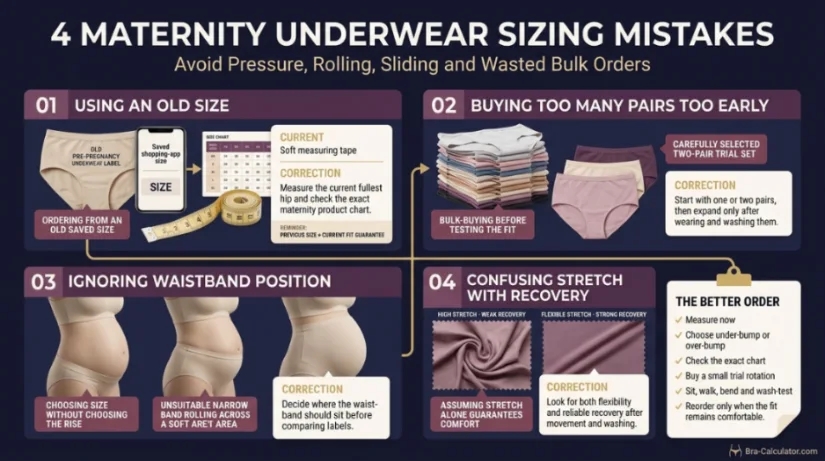
Using an old measurement
Your body keeps changing while the size saved in a shopping app doesn’t. Re-measure whenever the last result feels off, and definitely before ordering anything less forgiving, like postpartum shapewear.
Mixing measurement points
Natural waist, high hip and full hip are three different circumferences. Measure the exact point the chart asks for — not wherever your favorite pre-pregnancy pair happens to sit.
Assuming more stretch always means size down
Stretch is how far fabric moves; recovery is whether it actually comes back. A very stretchy fabric with weak recovery can slide and sag by afternoon, while a firmer, high-recovery fabric can feel smaller than the label suggests.
Comparing unrelated products
Switching from a cotton brief to seamless microfiber changes fabric, seams, rise and coverage all at once. To isolate size as the actual variable, compare adjacent labels within one identical product line.
maternity-underwear-buying-mistakes.webp to replace this fallback.What to check on the product page
Read the product page like a fit document, not a marketing page. The details that actually matter are usually below the headline photo: the body-measurement chart, rise description, fabric composition, model measurements, coverage photos and return conditions.
Confirm which measurements the chart uses
Some charts list natural waist and full hip; others only list a clothing size or garment measurement. These aren’t interchangeable — a garment measurement bakes in design ease and stretch, while a body chart describes the wearer range directly.
Locate the actual waistband
Low, mid and high rise are relative terms that vary by brand — doubly true for maternity lines. Use side-view photos and any “sits at” description to estimate where the band lands, since that decides whether waist or hip should drive your size call.
Separate stretch from recovery
Elastane percentage hints at stretch, but knit density and elastic construction decide recovery. A review mentioning sliding, bagging or rolling tells you more than a spec sheet claiming “stretchy fabric.”
Study front, side and back views
Coverage naming is inconsistent across brands. Look at seat width, leg-opening angle, gusset length and how the panel handles the bump specifically — these predict riding, wedging and visible lines far better than the product name.
For categories like under-bump maternity briefs, over-bump maternity underwear and postpartum high-rise briefs, weigh recent fit comments from shoppers with a similar waist-to-hip proportion more heavily than height or weight alone. Confirm whether underwear returns are accepted, whether the hygiene liner has to stay attached, and whether multipacks can be partially returned — five extra minutes here saves a lot of guesswork later.
How this guide handles uncertainty
We separate measurement, label conversion and construction on purpose — they answer three different questions. The measurement gives you a body range. The regional label helps you navigate a specific retailer. The construction determines how that label actually behaves once you’re sitting, walking and bending in it, week after changing week.
Brand guidance referenced here was checked on 2026-07-20. We don’t claim one universal chart beats a seller’s current product chart, and we deliberately avoid price, star-rating or stock claims that go stale within weeks. Where waist and hip data disagree, we explain the trade-off rather than pretending there’s one clean answer.
Primary editorial references
- Jockey Size Charts — Natural-waist and fullest-hip measurement instructions.
- Wacoal Size Charts — Published panty waist and hip ranges showing why brand charts matter.
- Thinx High-Waist Period Underwear — Current hip-led sizing and below-waist/postpartum comparison guidance.
- Knix Leakproof Underwear Fit Guide — Waist and fullest-hip measurement guidance for leakproof underwear.
Relevant products to compare
These picks are chosen by construction and fit purpose, not commission size. Links open current Amazon search results rather than making fixed price, stock or rating claims that would be outdated within days.
Affiliate disclosure: As an Amazon Associate, Bra-Calculator.com earns from qualifying purchases at no extra cost to you. Recommendations are based on fit criteria, not commission rates.
Under-bump maternity briefs
A dipped front can reduce pressure across the abdomen.
- Compare the exact seller size chart.
- Check rise, fabric and coverage before ordering.
- Prices and availability can change.
Over-bump maternity underwear
Soft stretch panels can adapt through several stages.
- Compare the exact seller size chart.
- Check rise, fabric and coverage before ordering.
- Prices and availability can change.
Postpartum high-rise briefs
Look for soft seams and flexible waistband recovery.
- Compare the exact seller size chart.
- Check rise, fabric and coverage before ordering.
- Prices and availability can change.
Frequently asked questions
Not automatically. Follow the product chart — some brands size to pre-pregnancy measurements, others to current ones.
It has a low, flexible waistband designed to sit below the abdomen instead of over it.
It covers the abdomen with an upper band designed to stretch gently as you grow.
Full hip first, then use the product’s stated waistband position to decide how much weight to give the waist.
Remeasure as soon as current underwear starts digging, sliding or rolling, and again before buying in bulk.
Yes, as long as it stays comfortable and fits well. Maternity construction is an option, not a requirement.
Soft, non-restrictive construction that follows your healthcare provider’s guidance and never causes pain.
No — test one or two pairs first. Measurements and preferred rise shift enough that bulk-buying ahead often wastes money.
Continue through the sizing system
Measure First. Then Choose the Construction.
Use the Panty Size Calculator for a private starting size, regional equivalents, fit-conflict explanation and product suggestions matched to your rise and comfort preferences.