Breast Ptosis Calculator: Find Your Grade & Best-Fit Bra Support
Our breast ptosis calculator uses the clinically established inframammary fold (IMF) method to estimate whether your nipple position, lower fullness, and fit symptoms indicate pseudoptosis, Grade 1, Grade 2, or Grade 3 ptosis — then matches you to the exact bra construction that delivers real, all-day support.
No photo uploads. No sign-up. No body judgment. Just precise, private bra-fit guidance based on anatomical science — not guesswork.
What Is a Breast Ptosis Calculator?
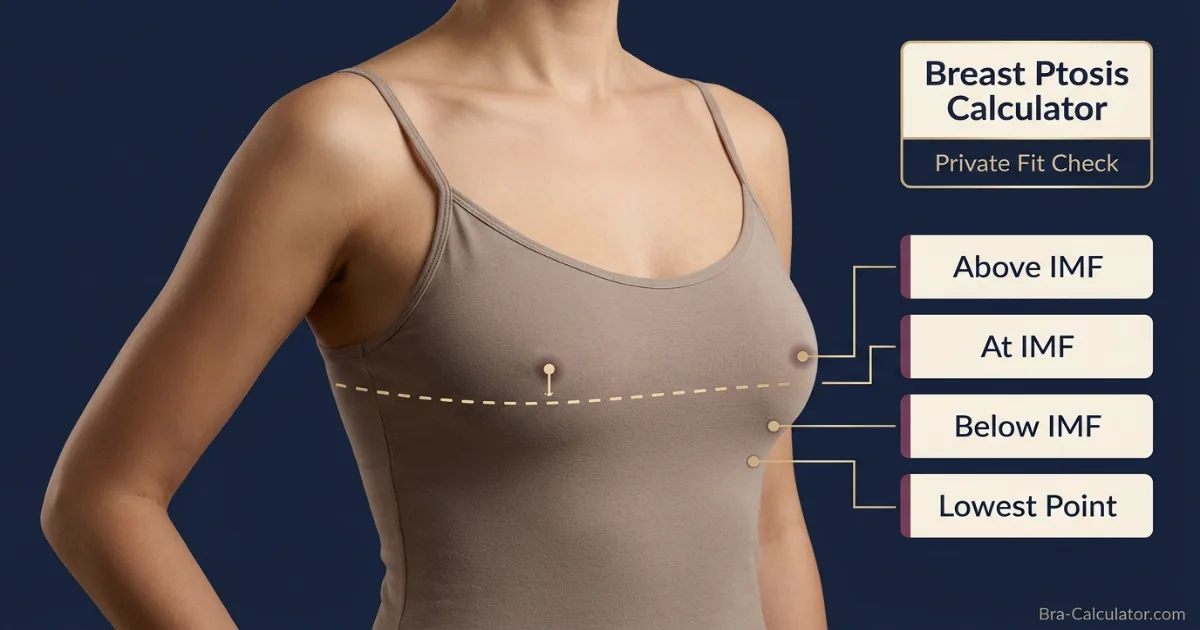
A breast ptosis calculator estimates the degree of breast drooping by comparing nipple position to the inframammary fold (IMF) — the natural crease under the breast. It converts that comparison into a grade from pseudoptosis to Grade 3, then recommends the bra styles most likely to provide stable, comfortable daily support.
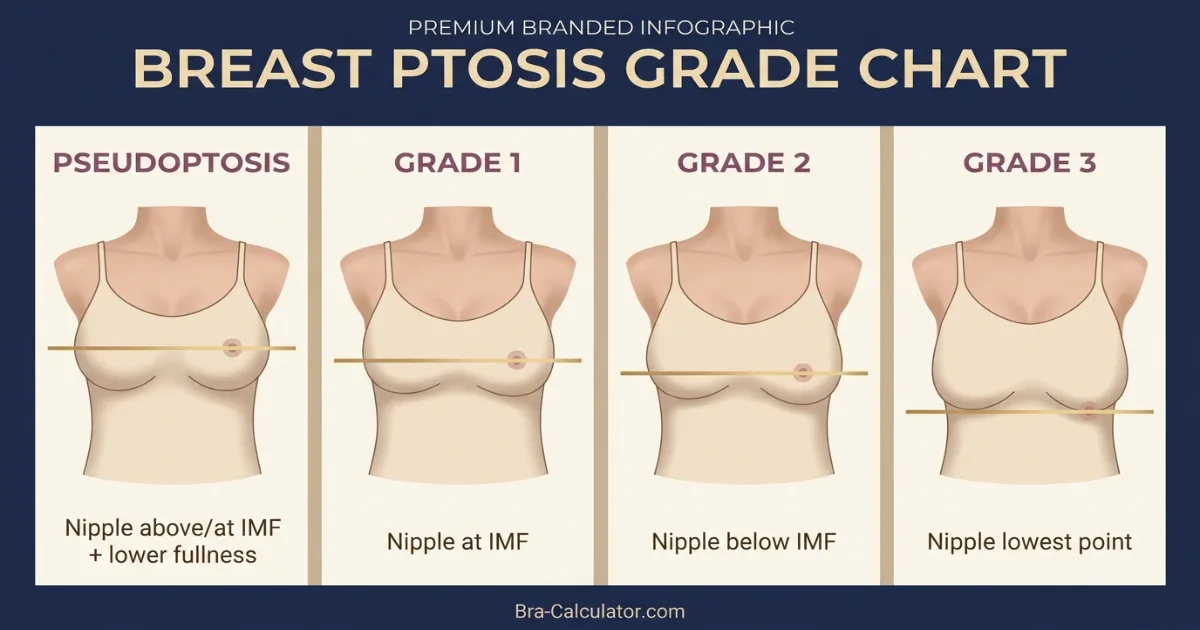
Breast ptosis describes how far breast tissue has descended on the chest wall relative to the inframammary fold (IMF). Plastic surgeons use the Regnault grading system (first published 1976, widely adapted since) as the clinical standard. For bra fitting — which is the sole purpose of this calculator — the grade matters because lower tissue position requires increasingly specific bra architecture: stronger lower-cup structure, firmer band width, higher side wings, and cup shapes that lift from the base rather than from the top.
🌿 Pseudoptosis
Nipple at or above the fold, but lower tissue is heavy. Standard molded cups gap at the top while the lower cup overflows. Needs deep lower cup + flex upper panel.
📏 Grade 1–2 Ptosis
Nipple at or slightly below the fold. Benefits from full cups, seamed balconette, high side panels, and a firm underwire band that stays level across the back.
🏋️ Grade 3 Ptosis
Nipple below the fold and the lowest breast point. Requires strong underwire, longline bands, full coverage cups, and wide straps — all working together as one frame.
Breast Ptosis Grades at a Glance
| Grade | Nipple vs. IMF | Key Bra Challenge | Best Bra Type |
|---|---|---|---|
| No ptosis | Clearly above the fold | Cup shape / projection mismatch | T-shirt, plunge, balconette |
| Pseudoptosis | Nipple above fold; tissue below | Upper cup gaps; lower cup overflows | Stretch upper cup + deep lower cup |
| Grade 1 | At the level of the fold | Bottom heaviness, band instability | Seamed balconette, full cup |
| Grade 2 | Below fold; tissue still lower | Band rides up, side tissue migration | Side support, 3-part cup, longline |
| Grade 3 | Nipple is the lowest point | All support must come from frame | High-support full coverage, longline |
Breast Ptosis Calculator — Get Your Grade & Bra Match
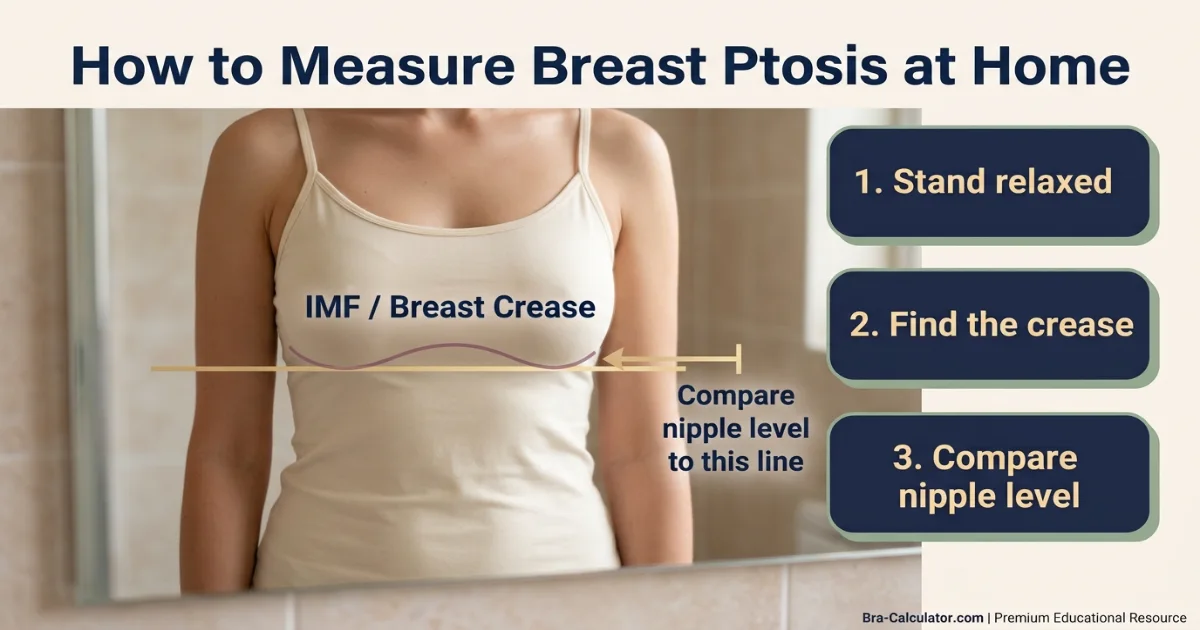
Stand relaxed in front of a mirror without a bra. Use the natural crease under your breast as your reference line. Complete all five questions — your support score and personalised bra recommendations will appear instantly on the right.
How to Measure Breast Ptosis at Home — Step-by-Step
To estimate breast ptosis at home, stand without a bra and locate the inframammary fold — the crease under the breast where it meets the chest wall. Compare your nipple position to that line. If the nipple is below the crease and also the lowest point of the breast, that indicates Grade 3. This single comparison is the core of the clinical Regnault grading method.
Stand naturally without a bra
Keep your shoulders relaxed, arms at your sides, posture normal. Do not lift the breast or pull the skin taut. The result must reflect your natural resting position — what a bra must support across an entire day.
Locate the inframammary fold (IMF)
The IMF is the horizontal crease where the lower breast meets the chest wall. This is the standard reference line for all ptosis grading. Place one finger along this crease to mark it visually in the mirror. It is the single most important reference point in bra fitting for bottom-heavy shapes.
Compare nipple level to the fold
Is your nipple above, at, or below the fold line? If below, check whether breast tissue still hangs lower than the nipple (Grade 2), or whether the nipple itself is the lowest point of the breast (Grade 3). This comparison alone captures the core of the Regnault classification.
Assess lower-breast fullness distribution
Even when the nipple is not low, heavy lower fullness creates pseudoptosis-pattern fit problems — specifically upper-cup gaping in standard molded bras while the lower cup fills or overflows. Recognising this pattern prevents the common error of sizing up in cup when the real fix is a different cup shape.
Identify your recurring bra-fit symptoms
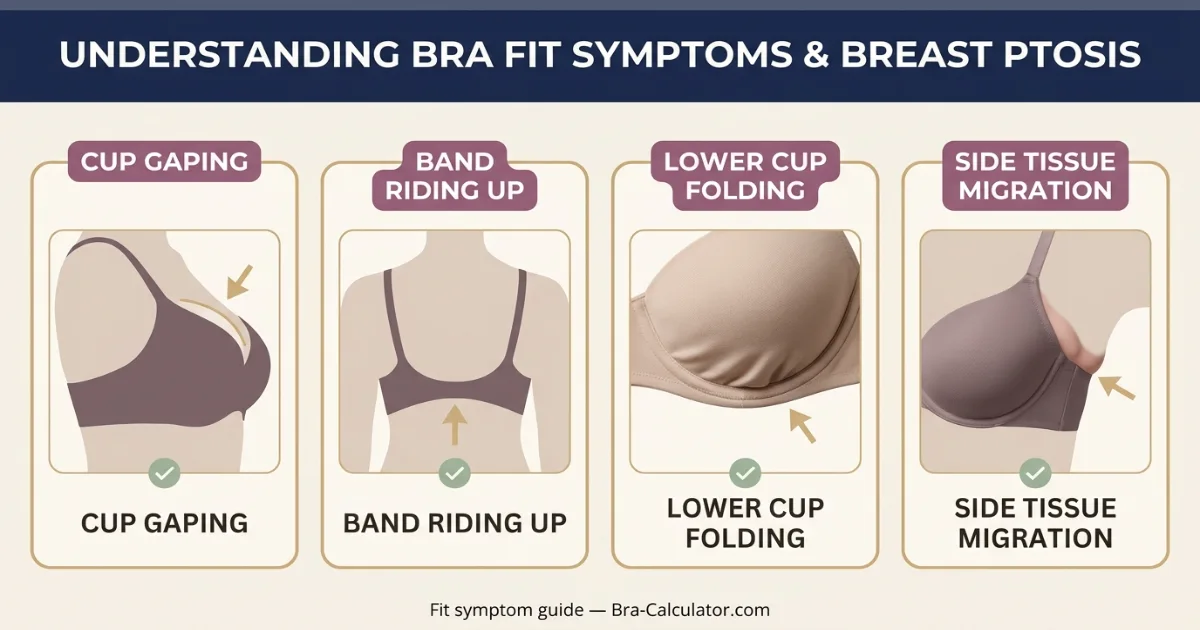
Band riding up, strap digging, side tissue escaping, and upper-cup gaping are structural clues. Experiencing multiple symptoms simultaneously is a reliable indicator that current bra construction does not match your anatomical grade — not that you need a different size.
Enter your answers and get your bra match
The calculator above weights each factor and produces a support score, grade estimate, and grade-matched bra style list. Use this as your filter for your next bra purchase — not as a medical finding or diagnosis of any kind.
Best Bra Styles by Ptosis Grade — Detailed Breakdown
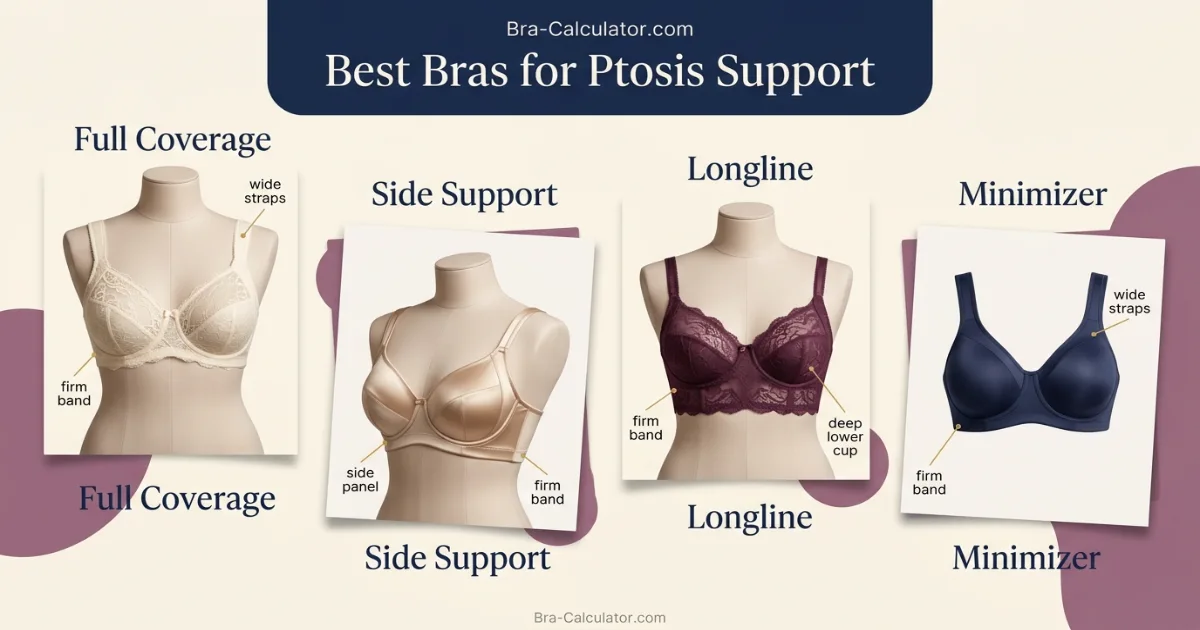
The single most important principle for ptosis bra fit: the band and lower cup must do 80–90% of the lifting. Straps are fine-tuning, not structural support. Every recommendation below applies this principle to a specific grade.
Pseudoptosis & Grade 1 — Shape Before Strength
At these grades, the challenge is distribution mismatch rather than a true structural support deficit. A standard rigid molded shell assumes even fullness — but your breast has most of its volume below the nipple line, so the top third of the cup forms a void.
- Stretch or soft-lace upper cups that flex to meet actual upper breast position
- Seamed balconette bras for gentle centred lift from the outer cup edge
- Firm band sized to the snug hook (not the comfortable hook — that comes later)
- Deep lower cups with enough room to contain tissue without folding under
- Centred underwire gore that anchors the front panel without pressing on breast tissue
Grade 2 & Grade 3 — Structure Over Style
At Grade 2 and 3, styling choices cannot compensate for inadequate bra architecture. Every element of the bra must be calibrated to manage position: the frame width, band depth, underwire channel height, lower cup volume, and side wing height all matter simultaneously.
- Full-coverage cups that fully enclose breast tissue without cutting across
- Side-support panels that redirect tissue forward and inward, not outward
- Longline bands (extended below standard bra line) for sustained horizontal levelness
- 3-part or multi-seam cups that hold shape under gravitational load
- Wide, padded straps for comfort — but straps are not the support source
3 Bra Myths That Worsen Every Ptosis Grade
❌ Myth: Tighter straps = better lift
Straps that dig in almost always indicate a band failing to do its job. The band supplies 80–90% of structural support. Tightening straps without fixing band fit creates shoulder grooving and posture strain with zero improvement in breast position.
❌ Myth: Bigger cup = more comfortable
A cup too large creates excess fabric in the upper cup, which wrinkles and folds — the exact problem pseudoptosis and bottom-heavy shapes already experience in standard molded bras. The fix is a correctly sized deep cup with an upper flex panel, not an upward cup adjustment.
❌ Myth: Underwire is always uncomfortable
Underwire discomfort traces to the wire sitting on — rather than underneath — breast tissue. This indicates the wire is too narrow for breast root width. A correctly fitted underwire for your projection is structurally superior to wire-free for Grade 2–3 support needs.
When Poor Bra Fit Looks Like Higher Ptosis
One of the most actionable insights in bra fit: breasts often look and feel significantly lower than their actual anatomical position when the bra is structurally failing. Before accepting a Grade 3 assessment, verify these three common structural failures:
Band too large
When the back band rides up, the front cups are dragged downward and forward. Breast tissue appears to hang lower than it actually does when supported correctly. Test: try a band 2 sizes smaller with a cup 2 sizes larger. If the breast position improves substantially, the band was the problem.
Cup too shallow
Projected or bottom-heavy breast shapes fill the lower cup so completely that there is no remaining room for the breast to sit in a centred position. Tissue then spills outward and downward, which reads as higher-grade ptosis. A deeper cup with the same cup volume solves this without any band or cup-letter change.
Underwire too narrow
Wire sitting on breast tissue (rather than in the natural crease below it) creates constant downward pressure on the lower cup and outward force on the side panel. The bra never positions the breast correctly regardless of size. Wider-root underwire bras are the structural solution.
Breast Ptosis Across Life Stages: What Actually Changes Your Grade
Ptosis grade is not fixed. Several predictable physiological events shift both anatomical position and the bra-fit experience. Re-running this calculator after any of these changes gives you a more accurate current baseline:
🤱 Pregnancy & Breastfeeding
Volume increases substantially during pregnancy; rapid volume loss after weaning is one of the most common causes of Grade 2 and Grade 3 changes in women under 40. During active breastfeeding, bra priorities shift to adjustability, soft fabrics, and easy nursing access rather than a fixed ptosis grade. Re-run this calculator 6–8 weeks after weaning once volume has stabilised.
⚖️ Weight Fluctuation
Breast tissue contains a high proportion of fat, so weight gain and loss directly affect volume and the skin envelope around it. Rapid weight loss — especially in larger-breasted individuals — often increases perceived ptosis grade because skin elasticity hasn’t had time to adapt. After significant change (15+ lbs), re-run the calculator with your current resting position.
🌿 Aging & Skin Laxity
Collagen and elastin density decrease with age, causing the Cooper’s ligaments (breast suspensory structures) to gradually stretch. This is universal and normal — not a condition requiring treatment unless it causes physical discomfort. The bra solution is structural: firmer band, deeper cups, higher side wings, and wider underwire base width. See our guides for best lifting bras for sagging breasts over 50 and our senior bra size calculator.
📐 Breast Size & Density
Larger and denser breasts exert more downward gravitational force on the Cooper’s ligaments. Grade 2–3 ptosis is statistically more prevalent in cup sizes D and above, which is why correct underwire width and firm band length are non-negotiable at larger sizes. Cup-size-appropriate construction — not just a larger cup letter — is the differentiator for long-term comfort and support.
Breast Ptosis Grade Chart — Full Category Reference
Breast ptosis grades range from no ptosis through Grade 3. The defining marker at each level is where the nipple sits relative to the inframammary fold, and whether it becomes the lowest dependent point of the breast. Each grade has predictable bra-fit challenges and a specific set of construction features that address them effectively.
| Category | Nipple position vs. IMF | Typical fit challenge | Best bra construction | Internal resource |
|---|---|---|---|---|
| No ptosis | Clearly above the fold; lower tissue light | Size or projection mismatch; not a support architecture issue | T-shirt, plunge, balconette, lightly lined cup | Bra Size Calculator |
| Pseudoptosis | Nipple above fold; significant tissue sits below it | Upper cup gaps while lower cup fills or overflows | Stretch upper cup, deep lower cup, side support, firm band | Cup Gaping Guide |
| Grade 1 / Mild | Roughly at the level of the inframammary fold | Slight bottom heaviness, strap pressure, mild cup folding | Balconette, full cup, seamed underwire, firm band | Sister Size Calculator |
| Grade 2 / Moderate | Below IMF but not the lowest dependent point | Band rides up, upper cup gaps, lateral tissue migration, cup collapse | Side-support cups, full-coverage, 3-part cup, longline, firm underwire | Band Rides Up Guide |
| Grade 3 / Pronounced | Below IMF and is the lowest point of the breast | Lift must come from band, frame, lower cup — not straps | High-support full coverage, longline, minimizer, wide straps, deep cup | Best Lifting Bras |
Source: Based on the Regnault (1976) clinical breast ptosis grading system, adapted for bra-fit education. See NCBI: Breast Ptosis for the full clinical classification.
Best Bras for Breast Ptosis — Verified Amazon Picks by Grade
Every product below is matched to the support architecture patterns from the calculator above. Cards are organised by grade applicability — from stretch-upper-cup options for pseudoptosis through high-support full-coverage for Grade 3. Always confirm your size, seller, and current price before purchasing.

Wacoal Basic Beauty Full Coverage Underwire Bra
An everyday full-coverage underwire with smooth cups that encase the entire breast — ideal for Grade 1 and pseudoptosis shapes needing forward projection control.
Check Price on Amazon →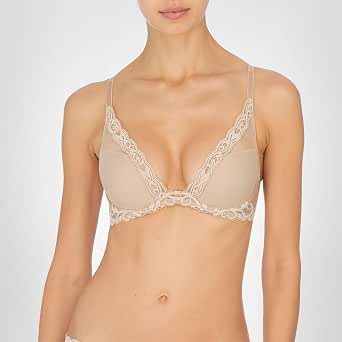
Natori Feathers Underwire Contour Plunge Bra
Natori’s Feathers uses a feather-weight lace overlay over a contour cup — the flexible upper lace adapts to uneven fullness distribution, making it a strong pseudoptosis pick when upper cup gaping is the main problem.
Check Price on Amazon →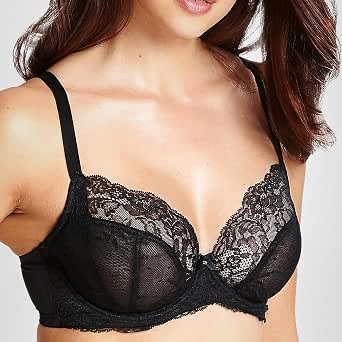
Panache Andorra Underwire Full Cup Bra
The Andorra is a seamed three-part cup that lifts tissue from the outer edge upward — the architecture most effective for Grade 1 and early Grade 2 shapes, particularly where the lower cup folds in standard bras.
Check Price on Amazon →
Elomi Cate Underwire Full Cup Banded Bra
The Elomi Cate combines a banded lower frame with full-coverage side-support cups — the combination that addresses Grade 2 and Grade 3 lateral tissue migration and band instability simultaneously.
Check Price on Amazon →
Glamorise MagicLift Original Support Wirefree Bra
When underwire is uncomfortable due to rib sensitivity, the MagicLift delivers lift from a cushioned inner band and contoured cup construction rather than a wire channel — a solid Grade 1–2 wire-free alternative.
Check Price on Amazon →
Elomi Matilda Underwire Side Support Bra
The Matilda adds extended side wings and a deeper band to Elomi’s side-support construction — maximising band stability and lateral tissue control for Grade 2–3 shapes where the band riding up is a persistent problem.
Check Price on Amazon →
Freya Deco Underwire Molded Balcony Bra
The Deco’s low-centre balcony construction with a J-hook adaptor suits pseudoptosis and Grade 1 shapes who want a push-forward rather than push-up effect — good for lower necklines without relying on upper cup projection.
Check Price on Amazon →
Amoena Valletta Underwire Mastectomy Bra
For post-mastectomy or post-lumpectomy wearers — or anyone requiring bilateral or unilateral prosthesis pockets — the Amoena Valletta provides full-coverage Grade 2–3 support architecture with integrated softform pockets.
Check Price on Amazon →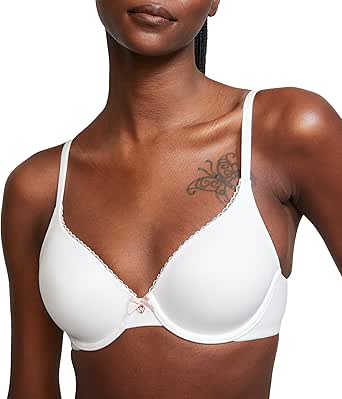
Victoria’s Secret Bombshell Push-Up Bra
For no-ptosis and early pseudoptosis shapes seeking enhanced cleavage and a round silhouette — the Bombshell adds graduated foam padding below the cup for upward projection rather than structural support.
Check Price on Amazon →Product availability, price, colours, and size ranges change frequently on Amazon. Always confirm your specific size and current stock before purchasing. If a product is unavailable, search for the exact product name in Amazon with the same support construction criteria.
Breast Ptosis Calculator: Expert Answers to Common Questions
Is this breast ptosis calculator medically accurate?
This is an educational bra-fit estimator, not a clinical measurement tool. It uses the same anatomical reference — the inframammary fold — that clinicians use in the Regnault-style grading system, but translates that marker into practical bra support guidance rather than a surgical classification. For clinical accuracy in a medical context, assessment by a qualified healthcare professional is required.
What is the most accurate home method to check for breast ptosis?
The most reliable home method is the inframammary fold test. Stand without a bra in front of a mirror, locate the natural crease under your breast where it meets the chest wall, and compare your nipple position to that line. Nipple at the fold indicates approximately Grade 1. Nipple below the fold but not the lowest point of the breast indicates Grade 2. Nipple below the fold and also the lowest point indicates Grade 3. This single comparison captures the core of the clinical grading method without requiring a photo or clinical examination.
Can wearing the right bra reduce breast ptosis?
A correctly fitted bra improves supported breast position, significantly reduces bounce-related stress on the Cooper’s ligaments, and dramatically improves daily comfort and posture. However, it does not permanently alter the anatomical position of breast tissue. For permanent anatomical change, the medical options are mastopexy (surgical breast lift) or augmentation with lift — both requiring consultation with a board-certified plastic surgeon. This calculator helps with bra fit optimisation, not surgical decisions.
What is the best bra for Grade 2 breast ptosis?
Grade 2 ptosis typically responds best to full-coverage bras with firm underwire, side-support panels that redirect tissue forward rather than outward, seamed or 3-part cups that maintain shape under gravitational load, and a firm band that stays level across the back. Soft molded T-shirt bras consistently underperform for Grade 2 shapes because their rigid shell assumes even fullness distribution that does not match the bottom-heavy tissue position. The Elomi Cate and Panache Andorra are strong structural fits for this grade.
Why does my upper cup gap even when the lower cup feels completely full?
This is the characteristic pseudoptosis or bottom-heavy distribution pattern. When most breast volume sits below the nipple line, a rigid molded cup cannot make contact with the upper chest — creating a gap or wrinkle even as the lower cup fills to capacity. The solution is a bra with a flexible or stretch upper panel (stretch lace, soft jersey, or unlined upper cup) combined with a deeper, reinforced lower cup. Side-support styles also address this by moving tissue forward into the cup rather than allowing it to drift outward and downward. Resizing to a larger cup does not fix this and often makes the upper-cup gap worse.
Should I use this calculator during pregnancy or breastfeeding?
During active pregnancy and breastfeeding, breast volume fluctuates significantly — sometimes week to week. This calculator provides a snapshot of your current resting position, not a stable long-term grade. During these stages, bra priorities should focus on adjustability, soft fabrics, and easy nursing access rather than a fixed ptosis grade. Re-run the calculator once your size and shape have been stable for at least six to eight weeks after weaning and the volume has settled.
What is pseudoptosis and how is it different from Grade 1 ptosis?
Pseudoptosis means the nipple is at or above the inframammary fold — which in clinical terms indicates no ptosis — but significant breast tissue sits below the nipple line, creating a distinctly bottom-heavy shape. Grade 1 ptosis, by contrast, means the nipple itself is at the fold line. Both categories share similar bra-fit challenges (upper-cup gaping, lower-cup overflow, strap pressure), but pseudoptosis is frequently missed because people assume the nipple position alone determines ptosis grade. Pseudoptosis often produces more frustrating fit problems than Grade 1 because the standard clinical classification doesn’t flag it, yet the bra-fit experience is equally challenging.
Does bra size directly affect ptosis grade?
Bra size does not directly cause ptosis, but larger cup volumes are associated with higher grades over time because greater breast mass increases gravitational force on the Cooper’s suspensory ligaments. This is why wearing appropriately supportive bras — particularly during high-impact exercise — is frequently recommended for larger cup sizes. The research on long-term prevention remains inconclusive, but the biomechanical rationale for consistent support is sound. Larger cup sizes also require cup-size-appropriate underwire width, which standard bras often do not provide.
Is breast ptosis the same as sagging, and is it normal?
Breast ptosis and sagging describe the same anatomical condition — the descent of breast tissue relative to the inframammary fold. The clinical term is ptosis; the common term is sagging. Both are entirely normal. The vast majority of women have some degree of breast ptosis by midlife, and it increases predictably with pregnancy, breastfeeding, aging, and weight fluctuation. It is not a disease or abnormality — it is a natural variation in breast position that affects bra fit, which is exactly what this calculator is designed to help with.
What is the difference between ptosis, pendulous breasts, and tuberous breasts?
These are three distinct anatomical categories. Breast ptosis describes how far the nipple and tissue have descended relative to the IMF — a position-based classification. Pendulous breasts describes large, heavy breasts with significant downward projection regardless of ptosis grade — a size and weight characteristic. Tuberous breasts (also called tubular breasts) describe a developmental condition involving a constricted breast base, high IMF, and often asymmetry or wide areola — this is a shape characteristic, not a ptosis grade. All three have different bra-fit implications and can co-exist or occur independently.
When to Seek Medical Advice — Red Flag Symptoms
This calculator addresses bra support and comfort only. Contact a qualified healthcare provider promptly if you notice any of the following:
Seek medical evaluation for: a new lump or thickening in breast tissue or under the arm; sudden change in size or shape affecting one breast only; nipple discharge (not breast milk), especially if blood-stained or from one nipple only; skin dimpling, puckering, or orange-peel texture; nipple newly pulling inward when previously flat or outward-pointing; unexplained persistent pain localised to one area; redness, swelling, or warmth that does not resolve; or sudden visible veins appearing on the breast surface.
For breast cancer symptom reference, see the CDC: Breast Cancer Symptoms page.
Related Bra-Calculator.com Tools & Guides
Use your ptosis grade result as the starting point, then use the tools below to confirm your exact size, address specific fit symptoms, and find bras built for your shape and support level.
📐 Size & measurement tools
Bra Size Calculator Sister Size Bra Calculator Global Bra Size Converter Plus-Size Bra Calculator Senior Bra Size Calculator🔧 Fit problem guides
Bra Cup Gaping Fix Guide Bra Band Rides Up Fix Side Boob in Bra Fix Underwire Digging In Guide 20 Bra Fit Problems Guide🌿 Body-change & support guides
Best Lifting Bras Over 50 Post-Weight Loss Bra Size Nursing Bra Size Calculator Breast Size Comparison Guide Bra Cup Size From PhotoSources & Research Basis
This educational calculator uses the Regnault (1976) inframammary fold classification framework as its anatomical grounding, adapted for bra-fitting guidance rather than surgical planning. All support recommendations are based on bra construction principles, not medical treatment claims.
- NCBI Bookshelf: Breast Ptosis — Clinical overview of ptosis classification and grading system.
- NCBI Bookshelf: Mastopexy — Surgical overview including pseudoptosis and Regnault-style categorisation.
- CDC: Breast Cancer Symptoms — Red-flag reference for when medical evaluation is clinically appropriate.
Author: Amelia B., Bra Fit Specialist — Bra-Calculator.com Editorial Team · Purpose: Educational bra-fit guidance only · Not a medical tool
Match Your Ptosis Grade With the Right Bra Size
Knowing your support level is half the answer. Pair it with your exact band and cup measurements to choose a bra built for your shape — not just your label size. The right size in the wrong construction will still underperform.
Bra-Calculator.com · Educational bra-fit guidance only · Not a medical tool · © 2026