30B vs 30D: Are They the Same Size? Same Band, Two Full Cups Apart Explained (2026)
Quick Answer: No — 30B and 30D are not the same size, and they are not sister sizes. They share the same 30-inch band but are two full cup sizes apart in volume. The 30D holds significantly more breast tissue than the 30B — a 4-inch bust-to-underbust differential versus a 2-inch differential on the same band. The 30C sits directly between them as the correct intermediate size. If you are choosing between 30B and 30D, the answer is almost certainly 30C first.
⚠️ This is NOT a sister size comparison — and the gap is two full cups. Unlike adjacent size comparisons such as 30B vs 30C (one cup apart) or 30C vs 30D (one cup apart), 30B and 30D are separated by two complete cup sizes on the same band. The 30C is the correct intermediate step between them. If your 30B cups are too small, try 30C — not 30D. If your 30D cups are too large, try 30C — not 30B. Always change cup size one letter at a time.
Choose the fit signs you notice in the band, cups, center and straps. We’ll turn them into a practical next step for 30B.
Private fit check — your answers stay in your browser and are used only for this on-page guidance. Nothing is stored or submitted.
⚡ Key Takeaways
- NOT the same size: 30B and 30D share a band but are two full cup sizes apart in volume — 30C is the correct step between them.
- 30D is significantly larger: The 30D cup holds two complete cup sizes more breast tissue than the 30B on the same 30-inch band.
- Same band ≠ same size: Two letters apart on the same band is a real and visible difference — approximately 2 inches of bust circumference and two full cup sizes of breast tissue volume.
- Same underbust, very different bust: Both fit ~27–28″ (68–71 cm) underbust; 30B = ~32″ bust; 30C = ~33″ bust (intermediate); 30D = ~34″ bust.
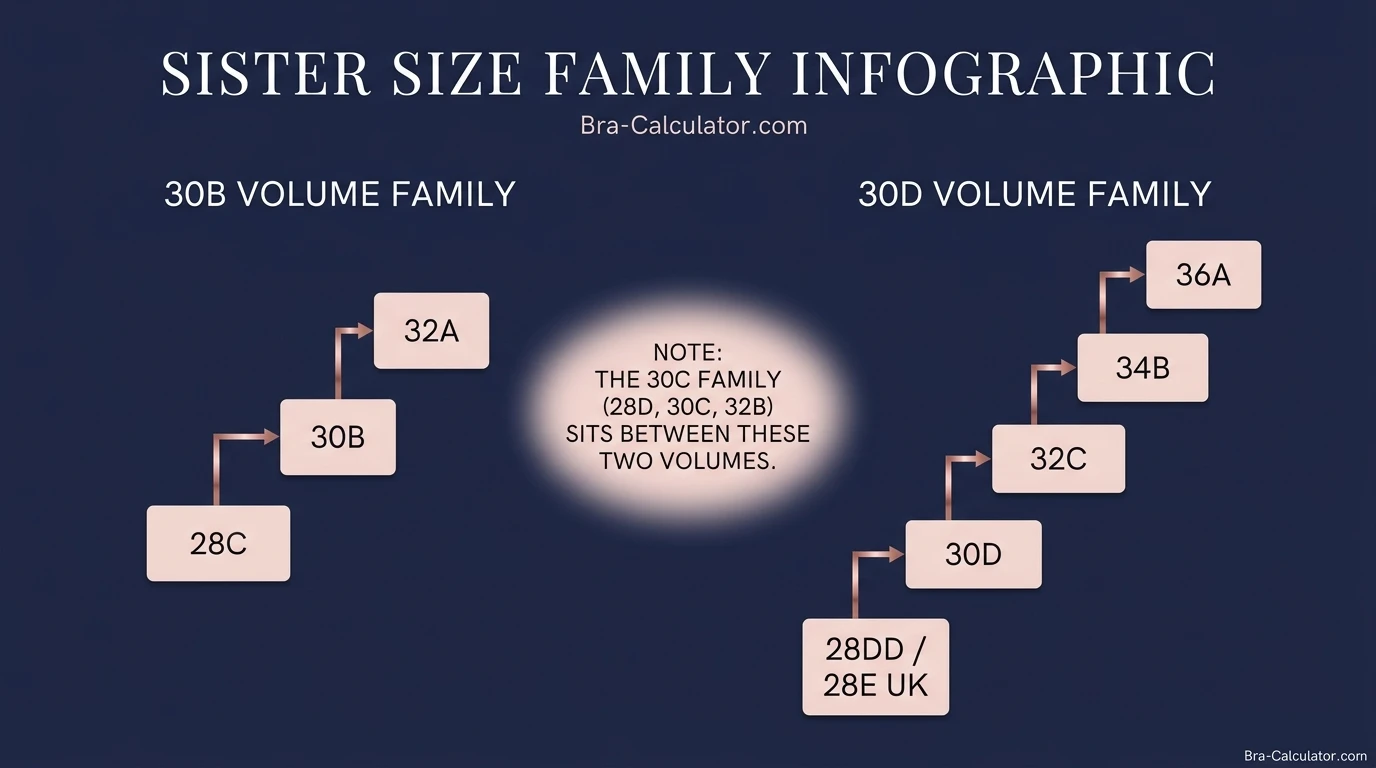
- Completely different sister families: 30B sisters → 28C, 32A. 30D sisters → 28DD (28E UK), 32C, 34B, 36A.
- One letter at a time: Never jump from 30B to 30D. Move 30B → 30C first, assess the fit, then go to 30D only if still needed.
- Never change both band and cup simultaneously when diagnosing a fit problem — change one variable at a time.
- Wearing 30B on a 30D frame means severe cup overflow and a floating gore. Wearing 30D on a 30B frame means two full cup sizes of gaping and wrinkling. Neither is a subtle error.
- Both are relatively accessible sizes — 30B and 30D are both stocked by specialist and many mainstream retailers, with 30C also widely available as the intermediate step.
Why 30B and 30D Are Two Full Cup Sizes Apart
Most bra size comparisons deal with sizes that are either sister sizes (same volume, different band) or adjacent cup sizes (one letter apart on the same band). The 30B vs 30D comparison is different: these two sizes are separated by two full cup letters on the same band. The 30C sits directly between them. Understanding why this gap matters — and why you should never skip it — starts with how cup sizing is constructed.
Cup size is the difference between your bust measurement and your underbust measurement, expressed as a letter. Each inch of difference equals one cup letter:
- 1″ = A | 2″ = B | 3″ = C | 4″ = D | 5″ = DD/E | 6″ = DDD/F
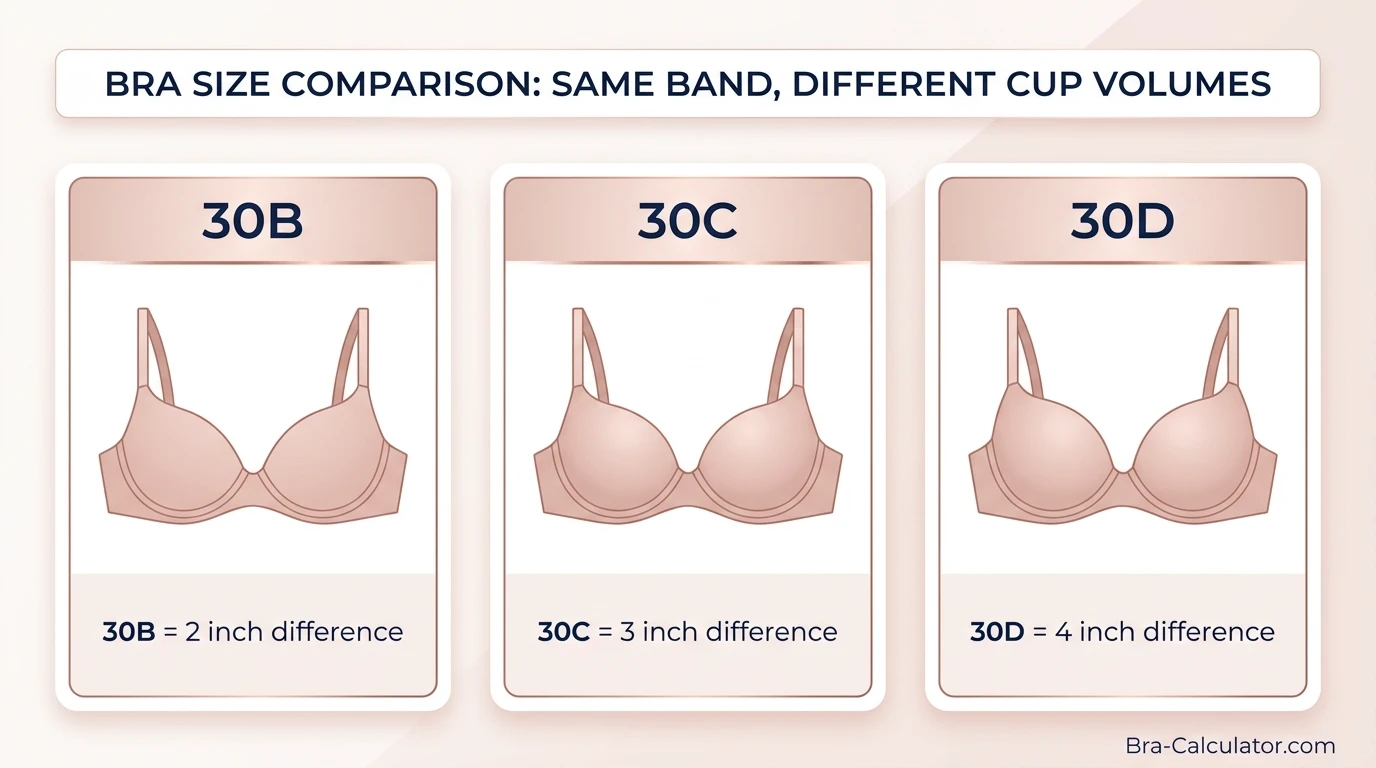
A 30B means the bust is 2 inches larger than a 30-inch underbust — producing a bust of approximately 32 inches. A 30D means the bust is 4 inches larger than the same underbust — producing a bust of approximately 34 inches. That is a 2-inch difference in bust circumference representing two complete cup sizes of additional breast tissue — all on the same 30-inch frame. On a relatively narrow 30-inch band, that two-inch gap is visible, structural, and immediately apparent from the first wear.
The Three-Step Progression: 30B → 30C → 30D
← Intermediate
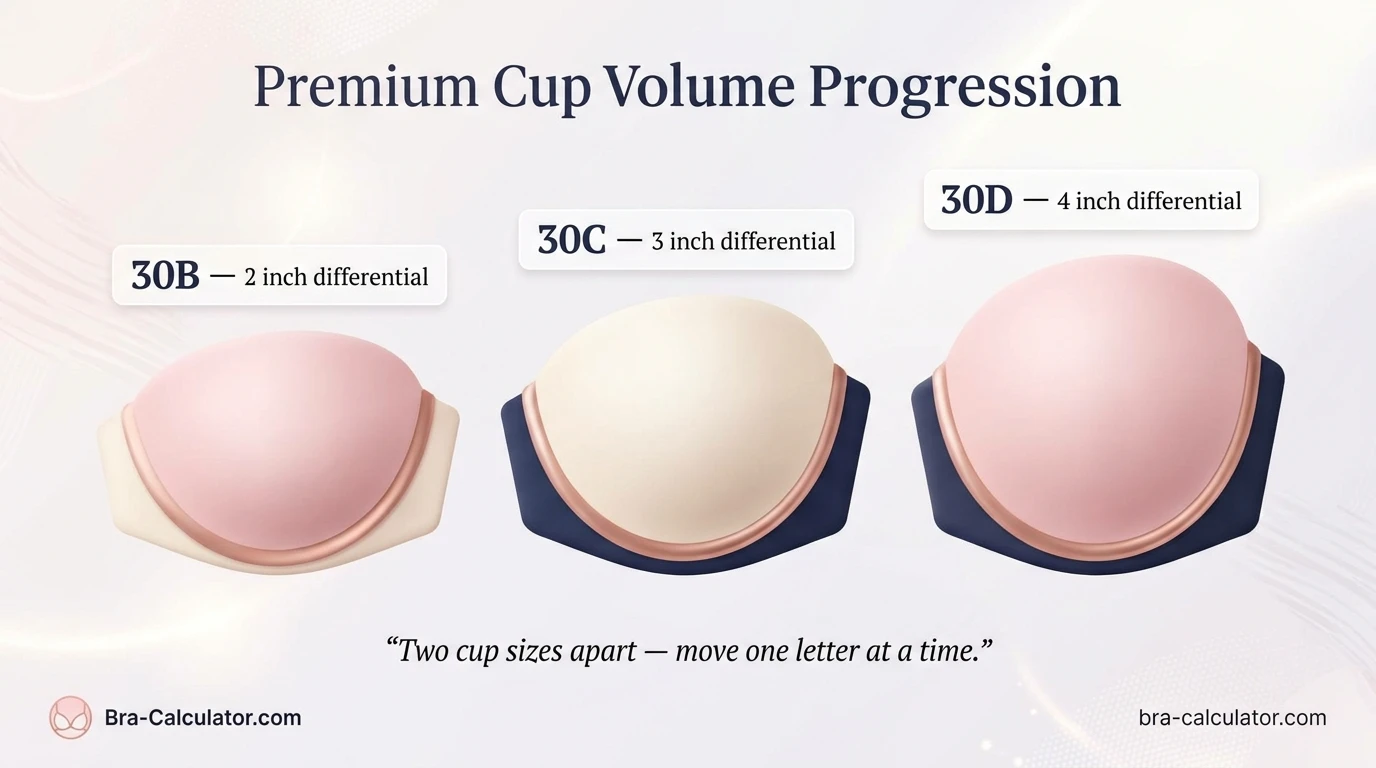
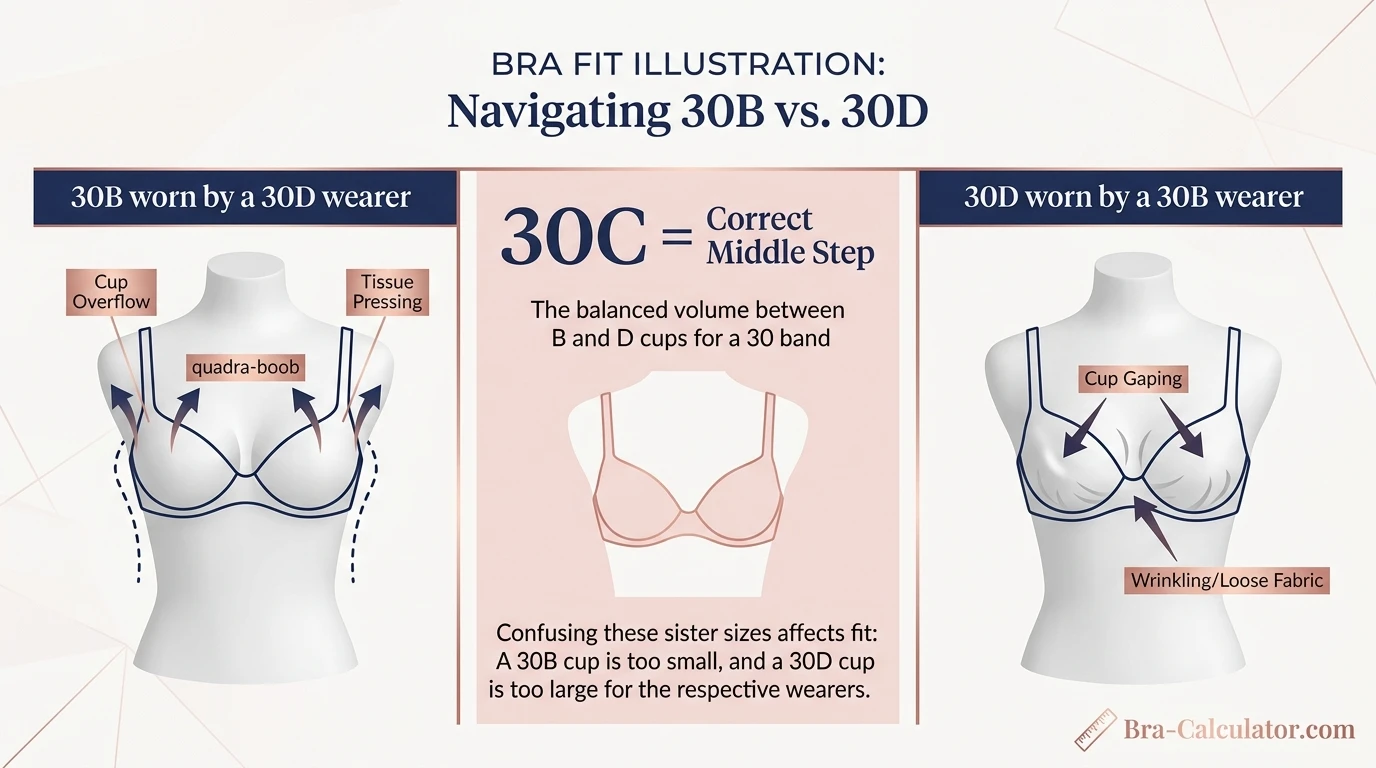
This two-letter gap is critical in practice. If your 30B cups are overflowing, the answer is not to jump directly to 30D — it is to try 30C first. Jumping two cup sizes at once risks overcorrecting. Moving one letter at a time: 30B → 30C, then assess whether 30D is actually needed. Equally, if you’re in a 30D and the cups are slightly too large, the correct move is 30C — not 30B. For a full visual breakdown of how cup volumes compare, visit our cup size visuals page.
Measurement Breakdown: 30B, 30C, and 30D
The table below includes all three sizes — 30B, the intermediate 30C, and 30D — to show the complete progression. The band and underbust are identical throughout; the bust measurement and cup differential increase by one inch with each letter.
| Size | Underbust (Band) | Bust (Fullest Point) | Cup Difference | Cup Volume |
|---|---|---|---|---|
| 30B | ~27–28″ (68–71 cm) | ~32″ (81 cm) | 2″ (5 cm) | Smallest of the three ↓ |
| 30C (intermediate) | ~27–28″ (68–71 cm) | ~33″ (84 cm) | 3″ (8 cm) | Middle — between 30B and 30D |
| 30D | ~27–28″ (68–71 cm) | ~34″ (86 cm) | 4″ (10 cm) | Largest of the three ↑ |
The underbust is identical across all three — all sit on the same 30-inch band. The bust measurements increase by approximately 1 inch per cup letter: 30B = ~32″, 30C = ~33″, 30D = ~34″. From 30B to 30D, that is a full 2-inch difference in bust circumference, representing two distinct cup sizes of breast tissue volume. These sizes are not interchangeable under any circumstances.
EU sizing: 30B = 65B; 30C = 65C; 30D = 65D. All three share the EU 65 band, which corresponds to the US/UK 30 band. Cup letters A through D are identical across US, UK, and EU sizing — there is no naming convention difference to navigate at these cup sizes. Use our international bra size charts for full reference.
Completely Different Sister Size Families: Where 30B and 30D Each Belong
Because 30B and 30D hold very different cup volumes, they belong to entirely separate sister size families with no overlap. Between these two families sits the 30C family — illustrating just how far apart 30B and 30D actually are in the volume hierarchy.
30B Sister Size Family
30D Sister Size Family
Notice the dramatic separation between families. The 30B family connects to 28C and 32A — small-cup sizes on adjacent bands. The 30D family connects to 28DD, 32C, 34B, and 36A — a completely different cup volume tier. Between these two families sits the 30C family (which connects to 28D, 32B, and 34A) — further illustrating how far apart 30B and 30D actually are.
If your 30B is unavailable, the correct sister size alternatives are 28C (firmer band, same volume) or 32A (slightly wider band, same volume). If your 30D is unavailable, the correct alternatives are 28DD / 28E UK (firmer band, same volume) or 32C (wider band, same volume). Neither size can substitute for the other. Explore the full logic at our sister sizes guide or generate your personal ladder with the sister size bra calculator.
Real Fit Differences Between 30B and 30D
With the band identical and two full cup sizes separating them, the fit differences between 30B and 30D are substantial. Here is what each mismatch looks like in practice — and why it’s always visible from the first wear.
Band Fit — Identical Between Both Sizes
The band is the same construction on both sizes — designed for a ribcage of approximately 27–28 inches. A band fit problem (riding up, too tight, too loose) is never a B vs D question. If the band rides up during activity, your underbust may be closer to 29–30 inches and you should try a 32 band — moving to 32A (sister of 30B) or 32C (sister of 30D) depending on your cup. If the band feels genuinely constricting, your underbust may be closer to 26 inches and you should try a 28 band. See our bra fit problems guide for a complete band diagnosis.
Cup Fit — Where the Two Sizes Are Entirely Different
Wearing a 30B when you measure as a 30D means significant cup overflow — tissue escaping over the top and toward the underarms, the underwire sitting on breast tissue rather than ribcage, and the gore lifting away from the sternum throughout the day. This is not a subtle spill. On a 30-inch band with D cup breast tissue, a B cup doesn’t come close to containing what’s there — and the structural failure is visible under clothing within the first hour.
Wearing a 30D when you measure as a 30B means two full cup sizes too large. The cup shell will wrinkle significantly at the top, fabric will gape away from the body, and the breast tissue will sit loose inside an oversized space with no meaningful containment or lift. At a smaller breast volume, the gap between the cup and the tissue is immediately apparent — the bra sits away from the body rather than following its contour.
Cup Depth and Projection on the 30 Band
On a 30-inch frame, the difference between a B and a D cup is particularly pronounced in terms of cup height and depth. The 30B cup is shallow and relatively close to the chest wall; the 30D cup is noticeably taller and projects further forward, because it must contain two additional cup sizes of breast tissue within the same base width. The visual difference on the body is clear and is one reason wearers sometimes describe feeling like their bra is “too small” or “too big” without being able to pinpoint why — the cup depth is the variable they’re experiencing.
Who Should Choose 30B?
- Your underbust measures approximately 27–28 inches (68–71 cm) snugly beneath the breasts.
- Your bust at the fullest point measures approximately 32 inches (81 cm) — a 2-inch differential on this frame.
- You’ve tried a 30C and found the cups gaping or wrinkling significantly at the top, confirming you need a smaller cup.
- After scooping and swooping, your breast tissue fills the 30B cup completely without overflowing at the top or sides.
- The gore lies completely flat against the sternum and stays flat throughout a full day of wear.
If your 30B cups feel slightly small but the band is correct, move one letter up to 30C — not directly to 30D. Always change cup size one letter at a time. Confirm your correct fit at our how to know your bra fits page.
Who Should Choose 30D?
- Your underbust measures approximately 27–28 inches (68–71 cm) snugly beneath the breasts.
- Your bust at the fullest point measures approximately 34 inches (86 cm) — a 4-inch differential on this frame.
- You’ve tried a 30C and found the cups still overflowing — confirming a further cup increase is needed.
- After scooping and swooping in a 30C, there is still tissue escaping over the top or sides — moving to 30D is the correct next step.
- The gore lies flat, the underwire sits fully on the ribcage, and the cups contain all breast tissue cleanly in the 30D.
If your 30D cups feel slightly small but the band is correct, move to 30DD (30E UK) on the same band — not a different band size. If 30D is unavailable in your preferred style, the correct sister size alternative is 32C (same volume, slightly wider band). Use our breast shape identifier and size charts to verify your best style match.
🛍️ Best Bras in 30B and 30D — Our Top Picks
Whether you’ve confirmed your size is 30B, 30C, or 30D — or you’re still finding your correct cup — these four bras are among the best-reviewed for the 30-inch band across the B through D cup range. All are available on Amazon and deliver the correct band anchoring, cup containment, and all-day comfort that fit research consistently identifies as the key variables. Sister sizes are noted for each to give you the widest range of availability.
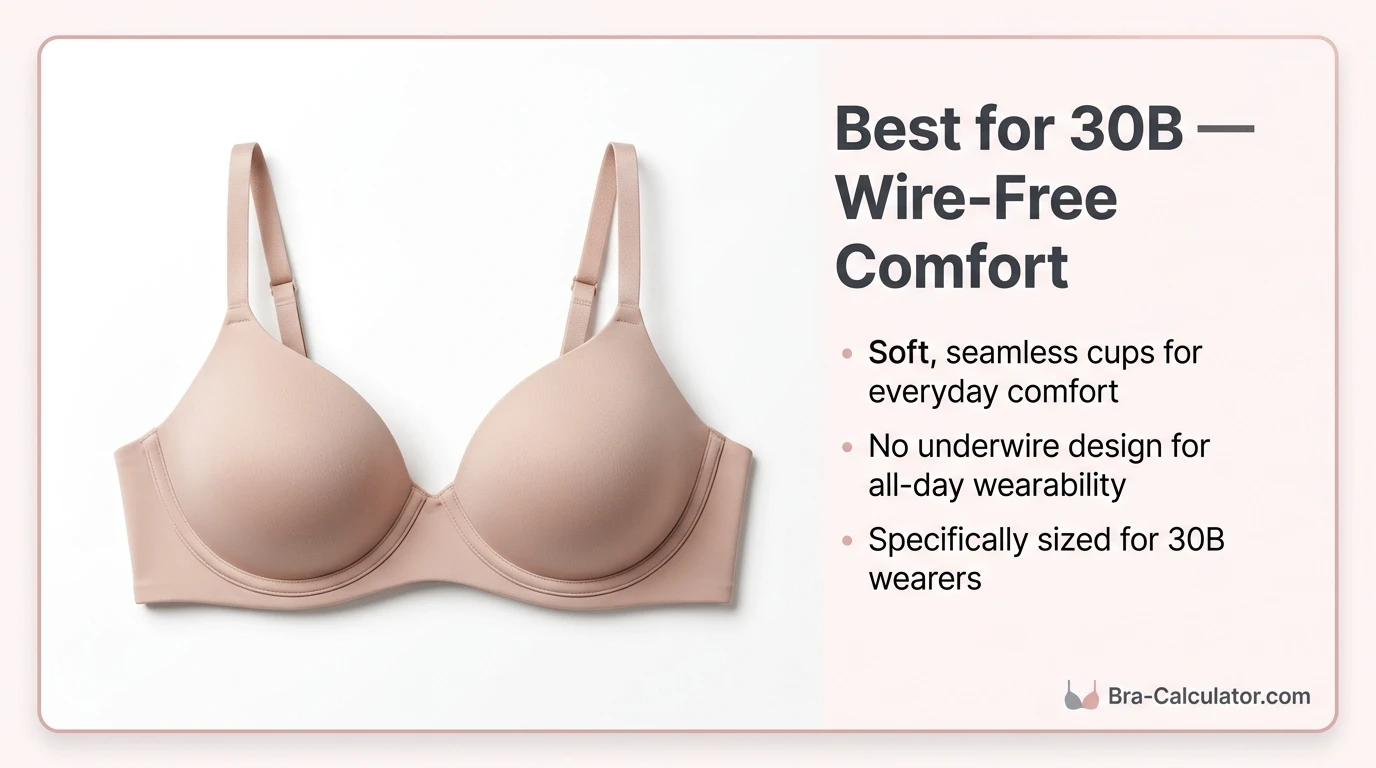
Warner’s Women’s Elements of Bliss Wire-Free Contour Bra #1269
For 30B wearers, the challenge is finding a well-structured bra in a size that some mainstream retailers treat as an afterthought. Warner’s Elements of Bliss consistently delivers: the pre-shaped contour foam cups hold their silhouette throughout a full wear day without wrinkling or collapsing at smaller cup volumes, the wide structured back band stays level on a 30-inch band without rolling, and the tagless construction eliminates underarm irritation. At over 14,000 reviews, this is the most extensively validated everyday wire-free option at smaller cup sizes in the 30-band range. Available in 30B — and in sister sizes 28C and 32A if your preferred 30B is out of stock in this style. At under $25, rotating between two bras for proper care is financially straightforward.
Available in: 30B — sister sizes 28C and 32A hold equal volume on adjacent bands
View on Amazon →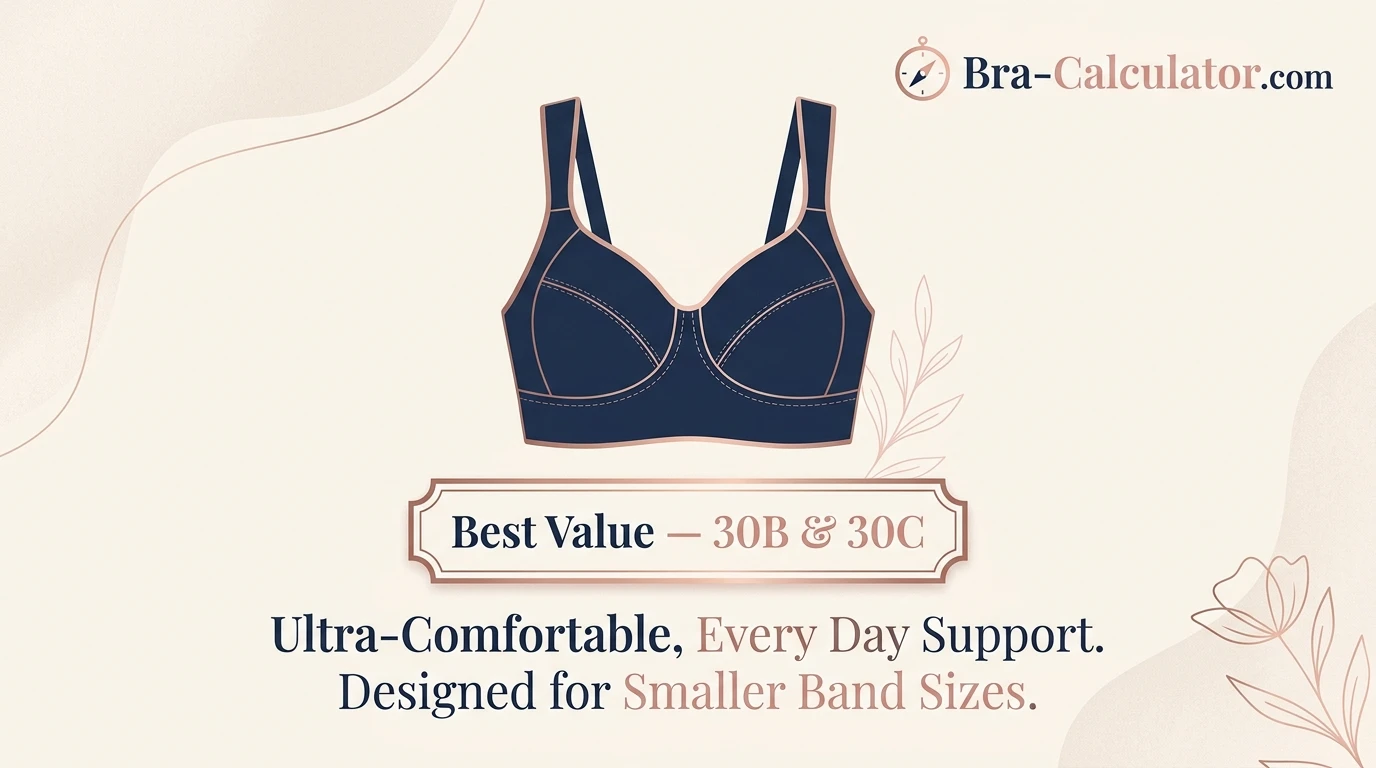
Maidenform Women’s Comfort Devotion Extra Coverage Wire-Free Bra #09404
The memory foam cups in the Comfort Devotion conform to the individual shape of the breast tissue rather than holding a fixed pre-moulded geometry. For 30B and 30C wearers who find that standard moulded cups either gape at the top or don’t follow the natural breast contour at smaller volumes, memory foam produces a noticeably more comfortable daily fit. The extra-coverage cup height prevents the neckline overflow that can occur in lower-cut styles at B and C cup, and the smoothing side panel keeps lateral tissue contained under fitted clothing. Available in 30B and 30C with the multi-hook back providing long-term band adjustability — particularly useful for wearers who are between sizes and trialling both 30B and 30C to find the correct fit.
Available in: 30B and 30C — full range 32B–42DDD (confirm 30 band availability in this style)
View on Amazon →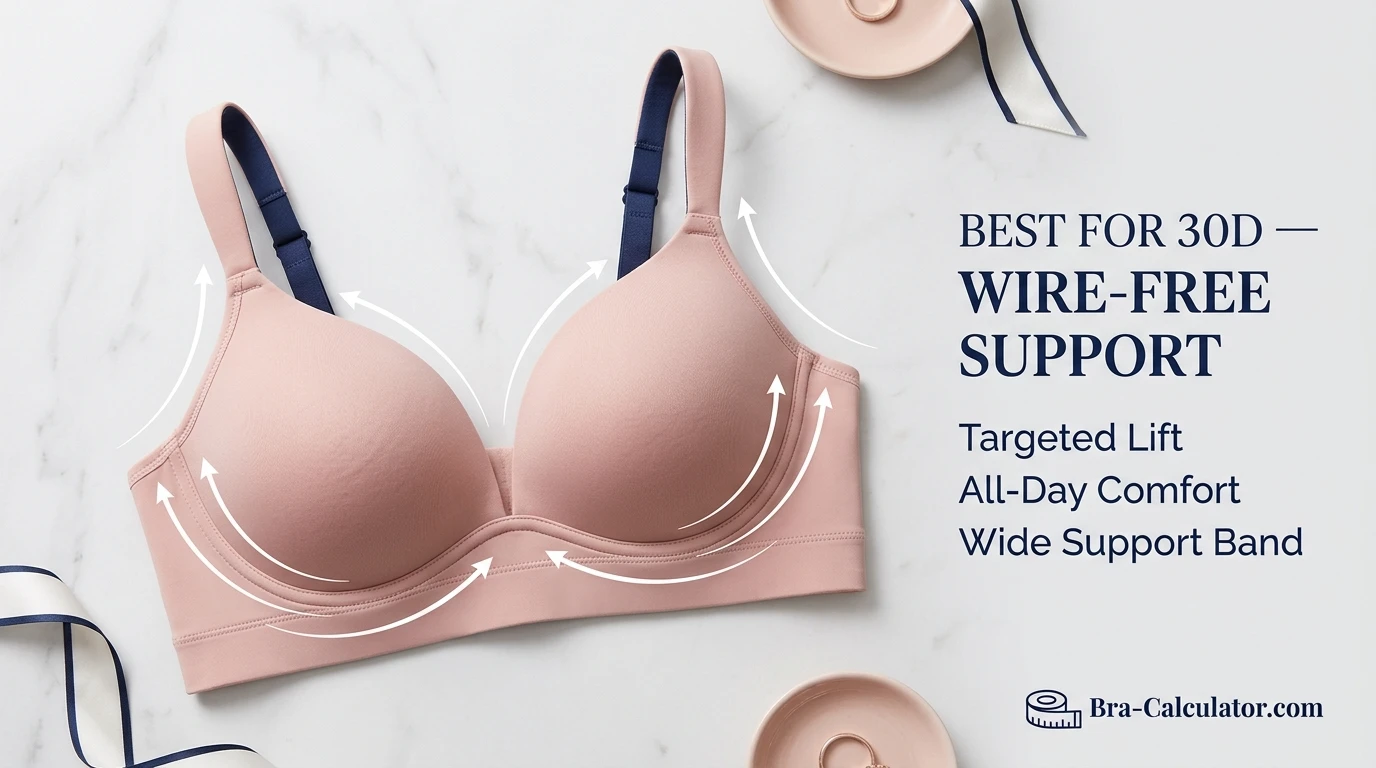
Glamorise Women’s Full Figure MagicLift Active Support Wirefree Bra #1005
For 30D wearers, the MagicLift inner sling system delivers lift and separation without a wire — directly addressing the most common complaint at D cup volume on a 30-inch band, which is underwire width mismatch causing side discomfort when the wire channel is calibrated for a wider chest wall than a 30-band wearer has. The sling avoids this problem entirely by providing structured lift through fabric geometry rather than metal. The multi-hook back band stays level on a 27–28 inch ribcage without the rolling that affects wider-band equivalents, and cushioned non-slip straps carry guidance rather than load. At 6,800+ reviews with consistent feedback praising all-day comfort at extended wear, this is a reliable structured option for the 30D range. If 30D is temporarily out of stock, the sister size 32C holds equal cup volume on a wider band.
Available in: Wide range from 36C–46H — confirm 30D availability; sister size 32C widely stocked
View on Amazon →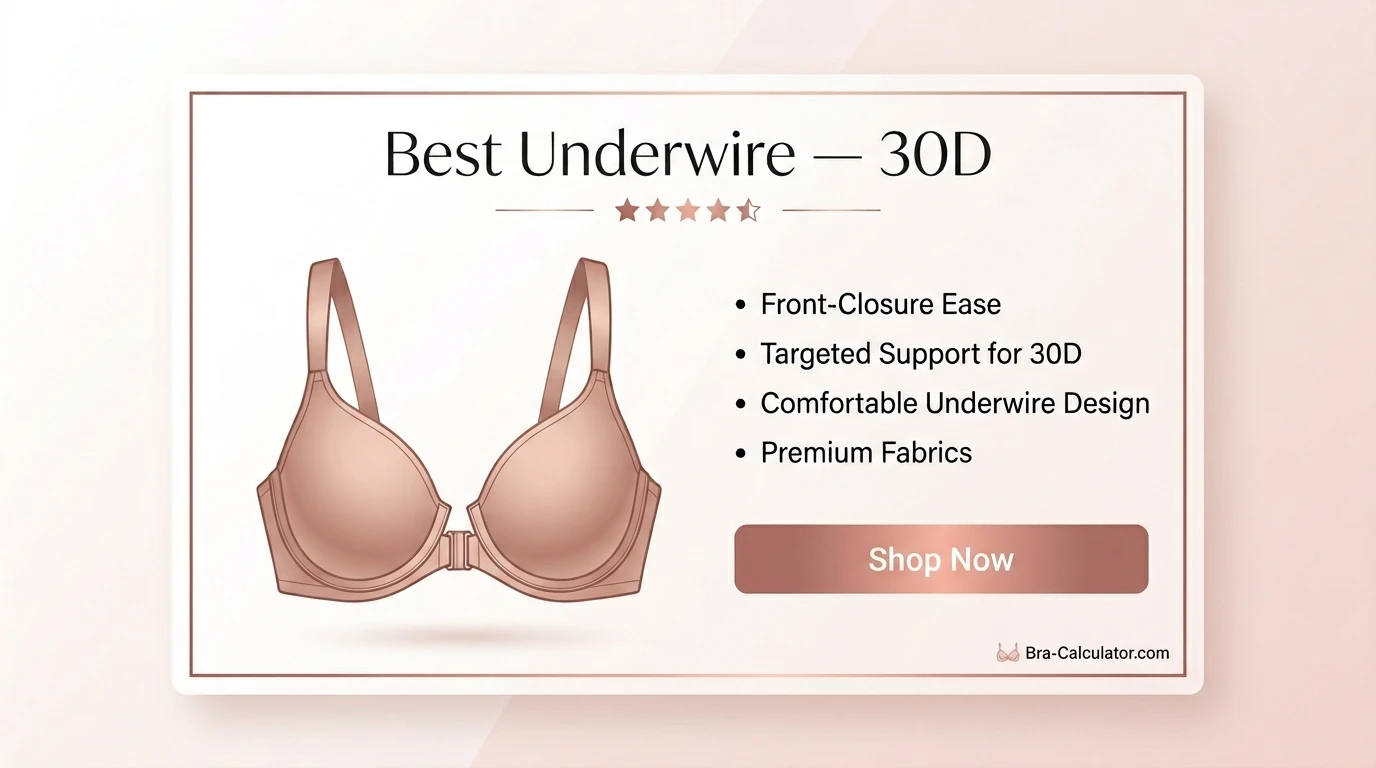
Glamorise Women’s WonderWire Front-Close Underwire Bra #1245
For 30D wearers who prefer an underwire style, the WonderWire is one of the most practical options available on Amazon. At D cup volume on a 30-inch band, standard narrow underwire channels can sit too close together for broader breast roots, or dig into the sides of breast tissue rather than resting cleanly on the ribcage. The WonderWire’s wider, cushioned channel distributes pressure across a broader base, making it significantly more likely to sit correctly on the ribcage without side pressure. Wide side panels contain the lateral tissue spread that becomes more significant at D cup on a narrow band, and the front-close design removes the difficulty of reaching around a narrow 30-inch band to fasten a back hook — a genuinely practical advantage. Available in sister size 32C (same volume as 30D on a slightly wider band) if 30D is out of stock in this style.
Available in: 34D–48H — confirm 30D availability; sister size 32C widely stocked in this range
View on Amazon →ℹ️ As an Amazon Associate, Bra Calculator earns from qualifying purchases. All picks are independently selected based on fit quality, construction, and relevance to the 30B and 30D cup range. Prices and availability subject to change — confirm your specific size is in stock before ordering.
The One-Letter Rule: How to Move Between 30B and 30D Correctly
| Comparison Type | Example | Same Volume? | Relationship |
|---|---|---|---|
| Same band, two cups up | 30B → 30D | ❌ No | 30D is two full cups larger — skip 30C only if confirmed necessary |
| Same band, one cup up (correct step) | 30B → 30C | ❌ No | 30C is one cup larger — the correct first step if 30B cups are too small |
| Same band, one more cup up | 30C → 30D | ❌ No | 30D is one cup larger than 30C — the correct second step if 30C still overflows |
| Band up + Cup down (30B) | 30B → 32A | ✅ Yes | Sister sizes — equal volume, slightly wider band |
| Band down + Cup up (30B) | 30B → 28C | ✅ Yes | Sister sizes — equal volume, firmer band |
| Band up + Cup down (30D) | 30D → 32C | ✅ Yes | Sister sizes — equal volume, slightly wider band |
| Band down + Cup up (30D) | 30D → 28DD (28E UK) | ✅ Yes | Sister sizes — equal volume, firmer band |
| Band up, same cup letter | 30B → 32B | ❌ No | 32B is larger than 30B — one full cup above 30B on a wider band |
| Band up, same cup letter | 30D → 32D | ❌ No | 32D is larger than 30D — one full cup above 30D on a wider band |
The golden rule for this comparison: never jump from 30B directly to 30D without trying 30C first. The 30C is the correct intermediate step — it holds one cup more than 30B and one cup less than 30D. Skipping it risks both overcorrecting and missing your actual correct size. If you’re genuinely unsure whether you’re a 30B or 30D, start by establishing whether you’re a 30C — and work from there in one direction at a time.
30B vs 30D: Full Side-by-Side Comparison
| Feature | 30B | 30D |
|---|---|---|
| Band Size | 30 (~27–28″ / 68–71 cm underbust) | 30 (~27–28″ / 68–71 cm underbust) |
| Cup Letter (US and UK) | B — 2″ (5 cm) over underbust | D — 4″ (10 cm) over underbust |
| EU Approximate | 65B | 65D |
| Gap Between Them | Two full cup sizes — 30C is the correct intermediate | |
| Bust Measurement | ~32″ (81 cm) | ~34″ (86 cm) — approximately 2″ larger |
| Sister Size? | ❌ No — two cup sizes apart, two entirely different volume families | |
| Underwire Width | Identical — both built on the same 30-inch band | |
| Cup Height / Depth | Shallower — 2″ differential | Noticeably taller and deeper — 4″ differential |
| Intermediate Size | 30C — 3″ differential, ~33″ bust, sits exactly between these two sizes | |
| Sister Size Family | 28C — 30B — 32A (chain ends at A cup) | 28DD (28E UK) — 30D — 32C — 34B — 36A |
| If cups too small (first step) | Try 30C first (same band, +1 cup) | Try 30DD / 30E UK (same band, +1 cup) |
| If cups too large (first step) | Try 30A (same band, -1 cup) | Try 30C first (same band, -1 cup) |
| If band too narrow | Try 32A (sister — same volume) | Try 32C (sister — same volume) |
| If band too wide | Try 28C (sister — same volume) | Try 28DD / 28E UK (sister — same volume) |
| Availability | Widely available — standard size well-stocked by mainstream and specialist retailers | Widely available — D cup on 30 band stocked by most specialist fuller-bust retailers and many mainstream stores |
Quick Bra Fit Test: 5 Checks for 30B and 30D Wearers
On a 30-inch band, fit precision matters. The narrower frame amplifies every cup error — a cup that’s a full size off is immediately visible, and two sizes off (as in this comparison) is never subtle. Run these five checks carefully whenever trying a new size, brand, or style in the 30-band range.
Lean forward and scoop all breast tissue fully forward and upward into the cups. After scooping: overflow at the top or sides means the cup is too small — go up one letter at a time (30B → 30C first; 30C → 30D only if 30C still overflows). Wrinkling or gaping means cup too large — go down one letter (30D → 30C first; 30C → 30B only if 30C still gapes). At two letters’ difference, the mismatch is never subtle — but the correction should still happen one step at a time. Never jump from 30B to 30D or from 30D to 30B without trialling 30C.
The gore must lie completely flat against the sternum throughout the entire day. On a 30-inch band, the gore is one of the most reliable fit indicators — the narrower frame leaves little slack for a cup problem to partially hide. A floating gore at any point during the day means the cup is too small: go up one cup letter on the same band. A gore that lies flat but cups wrinkle at the top means cup too large — go down one letter. Never try to press the gore down with strap tightening or a different bra position — these don’t solve the problem.
The underwire must sit fully on the ribcage and encircle all breast tissue at every point from the gore to the side seam. Because 30B and 30D share the same 30-inch band, they share the same underwire width. If the underwire is sitting on breast tissue at the sides rather than ribcage — this is a cup-too-small problem, not a wire-width problem: go up one cup letter. If the wire fits correctly but the cup gapes above it — the cup is too large: go down one letter. Underwire width problems on a 30 band are usually a band-width problem — if the wire consistently feels too wide for your chest wall, your underbust may be closer to 26 inches and a 28 band would fit more accurately.
On the loosest hook, slide two fingers under the back band with firm, consistent resistance. A 30-band bra should feel genuinely snug — clearly anchored, not constricting. If your whole hand slides easily under the band, your underbust may be closer to 29–30 inches and a 32 band is likely more appropriate — with the cup letter adjusting via sister sizing (30B → 32A, or 30D → 32C). If one finger won’t fit comfortably on the loosest hook from day one, the band is too tight — your underbust may measure closer to 26 inches and a 28 band may be correct. The band carries approximately 80% of all breast support — getting it right is the foundation of correct bra fit.
Raise both arms overhead, twist from side to side, and walk briskly for 60 seconds. The band must stay completely level front and back, cups must remain fully in position with all tissue contained, and straps must stay on shoulders without digging in. Any downward shift of the cups during movement is a band problem — the band is too loose for the cup volume. Switch to the sister size with the firmer band for your cup volume (30B → 28C, or 30D → 28DD). Any restriction in the torso during normal movement means the band is too tight — switch to the wider sister size (30B → 32A, or 30D → 32C). Never tighten straps to compensate for a moving band — this solves nothing and creates shoulder and neck strain.
Still unsure whether 30B, 30C, or 30D is your correct size — or whether the 30 band is genuinely right for your ribcage? Our AI calculator gives you a precise band, cup, and complete sister size family in under 2 minutes based on your actual measurements.
Try the AI-Powered Bra Size Calculator →People Also Ask: 30B vs 30D — Answered
Are 30B and 30D the same size?
No — 30B and 30D are not the same size and are not sister sizes. They share the same 30-inch band but are two full cup sizes apart in volume. The 30D holds two complete cup sizes more breast tissue than the 30B on the same frame, with a 4-inch bust-to-underbust differential versus the 30B’s 2-inch differential. The 30C sits directly between them as the correct intermediate size.
Which is bigger — 30B or 30D?
The 30D is bigger — by two full cup sizes. Both share the same 30-inch underbust, but the 30D bust is approximately 34 inches versus the 30B’s approximately 32 inches. That 2-inch difference in bust circumference represents two complete cup sizes of additional breast tissue on the same band. The 30C, at approximately 33 inches bust, sits exactly between them.
My 30B cups are too small — should I try 30C or 30D?
Try 30C first — not 30D. Always change cup size one letter at a time. If your 30B cups are overflowing, the correct next step is 30C (one cup larger on the same band). After trialling 30C, assess the fit: if cups now contain all tissue without overflow or gaping, 30C is your correct size. If there is still overflow after a thorough scoop-and-swoop, then try 30D. Jumping from 30B directly to 30D risks overcorrecting — potentially ending up one cup size too many rather than finding the precise correct size. One letter at a time is always the right approach.
My 30D cups are gaping — should I try 30C or 30B?
Try 30C first — not 30B. If your 30D cups are gaping or wrinkling at the top, the correct next step is 30C (one cup smaller on the same band). After trialling 30C, assess: if cups now fit without gaping or overflow, 30C is correct. If there is still significant gaping in 30C, then try 30B. Moving from 30D directly to 30B without trialling 30C risks ending up two cup sizes too small — potentially too small to contain your breast tissue properly. One letter at a time preserves your ability to find the precise right cup on the correct band.
What are the sister sizes of 30B?
The sister sizes of 30B — sizes that hold approximately equal cup volume on different band widths — are 28C (firmer band, same volume) and 32A (slightly wider band, same volume). The 30B sister size family is one of the shorter chains in the sister size system because the A cup is the smallest standard letter — the family ends at 32A with no 34AA widely available. If your 30B is unavailable, 32A is the correct same-volume alternative on a slightly wider band.
What are the sister sizes of 30D?
The sister sizes of 30D are: 28DD (28E UK) — firmer band, same volume; 32C — slightly wider band, same volume; 34B — wider band, same volume; 36A — widest, same volume. The most practical and accessible sister sizes are 32C and 34B — both widely stocked by mainstream and specialist retailers. If your 30D is unavailable, 32C is the correct same-volume alternative on a slightly wider band. Use our sister sizes guide for the full family.
How do I know if I’m a 30B, 30C, or 30D?
Measure your underbust snugly — approximately 27–28 inches confirms the 30 band. Measure your bust at the fullest point and subtract: 2 inches = B, 3 inches = C, 4 inches = D. Verify with fit checks: band level and firmly anchored all around, gore flat against sternum throughout the day, underwire on ribcage encircling all breast tissue, two fingers under back band on loosest hook with firm resistance, and no cup or band movement during 60 seconds of activity. Use our bra size chart calculator for a personalised measurement-based result or try the AI smart fit calculator for an instant answer.
Is the 30 band hard to find?
More available than very narrow bands (28 and below) but less available than 32 and above in mainstream retail. Specialist lingerie retailers — including Freya, Panache, Bravissimo, and Curvy Kate for UK brands; HerRoom and Bare Necessities for US online options — consistently stock 30-band bras across A through DD and beyond. If your exact 30-band size is out of stock in a preferred style, sister sizing to the adjacent 32-band size (32A for 30B volume, 32C for 30D volume) gives you access to a much wider selection while maintaining the same cup volume.
What is 30D in UK and EU sizing?
30D is the same in both US and UK sizing — the D letter is identical in both conventions up to and including D cup. EU sizing: 30D = approximately 65D. Similarly, 30B = EU 65B. The US/UK/EU systems all agree at B and D cup — there is no naming convention difference to navigate at these cup sizes, unlike higher cups where US DDD and UK F diverge. Always verify with the specific brand’s chart, as EU conventions can vary slightly between manufacturers.
Can I use a bra extender instead of going up a cup size?
A bra extender adds length to the back band — it widens the band, not the cup. If your 30B cups are too small, a bra extender will make your 30B into an approximate 32B (wider band, same cup volume) — which may help if your band was genuinely too tight, but does nothing for the cup overflow. To fix a cup-too-small problem, you must go up a cup letter on the same band (30B → 30C), not extend the band. Extenders are useful tools for band adjustability, but they never address cup volume — which is always solved by changing the cup letter.