36G vs 38F: Are They the Same Size? (Sister Size Explained 2026)
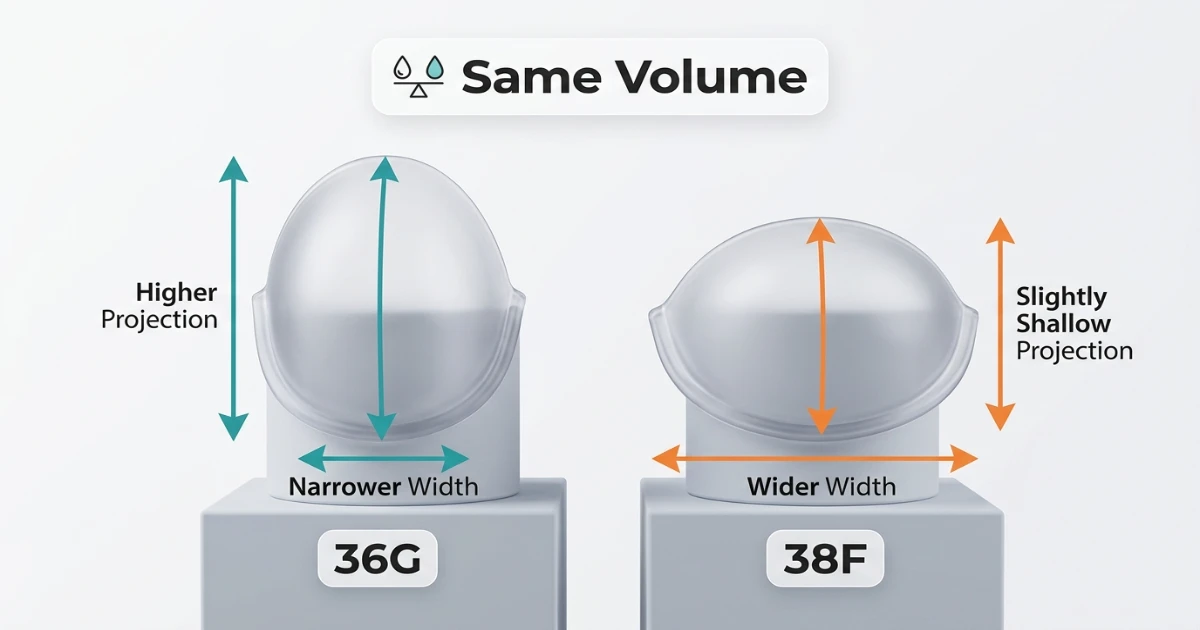
Quick Answer: Yes — 36G and 38F are sister sizes. They hold approximately the same cup volume, meaning the same amount of breast tissue fits in both. The key difference is the band: a 36G grips a narrower ribcage more firmly and produces a deeper, more projected cup, while a 38F sits on a wider ribcage with a broader, slightly shallower cup. Neither is physically larger — they simply suit different body frames at the fuller end of the cup spectrum.
Choose the fit signs you notice in the band, cups, center and straps. We’ll turn them into a practical next step for 36G.
Private fit check — your answers stay in your browser and are used only for this on-page guidance. Nothing is stored or submitted.
⚡ Key Takeaways
- Same cup volume: 36G and 38F enclose approximately equal breast tissue volume.
- Different band sizes: 36 fits ~31–32″ (79–81 cm) underbust; 38 fits ~33–34″ (84–86 cm) underbust.
- 36G = tighter band, deeper cup: More forward projection on a narrower frame.
- 38F = wider band, shallower cup: More lateral spread across a broader chest.
- US equivalents: 36G ≈ 36DDDD; 38F ≈ 38DDD — labelling varies by brand.
- Band fit is critical at G and F sizes: Heavy breast tissue at these cup sizes makes a correctly fitting band absolutely non-negotiable.
- Specialist brands essential: Neither size is found reliably in mainstream stores — dedicated fuller-bust retailers are required.
- Underwire width is a primary fit factor: At G and F cup sizes, the breast root is broad — wire width must match it precisely.
Understanding the Band Size Difference: 36 vs 38 at G and F Cup Sizes
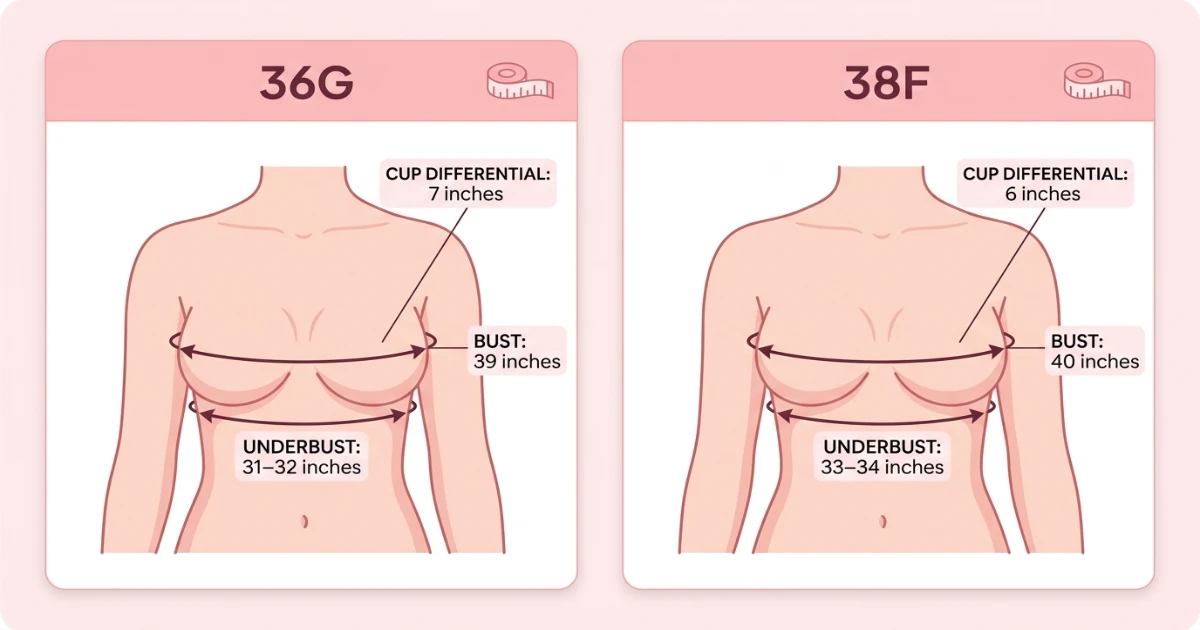
At G and F cup sizes, the band does more structural work than at any smaller cup size in this entire comparison series. The breast tissue contained in a G or F cup is substantially heavy — and the consequences of a loose band at these sizes are felt almost immediately. A 36-band is built for an underbust of approximately 31–32 inches (79–81 cm); a 38-band is designed for roughly 33–34 inches (84–86 cm).
The two-inch difference in band size represents two very different structural anchoring scenarios. On a correctly fitting ribcage, both bands can provide excellent all-day support. On the wrong ribcage, the failure happens faster and more dramatically at G and F cup sizes than at any smaller cup — because the heavier the breast tissue, the less margin there is for even slight band looseness before support collapses.
The Cascade Effect of a Loose Band at G and F
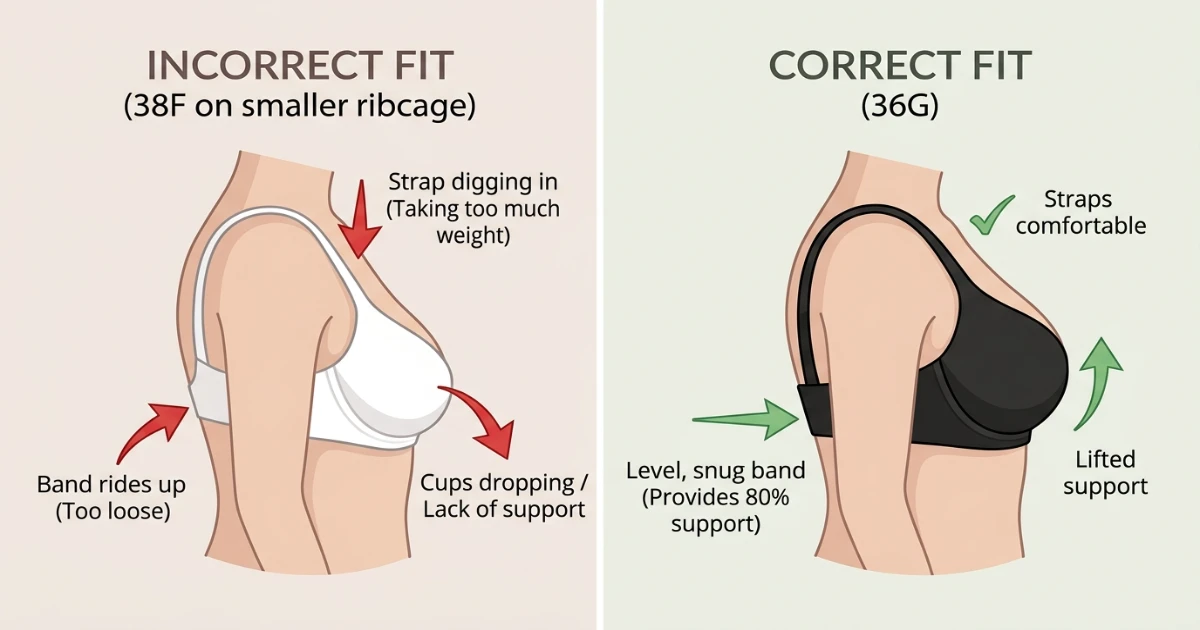
Bra fitting specialists agree that approximately 80% of breast support comes from the band. At G and F cup sizes, this figure is arguably closer to 90%. A 38F band on a 32-inch ribcage will rise upward at the back within two to three hours. Each centimetre it rises drags the deep G-volume cups further downward in front — pushing underwires off the ribcage, opening the gore away from the sternum, and transferring breast weight to the straps.
At this cup size, that weight loading on the straps is severe, causing shoulder grooves, neck tension, and upper back pain that many G and F wearers accept as simply inevitable consequences of their size. They are not. They are the consequence of a too-loose band. An accurate underbust measurement resolves this entirely.
Measurement Breakdown: 36G vs 38F
| Size | Underbust | Bust (Fullest Point) | Cup Differential | UK Cup | US Equivalent |
|---|---|---|---|---|---|
| 36G | ~31–32″ (79–81 cm) | ~39″ (99 cm) | 7″ (18 cm) | G | DDDD (some brands) |
| 38F | ~33–34″ (84–86 cm) | ~40″ (102 cm) | 6″ (15 cm) | F | DDD |
The bust measurements differ by approximately one inch — consistent with sister sizing across all families. The 38F cup compensates for its smaller letter differential with a wider circumference, producing approximately the same enclosed cup volume as the deeper, narrower 36G cup. Both sizes sit at the substantial end of the fuller-bust spectrum.
EU band sizes: 36G = 80G; 38F = 85F. Note that EU cup letters may vary from UK letters at these sizes depending on the brand — always check the brand’s specific size guide when ordering. Cross-reference all conventions with our international size charts.
Why Cup Volume Is the Same: The Sister Size Principle
Cup letters are ratios, not fixed measurements. At every cup size — including G and F — the letter simply expresses how many inches the bust exceeds the underbust. Change the band and the same ratio produces a different physical volume.
- 5″ = DD/E | 6″ = DDD/F | 7″ = DDDD/G | 8″ = H | 9″ = GG/I
A 36G has a 7-inch differential on a 36-inch frame. A 38F has a 6-inch differential on a 38-inch frame. Because the 38 frame is already 2 inches wider, a smaller differential still generates approximately the same enclosed cup volume. G on a 36 band does not mean more volume than F on a 38 band. They are sister sizes — the same space, achieved through different geometry.
Full Sister Size Equivalency for This Family
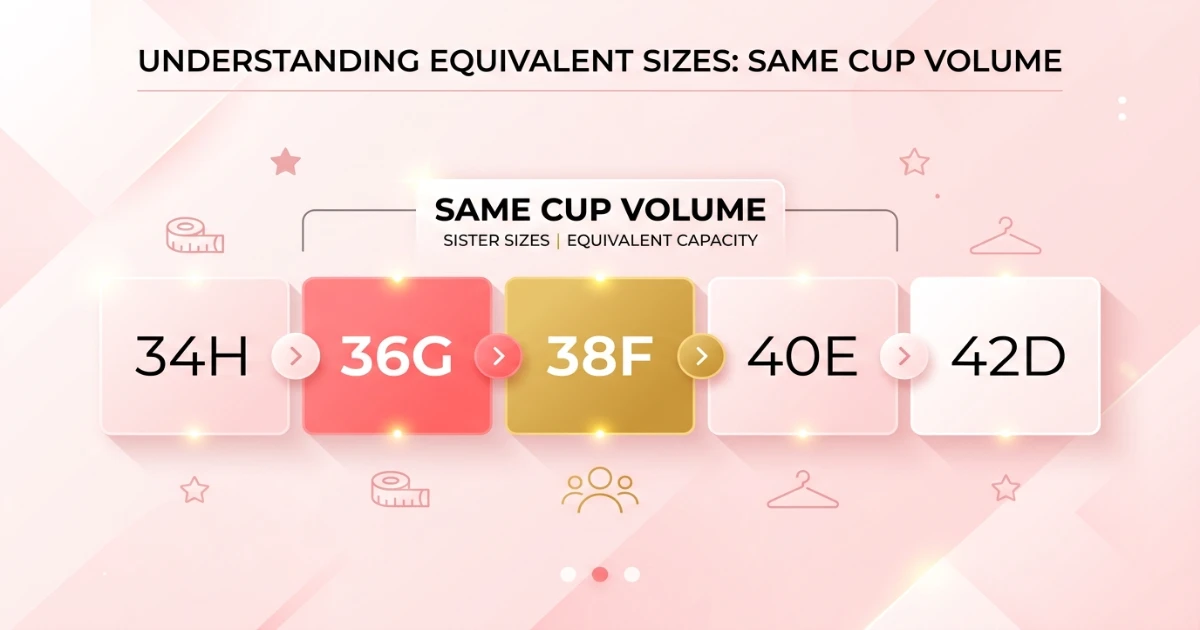
- 34H ≈ 36G ≈ 38F ≈ 40E ≈ 42D — all approximately equal cup volume.
At the fuller end of the cup spectrum this is especially useful knowledge: if your usual size is unavailable, the sister size on the next band is your best alternative. Explore the complete guide on our cup size visuals page.
Real Fit Differences Between 36G and 38F
Band Tension and Structural Support
A correctly fitted 36G band runs level all the way around the ribcage, functions as the primary load-bearing structure of the entire bra, and requires minimal contribution from the straps. At G cup volume this is not optional — it is the difference between a bra that works and one that progressively fails through the day. A 38F on a narrower ribcage starts migrating within hours. Once it rises, the G-volume cups drop, the underwires press into tissue, and the straps carry a weight load that causes real physical discomfort by midday. This is solved entirely by wearing the correct band size.
Cup Depth, Projection, and Shape
The 36G cup is deeply projected and narrow at the base — it points forward significantly from the chest wall, designed for breast tissue that extends prominently away from the body on a smaller frame. The 38F cup is wider and slightly shallower, constructed to spread across a broader chest wall with more lateral tissue distribution. Both cups contain the same volume but the shape they create on the body is distinctly different — the 36G creates a more forward, defined silhouette while the 38F creates a broader, more spread profile. Understanding this shape difference is important: wearing the wrong geometry for your breast shape creates discomfort even when the cup volume is correct.
Underwire Width — The Most Critical Factor at G and F
At G and F cup sizes, the natural breast root is typically broad. The underwire must span this entire root — from the inner edge near the sternum to the outer edge near the underarm — resting exclusively on firm ribcage throughout. The 36G underwire is narrower, designed for the breast root of a smaller chest. The 38F underwire is wider, built for the broader root of a larger frame. A wire that is too narrow at these cup sizes digs into breast tissue at the sides and causes pain that is frequently misdiagnosed as the wrong cup size or wrong style.
A wire that is too wide sits on bare ribcage and causes jabbing at the outer ends. Getting the underwire width right is, at G and F cup sizes, as important as getting the cup volume right. Diagnose all wire issues at our bra fit problems guide.
Who Should Choose 36G?
- Underbust measurement approximately 31–32 inches (79–81 cm) confirmed snugly, measured on the exhale.
- Bust measurement at the fullest point approximately 39 inches (99 cm) — a 7-inch differential.
- Current 38F band rides up at the back, requires constant repositioning, or causes straps to dig in despite being loosened.
- Breasts project significantly forward from the chest wall on a narrower frame — the 36G cup geometry matches this shape.
- The 38F underwire extends into the armpit well past the natural breast tissue boundary.
- Currently experience shoulder grooves or neck tension while wearing a 38F — classic signs of band-induced strap overloading.
Confirm your correct fit at our how to know your bra fits page.
Who Should Choose 38F?
- Underbust measurement approximately 33–34 inches (84–86 cm) confirmed snugly.
- Bust measurement at the fullest point approximately 40 inches (102 cm) — a 6-inch differential on the wider frame.
- The 36G band feels genuinely tight or restrictive even on the loosest hook from the very first wear.
- Breast tissue has a wide, laterally spread root — the 36G underwire digs into breast tissue at the sides even when the band seems acceptable.
- Consistently find 36-band bras constricting across the whole torso regardless of cup size.
- The 38F underwire encircles all breast tissue cleanly without pinching, confirming the wider wire matches your breast root.
Use our breast shape identifier and size charts to confirm your best-fit size before purchasing at these specialist sizes.
🛍️ Best Bras for 36G and 38F — Top Amazon Picks
At G and F cup sizes, only specialist fuller-bust brands produce bras with the cup depth, underwire width, and band strength that these sizes demand. These two top-rated Amazon picks are engineered specifically for G and F cup wearers and are available in both sizes.

- Three-part cup construction built for G cup depth — full containment with no overflow
- Narrower underwire channel precisely matched to the 36-band breast root width
- Reinforced firm band engineered to bear heavy G cup breast tissue load all day
- Side-sling support panel prevents lateral tissue migration common at G cup sizes
- Widely available in 36G across multiple colourways from classic to fashion prints
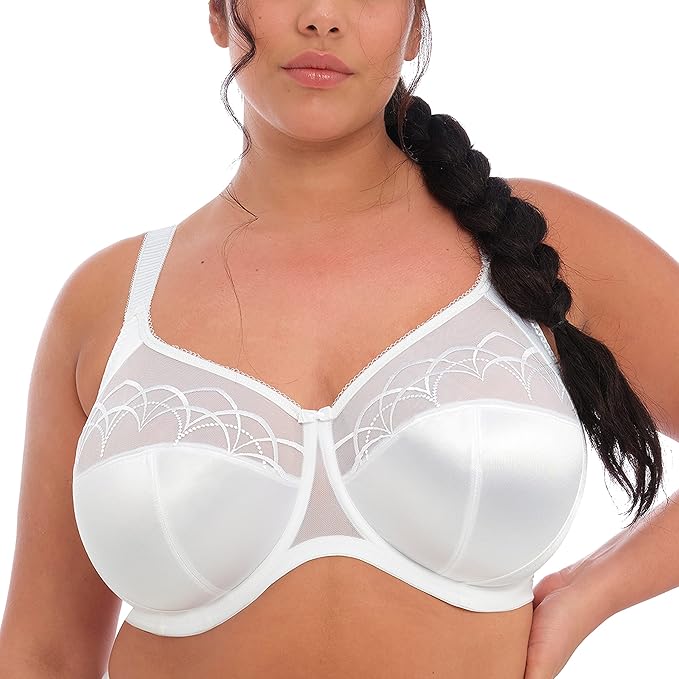
- Wide, anatomically correct underwire designed to follow the full F cup breast root on a 38 frame
- Full-coverage cup with lateral side support — ideal for wider-spread breast tissue on broader chests
- Heavy-duty firm band stays level all day under significant F-cup breast load on a 38 ribcage
- Banded construction with internal sling for maximum uplift and zero droop throughout the day
- Available in 38F / 38DDD with extensive colourway options from Elomi’s fuller-bust range
The Sister Size Ladder: Where 36G and 38F Sit
36G and 38F are direct neighbours on the same sister size chain. All five sizes in this ladder hold approximately equal cup volume — only band tightness, cup geometry, and underwire width shift as you move along it.
US equivalents for this ladder: 34H → 36DDDD (36G) → 38DDD (38F) → 40DD → 42D. Moving left tightens the band and deepens the cup. Moving right loosens the band and widens the cup. Volume stays approximately constant throughout. Explore the complete chart on our sister sizes guide or generate your personal ladder with the sister size bra calculator.
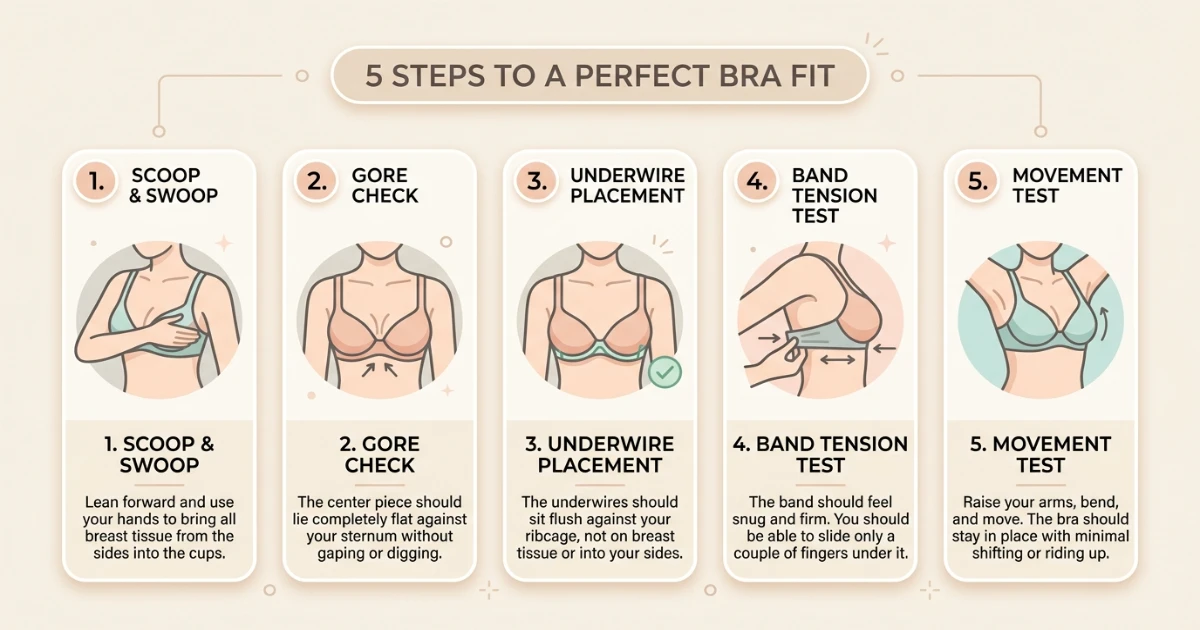
Quick Bra Fit Test: 5 Checks for G and F Cup Wearers
At G and F cup sizes, fit issues are the most consequential of any size in this entire comparison series. The breast tissue is heavier, the cups deeper, and the margin for error smaller. Run through these five checks to confirm whether your current bra is genuinely working for your body.
Lean forward and scoop all breast tissue — the significant side fullness and underarm extension common at G and F cup sizes must be fully included — forward and upward into the cup. At these cup sizes, the amount of tissue sitting outside an ill-fitting cup is often surprising. Any overflow after thorough scooping means the cup is too small or the underwire too narrow. Wrinkling at the top means the cup is too large. This single check is the most important fit assessment available.
The centre gore must lie completely and continuously flat against the sternum. At G and F cup sizes, a floating gore is the most consistent and reliable sign of insufficient cup depth — the breast tissue is simply too voluminous and too projected to allow the cup to close against the sternum. If the gore floats even slightly, go up one cup size or try the sister size with a tighter band. At these sizes, a correctly positioned gore that lies flat all day is a definitive confirmation of correct cup volume.
The underwire must rest entirely on firm ribcage, encircling all breast tissue from the side seam to the centre gore. At G and F cup sizes, the breast root is typically broad — check that the wire starts and ends precisely at the natural edges of your breast tissue. Wire ending on bare ribcage = too wide for your breast root (38F wire on a 36G wearer). Wire digging into breast tissue at the side = too narrow for your breast root (36G wire on a 38F wearer). At these cup sizes, wire width mismatch is the most common source of persistent, daily discomfort.
On the loosest hook, two fingers under the back band with firm, definite resistance. At G and F cup sizes, the band is carrying very significant breast tissue weight. Even slight looseness translates immediately into cup drop. If more than two fingers slide in easily, go down one band size and up one cup letter to maintain volume — that means 38F → 36G. The band must run perfectly level all the way around your body, front and back equally, from the moment you put the bra on.
Raise both arms overhead, twist from side to side, walk briskly for a full minute. At G and F cup sizes, movement exposes fit problems immediately and dramatically. A correctly fitting bra stays completely stable throughout all of this movement. Any band riding, cup dropping, or strap digging during movement at these cup sizes is not a minor inconvenience — it is the bra structurally failing under load. If it happens, revisit the band size first, then the cup size and underwire width in that order.
Still unsure whether 36G or 38F is the right fit for your body? Our AI calculator gives you a precise answer from your actual measurements.
Try the AI-Powered Bra Size Calculator →36G vs 38F: Full Side-by-Side Comparison
| Feature | 36G (36DDDD) | 38F (38DDD) |
|---|---|---|
| Band Size | 36 (31–32″ / 79–81 cm underbust) | 38 (33–34″ / 84–86 cm underbust) |
| Cup (UK / US) | G / DDDD — 7″ (18 cm) differential | F / DDD — 6″ (15 cm) differential |
| EU Size | 80G | 85F |
| Cup Volume | ~Equal ✓ | ~Equal ✓ |
| Bust Measurement | ~39″ (99 cm) | ~40″ (102 cm) |
| Cup Shape | Deep, narrow — significant forward projection | Wider, slightly shallower — lateral spread |
| Underwire Width | Narrower — close-set breast root on smaller frame | Wider — broader breast root on larger frame |
| Support Level | High — firm band critical at G cup weight | Good — correct band for broader G-volume frame |
| Comfort Feel | Snug — non-negotiable firm anchor | More relaxed — correct for wider ribcage |
| Best For | Underbust ~31–32″, projected breast shape | Underbust ~33–34″, wider lateral breast spread |
| Availability | Specialist brands only — best range online | Specialist brands only — better mainstream availability than 36G |
| Recommended Brands | Panache, Freya, Curvy Kate, Bravissimo | Elomi, Fantasie, Goddess, Panache Sport |
People Also Ask: 36G vs 38F — Answered
Are 36G and 38F the same size?
Yes — 36G and 38F are sister sizes holding approximately the same cup volume. The 36G (36DDDD in some US sizing) has a tighter band for a ~31–32 inch ribcage with a deeper, projected cup. The 38F (38DDD in US sizing) has a wider band for a ~33–34 inch ribcage with a broader, slightly shallower cup. Neither encloses more breast tissue than the other.
Which is bigger — 36G or 38F?
Neither is bigger in cup volume — both hold approximately the same amount of breast tissue. The 36G cup projects more deeply forward from a narrower base; the 38F cup spreads more widely across a broader chest. At G and F cup sizes especially, the cup letter alone is a completely unreliable guide to absolute size — band number and letter must always be considered together.
What is 36G in US bra sizing?
In US bra sizing, the G cup represents a 7-inch bust-to-underbust differential. Some US brands label this DDDD while others use G — both refer to the same measurement. The 38F in UK/EU sizing equals 38DDD in US sizing, representing a 6-inch differential on a 38 band. Cup letter conventions are particularly inconsistent at these sizes — always verify the specific brand’s size guide before purchasing.
Is 36G tighter than 38F?
Yes. The 36 band fits an underbust of approximately 31–32 inches (79–81 cm); the 38 band fits roughly 33–34 inches (84–86 cm). At G and F cup sizes this tighter band is more consequential than at any smaller cup — the breast tissue being supported is substantial in weight, and even slight band looseness causes progressive cup failure within hours of wear.
Can I switch between 36G and 38F?
Yes, in many situations. If your 38F band rides up, causes shoulder grooves, or requires constant repositioning, try a 36G for a firmer fit with the same cup volume. If the 36G band pinches on the loosest hook or the underwire digs into the side of the breast, the 38F’s wider construction is likely the better fit for your ribcage and breast root. Always try both where possible — brand sizing variation at these cup sizes is significant.
What is sister sizing?
Sister sizing is the principle that certain bra sizes hold approximately equal cup volume despite different band numbers and cup letters. Increasing the band by one step means dropping one cup letter to maintain the same volume. The sister size chain for 36G is: 34H → 36G → 38F → 40E → 42D — all holding approximately equal cup volume.
Does band size change cup shape at G and F?
Yes — and at G and F cup sizes the shape difference between sister sizes is more pronounced than at any smaller cup. The 36G cup projects deeply forward from a narrow base with a closer-set underwire. The 38F cup is wider and slightly shallower with a broader underwire built to span a larger frame. Getting cup shape wrong at these sizes produces more discomfort and more visible fit issues than at smaller cups. Underwire width is particularly critical.
Which gives better support — 36G or 38F?
For a 31–32 inch ribcage, the 36G delivers significantly better support. At G cup sizes, breast tissue is heavy and a loose band fails fast. A correctly fitted 36G stays level and anchored all day; a 38F on the same narrower frame migrates upward within hours, drops the cups, and loads the straps with a weight that causes real shoulder and neck pain. Support at G cup sizes is entirely dependent on correct band fit.
Where can I find 36G and 38F bras?
Both sizes are specialist sizes unavailable in most mainstream stores. The best sources are dedicated fuller-bust brands and retailers — Freya, Panache, Curvy Kate, Bravissimo, Elomi, and Fantasie all stock both sizes consistently. Online shopping gives access to the broadest range of styles. Never compromise your fit by buying an incorrect size just because it is easier to find locally.
How do I know my correct bra size?
Measure your underbust snugly for your band and your bust at the fullest point for your cup. Subtract underbust from bust — each inch equals one cup letter. A 7-inch differential on a 36 frame = 36G; a 6-inch differential on a 38 frame = 38F. Verify fit: level band, flat gore, underwire fully on ribcage matching breast root width, two fingers under back band, no movement during activity. Use our bra size chart calculator for a precise result.
🎉 Complete Size Comparison Series
This is the final article in the 36-band size comparison series. Explore all comparisons — from 36B vs 36D through 36G vs 38F — using the full breast size comparison chart.