28B vs 28D Bra Size: What Is the Real Difference? (2026 Fit Guide)
Quick Answer: No — 28B and 28D are not the same size. Both sit on the same 28-inch band, fitting the same narrow ribcage of approximately 23–24 inches (58–61 cm), but they hold different cup volumes. A 28D contains two full cup sizes more breast tissue than a 28B. The band is identical; only the cup depth and enclosed volume differ — and a two-letter gap at any band size is a meaningful difference.
If you are choosing between the two, the deciding factor is your bust-to-underbust differential: a 2-inch gap points to 28B; a 4-inch gap points to 28D. There is no crossover — these are genuinely distinct sizes for different breast tissue volumes on the same narrow 28-inch frame.
⚡ Key Takeaways
- Not the same size: 28B and 28D share one band but hold different cup volumes — 28D is two full cups larger than 28B.
- Same 28 band: Both fit an underbust of ~23–24″ (58–61 cm) — one of the narrowest mainstream band sizes available.
- 28B cup: 2″ bust-to-underbust differential — shallow cup, modest enclosed volume.
- 28C cup (in between): 3″ differential — the mid-point between these two sizes.
- 28D cup: 4″ bust-to-underbust differential — moderately deep cup, two full sizes more volume than 28B.
- Not sister sizes: Sister sizing requires changing both the band AND cup letter. These are on the same band.
- Sister size of 28B: 30A (wider band, same cup volume) and 26C (tighter band — where available).
- Sister size of 28D: 30C (wider band, same cup volume) and 26DD (tighter band — where stocked).
- UK/EU alignment: US 28B = UK 28B = EU 60B; US 28D = UK 28D = EU 60D. No naming divergence at B and D cups.
- 28 band is specialist territory: Mainstream retailers rarely stock this band. Specialist brands and online ordering are essential.
- 28D is frequently misunderstood: A D cup on a 28 band is moderate projection on a small frame — not large. 28D holds less total volume than 34B despite the higher cup letter.
28B vs 28D: The Core Difference Explained
Both 28B and 28D are built on the same 28-inch band. The band’s circumference, hook-and-eye length, underwire span across the chest wall (where applicable), and strap attachment points are all engineered to the same narrow 23–24 inch underbust specification. On the correct ribcage, both will anchor with equal band tension.
The cup is the only variable — and the gap here is two full sizes. Cup letters represent the difference between your fullest bust and your underbust. Each inch of that gap equals one cup letter:
- 1″ difference = A cup
- 2″ difference = B cup
- 3″ difference = C cup
- 4″ difference = D cup
- 5″ difference = DD cup
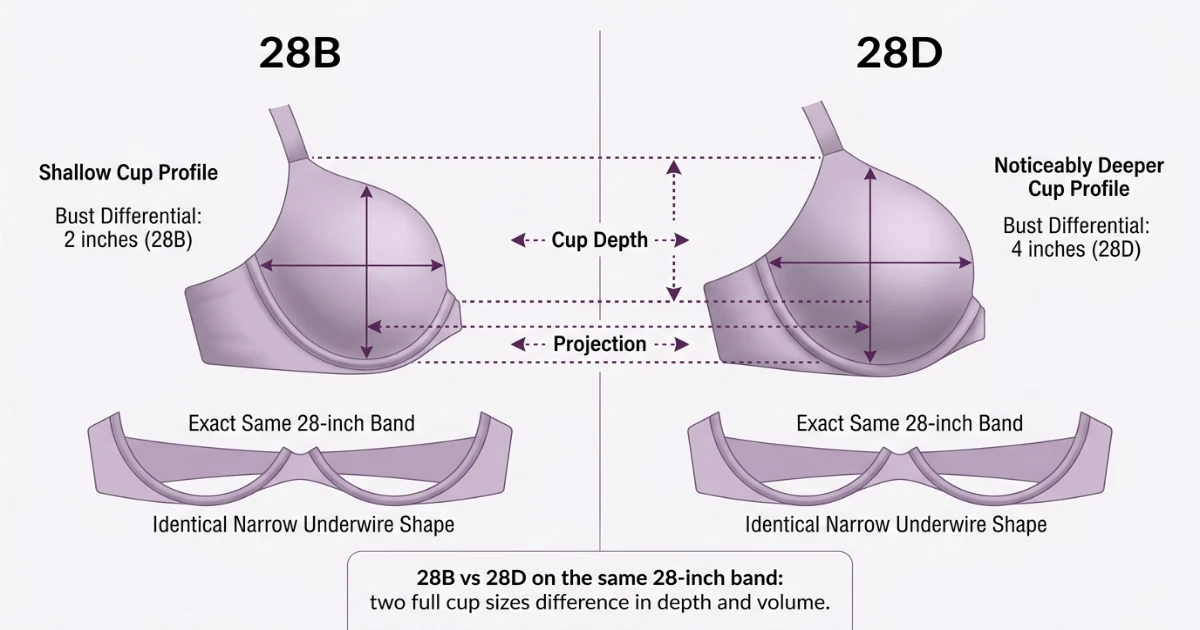
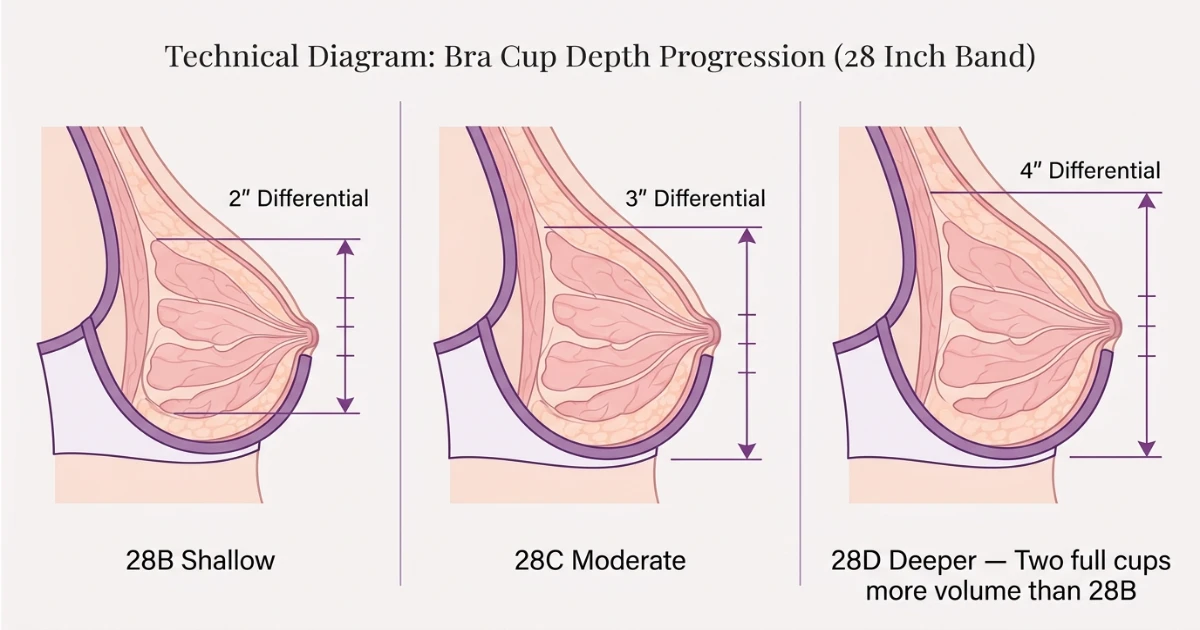
A 28B means your bust is 2 inches larger than your underbust on a 28-inch frame — a shallow cup with modest projection. A 28D means your bust is 4 inches larger on that same frame — a cup that is significantly deeper and wider in its internal structure. That two-inch, two-letter gap represents a real and visible difference in how much breast tissue the cup is designed to contain. Moving from 28B to 28D is not a minor adjustment; it is the equivalent of skipping an entire cup size (28C) between them.
The Two-Cup Volume Difference Visualised
28D holds two full cup sizes more volume than 28B — same band, genuinely different cups · 28C sits in between
Moving between 28B and 28D changes cup volume — not band fit. If your 28B cups overflow or the centre gore floats, the next step is 28C on the same band, then 28D if 28C is still insufficient. If your 28D cups wrinkle or gape after scooping, try 28C first. Do not change the band to resolve a cup fit issue.
Measurement Breakdown: 28B vs 28D
The table below shows exactly how each size is derived from body measurements, including the intermediate 28C size that sits between them, and their international equivalents.
| Size | Underbust (Band) | Bust (Fullest Point) | Cup Differential | UK Equivalent | EU Equivalent | Cup Volume |
|---|---|---|---|---|---|---|
| 28B | ~23–24″ (58–61 cm) | ~25–26″ (64–66 cm) | 2″ (5 cm) | 28B | 60B | Smaller ↓↓ |
| 28C (between) | ~23–24″ (58–61 cm) | ~26–27″ (66–69 cm) | 3″ (8 cm) | 28C | 60C | One cup more than 28B |
| 28D | ~23–24″ (58–61 cm) | ~27–28″ (69–71 cm) | 4″ (10 cm) | 28D | 60D | Larger ↑↑ (two full cups more than 28B) |
International sizing is straightforward at B and D cups — unlike the DDD/F confusion that occurs above DD, cup letters B through D are consistent across US, UK, and EU systems. US 28B = UK 28B = EU 60B. US 28D = UK 28D = EU 60D. No cross-system conversion is needed at these cup letters — only the band number notation differs (EU uses the actual underbust measurement in cm rather than a derived band number). Use our international bra size charts for full reference across all systems.
Sister Sizes: 28B and 28D Each Have Their Own Volume Family
Because 28B and 28D hold different cup volumes, they belong to entirely separate sister size families. Their chains do not overlap. At this band size especially, knowing your correct sister size is critical — the 28 band is so rarely stocked that a sister size swap to a 30 band is frequently the only practical option for finding a bra in your cup volume.
Sister Size Family for 28B
All sizes below hold the same cup volume as 28B:
The most practical sister size for 28B is 30A — one band wider, same cup volume. 30A is significantly more commonly stocked than 28B. If your 28B band is genuinely too tight, 30A preserves the volume. Note that 30AA holds less cup volume than 28B, and 30B holds more — only 30A is the correct sister size.
Sister Size Family for 28D
All sizes below hold the same cup volume as 28D — entirely separate from the 28B volume family above:
The most accessible sister size for 28D is 30C — one band wider, same cup volume, and widely stocked by most lingerie retailers. If your 28D band is too tight, 30C gives you the same cup space with a slightly wider and more relaxed band. 32B is the next step wider still, with the same volume. Use our sister sizes guide or the sister size bra calculator for your complete personal ladder.
The Same-Band Cup Rule Applied to 28B and 28D
| Comparison Type | Example | Same Volume? | What Changes |
|---|---|---|---|
| Same band, two cups up | 28B → 28D | ❌ No | Cup volume increases by two full sizes — band unchanged |
| Same band, two cups down | 28D → 28B | ❌ No | Cup volume decreases by two full sizes — band unchanged |
| Same band, one cup up | 28B → 28C | ❌ No | Cup volume increases by one full size — band unchanged |
| Same band, one cup up | 28C → 28D | ❌ No | Cup volume increases by one full size — band unchanged |
| Band up + Cup down (sister of 28B) | 28B → 30A | ✅ Yes | Wider band, same cup volume as 28B |
| Band down + Cup up (sister of 28B) | 28B → 26C | ✅ Yes | Tighter band, same cup volume as 28B |
| Band up + Cup down (sister of 28D) | 28D → 30C | ✅ Yes | Wider band, same cup volume as 28D |
| Band down + Cup up (sister of 28D) | 28D → 26DD | ✅ Yes | Tighter band, same cup volume as 28D |
| Same band, same letter | 28B → 28B | ✅ Yes | Identical — same band, same cup, same volume |
The governing rule: any change to the cup letter on the same band always changes volume. The 28B and 28D are two letters and two cup sizes apart — there is a 28C between them, and both transitions (28B→28C and 28C→28D) represent genuine increases in enclosed breast tissue. Volume is only preserved when you change both band and cup letter simultaneously in opposite directions.
Real Fit Differences Between 28B and 28D
Cup Depth, Volume, and Shape
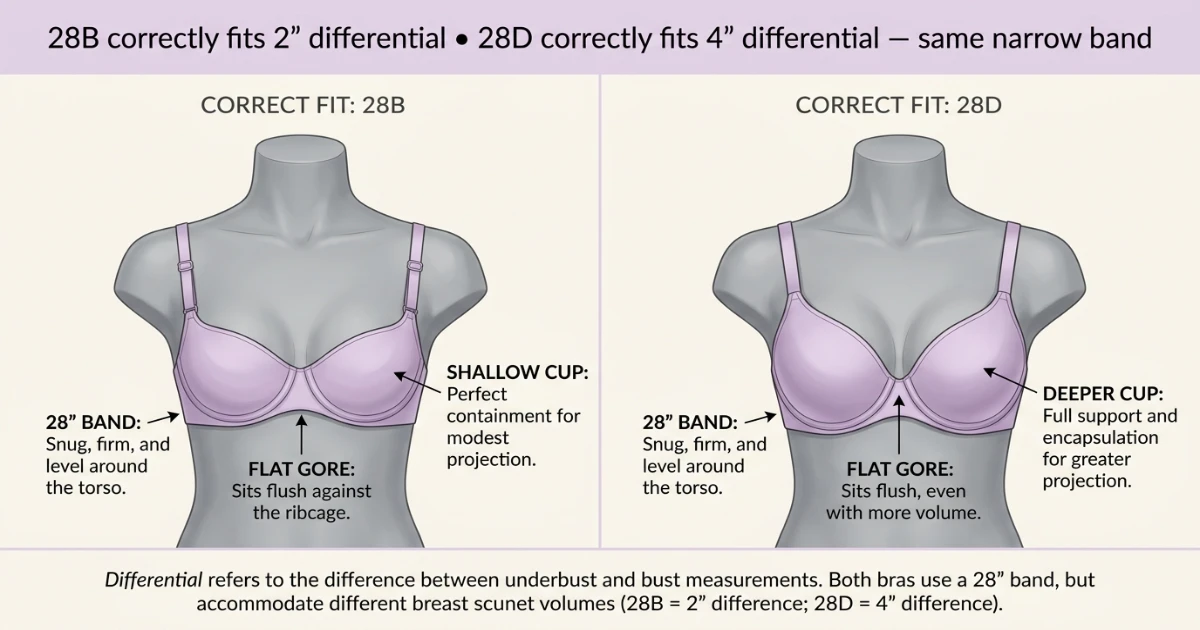
The most immediately apparent difference between 28B and 28D is the depth of the cup structure. A 28B cup is engineered to contain a modest amount of breast tissue — the cup is shallow to moderately shallow, projecting from the band with a small-to-moderate internal volume. For smaller-to-moderate breasts on a narrow ribcage, this is exactly the right construction.
A 28D cup is noticeably deeper — designed to contain substantially more breast tissue on the same 28-inch frame. The cup panels are cut wider and deeper, the internal volume is meaningfully larger, and the cup profile projects further from the body. For someone whose bust genuinely measures 4 inches more than their underbust on a 23–24 inch frame, the 28D provides the structured containment that a 28B physically cannot deliver — the B cup simply does not have enough cup space to hold the tissue correctly.
Understanding 28D: Not a “Large” Size
There is a widespread misconception that a D cup is a large bra size. On a 28 band, this is categorically false. A 28D corresponds to a 4-inch bust-to-underbust differential on a frame with a ~23–24 inch ribcage — this is moderate projection on a very small frame. In absolute terms, a 28D holds less total breast tissue volume than a 34B, even though the cup letter is higher. Cup volume is relative to band size, not absolute.
If you have been sized as a 34B by a retailer using the +4 method (adding 4 inches to underbust), your true size is likely close to 30D or 28DD — not 34B. The 28D is a common result when women remeasure using modern bra fitting standards that do not add inches to the underbust.
Underwire Specifics on the 28 Band
On a 28 band, the underwire span is built for the narrowest chest walls in mainstream sizing. Both 28B and 28D share the same narrow band width, and the underwire in both is correspondingly shorter than on wider bands — but the cup arc height differs. The 28D underwire curves higher above the breast root to encircle the deeper breast tissue volume, while the 28B wire has a lower arc suited to the modest tissue volume it is designed to contain. If a 28B underwire sits at or above your breast tissue rather than beneath it, this is a clear signal your cup volume is larger than B — try 28C, then 28D.
Band Fit: Identical for Both, but Critical at 28 Inches
Because 28B and 28D share the same band, band fit concerns apply equally to both. A correctly fitting 28 band sits on a ribcage of approximately 23–24 inches (58–61 cm) — this is a genuinely narrow measurement that many women who believe they wear a small size do not actually have. The 28 band will feel noticeably firmer than a 30 or 32 band at equivalent cup volumes — this is expected and correct. Roughly 80% of a bra’s support comes from the band, and on a 28-inch frame that firmness is what delivers all-day stability.
If the 28 band feels uncomfortably tight even on the loosest hook from the first wear, your underbust measurement may actually be closer to 25–26 inches (pointing to a 30 band) rather than 23–24 inches. Remeasure before investing in specialist 28-band bras — see our underbust measurement guide for correct snug-tape technique.
Who Should Wear 28B?
- Underbust measurement approximately 23–24 inches (58–61 cm) snugly measured just beneath the bust — genuinely narrow.
- Bust measurement at the fullest point of approximately 25–26 inches (64–66 cm) — a 2-inch differential.
- Breast tissue is modest in volume; cups contain all tissue comfortably with no overflow, no floating gore, and no cup fabric wrinkling after scooping.
- Previously tried 28A and found the cups too small — overflowing, floating gore, or wire sitting on breast tissue.
- Previously tried 28C and found the cups too large — wrinkling, gaping, or cups that do not contact breast tissue across the full surface after a thorough scoop-and-swoop.
- UK/EU sizing: Shop for 28B / EU 60B — labels align directly across all systems at B cup.
- If 28B cups overflow or gore floats: move up to 28C first, then 28D — one cup at a time on the same band.
- If 28B band is too tight: try 30A (sister size — same cup volume, wider band).
Verify your fit with the five-point check on our how to know your bra fits page.
Who Should Wear 28D?
- Underbust measurement approximately 23–24 inches (58–61 cm) snugly measured — same narrow frame as 28B.
- Bust measurement at the fullest point of approximately 27–28 inches (69–71 cm) — a 4-inch differential.
- Previously tried 28B and 28C and found the cups too small — overflowing, a persistently floating gore, or underwire arc sitting on breast tissue rather than fully beneath it.
- Breast tissue fills a D-cup space comfortably — cups contain all tissue without overflow or gaps after scooping.
- Common sizing confusion: If you currently wear 34A or 32B and find the band loose, your true size may be 28D. The +4 fitting method frequently mis-sizes narrow-ribcage wearers into larger bands with smaller cup letters.
- UK/EU sizing: Shop for 28D / EU 60D — labels align directly across all systems. No naming divergence at D cup.
- If 28D cups overflow: move up to 28DD (US) / 28E (UK) on the same band. Note the US/UK divergence begins above D.
- If 28D band is too tight: try 30C (sister size — same cup volume, wider band).
- Prioritise specialist narrow-band brands — Ewa Michalak, Freya, Bravissimo, Comexim — as 28D is rarely stocked by mainstream retailers.
Use our breast shape identifier and size charts to confirm the best construction style for your shape.
Where to Find 28B and 28D: The Narrow-Band Reality
The 28 band is the narrowest size in mainstream bra production, and even specialist brands do not stock every cup size in it. 28B is modestly more accessible than 28A but still requires going beyond high-street retailers. 28D is somewhat better stocked by specialist brands but remains rare in physical stores. Both sizes benefit significantly from knowing their sister sizes (30A for 28B volume; 30C for 28D volume) for practical shopping.
Brands That Stock 28B and 28D
- Ewa Michalak (Poland) — one of the most comprehensive 28-band ranges available, including B through full cup sizes. Polish sizing requires conversion but their size guides are thorough.
- Comexim (Poland) — similar to Ewa Michalak in coverage; semi-custom and made-to-measure options available for difficult-to-source narrow band sizes.
- Bravissimo (UK) — specialist retailer; good coverage of 28D and above, with some 28B availability. Physical stores in the UK for trying before buying.
- Freya (UK) — selected styles in 28 band from B cup upward. Better 28D coverage than 28B. Check individual product pages for band availability.
- Panache (UK) — limited 28-band coverage; better for D cup and above on this band.
- Change Lingerie — some 28 band coverage in B through D cups; availability varies by region.
🛍️ Best Bras for 28B and 28D — Our Top Picks
At B and D cup on a 28 band, the bra requirements are precise: a genuinely narrow underwire that does not overextend onto a small ribcage, a band that stays level on a 23–24 inch frame without being uncomfortably rigid, and cup depth appropriate for the actual tissue volume. These two consistently top-rated options cover the two most important use cases for narrow-band wearers — wire-free everyday comfort and structured underwire support — and extend across the B through D cup range on narrower bands.

Glamorise Women’s MagicLift Active Support Wirefree Bra #1005
A top-rated wire-free everyday bra for B and D cup wearers on narrower bands who need all-day comfort and lift without underwire. The MagicLift internal sling system lifts and separates without a wire — delivering shape and separation that matters at B and D cup sizes, where wire-free designs can otherwise produce a flattened silhouette.
At narrower band sizes, the multi-hook back provides precise band tension adjustment — critical because even a 1 cm variation in band tension is perceptible at 23–24 inch underbust measurements. Wide cushioned straps stay in place without digging. Moisture-wicking cotton-blend fabric handles full-day wear comfortably.
Available in: Band sizes 30–46, cups B–K · Multiple colors · Check brand chart for narrowest available band
View on Amazon →
Glamorise Women’s WonderWire Front-Close Underwire Bra #1245
A structured underwire option for B and D cup wearers on narrower bands requiring lift, separation, and all-day support with a wire. The WonderWire cushioned underwire channel distributes wire pressure evenly across a padded channel rather than concentrating force at the wire ends — reducing the side-poking that can affect wearers at narrower band sizes where the wire-to-ribcage contact zone is more compact. Front closure is especially practical for women with shorter arms or limited shoulder mobility, which can be relevant for narrower frames.
Reinforced side panels keep the band flat and smooth. Multi-hook back provides three adjustment levels. For 28 band shoppers: verify the smallest available band size with the brand chart, or use sister sizes 30A (for 28B volume) and 30C (for 28D volume) for immediate availability.Available in: Full range through 48H including B and D cup volumes · Multiple colors
View on Amazon →ℹ️ As an Amazon Associate, Bra Calculator earns from qualifying purchases. Product availability and pricing are subject to change. For 28 band sizing, always verify the band measurement against the brand’s specific chart. Mainstream Amazon ranges may not include 28 band explicitly — specialist narrow-band retailers (Ewa Michalak, Bravissimo, Comexim, Freya) offer confirmed 28-band stock. Sister sizes 30A (for 28B volume) and 30C (for 28D volume) are significantly more accessible starting points.
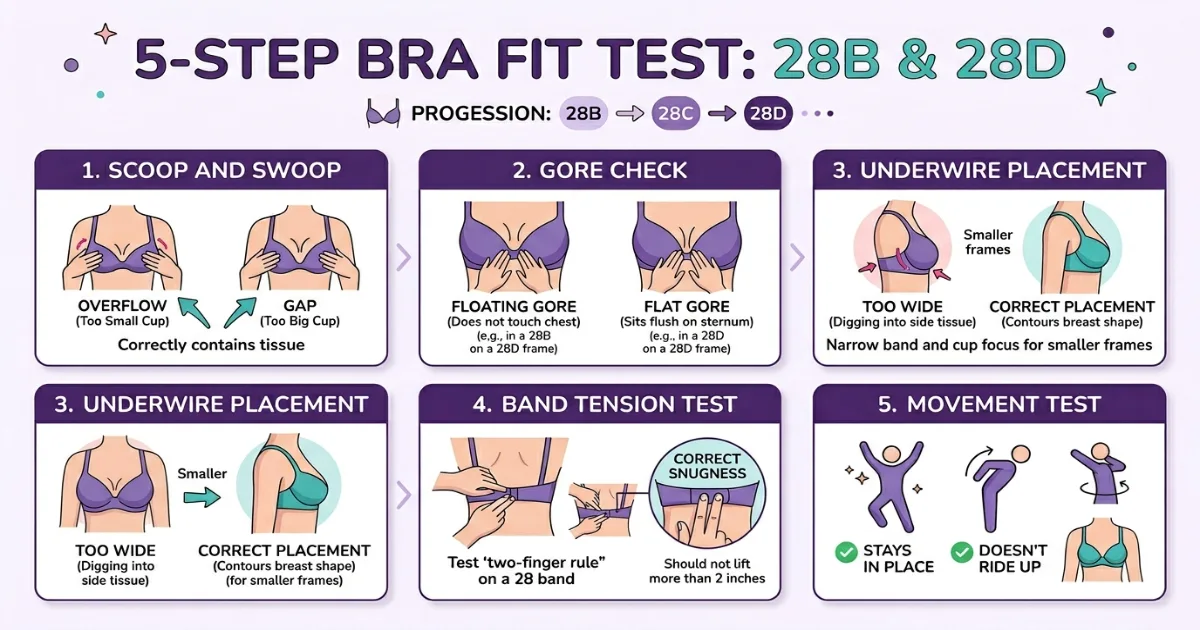
5-Step Bra Fit Test: Confirm 28B or 28D Right Now
On the same 28 band, the distinction between 28B and 28D is purely about cup volume — two full cup sizes of enclosed breast tissue. These five checks confirm both whether the cup volume is correct and whether the 28 band is genuinely the right band for your ribcage.
Lean forward and scoop all breast tissue fully forward and upward into the cup. Overflow at the top or sides after scooping means the cup is too small: move up one cup letter at a time on the same 28 band (28B → 28C → 28D). Wrinkling or gaping fabric after scooping means the cup is too large: move down one letter. Two letters of difference between 28B and 28D means going directly between them without trying 28C first is not recommended — the intermediate 28C is likely closer to correct for many wearers.
The centre gore must lie completely flat against the sternum at all times. A floating gore is almost always a sign the cup is too small — move up one cup letter on the same 28 band before making any other adjustment. In a 28B, a floating gore is the most common signal you need 28C rather than jumping straight to 28D; in a 28C, a floating gore suggests you need 28D. Go one step at a time rather than jumping two letters.
The underwire must encircle all breast tissue and rest entirely on firm ribcage at every point. On a 28 band, check the underwire width specifically against your breast root — the wire should begin and end precisely at the natural outer edge of your breast tissue. Wire extending onto bare ribcage past your breast = underwire too wide for your frame (consider a different brand in 28, or a specialist narrow-channel bra). Wire sitting on breast tissue at the sides = cup arc too low, go up one cup letter on the same band.
On the loosest hook, slide two fingers under the back band — firm, consistent resistance is required. The 28 band on the correct ribcage will feel noticeably snugger than larger bands: this is expected and correct at 23–24 inches. The band must run horizontally level all the way around. If the band rides up at the back in both 28B and 28D, the 28 band may be too tight for your actual underbust — remeasure carefully and consider whether your true measurement points to a 30 band with the equivalent sister size cup (30A for B-cup volume; 30C for D-cup volume).
Raise arms overhead, twist side to side, and walk briskly for 60 seconds. The band must stay completely level, cups must hold all breast tissue in position, and straps must stay on the shoulders without slipping or digging. Any downward shift of the cups during movement means the band is too loose — a band problem, not a strap problem. Any breast tissue escape over the cup top during movement means the cup is too small: go up one letter on the same 28 band. Any cup collapse or gaping during movement means the cup is one size too large: go down one letter.
Not sure whether 28B, 28C, 28D, or a completely different size is right for your measurements? Our AI calculator gives you a precise answer — including the best sister size if 28 band stock is limited in your area.
Try the AI-Powered Bra Size Calculator →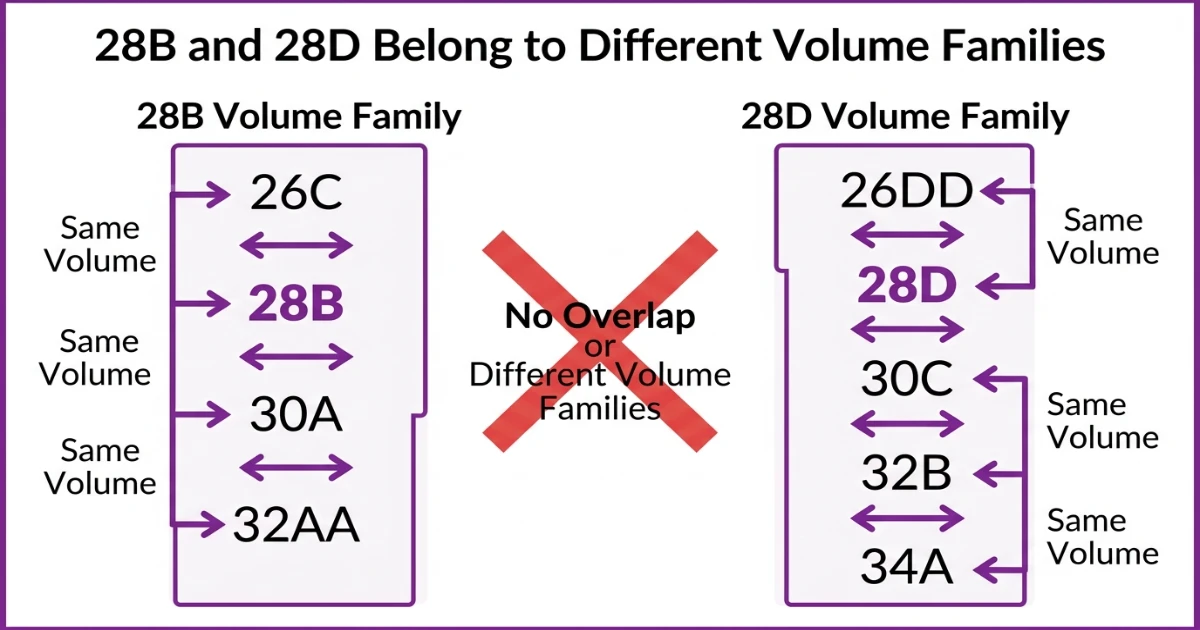
28B vs 28D: Full Side-by-Side Comparison
| Feature | 28B | 28D |
|---|---|---|
| Band Size | 28 — same band, ~23–24″ / 58–61 cm underbust | |
| Cup Letter (US/UK) | B — 2″ (5 cm) over underbust | D — 4″ (10 cm) over underbust |
| EU Equivalent | 60B | 60D |
| Cup Volume | Smaller — shallow cup | Larger — two full cups more than 28B |
| Sister Sizes? | ❌ No — same band, different volumes. Not sister sizes. | |
| Bust Measurement | ~25–26″ (64–66 cm) | ~27–28″ (69–71 cm) |
| Cup Depth | Shallow — 2-inch differential | Moderate — 4-inch differential |
| Cup Between Them | 28C — 3-inch differential — sits midway between | |
| Band Construction | Identical — same narrow 28-inch frame, same hook-and-eye length | |
| International Naming | ✅ No divergence — B and D labels consistent across US, UK, EU | |
| Sister Size Family | 26C — 28B — 30A — 32AA | 26DD — 28D — 30C — 32B — 34A |
| If cups too small | Try 28C first, then 28D (same band, step up) | Try 28DD/E (same band, next cup up) |
| If cups too large | Try 28A (same band — where available) | Try 28C first, then 28B (same band, step down) |
| If band too tight | Try 30A (sister — same volume, wider band) | Try 30C (sister — same volume, wider band) |
| If band too loose | Try 26C (sister — same volume, tighter band · rare) | Try 26DD (sister — same volume, tighter band · rare) |
| Naming conflicts? | None — B and D are consistent across all major sizing systems | |
| Availability | Limited — 28B is better stocked than 28A but still requires specialist brands. Sister 30A is widely available. | Specialist brands — Freya, Ewa Michalak, Bravissimo, Comexim. Sister 30C is widely stocked. |
| Practical alternative | 30A (same volume, widely stocked) | 30C (same volume, widely stocked) |
| Best For | ~2-inch bust-to-underbust differential on a genuine 23–24″ ribcage | ~4-inch bust-to-underbust differential on a genuine 23–24″ ribcage |
| Volume Context | Same cup volume as 30A, 32AA | Same cup volume as 30C, 32B, 34A — NOT a large size |
People Also Ask: 28B vs 28D — Answered
Are 28B and 28D the same size?
No — 28B and 28D are not the same size. They share the same 28-inch band but hold different cup volumes. A 28D contains two full cup sizes more breast tissue than a 28B. The band fits the same narrow ribcage; the cup is genuinely different — the 28C cup sits in between them. These are not sister sizes; sister sizing requires a simultaneous band and cup change to preserve volume.
Which is bigger — 28B or 28D?
28D is larger in cup volume. A 28B has a 2-inch bust-to-underbust differential — a shallow cup with modest enclosed volume. A 28D has a 4-inch differential — a noticeably deeper cup containing two full cup sizes more breast tissue. On the same 28-inch band, that two-letter gap represents a meaningful and visible difference in cup construction.
Are 28B and 28D sister sizes?
No. Sister sizes are sizes on different bands that hold equal cup volume. 28B and 28D are on the same band and hold different cup volumes — so they cannot be sister sizes. The sister size of 28B is 30A (wider band, same volume). The sister size of 28D is 30C (wider band, same volume). These are entirely separate volume families with the 28C family sitting in between.
What is the sister size of 28D?
The primary sister size of 28D is 30C — one band wider, same cup volume, and significantly more commonly available. If your 28D band is too tight, 30C gives you the same cup space with a wider, more relaxed band. Further along the ladder: 32B and 34A also hold the same cup volume as 28D. If 28D is not available, 30C is the most practical first alternative to try.
What is the sister size of 28B?
The sister size of 28B is 30A — one band wider, same cup volume, and more commonly stocked than 28B. If your 28B band is too tight, 30A gives the same cup volume in a slightly wider band. Going tighter to 26C is technically the correct tighter-band sister, but 26 band is even rarer than 28. 32AA is another step wider with the same volume.
Is 28D a large bra size?
No — 28D is not a large bra size. On a narrow 28-inch band, a D cup corresponds to a 4-inch bust-to-underbust differential, which is moderate projection on a small frame. In absolute terms, a 28D holds approximately the same total breast tissue volume as a 34A — the cup letter alone does not indicate breast size without the band context. Many women wearing 34A or 32B would be better fitted as 28D when measured correctly without the +4 method.
My 28B cups overflow — should I try 28C or 28D first?
Try 28C first — not 28D. There are two full cup sizes between 28B and 28D, and jumping directly to 28D may overshoot your actual cup volume. The 28C sits exactly in between and is the correct next step. If 28C also overflows, then 28D is the right progression. Always change one cup letter at a time when addressing overflow on the same band.
My 28D cups feel too small — should I try 28DD or 30C?
If your 28D cups are too small but the band fits correctly, try 28DD (or 28E in UK sizing) on the same band — not 30C. Moving to 30C gives you the same cup volume as 28D in a wider band, which solves nothing if you need more cup space. Only consider 30C if your 28D band is also too tight. The cup and band are separate variables — address them independently.
Is there a naming difference between US and UK sizing for 28B and 28D?
No — cup letters B and D are entirely consistent across US, UK, and EU sizing systems. US 28B = UK 28B = EU 60B. US 28D = UK 28D = EU 60D. There is no cross-system naming confusion at these cup letters. Note that the D-to-DD transition above D cup does have US/UK divergence (US DD = UK E), but B and D are unaffected. Shop any brand’s 28B or 28D with full confidence that the cup letter means the same thing regardless of the brand’s country of origin.
How do I know my correct bra size on a 28 band?
Measure your underbust snugly — a true 28 band corresponds to approximately 23–24 inches (58–61 cm), genuinely narrower than most people expect. Subtract underbust from fullest bust: 1 inch = A cup, 2 inches = B cup, 3 inches = C cup, 4 inches = D cup. Verify fit with five checks: level band, flat gore, underwire sitting fully beneath breast tissue, two fingers under back band on loosest hook, no cup movement during activity. Use our bra size chart calculator for a precise personalised result including sister size alternatives.