Track how your cycle phase affects breast fullness, tenderness, and bra fit. Get daily comfort guidance and style suggestions — no account needed, no health data leaves your device.
14
Cycle day
Ovulation
No signup required
Stored in your browser only
Bra-fit focused — not a period app
Kadence-safe scoped CSS
Menstrual
Days 1–5
Follicular
Days 6–13
Ovulation
Days 14–16
Luteal
Days 17–28
Log today’s comfort
Local-only tracker
Today’s fit guidance
Updated live
Your bra comfort looks fairly steady today.
Log your cycle day and symptoms above to get a personalised daily comfort read and bra style suggestions.
Ovulation
76
Comfort score
Low
Pressure level
Keep your normal size
Quick fit takeaway
Suggested styles for today
Comfort note: Mild swelling or tenderness across the month doesn’t always mean your base size changed permanently. Comfort varies by phase.
Monthly comfort view
Saved in your browser
Less discomfort
More discomfort
How it works
1
Estimate your phase
Uses your cycle day and cycle length to place you in menstrual, follicular, ovulation, or luteal phase.
2
Blend phase + symptoms
Tenderness, swelling, band pressure, cup issues, and symptom checkboxes shape your personalised comfort score.
3
Comfort-first style picks
You get practical suggestions (wireless, stretch-cup, lounge) based on today’s actual feel — not a generic recommendation.
4
Track over the month
The heatmap shows your logged comfort days so you can spot your own patterns across the cycle.
Important: This tool is for comfort-tracking and bra-fit awareness only. It does not diagnose medical conditions, predict fertility, or replace professional healthcare advice. Persistent pain, unusual breast changes, or symptoms that concern you should always be discussed with a qualified clinician.
';
}).join('');/* Comfort note */
comfortNoteEl.innerHTML = 'Comfort note: ' + phase.note;
}/* ─── Heatmap ─── */
var DAYS = ['Su','Mo','Tu','We','Th','Fr','Sa'];function renderHeatmap() {
var log = getLog();
heatmapEl.innerHTML = '';/* Day headers */
DAYS.forEach(function(d) {
var el = document.createElement('div');
el.className = 'cbct-hm-head';
el.textContent = d;
heatmapEl.appendChild(el);
});/* 28 day cells */
var today = parseInt(cycleDayEl.value) || 14;
for (var d = 1; d <= 28; d++) {
var entry = log[d] || null;
var score = entry ? entry.score : null;
var level = 0;
if (score !== null) {
if (score >= 80) level = 1;
else if (score >= 65) level = 2;
else if (score >= 50) level = 3;
else if (score >= 35) level = 4;
else level = 5;
}var cell = document.createElement('div');
cell.className = 'cbct-hm-cell cbct-hm-l' + level + (d === today ? ' cbct-hm-today' : '');
cell.setAttribute('title', score !== null ? 'Day ' + d + ': score ' + score : 'Day ' + d + ': not logged');var dayDiv = document.createElement('div');
dayDiv.className = 'cbct-hm-day';
dayDiv.textContent = d;var dot = document.createElement('div');
dot.className = 'cbct-hm-dot';
if (score !== null) {
dot.style.background = 'linear-gradient(135deg,#c24b6e,#6b2d5e)';
dot.style.opacity = '0.7';
}var scoreDiv = document.createElement('div');
scoreDiv.className = 'cbct-hm-score';
scoreDiv.textContent = score !== null ? score : '';cell.appendChild(dayDiv);
cell.appendChild(dot);
if (score !== null) cell.appendChild(scoreDiv);
heatmapEl.appendChild(cell);
}
}/* ─── LocalStorage helpers ─── */
function getLog() {
try {
return JSON.parse(localStorage.getItem(LOG_KEY)) || {};
} catch(e) { return {}; }
}function saveLog(day, entry) {
var log = getLog();
log[day] = entry;
try { localStorage.setItem(LOG_KEY, JSON.stringify(log)); } catch(e) {}
}function savePrefs(data) {
try {
localStorage.setItem(STORAGE_KEY, JSON.stringify({
cycleLength: data.cycleLength,
cycleDay: data.cycleDay
}));
} catch(e) {}
}function loadPrefs() {
try {
return JSON.parse(localStorage.getItem(STORAGE_KEY)) || null;
} catch(e) { return null; }
}/* ─── Alert helpers ─── */
function showAlert(msg, type) {
alertEl.textContent = msg;
alertEl.className = 'cbct-inline-alert' + (type === 'green' ? ' cbct-alert-green' : '');
alertEl.style.display = 'block';
}
function hideAlert() { alertEl.className = 'cbct-inline-alert cbct-hide'; }/* ─── Toast helper ─── */
function showToast(msg) {
clearTimeout(toastTimer);
toast.textContent = msg;
toast.classList.add('cbct-toast-show');
toastTimer = setTimeout(function() {
toast.classList.remove('cbct-toast-show');
}, 3000);
}/* ─── Collect form data ─── */
function collectData() {
var day = parseInt(cycleDayEl.value) || 1;
var len = parseInt(cycleLengthEl.value) || 28;
return {
cycleDay: day,
cycleLength: len,
tenderness: parseInt(tendernessEl.value) || 0,
swelling: parseInt(swellingEl.value) || 0,
bandFeel: bandFeelEl.value,
cupFeel: cupFeelEl.value,
symptoms: getSymptoms(),
notes: notesEl.value.trim(),
phase: getPhase(day, len)
};
}/* ─── Update slider display + gradient ─── */
function updateSlider(el, valEl) {
var v = parseInt(el.value);
var min = parseInt(el.min) || 0;
var max = parseInt(el.max) || 5;
var pct = ((v - min) / (max - min)) * 100;
el.style.setProperty('--pct', pct + '%');
if (valEl) valEl.textContent = v;
}/* ─── Pill toggle visual ─── */
function updatePills() {
var pills = $$('.cbct-pill');
Array.prototype.forEach.call(pills, function(pill) {
var cb = pill.querySelector('input[type="checkbox"]');
pill.classList.toggle('cbct-pill-active', cb && cb.checked);
});
}/* ─── Main render call ─── */
function doRender() {
var data = collectData();
renderResults(data);
renderHeatmap();
savePrefs(data);
}/* ─── Form submit ─── */
form.addEventListener('submit', function(e) {
e.preventDefault();
hideAlert();
var day = parseInt(cycleDayEl.value);
if (!day || day < 1 || day > 60) {
showAlert('Please enter a cycle day between 1 and 60.', 'error');
cycleDayEl.focus();
return;
}
doRender();
showAlert('Result updated for day ' + day + '.', 'green');
setTimeout(hideAlert, 3000);
});/* ─── Save to log ─── */
saveBtn.addEventListener('click', function() {
var data = collectData();
var score = calcScore(data);
saveLog(data.cycleDay, {
score: score,
phase: data.phase,
tenderness: data.tenderness,
swelling: data.swelling,
ts: Date.now()
});
renderHeatmap();
showToast('Day ' + data.cycleDay + ' saved to your tracker ✓');
});/* ─── Reset ─── */
resetBtn.addEventListener('click', function() {
form.reset();
updateSlider(tendernessEl, tendernessVal);
updateSlider(swellingEl, swellingVal);
updatePills();
hideAlert();
doRender();
});/* ─── Live listeners ─── */
tendernessEl.addEventListener('input', function() {
updateSlider(tendernessEl, tendernessVal); doRender();
});
swellingEl.addEventListener('input', function() {
updateSlider(swellingEl, swellingVal); doRender();
});
cycleDayEl.addEventListener('input', doRender);
cycleLengthEl.addEventListener('change', doRender);
bandFeelEl.addEventListener('change', doRender);
cupFeelEl.addEventListener('change', doRender);/* Pill checkboxes */
var pillInputs = $$('.cbct-pill input[type="checkbox"]');
Array.prototype.forEach.call(pillInputs, function(cb) {
cb.addEventListener('change', function() {
updatePills();
doRender();
});
});/* ─── Init ─── */
var prefs = loadPrefs();
if (prefs) {
if (prefs.cycleLength) cycleLengthEl.value = prefs.cycleLength;
if (prefs.cycleDay) cycleDayEl.value = prefs.cycleDay;
}updateSlider(tendernessEl, tendernessVal);
updateSlider(swellingEl, swellingVal);
doRender();})();
Quick Answer
Your menstrual cycle affects breast fullness, tenderness, and bra comfort throughout the month. During the luteal phase (days 17–28), progesterone causes the most swelling and underwire sensitivity. The follicular phase (days 6–13) is the most stable window for everyday bra sizing. Use the tracker above to log your comfort daily and identify your personal pattern.
Key Takeaways
Breast volume can temporarily increase by up to one cup size during the luteal phase
Tenderness and underwire sensitivity peak in late luteal days (days 22–28 for most)
The follicular phase is the best time to measure your true baseline bra size
Sister sizing down one cup lets you keep the same volume in a wider, softer underband
Wireless and stretch-cup bras reduce pressure without permanently changing your size
How the Menstrual Cycle Changes Breast Tissue
Breast tissue is hormonally responsive throughout the entire cycle — not just during menstruation. Estrogen and progesterone fluctuate in predictable patterns that directly affect fluid retention, glandular tissue swelling, and nerve sensitivity in the breast. This is why a bra that fits perfectly on day 10 can feel genuinely uncomfortable by day 24.
Understanding which phase you are in tells you far more about your fit than simply knowing your static bra size. The tracker above uses your cycle day to estimate your phase in real time — but below we break down exactly what is happening at a tissue level in each phase, and what that means for your bra choice.
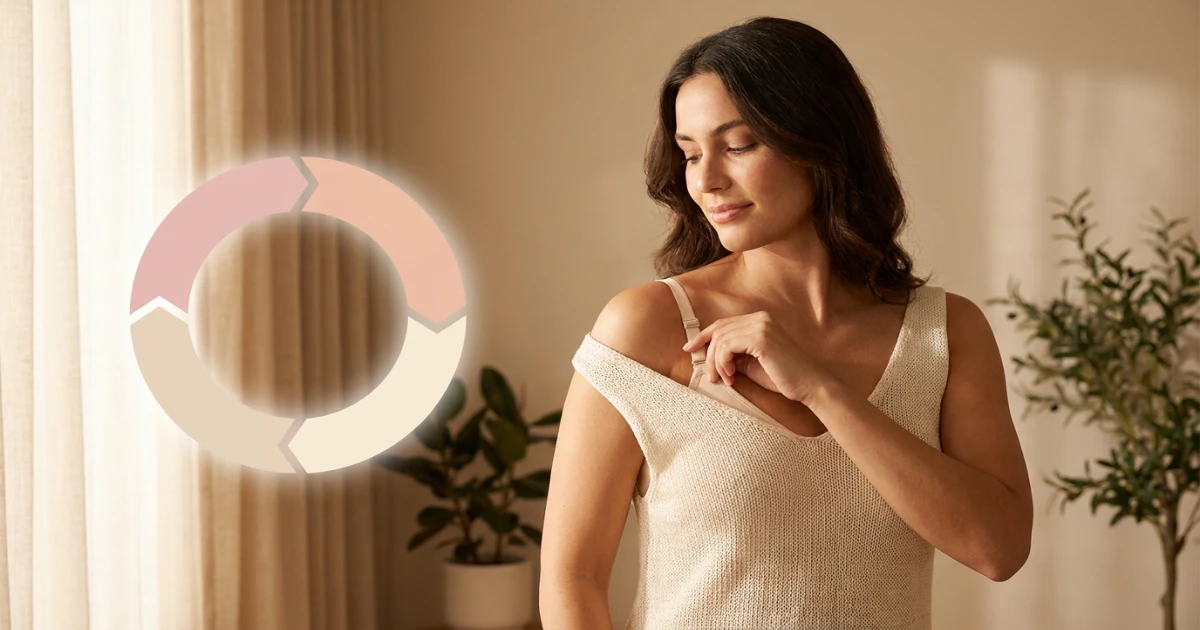
Phase awareness: Understanding where you are in your cycle helps you choose the right bra — not just the right size.
Phase-by-Phase Bra Fit Guide
Each of the four phases creates a distinct hormonal environment. Here is what that means for your bra fit day to day.
MenstrualDays 1–5
Softer support often feels better
Progesterone drops, but breast tissue may still feel tender from the late luteal peak. Many people report underwire sensitivity and pressure sensitivity in the first two days of flow.
💗 Best pick: wireless, lounge, or soft smooth-band bra
FollicularDays 6–13
Your most stable fit window
Rising estrogen with low progesterone means minimal swelling and fluid retention. Breast tissue is at its baseline volume. This is the best phase to get professionally fitted or measure yourself at home.
📏 Best pick: your everyday bra in your true base size
OvulationDays 14–16
Mild fullness may emerge
The LH surge around ovulation can cause subtle fullness for some people. It is usually less dramatic than the luteal phase, but a stretch-cup or slightly larger cup style can accommodate the change without discomfort.
Advertisement
🌸 Best pick: stretch-cup or full-coverage soft bra
LutealDays 17–28
Peak swelling and tenderness
High progesterone causes glandular tissue to swell and fluid to accumulate. Cups can feel genuinely tight, underwires dig in, and the band may feel restrictive. Volume can temporarily increase by close to one full cup size.
✨ Best pick: wireless, stretch-cup, or sister size up
The Luteal Phase: Why Bras Feel Tighter Before Your Period
The luteal phase — roughly days 17 to 28 of a standard 28-day cycle — is the single biggest driver of cyclical bra discomfort. After ovulation, progesterone rises sharply to prepare the uterine lining. A direct side effect of elevated progesterone is increased water retention in breast tissue, which causes both volume increase and heightened nerve sensitivity.
Luteal phase pressure: Temporary breast swelling in days 17–28 can make a well-fitting bra feel one cup size smaller than usual.
This is why so many people assume their bra size has changed — when in fact only their cyclical volume has shifted. The solution is rarely buying new bras in a larger size. Instead, using a sister size with a wider band and smaller cup letter delivers the same interior volume with more underband comfort. For example, if you normally wear a 34D, switching temporarily to a 36C keeps cup volume identical while relaxing band pressure.
💡
Sister size strategy for the luteal phase: Go up one band size and down one cup letter. A 34DD becomes a 36D. A 32B becomes a 34A. Volume stays identical — band pressure reduces significantly. Use our Sister Sizes Hub to find your exact matches.
The Best Time to Measure Your Bra Size
Most fitting experts agree: measure during the follicular phase (days 6–13). Estrogen is rising but progesterone is low, meaning breast tissue is at its most stable and consistent volume. A measurement taken during the luteal phase can be up to one full cup size larger than your actual baseline, leading to inaccurate sizing that does not reflect your day-to-day fit.
⚠️
Avoid measuring during days 20–28: Late luteal swelling routinely adds half a cup to a full cup of volume. Measuring here may result in a cup size that feels too big during the follicular and ovulation phases — when you are wearing the bra most of the time.
Cycle Phase vs. Bra Fit: Full Comparison Table
Phase
Approximate Days
Breast Volume
Tenderness
Best Bra Style
Menstrual
1–5
Decreasing from luteal peak
Moderate — fading
Wireless, lounge, soft cup
Follicular
6–13
Baseline — lowest of cycle
Low to none
Everyday bra in true base size
Ovulation
14–16
Mild temporary increase
Low to mild
Stretch-cup, full coverage
Luteal
17–28
Highest — up to +1 cup size
Moderate to high
Wireless, stretch-cup, sister size
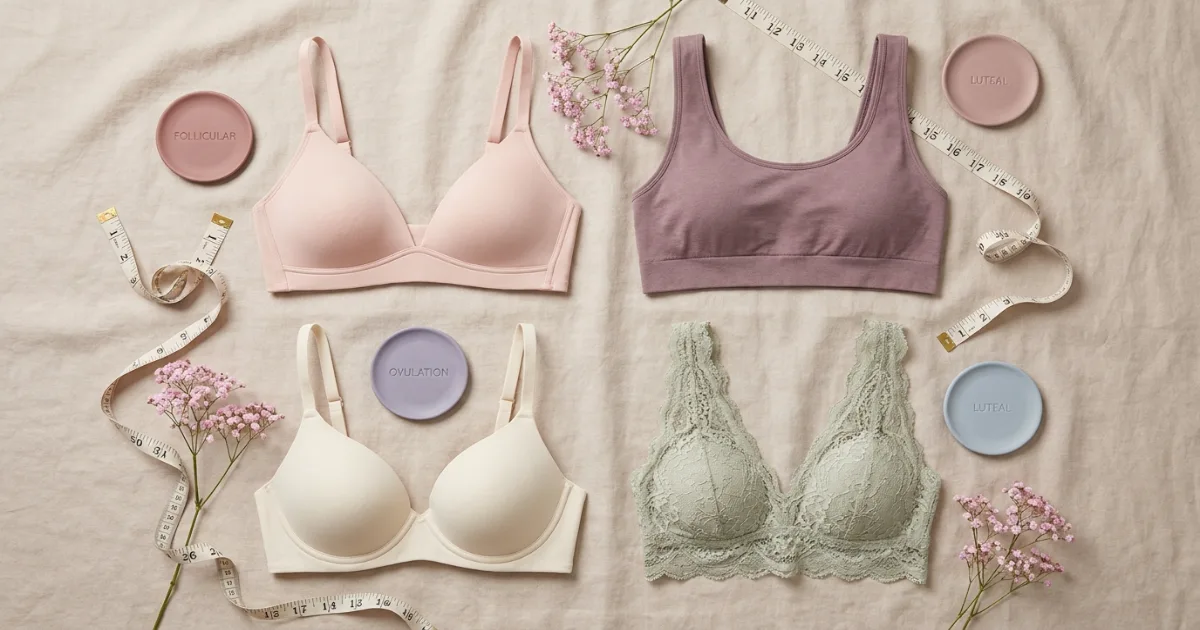
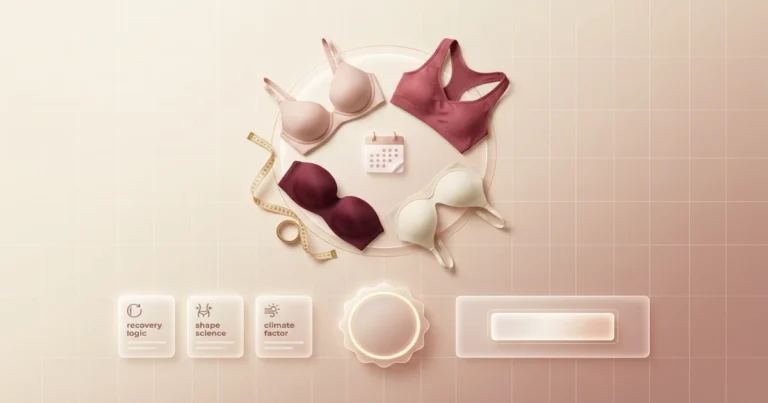
Style matters by phase: Keeping two or three different bra styles — structured, wireless, and stretch-cup — lets you adapt to cyclical changes without buying new sizes every month.
Practical Tips for Managing Cyclical Bra Discomfort
Own two or three bra styles — at minimum one structured everyday bra, one wireless option, and one lounge or sleep bra. This covers every phase of the cycle without size-switching.
Use sister sizes during the luteal phase — not a larger size. Going up a band and down a cup preserves volume while reducing underband pressure. See our full sister sizes guide for your exact matches.
Measure in the follicular window — days 6 to 13. Use our free bra size calculator for a precise baseline reading.
Choose stretch-cup fabrics for ovulation and early luteal days — these accommodate mild fullness increases without the hard upper edge of a moulded foam cup.
Log your comfort with the tracker above — a month of data reveals your personal pattern, which is more useful than any general cycle average.
Check your band extender — a single hook extender adds approximately one inch to your underband, which can be the difference between comfortable and painful during peak swelling days.
Frequently Asked Questions about Cycle and Bra Comfort Tracker
Does your bra size change during your period?+
Your bra size does not permanently change during your period, but breast volume can temporarily increase by up to one cup size — especially in the luteal phase (days 17–28). This swelling typically resolves after menstruation begins. Using sister sizes or a stretch-cup bra helps manage this without buying new bras.
Which phase causes the most breast tenderness?+
The luteal phase (approximately days 17–28) is when breast tenderness peaks for most people. Rising progesterone causes water retention and tissue swelling, making underwires and tight bands feel more uncomfortable than usual. Switching to a wireless or stretch-cup bra during this phase significantly reduces pressure on sensitive breast tissue.
What type of bra is best during your period?+
A wireless, soft-cup, or lounge-style bra is usually most comfortable during menstruation. These styles reduce pressure on tender breast tissue while still providing light support. Look for wide underbands, soft seams, and stretch-cup fabric to accommodate any temporary swelling that carries over from the late luteal phase.
When is the best time to get fitted for a bra?+
The best time to get fitted for a bra is during the follicular phase — roughly days 6 to 13 of your cycle. Breast tissue is least swollen and most stable during this window, giving you the most accurate measurement of your true baseline bra size. Avoid measuring during days 20–28 when luteal swelling can artificially inflate cup measurements.
Can I use the same bra size all month?+
Yes — most people wear the same base size all month, but the bra style may need to change. A structured moulded-cup bra may suit follicular days well, while the same size in a stretch-cup or wireless style works better during the luteal phase. Sister sizing can also help during peak swelling days without needing an entirely different permanent size.
Disclaimer: This article is for educational and comfort-tracking purposes only. It does not constitute medical advice, diagnose any condition, or predict fertility or cycle outcomes. Persistent pain, unusual breast changes, or symptoms that concern you should be discussed with a qualified healthcare professional.