38C vs 38D Bra Size: What Is the Real Difference? (2026 Fit Guide)
Quick Answer: No — 38C and 38D are not the same size. Both share the same 38-inch band — meaning they fit exactly the same ribcage — but they hold different cup volumes. A 38D contains one full cup size more breast tissue than a 38C. The band is identical; only the cup depth and volume differ.
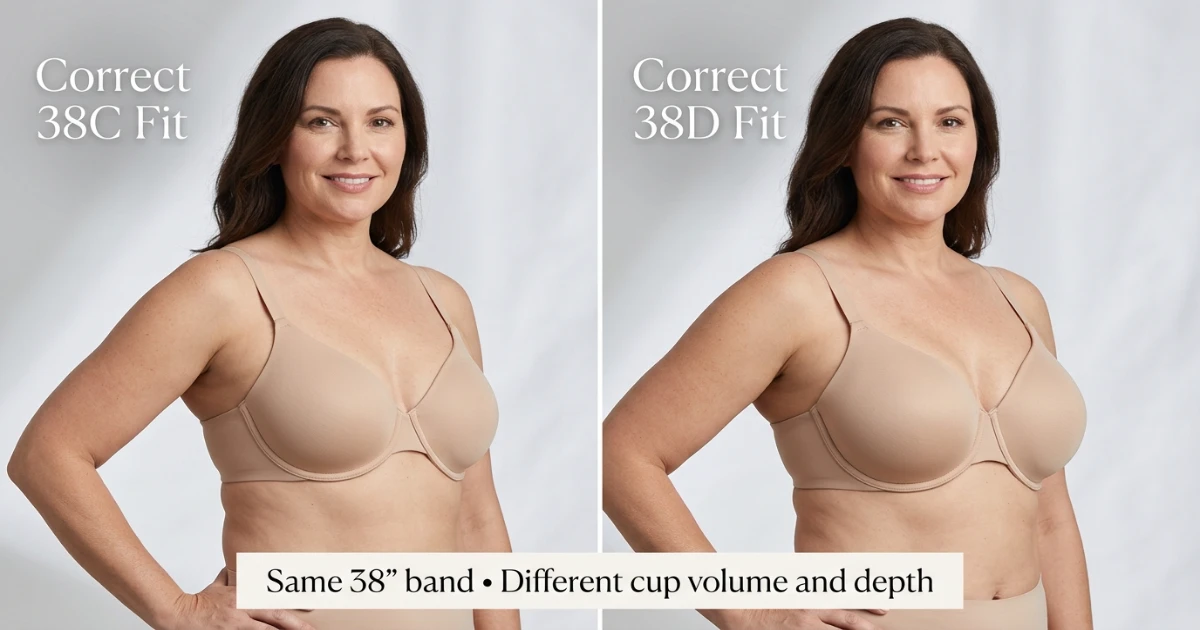
If you are choosing between the two, the answer comes down entirely to one measurement: the difference between your fullest bust and your underbust. A 3-inch differential points to 38C; a 4-inch differential points to 38D. There is no overlap — these are genuinely different sizes on the same frame.
Choose the fit signs you notice in the band, cups, center and straps. We’ll turn them into a practical next step for 38C.
Private fit check — your answers stay in your browser and are used only for this on-page guidance. Nothing is stored or submitted.
⚡ Key Takeaways
- Not the same size: 38C and 38D share one band but hold different cup volumes — 38D is one full cup larger.
- Same band, different cup: Both fit an underbust of ~33–34″ (84–86 cm). Only bust measurement and cup depth differ.
- 38C cup: 3″ bust-to-underbust differential — a moderately deep cup for a medium-volume bust.
- 38D cup: 4″ bust-to-underbust differential — noticeably deeper, one full cup size more volume than 38C.
- Not sister sizes: Sister sizing requires changing both band AND cup letter simultaneously. 38C and 38D are on the same band.
- Sister size of 38C: 36D (tighter band) and 40B (wider band) — both hold the same volume as 38C.
- Sister size of 38D: 36DD (tighter band) and 40C (wider band) — both hold the same volume as 38D.
- 38C gore floats or cups overflow → try 38D: Same band, one cup more space — no band change needed.
- 38D cups gap or wrinkle → try 38C: Same band, one cup less space — again, band stays the same.
- UK/EU sizing note: US 38C = UK 38C = EU 85C; US 38D = UK 38D = EU 85D. Labels align across all three systems.
- 38D is fuller-cup territory: Requires stronger band anchor and wider underwire than 38C — choose styles engineered for D cups.
38C vs 38D: The Core Difference Explained
Both 38C and 38D are built on exactly the same band. The horizontal band that encircles your ribcage — its length, the hook-and-eye construction, the underwire span across the chest wall, and the strap attachment points — is engineered to the same 38-inch specification in both sizes. On a 33–34 inch underbust, both will fit your frame equally well in terms of band tension.
The cup is the only variable. Cup letters represent the difference between your fullest bust circumference and your underbust circumference — each inch of that gap equals one cup letter:
- 1″ difference = A cup
- 2″ difference = B cup
- 3″ difference = C cup
- 4″ difference = D cup
- 5″ difference = DD (or E) cup
A 38C means your bust is 3 inches larger than your underbust on a 38-inch frame. A 38D means your bust is 4 inches larger on that same frame. That single additional inch of differential translates to a meaningfully deeper, larger cup — enough additional volume to make the distinction very noticeable in terms of coverage, projection, and containment. The D cup at this band size also crosses into fuller-cup territory, where bra construction standards — side panel depth, underwire gauge, strap width — begin to diverge from the lighter-duty C cup builds.
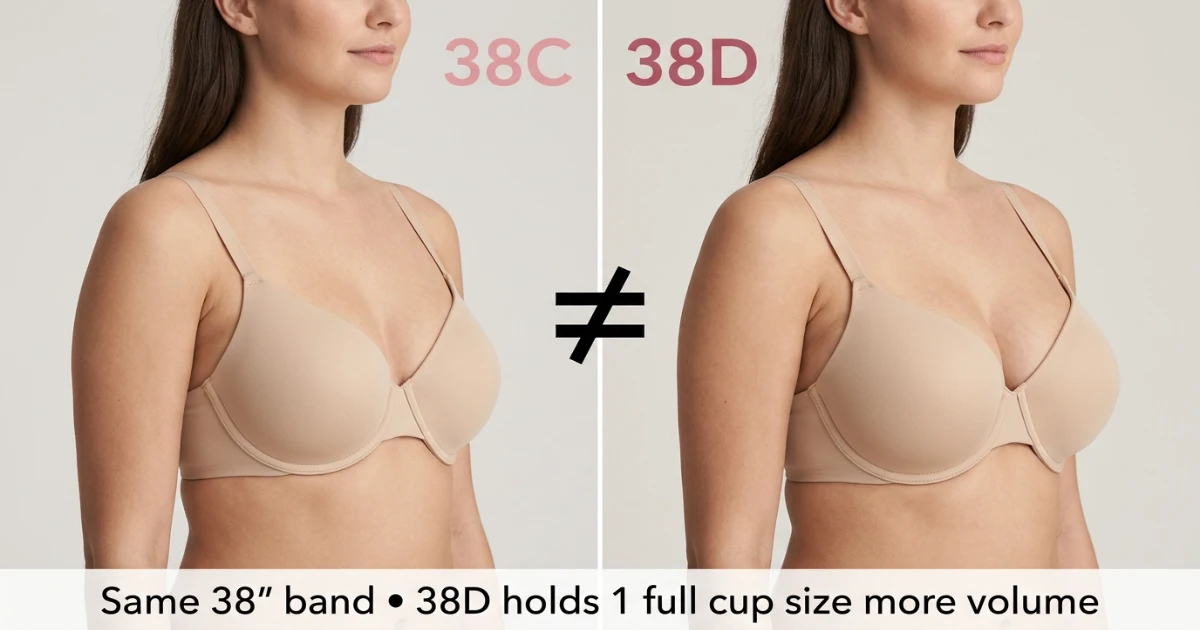
The Volume Difference Visualised
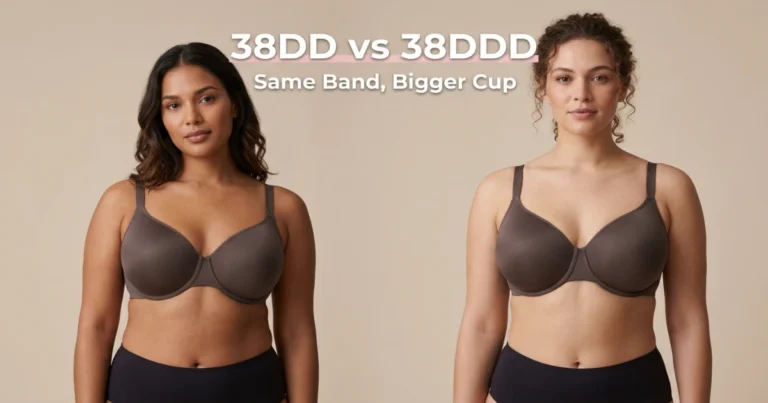
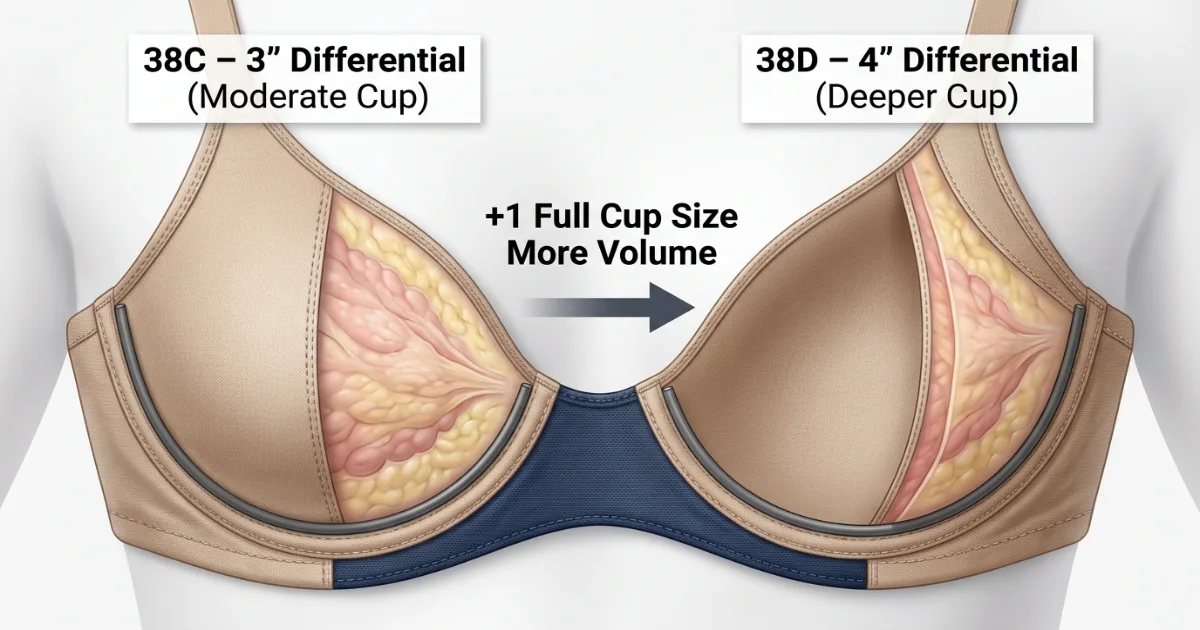
38D holds one full cup size more volume than 38C — same band, genuinely different cups
This is why moving from 38C to 38D is not a sister size swap. When you change only the cup letter on the same band, you are purely increasing or decreasing cup volume. Sister sizing only occurs when you change both variables — band up, cup letter down (or vice versa) — so that the total enclosed space remains constant. 38C and 38D do not share the same volume, so they cannot be sister sizes.
Measurement Breakdown: 38C vs 38D
The table below shows precisely how each size is derived from body measurements and what the resulting cup space looks like in practical terms.
| Size | Underbust (Band) | Bust (Fullest Point) | Cup Difference | Cup Volume |
|---|---|---|---|---|
| 38C | ~33–34″ (84–86 cm) | ~36–37″ (91–94 cm) | 3″ (8 cm) | Smaller ↓ |
| 38D | ~33–34″ (84–86 cm) | ~37–38″ (94–97 cm) | 4″ (10 cm) | Larger ↑ (one full cup more) |
EU sizing: US 38C = EU 85C; US 38D = EU 85D. UK sizing: Both align directly — US 38C = UK 38C; US 38D = UK 38D. Cup letters at C and D are consistent across US and UK systems, which makes international conversions at this size range straightforward. Always verify with the specific brand’s conversion chart before ordering internationally. Use our international bra size charts for full reference across all sizing systems.
One important construction note: at the D cup level on a 38 band, many manufacturers begin increasing underwire gauge, cup panel count, and side panel height compared to C cup versions of the same style. This means a 38D may feel structurally different to a 38C even within the same bra range — not just deeper in cup, but more reinforced overall.
Sister Sizes: 38C and 38D Each Have Their Own Ladder
Because 38C and 38D hold different cup volumes, they belong to entirely separate sister size families. Sister sizes are sizes on different bands that enclose the same cup volume. Since 38C and 38D have different volumes, their sister size chains have no overlap and must not be confused with each other.
Sister Size Family for 38C
All sizes below hold the same cup volume as 38C — approximately equal breast tissue on different band widths:
If your 38C band feels too loose, try 36D — same cup volume in a firmer, better-anchored band. If the 38C band pinches, try 40B for the same cup volume with a more relaxed fit around the torso.
Sister Size Family for 38D
All sizes below hold the same cup volume as 38D — entirely separate from the 38C volume family above:
If your 38D band feels too loose, try 36DD — same cup volume in a firmer band. If the 38D band pinches, try 40C for the same volume with a wider fit. Explore complete sister size chains on our sister sizes guide or generate your personal ladder using the sister size bra calculator.
The Same-Band Cup Rule Applied to 38C and 38D
| Comparison Type | Example | Same Volume? | What Changes |
|---|---|---|---|
| Same band, cup up | 38C → 38D | ❌ No | Cup volume increases by one full size — band stays the same |
| Same band, cup down | 38D → 38C | ❌ No | Cup volume decreases by one full size — band stays the same |
| Band down + Cup up (sister) | 38C → 36D | ✅ Yes | Tighter band, same cup volume as 38C |
| Band up + Cup down (sister) | 38C → 40B | ✅ Yes | Wider band, same cup volume as 38C |
| Band down + Cup up (sister) | 38D → 36DD | ✅ Yes | Tighter band, same cup volume as 38D |
| Band up + Cup down (sister) | 38D → 40C | ✅ Yes | Wider band, same cup volume as 38D |
| Same band, two cups up | 38C → 38DD | ❌ No | Cup volume increases by two full sizes |
| Same band, same letter | 38C → 38C | ✅ Yes | Identical — same band, same cup, same volume |
The governing rule is simple: any change to the cup letter on the same band always changes volume. Volume is only preserved when you change both the band and the cup letter simultaneously — one step in each direction. On the 38 band, every step from C to D to DD to DDD represents a genuine, measurable increase in cup volume — one that changes how the bra fits, feels, and performs.
Real Fit Differences Between 38C and 38D
Cup Depth and Projection
The most immediately noticeable difference between 38C and 38D is cup depth. A 38C cup is engineered to contain a moderate volume of breast tissue — the cup sits closer to the chest wall with a shallower profile. A 38D cup extends further forward from the band, with a deeper internal cup structure built to contain the additional inch of tissue that separates a C cup from a D cup on the same 38-inch frame. For women with projected breast shapes — tissue that sits away from the chest wall and extends forward — this depth difference matters significantly for coverage and containment.
Construction Differences at the D Cup Level
At the D cup level on a wider 38 band, bra construction often begins to shift noticeably. Many manufacturers increase the number of cup panels, deepen the side wings, widen the underwire channel, and reinforce the centre gore to handle the increased load. A 38D from a quality brand will typically feel structurally more robust than a 38C in the same line — not merely a deeper version of the same cup, but a more architecturally supported garment overall. When shopping for 38D specifically, look for styles marketed toward full cup or fuller-bust support rather than lightly padded demi styles, which often struggle to contain D cup volume adequately on a wider band.
Underwire and Side Panel Fit
Because the underwire span across the chest is determined primarily by the band size rather than the cup letter, the underwire width of a 38C and 38D will be similar. The key difference lies in the cup arch — the height of the underwire curve above the breast root. A 38D underwire curves higher to encircle the larger breast tissue volume. If a 38C underwire sits on breast tissue rather than beneath it, this signals that the cup arch is too low for your volume — and 38D is the correct next step on the same band.
Band Support and Breast Weight
The 38 band itself is the same in both sizes, but the load it carries differs. A D cup on a 38 band supports meaningfully more breast tissue weight than a C cup on the same band. Bra fitting experts consistently note that roughly 80% of breast support comes from the band. At D cup volume on a wider 38 frame, ensuring the band stays level and firmly anchored throughout the day becomes even more critical — a 38D on a correctly sized 33–34 inch ribcage will anchor well, but if the band is too loose for the ribcage, the additional cup weight will cause it to migrate upward faster than a 38C on the same loose band.
Who Should Wear 38C?
- Underbust measurement approximately 33–34 inches (84–86 cm) snugly measured just beneath the bust.
- Bust measurement at the fullest point of approximately 36–37 inches (91–94 cm) — a 3-inch differential.
- Breast tissue fills a C cup space comfortably — cups contain all tissue without overflow, gaps, or a floating centre gore.
- Previously tried 38D and found the cups too large — wrinkled or gaping fabric after scooping, or cups that don’t contact breast tissue across the full cup surface.
- In UK and EU sizing, shop for 38C / EU 85C — labels align directly across all three systems.
- If 38C cups overflow or gore floats: move up to 38D on the same band — do not change the band.
- If 38C band rides up: move to 36D (same cup volume, tighter band) — not 38D.
Verify your fit with the five-point check on our how to know your bra fits page.
Who Should Wear 38D?
- Underbust measurement approximately 33–34 inches (84–86 cm) snugly measured just beneath the bust.
- Bust measurement at the fullest point of approximately 37–38 inches (94–97 cm) — a 4-inch differential.
- Previously tried 38C and found the cups too small — overflowing, a floating centre gore, or underwire sitting on breast tissue rather than beneath it.
- Breast tissue is moderately full in volume — you require D cup depth to contain all tissue correctly after scooping.
- In UK and EU sizing, shop for 38D / EU 85D — labels align directly.
- If 38D cups overflow: move up to 38DD on the same band — do not change the band.
- If 38D band rides up: move to 36DD (same cup volume, tighter band) — not 38C.
- Prioritise bras marketed as full cup, minimiser, or full-bust styles — these are engineered for D cup volume on wider bands and will outperform demi or lightly padded styles.
Use our breast shape identifier and size charts to confirm the best construction style for your shape at this size.
🛍️ Best Bras for 38C and 38D — Our Top Picks
Women wearing a 38 band at C or D cup need bras with solid band construction, appropriately deep cups, and sufficient side support to prevent lateral tissue escape. At D cup level especially, reinforced construction and cushioned straps make a significant difference to all-day comfort. These two top-rated options on Amazon are available in both 38C and 38D and consistently earn high marks for support, fit accuracy, and durability.

Glamorise Women’s MagicLift Active Support Wirefree Bra #1005
The standout wire-free bra for C and D cup wearers on a 38 band who need genuine, all-day lift without an underwire. Glamorise’s MagicLift internal sling system lifts, separates, and supports without any wire — critical at D cup volume on a wider band where cheap wire-free designs fail to contain breast tissue. The 38-band construction is solid and stays level through daily activity. Wide cushioned straps distribute the increased D cup load across a broader shoulder area, and the moisture-wicking cotton-blend fabric keeps you comfortable from morning to evening. Multi-hook back provides three full levels of band adjustment — letting you fine-tune fit precisely as the bra stretches in with wear. Designed and refined in New York since 1921.
Available in: 38C, 38D, and full range from 30B through 46H
View on Amazon →
Glamorise Women’s WonderWire Front-Close Underwire Bra #1245
An underwire bra specifically engineered for wider band sizes at C and D cup volume — including 38C and 38D. The WonderWire cushioned underwire channel is the standout feature: it distributes pressure evenly across a wider, padded wire rather than concentrating it at points, virtually eliminating the side-poking and ribcage irritation common in standard underwire bras at D cup width. Front closure makes daily dressing faster and easier — particularly useful at D cup volume. Reinforced side panels prevent lateral tissue escape, and the multi-hook back delivers excellent band tension adjustability across both 38C and 38D. One of Amazon’s most consistently recommended underwire options in the fuller cup, wider band category.
Available in: 38C, 38D, and extended range through 48H
View on Amazon →ℹ️ As an Amazon Associate, Bra Calculator earns from qualifying purchases. Product availability and pricing are subject to change. Always verify cup depth and sizing with the brand’s own chart before ordering — construction varies significantly by style at C and D cup levels.
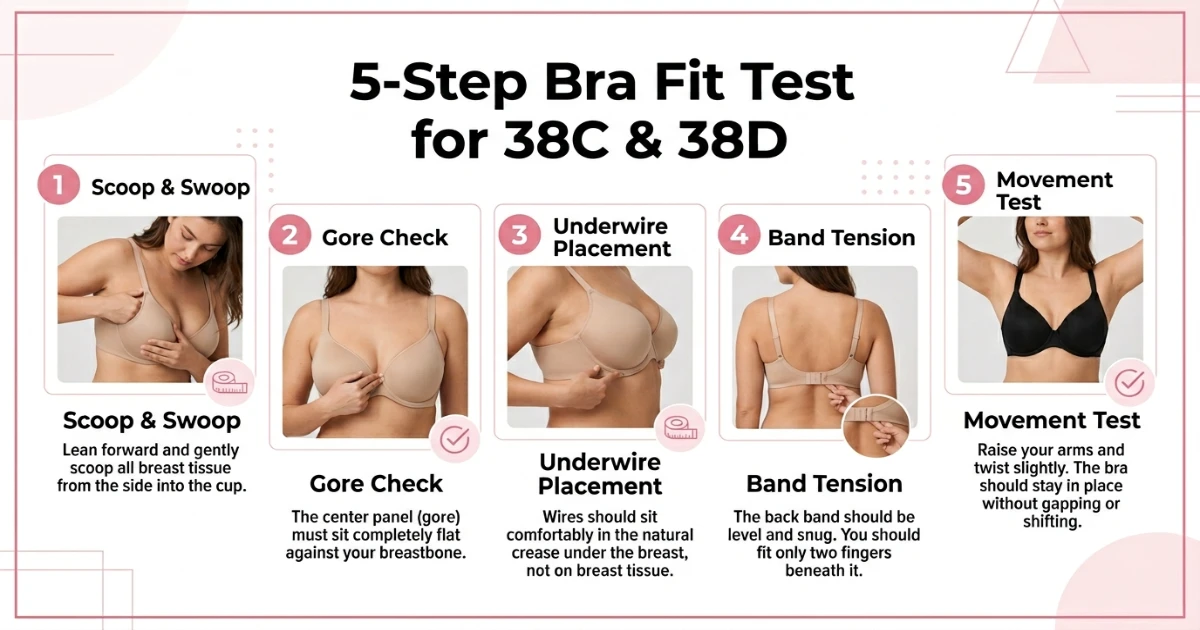
5-Step Bra Fit Test: Confirm 38C or 38D Right Now
On the same 38 band, the choice between 38C and 38D is determined entirely by cup volume. These five checks — run in whichever size you are currently wearing — will confirm immediately whether your cup matches your breast tissue or whether you need to move one letter up or down.
Lean forward and scoop all breast tissue — including any fullness along the sides toward the armpits — fully forward and upward into the cup. Overflow at the top or sides after scooping means the cup is too small: move up one cup letter on the same band (38C → 38D, or 38D → 38DD). Wrinkling or gaping fabric after scooping means the cup is too large: move down one letter (38D → 38C). At C and D cup volume, side fullness is often more significant than wearers expect — scoop thoroughly before judging cup size.
The centre gore must lie completely flat against the sternum throughout the day — not just when first put on. A floating gore is almost always a sign the cup is too small. In a 38C, a persistently floating gore is the clearest signal you need to move to 38D on the same band. Go up one cup letter before making any other adjustment — this check takes precedence over all other signals.
The underwire must encircle all breast tissue and rest entirely on firm ribcage. Because 38C and 38D share the same band, the underwire width across the chest is similar in both — but the cup arch height differs. If the 38C underwire sits on breast tissue rather than fully beneath it, the cup arch is too low for your volume — try 38D. If the 38D underwire extends above your breast tissue into empty space, the cup arch is too high — try 38C.
On the loosest hook, slide two fingers under the back band — you must feel firm, consistent resistance. The band should run horizontally level all the way around. At D cup volume, the breast tissue weight is meaningful — a band even slightly too loose will transfer that weight to the shoulder straps within the first hour, causing neck and shoulder discomfort that worsens throughout the day. If the band rides up in both 38C and 38D, neither cup size solves the problem — you need a tighter band via sister sizing (36D for C cup volume, 36DD for D cup volume).
Raise arms overhead, twist side to side, and walk briskly for 60 seconds. The band should stay completely level, cups should hold all breast tissue in position, and straps should stay on the shoulders without adjustment. If cups shift downward or breast tissue escapes during movement, the cup is too small — try 38D if in 38C. If cups collapse or gape forward during movement, the cup is too large — try 38C if in 38D. At D cup volume, any downward drift of the cups is a band problem, not a strap problem.
Not sure whether 38C, 38D, or a completely different size is the right fit for your measurements? Get a precise answer in seconds.
Try the AI-Powered Bra Size Calculator →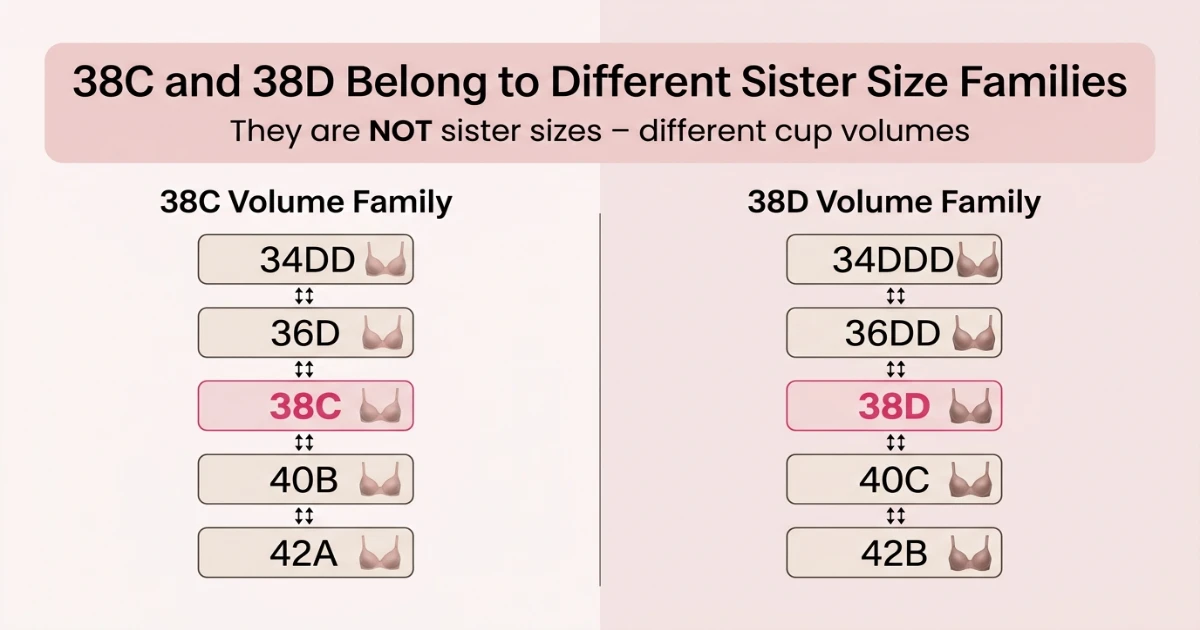
38C vs 38D: Full Side-by-Side Comparison
| Feature | 38C | 38D |
|---|---|---|
| Band Size | 38 — same band, ~33–34″ / 84–86 cm underbust | |
| Cup Letter (US/UK) | C — 3″ (8 cm) over underbust | D — 4″ (10 cm) over underbust |
| EU Equivalent | 85C | 85D |
| Cup Volume | Smaller | Larger — one full cup more than 38C |
| Sister Sizes? | ❌ No — same band, different volumes. Not sister sizes. | |
| Bust Measurement | ~36–37″ (91–94 cm) | ~37–38″ (94–97 cm) |
| Cup Depth | Moderate — 3-inch differential | Deeper — 4-inch differential |
| Band Construction | Identical — same 38-inch frame, same hook-and-eye length | |
| Sister Size Family | 34DD — 36D — 38C — 40B — 42A | 34DDD — 36DD — 38D — 40C — 42B |
| If cups too small | Try 38D (same band, next cup up) | Try 38DD (same band, next cup up) |
| If cups too large | Try 38B (same band, prior cup) | Try 38C (same band, prior cup) |
| If band too tight | Try 40B (sister size — same volume as 38C) | Try 40C (sister size — same volume as 38D) |
| If band too loose | Try 36D (sister size — same volume as 38C) | Try 36DD (sister size — same volume as 38D) |
| Cup Construction | Standard C cup — moderate panel depth | Fuller D cup — reinforced panels, deeper cup arch |
| Support Need | Moderate — standard C cup construction suitable | Higher — full cup or fuller-bust styles recommended |
| Availability | Very widely available — stocked by most retailers | Widely available — common in full-cup and everyday ranges |
| Best For | ~3-inch bust-to-underbust differential on a 38-inch frame | ~4-inch bust-to-underbust differential on a 38-inch frame |
People Also Ask: 38C vs 38D — Answered
Are 38C and 38D the same size?
No — 38C and 38D are not the same size. They share the same 38-inch band but hold different cup volumes. A 38D contains one full cup size more breast tissue than a 38C. The band fits the same ribcage; only the cup depth and volume differ. These are not sister sizes — they are adjacent sizes on the same band with genuinely different enclosed volumes.
Which is bigger — 38C or 38D?
38D is larger in cup volume. A 38C has a 3-inch bust-to-underbust differential while a 38D has a 4-inch differential — on the same 38-inch band. That single additional inch of differential represents one full cup size more enclosed breast tissue. The cups are visibly and structurally different in depth, not merely labelled differently.
Are 38C and 38D sister sizes?
No. Sister sizes are sizes on different bands that hold equal cup volume. 38C and 38D are on the same band and hold different cup volumes — so they cannot be sister sizes. The sister size of 38C is 36D (tighter band, same volume) and 40B (wider band, same volume). The sister size of 38D is 36DD and 40C. These are completely separate volume families.
Is 38C the same as 36D?
Yes — 38C and 36D are confirmed sister sizes. They hold approximately the same cup volume on different band sizes. The 36D band is tighter (for a 31–32 inch ribcage) while the 38C band fits a 33–34 inch ribcage more comfortably. If your 38C band rides up or feels loose, 36D provides the same cup volume in a firmer, better-anchored band that will deliver noticeably better support and stability.
My 38C cups overflow — should I try 38D or 36D?
If your 38C cups overflow but the band fits correctly, try 38D on the same band — not 36D. Moving to 36D would give you the same cup volume as 38C (just in a tighter band), which does not solve an overflow problem. You need more cup space, not a different band. Go up one cup letter: 38C → 38D. Only consider 36D if your 38C band is also too loose.
My 38D band feels too loose — should I try 36D or 38C?
If your 38D band feels too loose but the cups fit correctly, try 36DD — not 36D or 38C. Moving to 36DD gives you a tighter band while preserving the same cup volume as 38D. Moving to 38C reduces cup volume without changing the band, which solves nothing. Moving to 36D gives you a tighter band but also less cup volume — only correct if both your band and cups are too large.
What is the sister size of 38C?
The sister sizes of 38C are 36D (one band tighter, same cup volume), 40B (one band wider, same cup volume), 34DD (two bands tighter), and 42A (two bands wider). The most practical sister size swaps are 36D if the 38C band is too loose, and 40B if the band is too tight. All of these hold approximately equal breast tissue volume to 38C.
What is the sister size of 38D?
The sister sizes of 38D are 36DD (one band tighter, same cup volume), 40C (one band wider, same cup volume), 34DDD (two bands tighter), and 42B (two bands wider). If your 38D band rides up or feels loose during the day, 36DD provides the same cup volume with a firmer anchor — and roughly 80% of your bra’s support comes from that band, so the difference in comfort is significant.
Does a 38D offer more support than a 38C?
Not inherently — the band is the same in both sizes, so band-derived support is equal when both are correctly fitted to the same ribcage. However, a 38D on a correctly sized ribcage carries more breast tissue weight and therefore places greater demands on the bra’s construction. Quality 38D styles are typically engineered with more reinforced cup panels, deeper side wings, and sturdier underwire to handle the higher load — making a well-chosen 38D a more structurally substantial garment than a comparable 38C.
How do I know my correct bra size?
Measure your underbust snugly for your band and your bust at the fullest point for your cup. Subtract underbust from bust — 3 inches = C cup, 4 inches = D cup. Verify fit with five checks: level band, flat gore, underwire fully beneath breast tissue, two fingers under back band, no cup movement during activity. Use our bra size chart calculator for a precise personalised result.