Australian Bra Size Calculator & Converter
Calculate your Australian bra size using dress-size bands (AU 8, 10, 12, 14…) and UK-style cup letters, convert instantly to UK, US, EU & FR — with sister sizes and Berlei, Bonds, Bras N Things & Target AU fit notes.
How to measure correctly
- Wear a non-padded bra or no bra for accurate readings.
- Underbust: wrap tape snugly around your ribcage directly under the bust. Keep tape parallel to the floor. Exhale and measure.
- Overbust: measure around the fullest part of your bust. Tape should be loose enough to slide a finger underneath.
- Stand naturally — don’t lift arms or lean forward. Both measurements in the same posture.
- Round to the nearest ½ inch (or 0.5 cm) for best accuracy.
International Size Conversions
Your Sister Sizes (Same Cup Volume)
Recommended Bras in Your AU Size
Top-rated Australian and UK brands available internationally — verified for AU sizing.
- AU 8–22, cups A–G
- Three-section cup, wide straps
- Berlei, Triumph AU styles
- AU 10–22, cups E–J
- Underwire, side support
- Bravissimo, Panache, Freya styles

Measure in inches or centimetres — your AU band is a dress size, not a centimetre value
What Is the Australian Bra Sizing System?
Australian bra sizing uses dress-size band numbers (AU 6, 8, 10, 12, 14, 16, 18, 20…) paired with UK-style cup letters (A, B, C, D, DD, E, F, FF, G, GG, H) — the same cup alphabet as UK and India. The AU band is derived from your underbust measurement in centimetres using a dress-size lookup: 68–72 cm underbust equals AU 10, 73–77 cm equals AU 12. Cup letters are identical to UK/IN — AU DD equals UK DD equals IN DD. Major Australian brands Berlei, Bonds, Bras N Things, Target Australia, and Triumph AU all follow this system.
Australian bra sizing is unique in the global landscape because it uses dress-size bands — even numbers (6, 8, 10, 12, 14…) derived from Australian women’s clothing sizes — rather than direct centimetre or inch measurements. This means an Australian 12C bra and an Australian size 12 dress correspond to the same body measurement, creating an intuitive connection between clothing and lingerie sizing that no other country uses.
The cup letter system is inherited directly from the UK. Australian bra cups and UK bra cups are identical — same letters, same volumes, same progression (A, B, C, D, DD, E, F, FF, G, GG, H). This makes conversion between AU and UK cups effortless: keep the same cup letter, just convert the band. Indian sizing also uses the same UK-style cup letters, making AU-to-IN cup conversion equally straightforward.
Where Australian sizing creates confusion is at the band conversion. An Australian size 12 band corresponds to a UK 34, US 34, or EU 80 band — but the AU number 12 gives no hint of this. Shoppers buying from UK or US brands online must know that AU 10 = UK/US 34 = EU 75, and AU 12 = UK/US 36 = EU 80, to order correctly. Without this knowledge, many Australian shoppers order band sizes that are too large or too small when shopping internationally.
AU 10 and AU 12 are the most common Australian bra bands — equivalent to UK 32 and UK 34.
AU cup letters are identical to UK and Indian cups — A, B, C, D, DD, E, F, FF, G, GG, H.
- AU bands are dress sizes: AU 6, 8, 10, 12, 14, 16, 18, 20, 22, 24 — NOT centimetres or inches
- AU 12 = UK 34 = US 34 = EU 80 = IN 34 — all the same underbust (68–72 cm)
- AU cup letters are identical to UK/IN — AU DD = UK DD = IN DD. No conversion needed for cups
- AU 12E = UK 34E = US 34DDD = EU 80F = IN 34E — the most common plus-cup conversion example
- Berlei, Bonds, Bras N Things, Target AU, and Triumph AU all use dress-size band notation
How to Measure Your Australian Bra Size
You need your underbust and overbust in either inches or centimetres. The calculator will match your underbust to the correct AU dress-size band automatically.
Prepare correctly
Wear a non-padded bra or no bra. Stand naturally with arms relaxed. Padded bras add 1–2 inches (2–4 cm) to your overbust reading and shift your cup by one or two letters. Berlei’s fitting guides specifically recommend measuring without a bra for maximum accuracy.
Measure your underbust
Wrap the tape snugly around your ribcage directly beneath your bust. Keep it parallel to the floor all the way around. Exhale fully and record. Your AU band size is looked up from your underbust: 58–62 cm = AU 8, 63–67 cm = AU 10, 68–72 cm = AU 12, 73–77 cm = AU 14, 78–82 cm = AU 16, 83–87 cm = AU 18, 88–92 cm = AU 20.
Measure your overbust
Measure around the fullest point of your bust. Keep the tape horizontal and loose enough to slide one finger underneath. Record in inches or centimetres.
Calculate your AU cup letter
Subtract underbust from overbust: 1 in / 2.5 cm = A, 2 in / 5 cm = B, 3 in / 7.5 cm = C, 4 in / 10 cm = D, 5 in / 12.5 cm = DD, 6 in / 15 cm = E, 7 in / 17.5 cm = F, 8 in / 20 cm = FF. AU cups use the same UK progression — each step is approximately one inch or 2.5 cm.
Combine band and cup for your full AU size
Your Australian bra size is the dress-size band plus the cup letter: AU 12C, AU 14DD, AU 10E. The number is always a dress size (even number, typically 6–26), and the letter follows the UK cup alphabet.
Berlei Australia recommends professional bra fittings every 12 months and home remeasurement every six months. Their national fitting data shows that approximately 80% of Australian women wearing the wrong bra size are in a band too large and a cup too small — the same pattern seen globally. If you have not measured in the last year, your current AU size is likely incorrect.
Skip the calculation — use the calculator
Enter your measurements once and get your exact AU size plus conversions to UK, US, EU, FR and IN instantly.
Open the Australian Bra Size Calculator →Australian Bra Size Chart (Dress-Size Band Reference)
This chart is the standard AU sizing reference used by Berlei, Bonds, Bras N Things, Target Australia, and Triumph AU. Australian dress-size bands map to UK, US, EU, and FR bands via the underbust centimetre ranges.
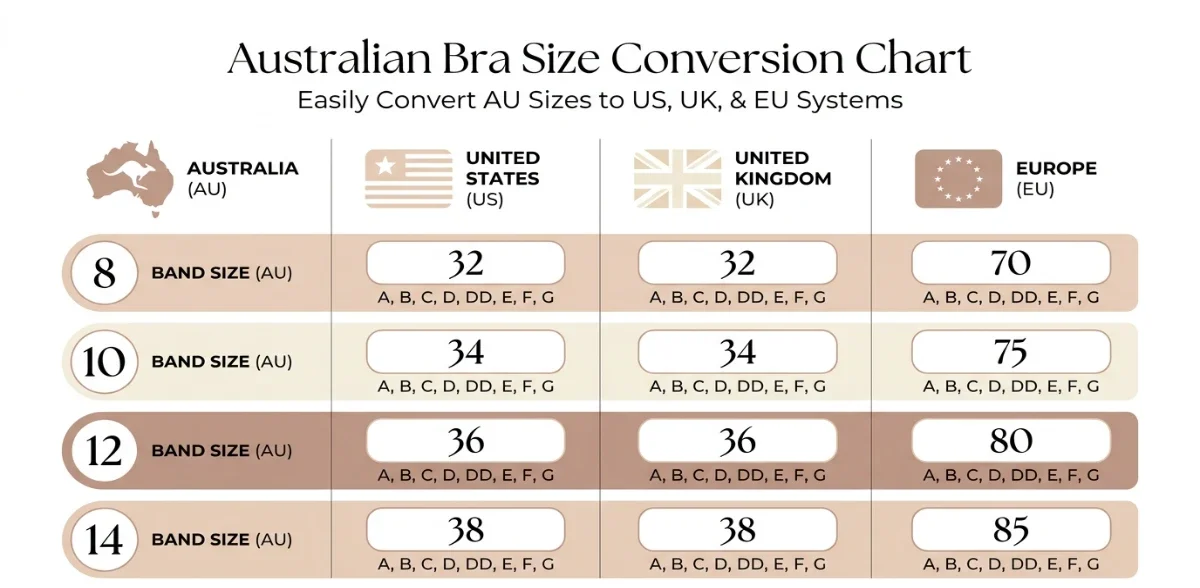
Australian dress-size bands compared with UK, US, EU, and FR systems
| AU Band | UK / US Band | EU Band | FR Band | IN Band | Underbust (cm) | Underbust (in) |
|---|---|---|---|---|---|---|
| AU 6 | 28 | EU 60 | FR 75 | IN 28 | 53–57 | 21–22.5 in |
| AU 8 | 30 | EU 65 | FR 80 | IN 30 | 58–62 | 23–24.5 in |
| AU 10 | 32 | EU 70 | FR 85 | IN 32 | 63–67 | 25–26.5 in |
| AU 12 | 34 | EU 75 | FR 90 | IN 34 | 68–72 | 26.5–28.5 in |
| AU 14 | 36 | EU 80 | FR 95 | IN 36 | 73–77 | 28.5–30.5 in |
| AU 16 | 38 | EU 85 | FR 100 | IN 38 | 78–82 | 30.5–32.5 in |
| AU 18 | 40 | EU 90 | FR 105 | IN 40 | 83–87 | 32.5–34.5 in |
| AU 20 | 42 | EU 95 | FR 110 | IN 42 | 88–92 | 34.5–36 in |
| AU 22 | 44 | EU 100 | FR 115 | IN 44 | 93–97 | 36.5–38 in |
| AU 24 | 46 | EU 105 | FR 120 | IN 46 | 98–102 | 38.5–40 in |
| AU 26 | 48 | EU 110 | FR 125 | IN 48 | 103–107 | 40.5–42 in |
AU Cup to UK, US, EU Conversion
AU cup letters are identical to UK and Indian cups. The only conversion needed for cups is when buying from US brands — where the cup letters diverge above D cup — or from EU brands where the cup letters run one step ahead of AU/UK above D.
| AU / UK / IN Cup | US Cup | EU Cup | JP / KR Cup | Difference (in) |
|---|---|---|---|---|
| AA | AA | AA | AA | ~0.5 in |
| A | A | A | A | 1 in |
| B | B | B | B | 2 in |
| C | C | C | C | 3 in |
| D | D | D | D | 4 in |
| DD | DD | E | E | 5 in |
| E | DDD | F | F | 6 in |
| F | DDDD/G | G | G | 7 in |
| FF | G/H | H | H | 8 in |
| G | H/I | I | — | 9 in |
| GG | I/J | J | — | 10 in |
| H | J/K | K | — | 11 in |
| HH | K/L | L | — | 12 in |
| J | L/M | M | — | 13 in |
Many Australian shoppers believe their AU 12 band is equivalent to a European size 12. It is not. AU 12 is a dress-size band corresponding to a 68–72 cm underbust — the same as UK 34, EU 75, and US 34. EU size 12 in clothing refers to something completely different and varies by country. The AU bra band system borrows dress-size numbers but these numbers have a specific cm underbust lookup table — they are not clothing measurements transplanted directly into lingerie.
What Are Sister Sizes in Australian Bras?
Sister sizes in the AU system work identically to UK — bands step by 2 AU sizes (e.g., AU 12 → AU 14) and cups shift by one letter. The AU band steps are equivalent to going up one UK/US band size (34 → 36).
The sister size rule
- Smaller band, larger cup: If your AU 14C band rides up, try AU 12D. Same cup volume, tighter band.
- Larger band, smaller cup: If your AU 14C band digs in, try AU 16B. Same cup volume, looser band.
| AU Size | UK Equiv. | Band Feel | Cup Volume |
|---|---|---|---|
| AU 12D | UK 34D | Tighter | Same as AU 14C |
| AU 14C | UK 36C | Standard | Your primary size |
| AU 16B | UK 38B | Looser | Same as AU 14C |
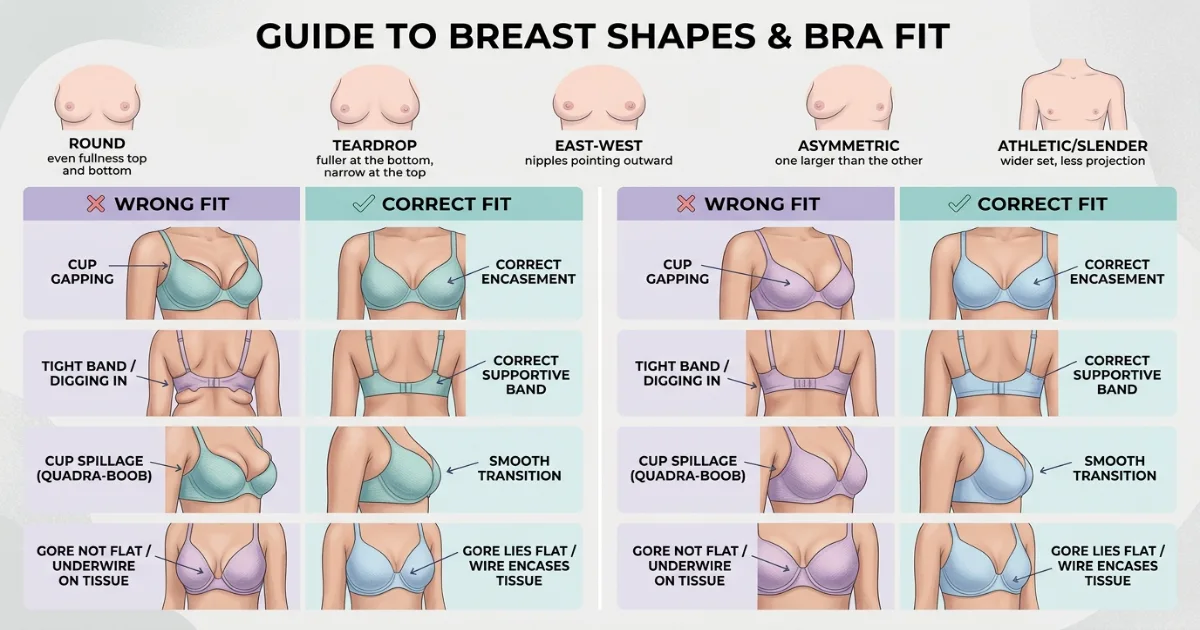
Australian brands cover a wide range — from Bonds basics to Berlei precision fit and Bravissimo D+ specialist imports
Australian Bra Brand Sizing Differences
All major Australian brands use dress-size band notation with UK-style cup letters, but construction varies meaningfully between labels.
Berlei AU
Australia’s oldest and most respected lingerie brand, founded in Sydney in 1917. Berlei is the Australian market reference for accurate bra sizing. Their sizing follows the AU dress-size standard precisely. Stocks AU 8–22 and cups A–J in their full range.
Fit: True to AU size. Berlei is the Wacoal of the Australian market — use it as your calibration brand when testing other AU labels. Their cups suit medium-projection breast shapes. Highly accurate band sizing.
Bonds AU
Australia’s most-worn everyday basics brand. Bonds bras use AU dress-size bands with UK-style cups. Known for soft-cup, wireless, and crop-bra styles. Stocks AU 10–20 and cups A–E. Bands run true to AU standard; cups in wireless styles run slightly generous.
Fit: True to AU band in wired styles. Cups run slightly generous in wireless/soft-cup — size down one cup in Bonds wireless if between sizes. Limited above E cup.
Bras N Things AU
Popular Australian lingerie retailer. Uses AU dress-size bands and UK-style cups. Stocks AU 8–18 and cups A–G in most stores. Known for fashion-forward styles at accessible price points. Bands tend to run slightly firm — particularly in wired styles.
Fit: Bands run slightly firm — size up one AU band if between sizes. Cups are approximately true to AU standard. Good selection of DD–F cup in fashion styles that other Australian retailers don’t stock.
Target Australia AU
Budget-to-mid-range AU bras using dress-size bands. Stocks AU 10–20 and cups A–E in most stores. Target AU sizing follows the standard with bands running true and cups running slightly shallow in moulded styles. Limited D+ cup range above DD.
Fit: Bands run true to AU. Cups run slightly shallow in moulded styles — size up one cup in Target AU padded bras if between sizes. Best value for A–C cup range.
Triumph Australia AU
German brand’s Australian subsidiary. Uses AU dress-size bands on Australian-market products — different from Triumph Europe’s EU notation. Triumph AU 12 = Triumph EU 75 = UK 34. Stocks AU 8–20 and cups A–H. Known for precision construction and consistent sizing.
Fit: True to AU size. Note that Triumph AU and Triumph EU use different band labelling for the same bodies — Triumph AU 12 ≠ Triumph EU 12. Always check which market label applies when shopping Triumph online.
Bravissimo UK (buying from AU)
UK D+ specialist. Ships to Australia. Uses UK sizing — band numbers convert directly (UK 34 = AU 12, UK 36 = AU 14) and cup letters are identical. AU E = UK E. An Australian shopper in AU 14E would order UK 36E from Bravissimo with no conversion needed for the cup.
Fit tip: Convert your AU band to UK: AU 12 → UK 34, AU 14 → UK 36. Keep your cup letter exactly — AU and UK cups are the same. Bravissimo’s D+ range starts where most Australian retailers stop.
Victoria’s Secret US (buying in AU)
Available online in Australia using US sizing. Band conversion: AU 12 = US 34, AU 14 = US 36. Cup: AU A–D = US A–D (identical). Above D: AU DD = US DD, AU E = US DDD, AU F = US DDDD. VS does not stock above US DDD (= AU E), limiting options for AU F+ cup shoppers.
Conversion: AU 12E → US 34DDD. AU 14DD → US 36DD. Keep the US band number matching your AU-to-UK conversion; convert the cup letter for D+.
Chantelle FR (sold in AU)
French brand sold in Australian department stores. Uses French sizing (+15 on band). A Chantelle FR 90 sold in Australia equals AU 12 (underbust 68–72 cm). Cup letters are EU-style — FR E = AU DD (one step behind AU above D). Subtract 15 from FR band, then convert to AU.
Conversion: FR 90E → EU 75E → AU 12DD (FR cup E = AU DD). FR band minus 15 = EU band → convert to AU using the table. Always check French vs EU labelling when shopping imported brands.
Signs Your AU Bra Size Is Wrong
Band size problems
- Band rides up at the back: band too big. Try one AU size down, one cup up (e.g., AU 14B → AU 12C).
- Band digs in or leaves marks: band too small. Try one AU size up, one cup down (e.g., AU 12C → AU 14B).
- Band pulls forward when arms are raised: band too loose. Tighten hooks or go down one AU size.
Cup size problems
- Spillover at top or sides: cup too small. Size up one cup letter (AU 14C → AU 14D).
- Gaping or wrinkling: cup too big. Size down one letter (AU 14C → AU 14B).
- Underwire on breast tissue instead of ribcage: cup too small. Size up immediately.
- Centre gore not flat against sternum: cup too small or wire too wide for breast spacing.
Berlei’s national fitting data shows approximately 80% of Australian women are wearing an incorrectly sized bra. The most common error is wearing an AU band 2–4 sizes too large (e.g., AU 16 when AU 12 is correct) and a cup 2–3 letters too small (e.g., B cup when DD cup is correct). If you have not measured in the last 12 months, or have never had a professional fitting, your current AU size is likely incorrect.
Why Australian Bra Sizing Confuses Shoppers
The dress-size band problem
The single biggest source of confusion in Australian bra sizing is the dress-size band notation. An Australian shopper who wears dress size 14 naturally gravitates toward AU 14 bra bands — even if her underbust measurement corresponds to AU 12. Australian dress sizes account for the whole body silhouette (bust, waist, hips), whereas bra bands correspond only to the underbust circumference. The two measurements often diverge, particularly for women with larger cup sizes whose dress size is driven by their bust measurement rather than their underbust.
The international shopping conversion problem
As Australian consumers increasingly shop from ASOS, Bravissimo, and US brands online, the dress-size band creates systematic ordering errors. An Australian shopper in AU 14E who sees UK 36E on a Bravissimo page correctly identifies the equivalent — but an AU 12E shopper who doesn’t know that AU 12 = UK 34 will often order UK 36E or UK 38E, resulting in a band too large. Knowing the single rule — AU band ÷ 2 + 5 = UK/US band (approximately) — prevents this error.
The Triumph AU vs Triumph EU problem
Triumph manufactures for both the Australian market (using AU dress-size bands) and the European market (using EU cm bands) under the same brand name. Triumph AU 12C and Triumph EU 75C are the same size — but they look completely different on the label. Australian shoppers purchasing Triumph from European Triumph online must convert their AU band to EU to find the correct size.
Our calculator converts your underbust measurement (in inches or centimetres) to an AU dress-size band using a lookup table — the same method used by Berlei, Bonds, and all major Australian brands. Cup size is calculated from the overbust-to-underbust difference in inches using the UK cup alphabet. We then output your AU size as the primary result and convert the band to UK/US (using the inverse dress-size lookup) and to EU (via underbust cm rounding) for international shopping. AU cup letters convert directly to UK and IN — no adjustment needed.
Shopping International Brands as an Australian Shopper
Buying from UK retailers (Bravissimo, ASOS, M&S)
Convert AU band to UK: AU 8 = UK 30, AU 10 = UK 32, AU 12 = UK 34, AU 14 = UK 36, AU 16 = UK 38, AU 18 = UK 40. Cup letters are identical — AU DD = UK DD, AU E = UK E. Keep your cup letter exactly and convert only the band. AU 14E = UK 36E at Bravissimo, Panache, or Marks and Spencer.
Buying from US retailers (Victoria’s Secret, ThirdLove)
AU band to US band is the same conversion as AU to UK: AU 12 = US 34, AU 14 = US 36. Cup: AU A–D = US A–D (identical). Above D: AU DD = US DD, AU E = US DDD, AU F = US DDDD, AU G = US G/H. So AU 12E = US 34DDD. US bands run small — size up one US band if borderline.
Buying from EU retailers (Triumph EU, Hunkemöller)
AU band to EU: AU 10 (63–67 cm) = EU 70, AU 12 (68–72 cm) = EU 75, AU 14 (73–77 cm) = EU 80. Cup: AU DD = EU E (one step ahead of UK/AU in EU above D), AU E = EU F, AU F = EU G. So AU 12E = EU 75F. Add one cup letter when converting AU to EU above DD.
Buying from French retailers (Chantelle, Simone Pérèle)
French band = EU band + 15: AU 12 → EU 75 → FR 90. AU 14 → EU 80 → FR 95. Cup: FR cup letters are same as EU, one ahead of AU above DD: FR E = AU DD, FR F = AU E, FR G = AU F. So AU 12E = EU 75F = FR 90F. Add 15 to the EU band and add one cup letter when converting AU to FR above DD.
When shopping on ASOS AU, check which market a brand’s bras are labelled for. Australian brands (Berlei, Bonds) listed on ASOS AU use AU dress-size bands. UK brands (Freya, Panache, Bravissimo sub-brands) use UK inch-based bands. The same size filter showing AU 12 will return AU 12 from Berlei and UK 34 from Freya — both the same band — but the filter doesn’t distinguish between the two numbering systems. Verify by checking the brand’s size guide on the product page.
Recommended Bras for Australian Sizing
As an Amazon Associate, Bra-Calculator.com earns from qualifying purchases at no extra cost to you.
- AU 8–22, cups A–J
- Three-section cup, wide straps
- Barely There, B Smooth styles
- AU 10–20, cups A–E
- Wire-free all-day comfort
- Comfy Bra, Cottonsox styles
- AU 10–22, cups E–J (UK sizing)
- Underwire, side support panel
- Bravissimo, Panache, Freya
- AU 10–18, cups B–F
- High impact, encapsulation design
- Electrify & Plunge styles
Frequently Asked Questions
Australian bra sizing uses dress-size band numbers (AU 6, 8, 10, 12, 14, 16, 18, 20…) paired with UK-style cup letters (A, B, C, D, DD, E, F, FF, G). The AU band is derived from your underbust measurement using a dress-size lookup — 68–72 cm underbust equals AU 12. Cup letters are identical to UK and Indian sizing. Major Australian brands Berlei, Bonds, Bras N Things, Target Australia, and Triumph AU all follow this system.
AU 12 equals UK 34 and US 34. All three correspond to an underbust measurement of 68–72 cm. The AU number 12 is a dress size, not a centimetre or inch measurement. AU 12 = UK 34 = US 34 = EU 75 = IN 34 = FR 90. These are all the same band expressed in different national conventions. For cup letters, AU and UK are identical — AU 12E equals UK 34E with no conversion needed for the cup.
Yes — completely identical. AU cup letters are exactly the same as UK cup letters: AU A = UK A, AU DD = UK DD, AU E = UK E, AU FF = UK FF. No conversion needed for cups when buying from UK brands. Convert only the band: AU 12 = UK 34, AU 14 = UK 36. So AU 14E at Berlei is the same as UK 36E at Bravissimo — same band, same cup, same fit (construction differences notwithstanding).
AU band to US band: AU 8 = US 30, AU 10 = US 32, AU 12 = US 34, AU 14 = US 36, AU 16 = US 38. Cup: AU A–D = US A–D (identical). Above D: AU DD = US DD, AU E = US DDD, AU F = US DDDD, AU FF = US G, AU G = US H. So AU 12E = US 34DDD. US bands run small — size up one US band if your underbust measurement is toward the top of the AU band range.
Triumph manufactures products for both markets under the same brand but uses different labelling conventions. Triumph AU uses Australian dress-size bands — Triumph AU 12 equals Triumph EU 75, which equals UK 34. The physical bra is identical; only the label number differs. When shopping Triumph online from European sites, find your AU band in the conversion table to identify the correct EU band. Triumph AU 12 = Triumph EU 75. Triumph AU 14 = Triumph EU 80.
Berlei’s national fitting data suggests AU 14B and AU 14C are the most commonly purchased sizes in Australia, with AU 12C and AU 16B also heavily sold. However, Berlei’s own fitting specialists report that the true measured average for Australian women is closer to AU 14DD or AU 16C when measured accurately. The discrepancy reflects the widespread pattern of wearing bands too large and cups too small — estimated at 80% of Australian women by Berlei’s national data.
Sister sizes are AU bra sizes with identical cup volume but different band widths. From AU 14C, the sister sizes are AU 12D (tighter band, same volume) and AU 16B (looser band, same volume). AU bands step in increments of 2 dress sizes, so sister sizes are always two AU band sizes apart with one cup letter shift. Sister sizes are particularly useful when shopping Berlei or Bras N Things online where specific AU sizes sell out during sales.
Measure your underbust in centimetres or inches. Match to the AU band: 63–67 cm = AU 10, 68–72 cm = AU 12, 73–77 cm = AU 14, 78–82 cm = AU 16. Measure overbust loosely. Subtract underbust from overbust: 1 in = A, 2 in = B, 3 in = C, 4 in = D, 5 in = DD, 6 in = E. Berlei recommends measuring without any bra. Our Australia calculator accepts both inches and centimetres.
Every six months at minimum, or after any weight change of 5 lb (2.5 kg) or more, pregnancy, breastfeeding, or starting or stopping hormonal contraception. Berlei’s national fitting programme recommends annual professional fittings and semi-annual self-measurement. Most Australian women who have not measured in over a year will find their size has changed by at least one band or cup step.
This is common and expected. AU bra band sizes are determined exclusively by your underbust measurement — not by your clothing dress size. A woman who wears AU clothing size 14 may have an underbust measurement of 68–72 cm (AU 12 bra band) because her dress size is driven by her bust or hip measurement rather than her underbust. Always measure your underbust and use the lookup table, rather than assuming your bra band matches your clothing size.
Berlei stocks through J cup in extended styles, with bands through AU 22. Target Australia and Bonds extend to AU 20 in limited cup ranges. For sizes beyond AU 20 and above F cup, Australian shoppers are best served by UK specialists like Bravissimo and Fantasie who ship internationally and whose cup letters are identical to AU — simply convert the AU band to UK (AU 22 = UK 44) and keep the same cup letter. Berlei’s extended range through J cup makes them the most comprehensive domestic Australian option.
On ASOS Australia, Australian brands (Berlei, Bonds) use AU dress-size bands while UK brands (Freya, Panache, Bravissimo sub-brands) use UK inch-based band numbers. The size filter may show both together — AU 12 from Berlei and UK 34 from Freya are the same band measurement. Cup letters are identical between AU and UK. For UK brands on ASOS AU: convert your AU band to UK (AU 12 = UK 34) and keep the same cup letter. Check the brand’s size guide on the product page to confirm which system applies.
Yes. New Zealand follows the same bra sizing convention as Australia — dress-size bands and UK-style cup letters. NZ 12C = AU 12C exactly. Most major Australian brands (Berlei, Bonds, Bras N Things) operate in New Zealand using the same sizing system and same labels. UK brands sold in NZ also use UK inch-based bands that convert identically to AU bands. NZ shoppers use the same conversion table as Australian shoppers when buying internationally.
Related Calculators & Guides
- UK Bra Size Calculator
- US Bra Size Calculator
- EU Bra Size Calculator
- India Bra Size Calculator
- Canada Bra Size Calculator
- France Bra Size Calculator
- Germany Bra Size Calculator
- Japan Bra Size Calculator
- Korea Bra Size Calculator
- All Country Calculators
- Global Bra Size Converter
- Free Bra Size Calculator
- Sister Size Calculator
- Cup Size Calculator
- Complete Bra Size Chart
- How to Measure Bra Size
- Common Bra Fit Problems
- Breast Shape Identifier
- AI Smart Fit Bra Calculator
- Cup Size Visual Guide
- Bra Fit Problem Solver
- How to Know If Your Bra Fits
Ready to find your exact Australian size?
Get your AU bra size plus conversions to UK, US, EU, FR and IN — free, instant, accurate.
Open the Australian Bra Size Calculator →