What Bra Hook Should You Use? Loosest, Middle or Tightest Explained
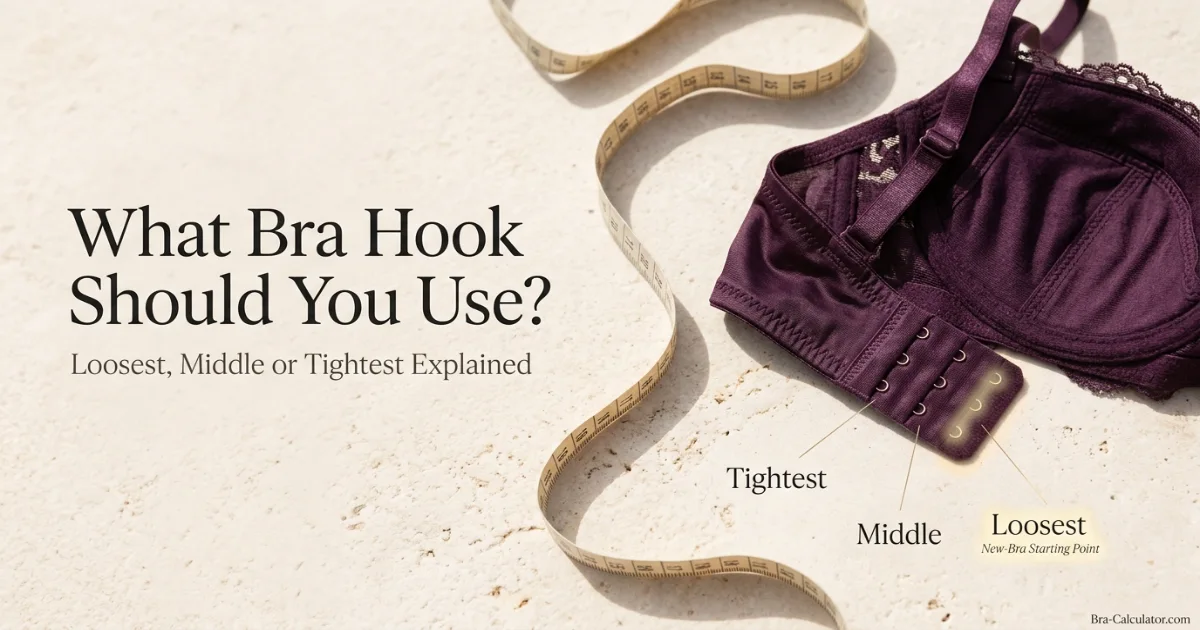
If you are asking what bra hook should I use, the usual starting point for a new multi-hook bra is the loosest setting that still feels secure. The tighter hooks are there mainly to recover support later as the band elastic relaxes.

Quick answer: what bra hook should I use?
Start a new bra on the loosest secure hook in most cases. Move to the middle and then the tightest hook only as the band relaxes with wear. If a brand-new bra needs the tightest hook or the loosest hook hurts, recheck the size rather than forcing the closure.
What Bra Hook Should I Use on a New Bra?
For most conventional multi-hook bras, a new bra should fit securely on the loosest usable hook. That leaves tighter settings available for later, when the band elastic naturally relaxes with wear. The hook position is not a score and it is not a rule you should force when the bra is uncomfortable. It is simply a useful way to preserve the working life of the band.
Why the Loosest Hook Is the Starting Point
Bra bands rely on elastic. Over repeated wears and washes, elastic gradually becomes less firm. Starting a new bra on the loosest hook gives you adjustment room. When the band later loses some tension, you can move to the middle and eventually the tightest hook instead of replacing the bra immediately.
The rule only works when the cups also fit. If the cups are too small, the whole bra can feel tight and make you believe the band should be worn on a looser hook or a larger size.
When Should You Move to the Middle Hook?
Move inward when the band has genuinely become less secure—not simply because the middle hook exists. Signs include the back beginning to rise, the bra shifting during movement, or the front losing stable support even though the cups and straps are adjusted correctly.
There is no universal week or month when this should happen. Bra rotation, washing, body changes, fabric quality and band construction all affect wear.
What Does the Tightest Hook Mean?
The tightest hook is usually the final adjustment stage of a bra’s working band life. If an older bra feels stable only on the tightest setting, that can be perfectly reasonable. If a brand-new bra already needs the tightest hook to stay in place, the band may be too large or unusually stretchy.
Use the bra band rides up guide if the back climbs even on the tightest hook. A smaller band with a sister-size cup may be a better long-term fit.
What If the Loosest Hook Feels Too Tight?
Do not force yourself into the “correct” hook position. First test whether the band itself is the problem.
- Fasten the bra backwards and upside down. Keep the cups out of the equation.
- Use the loosest hook. The band should feel secure without sharp restriction.
- Sit and breathe normally. Comfort has to survive real movement, not just mirror posture.
- Wear the bra normally. If it becomes much tighter once the cups are filled, check cup volume and shape.
If the cups are correct but the band remains too tight, try a roomier sister size with the Sister Size Bra Calculator.
Can I Use a Bra Extender?
A non-elastic extender can be useful when a new bra is only slightly firmer than comfortable, when your measurements sit between band sizes, or when temporary body changes make the usual band feel snug. It preserves the cup and wire geometry better than jumping to a much larger band.
An extender is less useful when the cups are already too small, the band rides up dramatically, or the whole bra frame is wrong for your shape.
Do More Hooks Mean More Support?
Hook count and hook position are different questions. A wider band may use two, three or more vertical hooks for structure, especially in larger sizes. That does not change the basic adjustment principle: begin with the loosest column that gives secure support, then move inward as the elastic relaxes.
Seven Hook-Position Clues to Read Correctly
| What happens | What it may mean | What to do |
|---|---|---|
| New bra is stable on loosest hook | Ideal starting adjustment range | Keep it there until band relaxes |
| New bra only works on tightest hook | Band may be too large/stretchy | Test one band down with sister cup |
| Loosest hook hurts even without cups | Band may be too small or too rigid | Try roomier sister size or extender |
| Band feels tight only with cups filled | Cup may be small/shallow | Recheck cup volume and projection |
| Older bra now needs middle hook | Normal elastic relaxation | Use middle if support improves |
| Older bra needs tightest hook | Later stage of band life | Use it if fit remains stable |
| Tightest hook still rides up | Band likely too loose/worn | Replace or test smaller band |
How to Set Your Bra Hooks Correctly
- Start with the loosest column on a new bra.
- Scoop and swoop fully into the cups.
- Check that the band is level. It should not climb toward the shoulder blades.
- Check the center gore and wires. Hook position cannot compensate for the wrong cup.
- Move inward only as the band relaxes over time.
- Replace the bra when even the tightest hook no longer anchors it.
Not sure whether the hook or size is wrong?
Use fresh measurements and compare the result with your current bra before changing the hook position.
Calculate My Bra SizeFrequently Asked Questions
What bra hook should I use on a new bra?
For most standard bras, start on the loosest hook that gives a secure, comfortable band. This leaves tighter settings available as the elastic relaxes.
When should I use the middle hook?
Use the middle hook when the band has begun to feel less secure and the tighter setting restores a level, stable fit.
Is it bad to use the tightest hook on a new bra?
It is not automatically bad, but it usually means you have little adjustment room left. If the new bra only feels supportive on the tightest hook, test whether the band is too large.
What if the loosest hook is too tight?
Test the band without the cups. If it is still uncomfortably tight, try a roomier sister size or a non-elastic extender.
Does a bra extender change cup size?
An extender adds band length without changing the labeled cup, although changing band tension can slightly change how the whole bra sits.
How do I know when a bra band is worn out?
If an older band rides up or shifts even on the tightest hook, and the cups are otherwise correct, the elastic may be too relaxed to provide stable support.
Should a sports bra follow the same hook rule?
If it uses adjustable back hooks, the same general principle can apply, but some sports bras are intentionally constructed with different compression and closure systems.
Related Bra Fit Guides
Share This Fit Guide
About this guide: Prepared for Bra-Calculator.com and reviewed by Amelia, Founder & CEO. This page explains bra-fitting principles for educational purposes. Persistent pain, unusual breast changes or significant skin symptoms should be discussed with a qualified healthcare professional.