Best Nursing Bra Fabrics for Sensitive Postpartum Skin
A fabric that felt perfectly fine before pregnancy can suddenly wreck you postpartum. Here’s what actually holds up against sensitive skin, hour after hour, feed after feed.
Affiliate disclosure: As an Amazon Associate, Bra-Calculator.com earns from qualifying purchases at no extra cost to you. Product suggestions are selected by fit purpose and construction, not commission size.
In This Guide
- Why Postpartum Skin Reacts Differently
- Fabric Comparison at a Glance
- Why Modal and Bamboo Outperform Standard Cotton
- Seam and Trim Placement Matters as Much as Fabric
- Fabric Blends and Percentage Composition
- Certifications Worth Checking For
- Fabric and Nursing-Specific Construction
- Skin Sensitivity Beyond Fabric
- Washing Habits That Protect Sensitive Skin
- Signs Your Fabric Choice Isn’t Working
- How to Patch-Test a New Fabric
- Balancing Comfort With Support Needs
- Fabric for Different Climates and Seasons
- Diagnosed Skin Conditions and Metal Sensitivities
- Balancing Cost and Fabric Quality
- The Bottom Line
Why Postpartum Skin Reacts Differently
Postpartum hormone shifts leave skin drier, thinner, and more reactive than it was during pregnancy, while night sweats spike from the same hormonal swing — which is exactly why sensitive postpartum skin needs a different fabric strategy than whatever worked for you before. Estrogen drops fast in the days after birth. That drop alone changes how your skin holds moisture and how it responds to friction.
Here’s the part that catches most new parents off guard: a fabric you wore comfortably for years can suddenly start causing chafing or a stubborn rash once you’re living in a nursing bra sixteen, eighteen, sometimes twenty hours a day. That’s not bad luck. A regular bra comes off at night. A nursing bra, especially in the first few months, barely does — so seams and elastic edges that used to get a few hours of skin contact now get almost constant contact, on skin that’s already working overtime to recover.
The usual suspects are pretty consistent from parent to parent: underwire channels covered in a stiff synthetic casing, decorative lace layered over the cup lining rather than tucked underneath it, and wide elastic bands that grip more than they should once any postpartum swelling shows up around the ribcage. None of those are dealbreakers on their own — plenty of people wear all three without issue — but when you stack them on top of already-sensitive skin, they’re the first places irritation tends to show up.
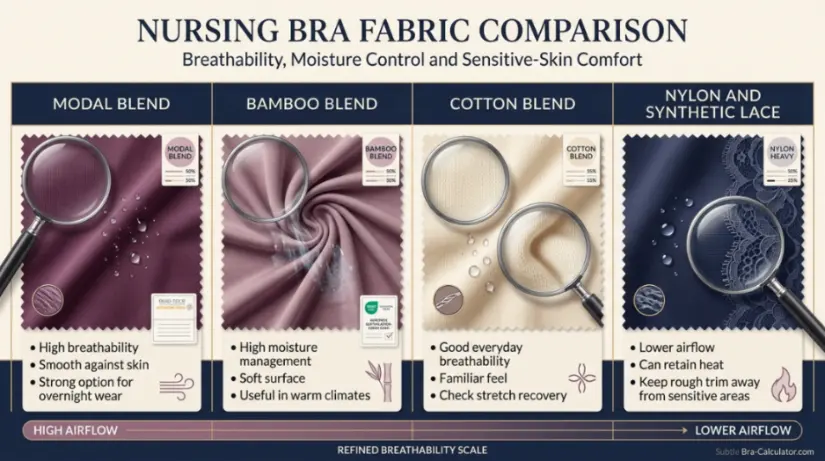
Modal and bamboo-blend fabrics consistently outperform nylon-heavy and lace-trimmed fabrics for postpartum skin comfort.
Measurement LogicFabric Comparison at a Glance
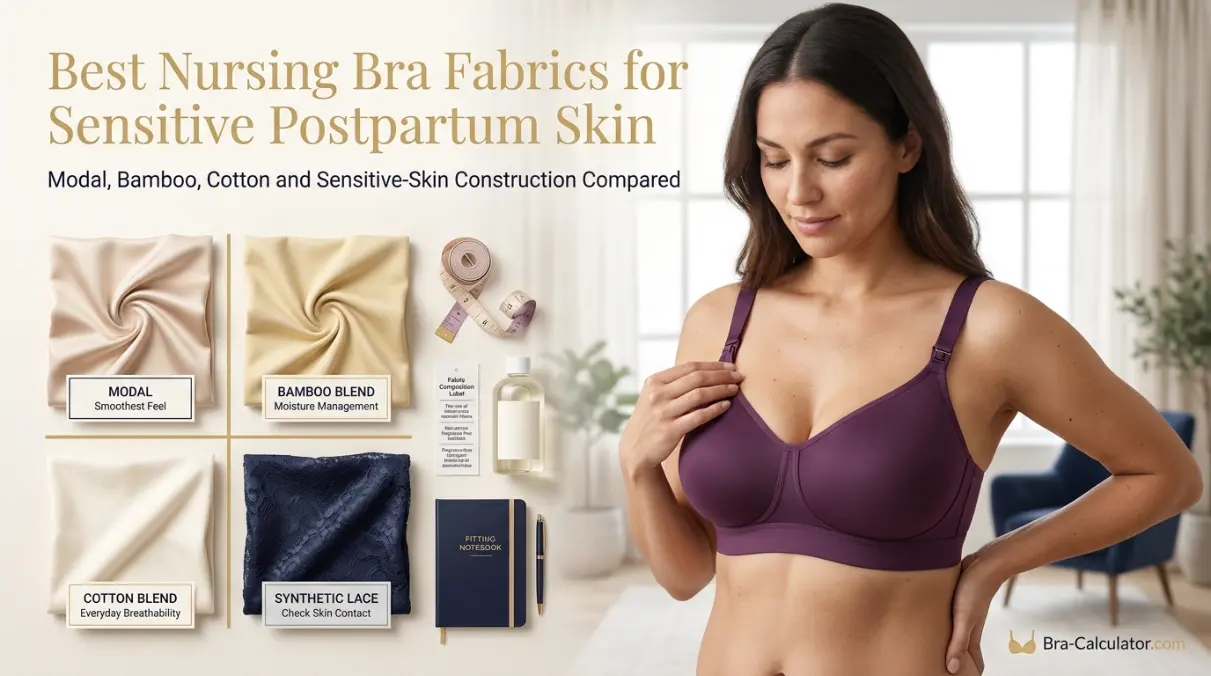
Modal and bamboo-blend fabrics score highest for breathability and are the best fit for sensitive postpartum skin, cotton blends are a solid mid-range everyday option, and nylon-heavy or lace-trimmed fabrics rank lowest for skin comfort despite often looking the prettiest on the hanger.
| Fabric | Breathability | Best For |
|---|---|---|
| Modal / bamboo blend | High | Sensitive skin, night sweats |
| Cotton blend | Medium-High | Everyday wear, budget-friendly |
| Nylon/spandex heavy | Low-Medium | Shaping bras, not ideal for sensitive skin |
| Lace trim (synthetic) | Low | Avoid directly against nipple/areola area |
Don’t let the table do all the work, though. Two bras both labeled “modal” can perform completely differently depending on what percentage of the blend is actually modal versus filler synthetics — more on that shortly.
The Deeper DiveWhy Modal and Bamboo Outperform Standard Cotton
Modal and bamboo fibers are engineered with a smoother, more uniform structure than standard cotton, which cuts down on the microscopic friction that causes chafing, and both wick moisture away from skin more effectively — a real advantage against postpartum night sweats, which tend to run heavier than typical daytime perspiration.
Fiber structure and friction
Cotton fibers are naturally a bit irregular under a microscope — think tiny, uneven ridges. Modal and bamboo-derived fibers are spun to be more consistent, which is why they tend to feel smoother against skin that’s already inflamed or irritated. Over sixteen-plus hours of daily contact, that difference compounds. It’s the same reason a rough seam feels fine for an hour but unbearable by hour twelve.
Moisture-wicking capacity
Modal and bamboo blends also pull perspiration away from skin faster than standard cotton, rather than letting it sit and soak in. That matters specifically for postpartum night sweats, which can be dramatically heavier than what you experienced pre-pregnancy thanks to the hormonal recalibration your body is going through after birth. A fabric that traps that moisture against skin all night is a near-guaranteed recipe for irritation by morning.
A quick caveat
None of this means cotton is a bad choice — it isn’t. It’s breathable, affordable, and widely available. Modal and bamboo just tend to edge it out specifically for the sensitive-skin, high-moisture scenario this guide is focused on.
Construction CheckSeam and Trim Placement Matters as Much as Fabric
Even the most breathable fabric can irritate skin if a seam sits directly over a sensitive area, so look for flat-seam or seamless construction around the cup edge and steer decorative lace away from the nipple or areola entirely.
This is where a lot of otherwise-good fabric choices get undermined by construction. Several current nursing lines have leaned into this problem directly — Kindred Bravely’s Sublime knit, for example, is built specifically to stretch without a seam pressing into skin at the point of most contact. That’s a design response to a real, common complaint, not a marketing gimmick.
Bra-Calculator.com MethodFabric Blends and Percentage Composition
Most nursing bras labeled “modal” or “bamboo” are actually blends combining those fibers with spandex, elastane, or standard polyester, so the printed percentage composition tells you far more about real-world breathability than the fabric name alone.
Here’s a concrete way to think about it: a bra that’s 20% modal and 80% polyester is going to perform much closer to a standard synthetic than to a true modal fabric, even though “modal” is the word on the tag. A blend that’s 60% modal or higher is a genuinely different product. Check the fiber content listed in the product details — most brands do disclose it, even if it’s buried a scroll or two down the page — before assuming the marketing name tells the whole story.
Real-World FitCertifications Worth Checking For
Oeko-Tex Standard 100 certification confirms a fabric has been tested and verified free of a defined list of potentially harmful substances, which is worth checking given how much direct skin and infant contact nursing bra fabric actually gets.
It’s not a requirement, and plenty of perfectly comfortable nursing bras don’t carry it. But if you’re already narrowing down between two similar options, an Oeko-Tex label is a reasonable tiebreaker — particularly for parents who are also thinking about what fabric sits closest to a nursing infant’s face during feeding.
Fit GuidanceFabric and Nursing-Specific Construction
Not every breathable fabric handles nursing-specific stretch panels and drop-cup mechanisms equally well, which creates a genuine trade-off between maximum breathability and long-term clip or panel performance that not every product resolves cleanly.
The stretch panels and clip-down or drop-cup mechanisms central to nursing bra design put real, repeated stress on fabric — dozens of times a day, for months. Some of the most breathable fibers simply don’t have the stretch-recovery of the synthetic-heavy blends more commonly used in those panels, which is why a bra can feel amazing on day one and start sagging or losing shape by week six. Reading reviews that specifically mention how a bra holds up after repeated washing, not just first impressions, is one of the more reliable ways to spot a product that’s actually solved this trade-off.
Reading the fine print on stretch panels
Product pages don’t always spell out what’s in the stretch panel itself, since it’s sometimes a different fabric than the main cup. If it isn’t listed, a quick message to customer service usually gets you an answer faster than you’d expect — and it’s a legitimate question, not a nitpicky one, given how directly that panel affects both comfort and how long the bra actually lasts in rotation.
Measurement LogicSkin Sensitivity Beyond Fabric
General postpartum hormonal shifts aren’t the only factor at play — many parents also experience nipple sensitivity or tenderness in the early weeks of establishing a feeding routine, which interacts with fabric choice differently than body-wide skin sensitivity does.
During that early stretch, extra-soft, seamless construction right at the point of direct nipple contact matters more than it will later, once feeding is established and any initial tenderness has settled. It’s worth being a little more particular about fabric and construction in those first weeks specifically, even if you loosen up on fabric choice for the rest of the bra later on.
Shopping StrategyWashing Habits That Protect Sensitive Skin
Fragrance-free, dye-free detergent, cold water washing, air-drying when possible, and skipping fabric softener entirely all help protect both skin and fabric performance — softener in particular coats fibers in a residue that blocks moisture-wicking over time.
Postpartum skin sensitivity often extends beyond the fabric itself to whatever’s left behind in the wash. Fragrance-free, dye-free detergent cuts down on one whole category of irritation you might not have even connected to your bra. And fabric softener, while it feels like it’s helping in the moment, is quietly working against you — that coated-fiber residue is exactly what blocks the moisture-wicking performance you paid extra for in a modal or bamboo blend.
At-Home Fit TestSigns Your Fabric Choice Isn’t Working
Redness or a rash that follows the exact line of a seam or elastic edge points to fabric or construction as the cause, and if switching to a seamless modal or bamboo-blend bra doesn’t resolve it within a week or two, it’s worth checking with a dermatologist.
That seam-shaped pattern is the tell. General postpartum skin sensitivity tends to show up more diffusely — a broader area, not a crisp line. When the irritation traces a seam almost perfectly, that’s your fabric or construction talking, not an unrelated skin condition. Trust that signal, switch fabrics, and give it a fair week or two before assuming something else is going on.
Comfort & SupportHow to Patch-Test a New Fabric
If you have a history of sensitive skin, wear a new nursing bra for a few hours on a low-stakes day before committing to all-day or overnight wear, and pay close attention to how skin responds at every seam and elastic contact point.
This sounds almost too simple to bother writing down, and yet it’s the single most-skipped step. A few hours around the house on a Saturday tells you almost everything you need to know before you’ve committed a full overnight — or worse, a return window that’s already closed — to a bra that was never going to work for your skin.
Common MistakesBalancing Comfort With Support Needs
Breathable fabrics like modal and bamboo are sometimes paired with lighter, less structured construction, but breathable and supportive aren’t mutually exclusive — full-bust brands increasingly engineer modal or bamboo blends into genuinely reinforced designs.
Don’t assume you have to trade one for the other. For a larger bust that needs more structural support, look specifically for brands that market to full-bust customers and have built breathable fabric into a reinforced frame, rather than defaulting to whichever soft, unstructured option shows up first in a general search. Not every budget option in this fabric category has solved for both comfort and support — but plenty of the better ones have.
Full-bust specialty labels tend to invest more engineering into this exact problem than mass-market lines do, simply because their customers have been asking for it longer and louder. It’s worth browsing that category specifically rather than assuming a supportive nursing bra automatically means a stiffer, less breathable one — the two goals have gotten a lot less mutually exclusive over the past few years.
Decision GuideFind Your Best Bra Match
Answer a few fit questions to get bra styles matched to your support needs, breast shape and everyday preferences.
Question 1 of 5
Why it matches
What to look for
What may not work
Private fit matching: your answers are used only to build the recommendation on this page. No measurements or fit selections are submitted to Bra-Calculator.com.
This tool suggests a starting bra style, not a medical or diagnostic recommendation. Individual brands and bra models can fit differently.
Fabric for Different Climates and Seasons
In hot, humid climates the breathability gap between fabric types becomes far more noticeable day to day, and if your nursing period spans multiple seasons, it’s reasonable to shift priorities — warmth and coverage in cooler months, maximum breathability once it warms up.
A breathability advantage that feels marginal in a cool, dry climate turns into something you genuinely notice once heat and humidity are already working against your comfort. If you’re nursing through a hot summer, or you live somewhere warm and humid most of the year, it’s worth leaning into breathable fabric more heavily than the general recommendation suggests. And if your baby was born in winter but you’re still nursing come summer, there’s nothing wrong with switching your go-to fabric partway through — your comfort needs aren’t static just because your fabric strategy was set on day one.
A practical way to handle this without overhauling your whole drawer: keep one or two breathable modal or bamboo bras in rotation year-round for overnight wear, since that’s when heat and moisture buildup matter most regardless of season, and let your daytime bras flex more freely with the weather. It’s a small adjustment, but it covers the highest-impact hours without asking you to plan your entire wardrobe around the forecast.
At-Home Fit TestDiagnosed Skin Conditions and Metal Sensitivities
Parents with a diagnosed skin condition like eczema or a known contact dermatitis history should treat this guide as a starting point, and anyone with a metal sensitivity should also check bra hardware — hooks, clips, and adjusters sometimes contain nickel, which can trigger a reaction that has nothing to do with fabric at all.
General fabric guidance is a reasonable baseline, but it isn’t a substitute for advice specific to your diagnosed condition. Fabric or dye sensitivities tied to eczema or psoriasis can call for narrower choices than a blanket modal-or-bamboo recommendation covers, so a quick conversation with your dermatologist is worth the appointment. And if you’ve tried every fabric fix in this guide and irritation is still showing up in a very specific spot — right where a hook or adjuster sits — it’s worth checking whether the hardware itself, not the fabric, is the actual culprit. Nickel-free hardware specifications are listed by some brands explicitly, and they’re worth seeking out if this sounds familiar.
Expert SummaryBalancing Cost and Fabric Quality
Higher-breathability fabrics like modal and bamboo blends typically cost more than standard cotton, so if budget is tight, prioritize the better fabric specifically for whichever bra sees the most consecutive hours of wear — usually the overnight one.
You don’t need to replace your entire bra rotation at once to get the benefit. Put the better fabric budget toward the bra that’s touching your skin for the longest, most uninterrupted stretch of the day, and let your daytime rotation stay a mix of whatever fits your budget. That’s a genuinely reasonable way to get most of the comfort payoff without the full-wardrobe price tag.
Amelia’s 3 Best Product Picks
These three options are a focused shortlist matched to this page’s fit goal. Compare the current size chart, materials, pump compatibility and return terms before ordering.
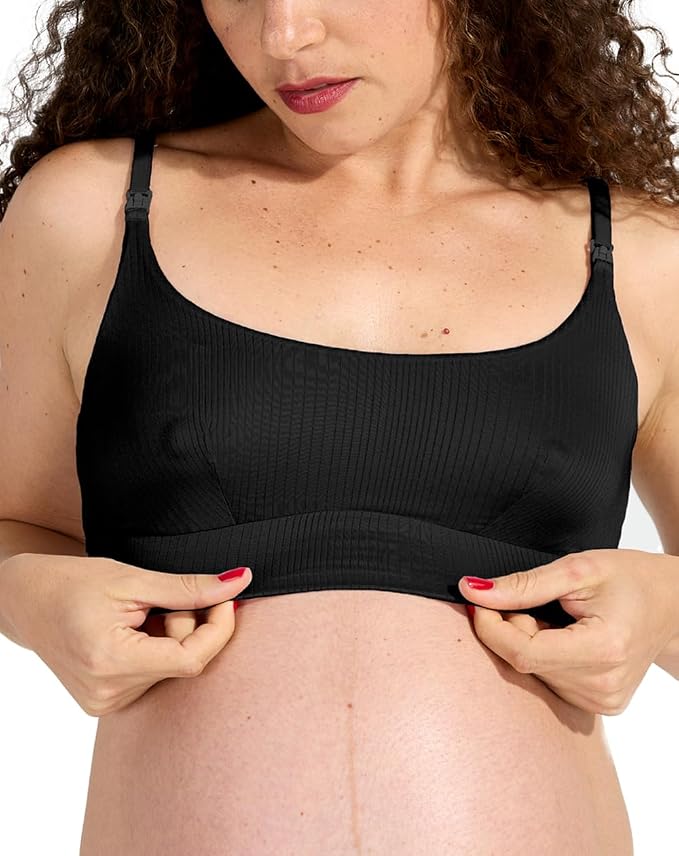
Bodily The Everything Bra
A low-pressure clip-down style designed to work from pregnancy into postpartum and beyond nursing.
Check before buying: This is a comfort-led option, not a high-impact or strongly projected full-bust bra.
View Options on AmazonAffiliate link · Availability and price can change
Bravado Designs Body Silk Seamless Nursing Bra
A wire-free 360-degree stretch design with knit-in support zones and a wide published band-and-cup range.
Check before buying: Use the newest size chart; older listings may show a different range or final-sale colorways.
View Options on AmazonAffiliate link · Availability and price can change
Cake Maternity Cotton Candy Nursing Bra
A seamless wire-free nursing style with flexible knitted support for low-pressure wear.
Check before buying: Treat it as light-to-medium support; fuller busts may prefer a more structured daytime option.
View Options on AmazonAffiliate link · Availability and price can changeKey Takeaways
- Modal and bamboo-blend fabrics offer the best breathability for sensitive postpartum skin — check the actual composition percentage, not just the name on the tag.
- Seam placement matters as much as fiber content; flat or seamless cup edges cut irritation risk significantly.
- Skip fabric softener and stick to fragrance-free detergent and cold water to protect both comfort and moisture-wicking performance.
- A rash that traces a seam or elastic line points to fabric or construction — not general skin sensitivity — as the cause.
The Bottom Line
If you only take one thing from this guide, make it this: check the actual fiber composition before you buy, not just the word printed on the tag, and put your best fabric budget toward whichever bra gets the most consecutive hours against your skin — for most people, that’s the overnight bra. Everything else here — seam placement, washing habits, patch-testing, climate — is worth doing, but that one habit alone will fix the majority of postpartum fabric complaints on its own.
Skin sensitivity during this stretch is temporary for most parents. It tends to settle back toward your pre-pregnancy baseline in the months after weaning, alongside the other tissue changes your body works through during that time. Small, boring habits — reading a label, skipping the fabric softener, giving a new bra a test run before an overnight — add up to a noticeably more comfortable few months than any single “perfect” purchase ever could.
If you’re shopping right now and want the short version: pick a modal or bamboo blend with a percentage composition you can actually verify, confirm the seam sits away from your nipple and areola, check for Oeko-Tex certification if it’s listed, and patch-test before an overnight commitment. Four checks, a few extra minutes at checkout, and a meaningfully lower chance of dealing with irritation on top of everything else the postpartum period already asks of you.
📐 Not sure which size to buy?
Frequently Asked Questions
- What fabric is best for postpartum night sweats?
- Modal and bamboo-blend fabrics handle postpartum night sweats better than nylon-heavy synthetics because their fiber structure wicks moisture away from skin instead of trapping it against you overnight.
- Is it safe to wear lace nursing bras against sensitive skin?
- Lace itself isn’t off-limits, but keep it away from direct nipple or areola contact. Synthetic lace trim in that specific zone is one of the most common irritation triggers on sensitive postpartum skin.
- Does Oeko-Tex certification actually matter for nursing bras?
- It’s a genuinely useful signal. Oeko-Tex Standard 100 confirms the fabric was tested for a defined list of harmful substances, which matters given how much skin and infant contact nursing bra fabric gets.
- Should I patch-test a new nursing bra before wearing it overnight?
- Yes, especially with a history of sensitive skin. Wear it a few hours on a low-stakes day first and check the seam and elastic contact points before committing to a full overnight wear.
- Does climate change which fabric I should prioritize?
- Yes. In hot, humid climates the breathability gap between modal or bamboo blends and standard synthetics becomes far more noticeable, so it’s worth prioritizing breathable fabric more heavily than you might in a cooler climate.
- Are all “modal” or “bamboo” nursing bras equally breathable?
- No. Most are blends with spandex or polyester at varying percentages, so checking the actual composition on the label tells you far more about real breathability than the fabric name printed on the tag.
- Does fabric choice affect how nursing clips and drop-cups perform?
- It can. Some of the most breathable fabrics have less stretch-recovery than the synthetic-heavy blends typically used in nursing-specific clip panels, creating a real trade-off between breathability and long-term mechanism performance.
- What’s the best way to wash nursing bras to protect the fabric?
- Cold water, air-drying when you can, skipping fabric softener, and washing with similarly colored garments all help preserve both breathability and shape over the many, many washes a nursing bra goes through.
- Does this fabric guidance still apply if I have eczema or another diagnosed skin condition?
- Treat it as a starting point, not a complete answer. Diagnosed conditions often come with specific fabric or dye sensitivities, so a quick check with your dermatologist is worth the extra step.
- Could my skin reaction be coming from the bra’s hardware instead of the fabric?
- It’s possible. Hooks, clips and adjusters sometimes contain nickel, which can cause a contact reaction that has nothing to do with the fabric. Nickel-free hardware is worth checking for if you have a known metal sensitivity.
- Should my fabric choice change across the seasons if I nurse for a year or more?
- Yes, it’s reasonable to lean toward warmth and coverage in cooler months and shift toward maximum breathability once the weather turns, rather than sticking with one fabric strategy for the entire nursing period.
Editorial Sources & Review Notes
Health and workplace statements were reviewed against the following primary or public-health sources. Product features can change, so current brand and Amazon listings should be checked before purchase.
This page provides general garment-fit and shopping information, not medical diagnosis or individualized lactation care. Contact a qualified clinician or lactation professional for persistent pain, fever, worsening redness, wound concerns, or pumping problems. As an Amazon Associate, Bra-Calculator.com earns from qualifying purchases.