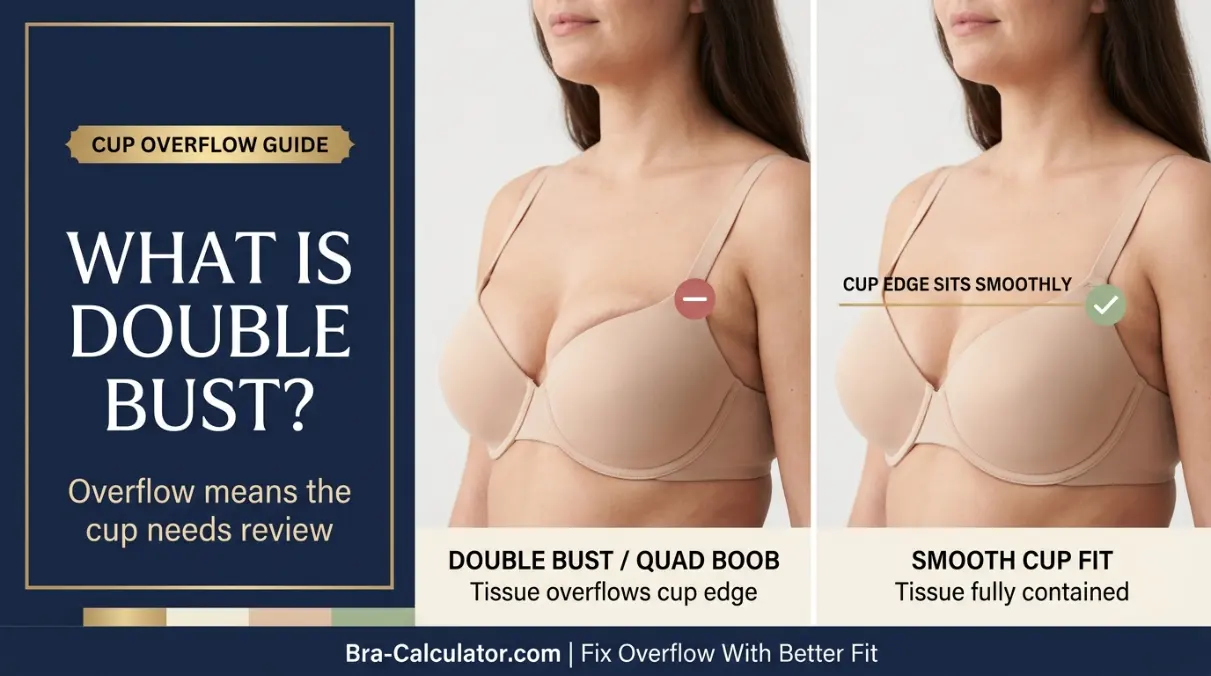
Double bust and quad boob both mean breast tissue is overflowing the bra cup and creating a visible second ridge. The most common cause is a cup that is too small in volume, but a cup that is too shallow, too narrow, or positioned with a neckline that sits below your breast root can create the same effect even at a nominally correct size. Go up one cup size first, scoop all tissue in, check band tightness, and then assess whether the cup shape — not just the volume — needs to change.
Double Bust & Quad Boob at a Glance
| Fit Sign | What It Can Mean |
|---|---|
| Tissue spills over the top cup edge | Cup volume is too small, or the neckline sits below your breast root. |
| A visible second ridge or fold above the cup | Classic double bust — the cup is compressing and redirecting breast tissue upward. |
| Tissue escapes from the side of the cup | Cup frame is too narrow; underwire does not reach your natural breast root at the sides. |
| Overflow plus uncomfortable band | Band may be too tight, pushing tissue up even if the cup volume is closer to correct. |
| Overflow only in certain movements | Cup may be a borderline size; also check if the underwire is seated correctly. |
| Overflow in one cup only | Natural breast asymmetry — the fuller side needs a bigger cup than the smaller side. |
What Does Double Bust Actually Mean?
A correctly fitting bra cup should contain all breast tissue smoothly with no bulging, no ridge pressing against the cup edge and no fabric cutting into the breast. When breast tissue escapes over the top or sides of the cup and creates a second visible mound, this is called the double bust or quad boob effect — because instead of one smooth breast line, you see four bulges or two layers of breast.
Double bust is one of the clearest signs that a bra cup is not the right size or shape for the body wearing it. Unlike cup gaping — where the cup is too large or the wrong shape — double bust almost always points toward insufficient cup volume, a cup that is too shallow for your projection, a neckline that does not reach high enough, or a band that compresses and pushes tissue upward.
Many people try to solve quad boob by pulling straps tighter, choosing a minimiser bra or wearing a smaller band. These approaches can make the problem significantly worse. The correct solution almost always involves increasing cup size, adjusting the cup shape, or switching to a construction that accommodates more volume and projection.
Fit truth: Going up in cup size does not mean your band size changes. You can increase cup volume while keeping the same band by simply moving to the next cup letter. A correctly sized cup is not larger-looking; it is smoother.
Five Checks Before You Apply a Quad Boob Bra Fix
Make these checks while wearing the bra you are evaluating. Double bust has several different causes and the correct fix depends on which one applies to you.
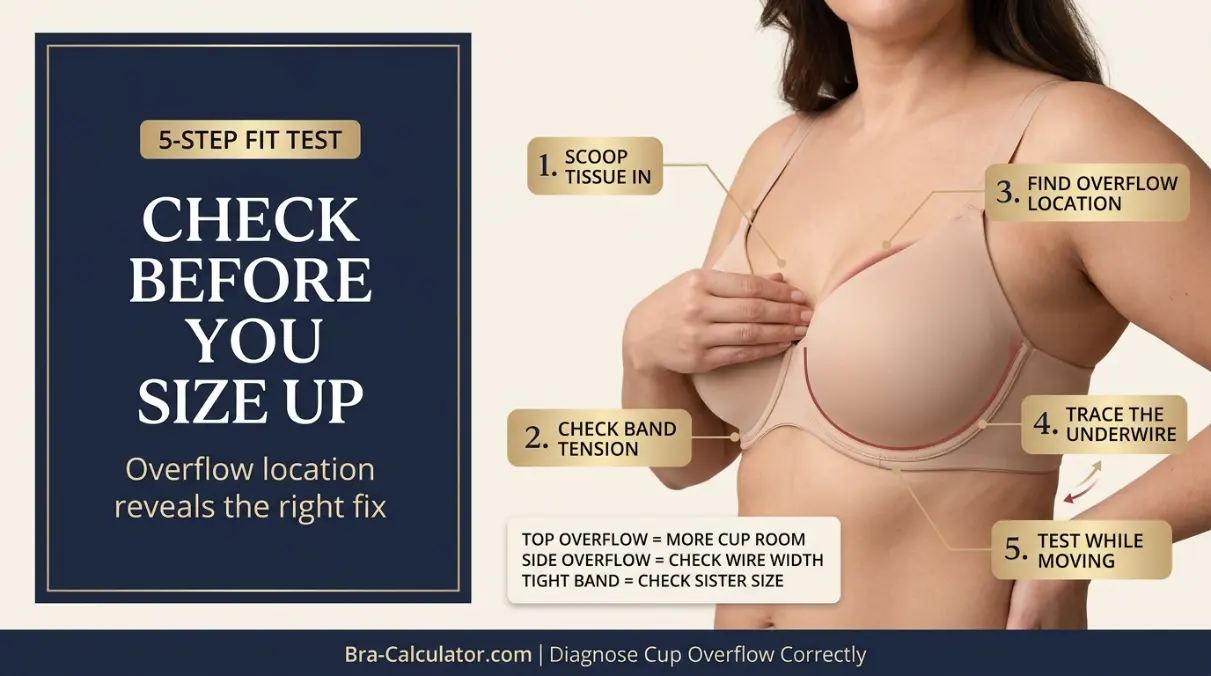
Lean slightly forward, reach into each cup and bring tissue fully forward from the sides and underneath. Some apparent overflow is simply tissue that has not been placed inside the cup. Only judge fit after this step.
Slide two fingers under the band at the back. If you cannot do this comfortably, the band is too tight and is actively pushing breast tissue upward. A too-tight band can create double bust even when the cup itself is not radically too small.
Note whether tissue escapes at the top centre, the top near the strap, the side toward the armpit, or all three areas. Each location points to a different fix: top overflow means cup too small or neckline too low; side overflow means frame too narrow.
The underwire should sit completely flat against your body along the breast root — the natural boundary where your breast meets the chest wall. If the wire sits on breast tissue anywhere, it is too small or too narrow and tissue will be pushed outward.
Raise your arms, sit down and walk. A cup that only overflows during movement is borderline — you may get away with the same size in a style with a higher neckline or better projection, or you may need to move up one cup size.
| Your Test Result | Likely Issue | Best First Change |
|---|---|---|
| Tissue overflows at the top even after scooping | Cup is too small in volume | Go up one cup size on the same band size. |
| Band is very tight and pushes skin | Band is too tight, forcing tissue up | Try the sister size: up one band, down one cup. |
| Tissue escapes at the side near the armpit | Cup frame or underwire too narrow | Look for a wider underwire frame in the same or larger cup. |
| Overflow only near the strap attachment | Neckline may sit too low | Try a fuller-coverage neckline in the same or next cup size. |
| Only one cup overflows | Breast asymmetry | Size to the larger breast; adjust or pad the smaller side. |
Why Your Bra Cups Are Causing Double Bust
1. The Cup Is Simply Too Small
This is the most straightforward cause. When there is more breast volume than the cup can contain, tissue takes the path of least resistance and spills over the edge.
2. The Cup Is Too Shallow
A cup can have technically adequate volume but be shaped too flat or wide for breasts with more forward projection. The cup cannot hold the shape and tissue pushes over the edge despite a nominally correct size label.
3. The Neckline Sits Below Your Breast Root
Every breast has a natural upper boundary where tissue begins. If the cup neckline sits below that point, breast tissue above the neckline is uncontained and will create a visible overflow.
4. The Underwire Frame Is Too Narrow
Underwires that are too narrow do not reach the natural side breast root. Breast tissue on the outer chest is left unsupported and migrates into the armpit or pushes forward, worsening overflow at the cup edge.
5. The Band Is Too Tight
An overly tight band acts like a tourniquet around the torso, compressing the body and forcing breast tissue that would otherwise distribute naturally to push upward and over the cup edge.
6. The Style Has a Plunge That Is Too Deep
A very deep plunge neckline in the centre can leave upper and inner breast tissue without enough support structure. Full-busted wearers in particular may overflow a deep plunge even at the correct cup size.
7. The Bra Is Worn on the Tightest Hook
New bras should always be worn on the loosest hook and fastened tighter as the band stretches over time. If a new bra is worn already on the tightest hook, the band is effectively too small and pushes tissue upward.
Double Bust vs Quad Boob vs Cup Gaping: Not the Same Problem
Understanding which overflow problem you have prevents you from applying the wrong correction. Most importantly, double bust and cup gaping are opposite problems — one cannot be fixed with the other’s solution.
| What You See | What It Often Suggests | Avoid This Mistake |
|---|---|---|
| Second ridge above the cup — classic double bust | Cup volume too small; breast tissue compressed over the edge | Do not tighten straps or wear a minimiser; go up in cup size first. |
| Four distinct bulges — quad boob effect | Cup neckline cuts across the breast, dividing it in two | Do not assume minimising; try a higher neckline or larger cup. |
| Side spillage near the armpit | Underwire frame too narrow; side breast tissue unsupported | Do not only go up in cup volume; check underwire width too. |
| Overflow plus band that digs in | Band is too tight; pushes tissue up independently of cup size | Do not simply go up in cup; also check whether band needs to change. |
| Cup gaping at the top with no overflow | Cup too large or wrong shape — opposite of double bust | Do not use a double bust fix; see the cup gaping guide instead. |
Key rule: Double bust means the cup is too small or too shallow. Cup gaping means the cup is too large or the wrong shape. These are opposites. Applying one fix to the other problem will make both issues worse.
Step-by-Step: How to Fix the Double Boob Bra Problem
Work through these steps in order. Going straight to a new size without checking band and position can lead to buying multiple bras that still do not fit.
Fasten the bra on the loosest secure hook and scoop all breast tissue into each cup. Check whether double bust remains after proper positioning.
You should be able to slide two fingers under the back band without significant effort. If you cannot, the band may be contributing to the overflow. Read the bra band too tight guide before changing cup size.
Keep your current band size and try the next cup letter. Most double bust resolves with one or two cup increases. Do not change band size at the same time or you will be solving two variables at once.
If you have sized up but still overflow near the strap or at the side, the cup neckline may be too low or the frame too narrow. Test a fuller-coverage style or a wider underwire in your new cup size.
A correctly sized cup should contain all breast tissue smoothly in all positions. If overflow only reappears during movement, consider whether the neckline height or wire seat needs fine-tuning.
Why Double Bust Happens on Different Bodies
Double bust is a fit signal, not a judgment about breast size. Body changes at different life stages can cause a previously well-fitting bra to suddenly overflow, even if underbust measurements have not changed dramatically.
Neckline Must Reach High
Breasts that are fuller on top need a cup neckline that reaches the natural upper boundary without cutting across it.
Try full coverageShallow Cups Will Overflow
Breasts that project significantly forward need cup depth, not just volume. Seamed or balconette cups offer more projection room.
Try seamed cupsFrame Width Matters
Side tissue can spill when the underwire does not extend to the natural breast root near the armpit.
Try wider underwireSize Changes Quickly
Breast volume can increase rapidly. A bra that fit well in early pregnancy can cause double bust within weeks as tissue grows.
Remeasure monthlyWhen to Change Cup Size or Try a Sister Size
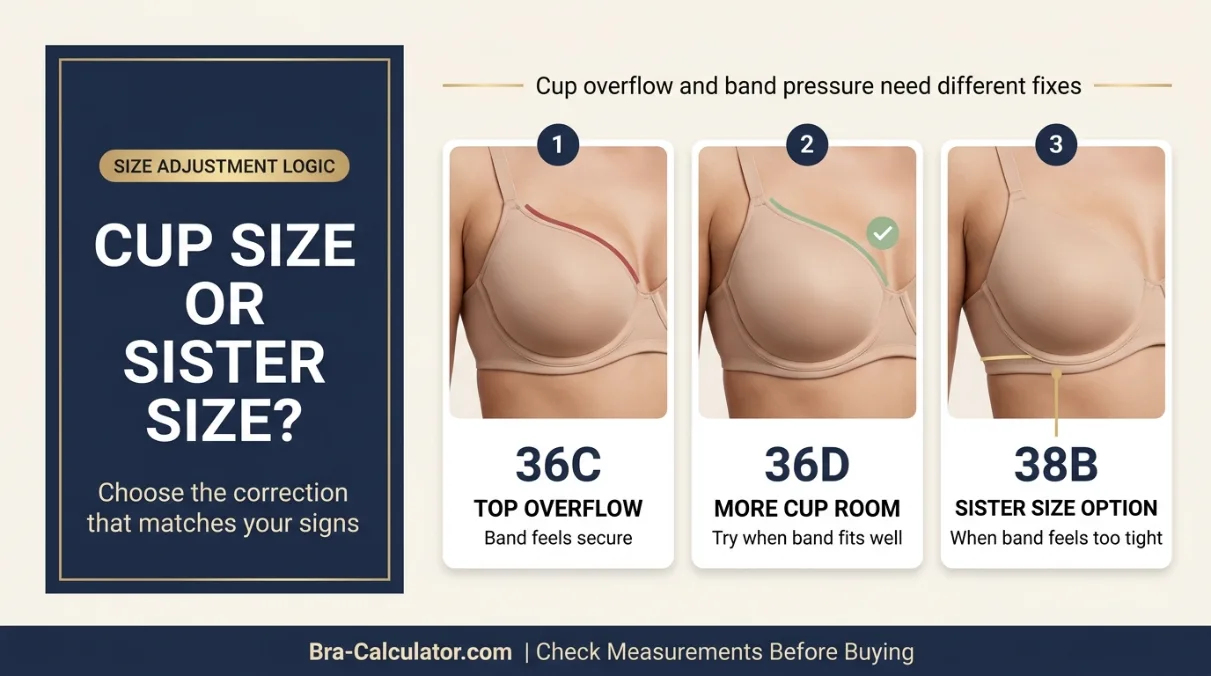
Two different sizing moves address double bust depending on whether the cup is too small or the band is too tight. These are not the same correction.
| Your Fit Signs | Try First | Why |
|---|---|---|
| Overflow; band comfortable and stable | Same band, one cup larger | The cup lacks sufficient volume. |
| Overflow; band very tight and digs in | Up one band, down one cup (sister size) | Band compression is forcing tissue over the cup edge. |
| Overflow only at the side near armpit | Wider underwire in same or next cup size | The frame does not cover the natural breast root. |
| Overflow near strap attachment only | Fuller coverage neckline; same or next cup size | The neckline sits below the upper breast root. |
| Only the fuller breast overflows | Fit to the fuller side; adjust smaller side separately | A smaller overall cup will compress the fuller breast. |
What Should You Fix First?
- Tissue overflows throughout the top edge
- Cup fabric is pressing against breast tissue
- Band fits comfortably and stays level
- Go up one cup size, keep same band
- Repeat scoop-and-swoop after sizing up
- Confirm no cup gaping before stopping
- Already sized up but still have overflow
- Overflow near strap or side only
- Shallow or flat cups compress the breast
- Try seamed or balconette cups for depth
- Look for wider underwire frame
- Test a higher neckline for upper overflow
- Band digs in or is visibly tight at the back
- Cannot slide two fingers under band
- Wearing on the tightest hook in a new bra
- Try sister size: up one band, down one cup
- Fasten new bras on the loosest hook first
- Recheck cup fit after releasing band pressure
- Only one cup overflows consistently
- Other side fits or even has slight gap
- One breast is noticeably fuller
- Size to the larger, fuller breast
- Adjust smaller-side strap gently
- Use removable insert for the smaller side if needed
Bra Styles That Help Stop the Double Bust Effect
A higher neckline that reaches the natural upper breast boundary prevents the most common form of top overflow.
Seam construction allows more precise projection and cup depth than moulded foam, which helps reduce overflow without compressing.
A well-constructed balconette with side boning or side support panels can contain side spillage while lifting the breast within the cup.
Some plunge styles compensate for a lower centre neckline with deep, tall side wings that contain tissue toward the cup.
Flexible nursing cup construction accommodates rapid size changes, preventing double bust as breast volume increases.
A minimiser compresses breast tissue rather than containing it — this can worsen double bust and cause side spillage.
Support Styles to Consider After Solving the Cup Size
Once you have identified the correct cup size through the steps above, these fuller-cup construction types are worth exploring. Always confirm the exact cup size with your measurements and the retailer’s size guide before purchasing.

Full-Coverage Underwire Bras
- Higher neckline reaches the natural upper breast boundary, preventing classic double bust at the top edge.
- Look for styles with a neckline that sits at or above where the breast begins, not below it.
- Confirm the cup size is correct first — a full-coverage bra in a too-small cup will still overflow.

Wide Side-Panel Support Bras
- Deeper side wings and wider underwire frames address spillage near the armpit that standard cups miss.
- Adjustable straps allow each cup to be positioned independently, useful when one breast is fuller.
- Check that the underwire extends fully to the side breast root before purchasing.

Flexible Full-Cup Comfort Bras
- Soft cup construction without rigid foam can accommodate fuller or more projected breasts that overflow moulded cups.
- Good everyday option once the correct cup size has been confirmed through measurement.
- Ensure the cup fully encloses breast tissue with no cut-in at the top or sides during movement.
Problems Often Confused With Double Bust
A gap at the cup edge is the opposite of double bust — it means the cup may be too large or the wrong shape, not too small.
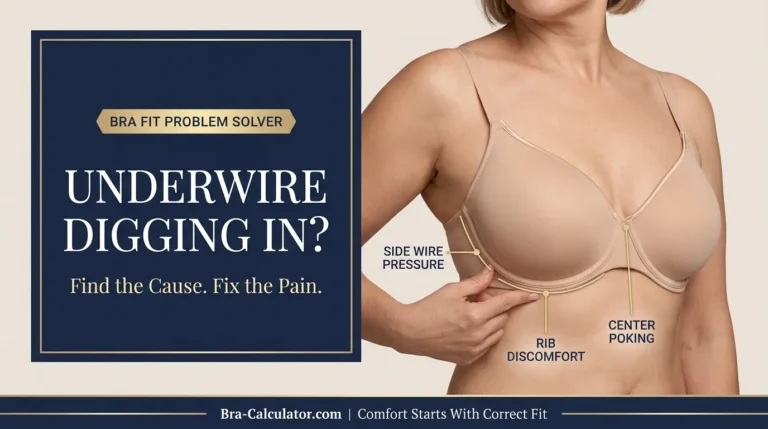
If the underwire digs into breast tissue at the sides or under the breast, the cup is almost certainly too small or the frame too narrow.
Overtightening straps to hold a too-small cup in place can create shoulder groove pressure — a secondary problem caused by the underlying cup size issue.
When the central gore floats away from the body, this can occur alongside double bust when tissue is being pushed toward the centre.
Frequently Asked Questions
What is double bust in a bra?
Double bust, also called the quad boob effect, is when breast tissue spills over the cup edge and creates a visible second ridge or fold above the bra. It is almost always caused by a cup that is too small in volume, too shallow in shape, or positioned with a neckline that sits below your natural breast boundary.
What causes quad boob?
Quad boob is caused by a bra cup that cuts across breast tissue instead of containing it smoothly. The cup may be too small overall, too shallow for your projection, too narrow at the sides, or the neckline may sit below the upper breast root. A too-tight band can also push tissue upward and create or worsen the effect.
How do I fix double bust in a bra?
Start by scooping all breast tissue fully into the cups, then check band tightness. If overflow remains, go up one cup size while keeping the same band size. If the problem persists, test a fuller-coverage neckline or a deeper, more projected cup shape in your new size.
Is quad boob always a sign the cup is too small?
Almost always yes in terms of cup volume or cup depth. A cup that is technically similar in volume but shaped too shallow or too narrow can create the same effect. Both the volume and the shape of the cup must match your breast to prevent overflow.
What is the difference between double bust and bra cup gaping?
They are opposite problems. Double bust means the cup is too small and tissue is overflowing. Cup gaping means part of the cup is not touching the body, suggesting the cup may be too large or the wrong shape. The fixes are also opposite — applying one to the other will worsen both problems.
Can a full-coverage bra fix quad boob?
A full-coverage bra can help when quad boob is caused by a neckline that sits too low. However, the cup must still be the correct size. A full-coverage bra in a cup that is still too small will still produce overflow, simply in a different location.
Does a too-tight band cause double bust?
Yes. A band that is too tight compresses the torso and pushes breast tissue upward toward the cup edge. When this is the cause, using a sister size — up one band, down one cup — often reduces overflow more effectively than going up in cup size alone.
Which bra styles help with double bust or quad boob?
Full-coverage bras, seamed fuller-cup bras, balconette styles with side support, and bras with wider underwire frames are the most commonly recommended styles. Brands such as Freya, Fantasie, Panache, Elomi and Curvy Kate are frequently recommended for fuller-cup fit with proper projection and coverage.
Fix Double Bust by Finding Your Real Size
A smooth cup starts with the right cup size and the right cup shape. Use the free calculator to check your measurements, then apply the symptom guide above to choose a style that contains every last bit of breast tissue comfortably.