Breast Weight & Volume Calculator
Estimate your breast weight and volume using your bra size or direct measurements. Switch tabs to explore all three modes.
Estimate by Bra Size
Breast Weight by Cup Size Chart
All estimates assume a mid-range band size (34–36) and average tissue density. Actual weight varies.
| Cup | Per breast (g) | Per breast (kg) | Per breast (lbs) | Both (lbs) |
|---|---|---|---|---|
| A | 140–180 g | 0.14–0.18 kg | 0.31–0.40 lb | 0.6–0.8 lb |
| B | 200–280 g | 0.20–0.28 kg | 0.44–0.62 lb | 0.9–1.2 lb |
| C | 300–400 g | 0.30–0.40 kg | 0.66–0.88 lb | 1.3–1.8 lb |
| D | 400–550 g | 0.40–0.55 kg | 0.88–1.21 lb | 1.8–2.4 lb |
| DD / E | 550–680 g | 0.55–0.68 kg | 1.21–1.50 lb | 2.4–3.0 lb |
| DDD / F | 680–820 g | 0.68–0.82 kg | 1.50–1.81 lb | 3.0–3.6 lb |
| G | 820–1,000 g | 0.82–1.00 kg | 1.81–2.20 lb | 3.6–4.4 lb |
| H | 1,000–1,200 g | 1.00–1.20 kg | 2.20–2.65 lb | 4.4–5.3 lb |
| I | 1,200–1,450 g | 1.20–1.45 kg | 2.65–3.20 lb | 5.3–6.4 lb |
| J | 1,450–1,700 g | 1.45–1.70 kg | 3.20–3.75 lb | 6.4–7.5 lb |
| K | 1,700–2,000 g | 1.70–2.00 kg | 3.75–4.41 lb | 7.5–8.8 lb |
| L | 2,000–2,350 g | 2.00–2.35 kg | 4.41–5.18 lb | 8.8–10.4 lb |
| M | 2,350–2,700 g | 2.35–2.70 kg | 5.18–5.95 lb | 10.4–11.9 lb |
| N | 2,700–3,100 g | 2.70–3.10 kg | 5.95–6.83 lb | 11.9–13.7 lb |
| O | 3,100–3,500 g | 3.10–3.50 kg | 6.83–7.72 lb | 13.7–15.4 lb |
| P | 3,500–4,000 g | 3.50–4.00 kg | 7.72–8.82 lb | 15.4–17.6 lb |
Estimate by Measurements
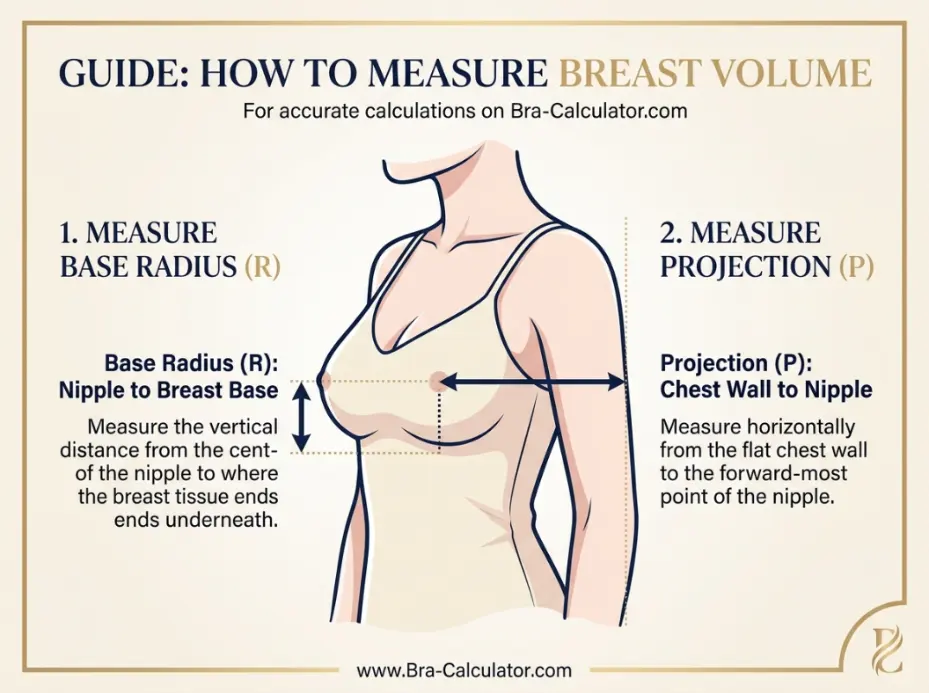
R = base radius: measure from the nipple horizontally to where the breast meets the chest wall.
h = projection: measure straight out from the chest wall to the nipple tip.
Breast Reduction Weight Estimate
Select your current size and your desired size after reduction to see the estimated tissue removed.
Estimated Tissue Removal
Estimate breast weight by bra size or direct measurements, then learn what the number means for comfort, posture, sports support, shoulder pressure, and bra choice. This page is built for real-life support decisions — not body judgement, not fear, and not medical guessing.
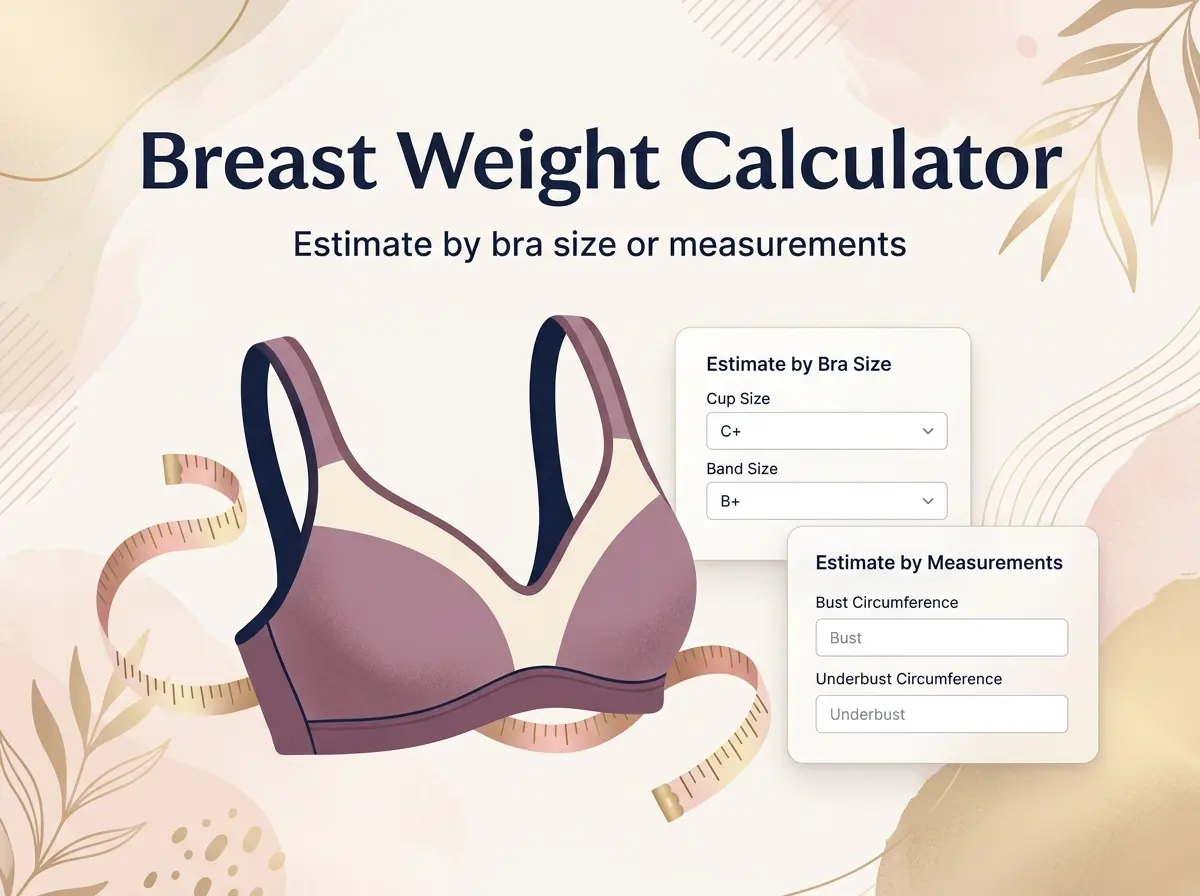
On average, one breast weighs between 0.5 lbs (230 g, or about 0.14–0.18 kg) for an A cup and 2–3 lbs (900–1,400 g, or about 0.9–1.4 kg) for a G–H cup. Both breasts together typically weigh 1–4 lbs for the most common cup sizes, though heavier cups can exceed 5–6 lbs combined. Average breast weight varies significantly by band size, tissue density, and breast shape — use the calculator above for a personalised estimate of how much your breasts weigh, whether you searched “how much do my breasts weigh” or “how much do my boobs weigh.”
A breast weight calculator gives an estimated weight for one breast and both breasts together, in grams, kilograms, and pounds. It can use your bra size for a quick result — including specific combinations like 34DD, 36D, or 32DDD — or it can use measurements such as breast base radius and projection for a more personalised volume-based estimate. The result is useful because breast weight affects how much support your bra needs to provide — heavier or more projected breasts often need a firmer band, wider straps, deeper cups, and better bounce control during movement.
Looking for your bra size rather than your weight? Use the main bra size calculator instead — this page is specifically for estimating breast weight and volume once you already know (or want to compare) a size.
A good calculator should not rely on cup letter alone. Cup size changes with band size, and breast shape can change how volume sits on the chest. That is why this page explains two methods: a simple bra-size method and an advanced measurement method.
In simple mode, you select your band size and cup size. The calculator converts the cup letter into an approximate volume category and adjusts that estimate with band size. This is the fastest option when you want a quick idea of breast weight without measuring projection.
- Best for: quick curiosity, support planning, and comparing general cup ranges.
- Limit: it cannot fully account for tissue density, breast width, projection, or asymmetry.
In advanced mode, you measure the breast base radius and projection from the chest wall. The calculator uses a spherical-cap style volume estimate, then converts that volume into approximate weight.
Volume ≈ πh²(3R − h) ÷ 3- R: breast base radius measurement.
- h: breast projection from chest wall to nipple point.
- Best for: a more personal estimate, especially if left and right breasts are different.
For the most accurate at-home estimate, measure each breast separately. Many people have natural asymmetry, so the left and right side may not return the same number. That is normal and expected.
- Use a soft tape measure and keep the tape relaxed, not tight.
- Measure base radius from the nipple area outward to where the breast base meets the chest.
- Measure projection from the chest wall to the nipple point while standing naturally.
- Do not press, lift, squeeze, or pull the tissue while measuring.
How to weigh your breasts without a scale: there’s no bathroom scale accurate enough to weigh breast tissue directly, since you can’t isolate it from the rest of your body weight. The two practical ways to estimate breast weight are the ones built into the calculator above: enter your bra size for a fast estimate, or take the base radius and projection measurements above for a more precise, volume-based result using the same math a lab would use for a water-displacement estimate.
Breast weight can influence how a bra feels after several hours. A bra may look fine in the mirror but still fail during walking, bending, working, driving, nursing, or exercising. The most common problem is that the straps start doing the job that the band should be doing. When that happens, shoulders can feel sore, the neck can feel tense, and the upper back can feel tired.
The band should carry most of the weight. If it rides up, the bra may be too loose or too stretched out.
Cups that are too shallow can push tissue forward, sideways, or downward, making weight feel less controlled.
Wider straps can improve comfort, but straps should fine-tune lift — they should not carry the full load.
Your result becomes useful when you connect it to daily symptoms. A lighter estimate does not automatically mean you need minimal support, and a heavier estimate does not automatically mean you need compression all day. The better question is: what does your body need during your normal routine?
| Your result or feeling | What it may suggest | Best next step |
|---|---|---|
| Breasts feel heavy by afternoon | Band may not be firm enough or cup shape may not lift from below | Check band fit, try stronger side support, and review how to know if your bra fits |
| Shoulders carry pressure | Straps may be compensating for weak band support | Try a firmer band, wider straps, and posture-support styles |
| Bounce during walking or workouts | Everyday bra may not be enough for movement | Use the sports bra calculator or read how to choose a sports bra |
| Clothes pull at the bust | Projection may be high or cup shape may push tissue forward | Consider full-coverage or minimizer bras for large busts |
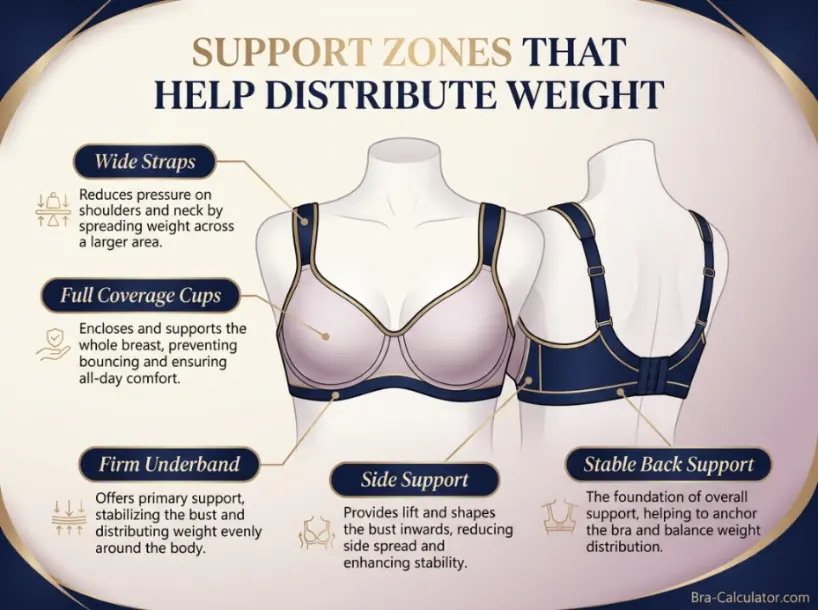
A supportive bra does not actually reduce breast weight, but it can make the weight feel better distributed. The best fit usually combines a stable band, cup depth that matches projection, straps that do not dig, and enough coverage for your activity level.
- Firm underband: stops the bra from sliding and carries support from below.
- Full cups: reduce spilling and help distribute tissue more evenly.
- Wide straps: reduce focused pressure on the shoulders.
- Stable back: improves balance and reduces twisting or rolling.
These ranges are educational estimates based on average tissue density and mid-range band sizes (34–36). Cup letters do not have one fixed weight because cup volume changes with band size — a 32G and a 42G are not the same breast weight. Tissue density, breast width, and projection also change the result. For a personalised answer, use the breast weight calculator above.
| Cup range | Common support need | Useful Bra-Calculator guide |
|---|---|---|
| A–B | Light support, shape comfort, low-impact movement | Bra Size Chart |
| C–D | Everyday support, stable band, better cup depth | Bra Cup Size Measurement Guide |
| DD–G | Wide straps, stronger band, full coverage, sports support | Best Bras for Large Bust |
| H+ | Full-bust brands, professional fitting, firm support system | Bra Fit Problems Guide |
Use the calculator first, then match your result with the support products and fit guides below.
These four product cards are matched to the real intent of this page: bounce control, shoulder relief, wire-free comfort, and smoother full-bust shaping. They are not random “pretty bra” picks; each card has a clear support job.
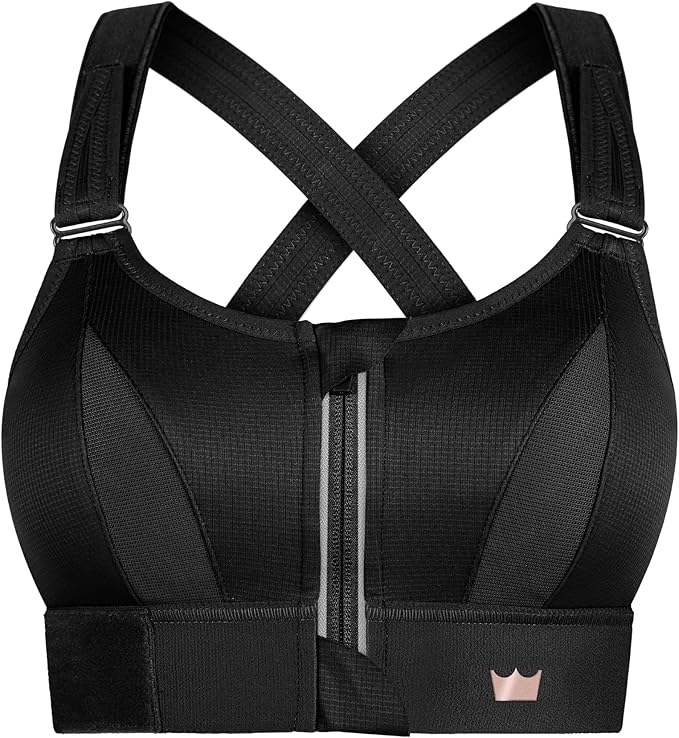
A strong option when breast weight feels hard to control during running, gym sessions, or high-movement days.
- Adjustable band and straps
- High support for bounce control
- Better for workouts than lounging

Useful when breast weight shows up as shoulder pressure, posture fatigue, or a need for easier front closure.
- Posture-back support feel
- Wide strap comfort
- Good for everyday full-bust support

A full-bust sports option for readers who need cup separation plus firm movement control instead of simple compression.
- Encapsulation-style support
- Good for larger cup movement control
- Best when underwire sports bras fit you well

Helpful when breast weight affects clothing fit, button gaps, or front projection under fitted tops.
- Smoother full-figure shaping
- Minimizer style for projection control
- Better for daily wear than workouts
Affiliate disclosure: As an Amazon Associate, Bra-Calculator.com earns from qualifying purchases. Product images, size range, prices, and availability can change. Replace image URLs with Amazon SiteStripe or approved hosted images before final publishing.
After checking estimated breast weight, the next smart step is to confirm size, support level, and style. These internal links help users move deeper into the site instead of leaving after one calculator result.
| Main problem | Best style to test first | What to avoid |
|---|---|---|
| Breasts feel heavy while walking | Full-coverage everyday bra with firm band and wide straps | Stretchy bralettes with weak underband support |
| Bounce during workouts | High-impact sports bra or encapsulation sports bra | Low-impact bras, fashion crops, loose compression tops |
| Shoulder dents or strap marks | Firmer band, posture-back style, wide cushioned straps | Tightening straps to fix a loose band |
| Outfits pull forward | Minimizer, side-support bra, or deeper full-coverage cup | Small cups that flatten tissue unevenly |
| Underwire pain | Check wire width and cup depth; try wireless support if needed | Assuming all underwire is bad when the size may be wrong |
Jump back to the tool, compare both calculator modes, then use the FAQ answers for support and fit decisions.
How much does the average breast weigh?
The average breast weighs approximately 0.5–1.5 lbs (230–680 g) per breast for the most common cup sizes (B–D), putting the average combined breast weight at roughly 1–3 lbs (450–1,360 g) for both breasts together. For larger cups (DD–G), a single breast typically weighs 1.2–2.2 lbs (550–1,000 g). These are population estimates — actual breast weight depends on band size, cup size, tissue density, breast width, projection, body composition, and hormonal stage. Use the breast weight calculator above for a personalised range.
Can breast weight cause back, neck, or shoulder pain?
Breast weight can contribute to discomfort when support is poor, the band is loose, or straps carry too much pressure. If pain is persistent, one-sided, sudden, or severe, speak with a healthcare professional.
Is cup size enough to calculate breast weight?
Cup size alone is not enough because cup volume changes with band size. A 34G and a 40G are not the same volume. A better estimate considers band size, cup size, projection, and tissue density.
Why do my breasts feel heavier at certain times?
Breasts may feel heavier before a period, during pregnancy, while breastfeeding, after weight changes, or during hormonal shifts. Tenderness and swelling can also change how support feels.
Can losing weight reduce breast weight?
It can, especially when breasts contain a higher proportion of fatty tissue. Results vary because breast size is also affected by glandular tissue, genetics, hormones, and skin elasticity.
How much do DD, D, C, and other cup sizes weigh?
Using average tissue density at a mid-range band size (34–36): C cup breasts weigh approximately 0.66–0.88 lbs (300–400 g, or 0.30–0.40 kg) each, or 1.3–1.8 lbs combined. D cup breasts weigh approximately 0.88–1.21 lbs (400–550 g, or 0.40–0.55 kg) each, or 1.8–2.4 lbs combined. DD/E cup breasts weigh approximately 1.21–1.50 lbs (550–680 g, or 0.55–0.68 kg) each, or 2.4–3.0 lbs combined. DDD/F cup breasts weigh roughly 1.50–1.81 lbs (680–820 g, or 0.68–0.82 kg) each. G cup breasts weigh approximately 1.81–2.20 lbs (820–1,000 g, or 0.82–1.00 kg) each, and H cup breasts weigh approximately 2.20–2.65 lbs (1,000–1,200 g, or 1.00–1.20 kg) each. These estimates increase with band size — a 40DD weighs noticeably more than a 32DD, since cup letter alone doesn’t fix the volume. Use the breast weight calculator above to get a more accurate estimate for your specific band and cup size, including exact combinations like 34DD, 36D, or 32DDD.
How much does a bra itself weigh, separate from breast weight?
A typical everyday bra weighs roughly 80–150 grams on its own, depending on style — lightweight wire-free t-shirt bras sit near the lower end, while full-coverage or underwire styles with more fabric and structure sit closer to 150 g. This is separate from breast tissue weight, which is what this calculator estimates. If you’re weighing yourself with and without a bra to work out breast weight by subtraction, keep in mind the bra’s own weight will affect the result.
How much tissue is typically removed in a breast reduction?
The amount varies by starting size and target size, which is exactly what the Reduction Estimate tab above calculates for your specific before-and-after sizes. As a general reference point, insurance criteria may consider estimated tissue removal along with symptoms, documentation, and plan-specific rules. Requirements vary by insurer and country. Always confirm exact criteria with your surgeon and insurance provider — this calculator gives an educational estimate only, not a surgical or medical plan.
Can this calculator estimate what size or weight breasts might be for a different body?
This calculator is built around a bra size or physical measurements you already have (or want to compare), rather than predicting future breast development for a different body or life stage. It can still be useful for general comparison — for example, seeing what a given cup size weighs in kg or lbs. For questions tied to medical situations, including hormone therapy or surgical planning, a doctor or endocrinologist can give guidance specific to your body.
Should I buy a bra based only on breast weight?
No. Breast weight helps explain support needs, but bra choice should also consider band fit, cup fit, wire width, strap comfort, breast shape, activity level, and how the bra feels after movement.

Amelia reviews Bra-Calculator.com sizing and fit content with a practical focus on measurement methods, sister sizing, support needs, and real-world bra fit. Read her bio and credentials →
Breast weight is useful because it turns a vague feeling — heaviness, bounce, strap pressure, or back strain — into something easier to understand. Once you know the estimate, you can choose support more intelligently: firmer band, wider straps, deeper cups, sports support, minimizer shaping, or a different size altogether.
The best result is not the smallest number. The best result is a bra that supports your body well enough that you stop thinking about the weight during the day.