Best Wireless Nursing Bras for Large Busts: What Actually Creates Support
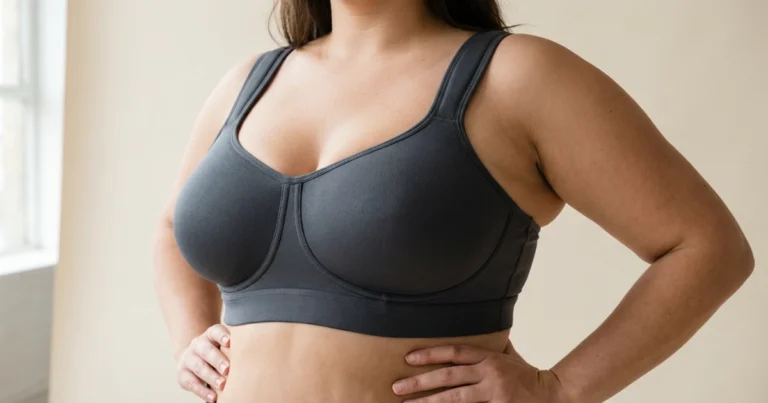
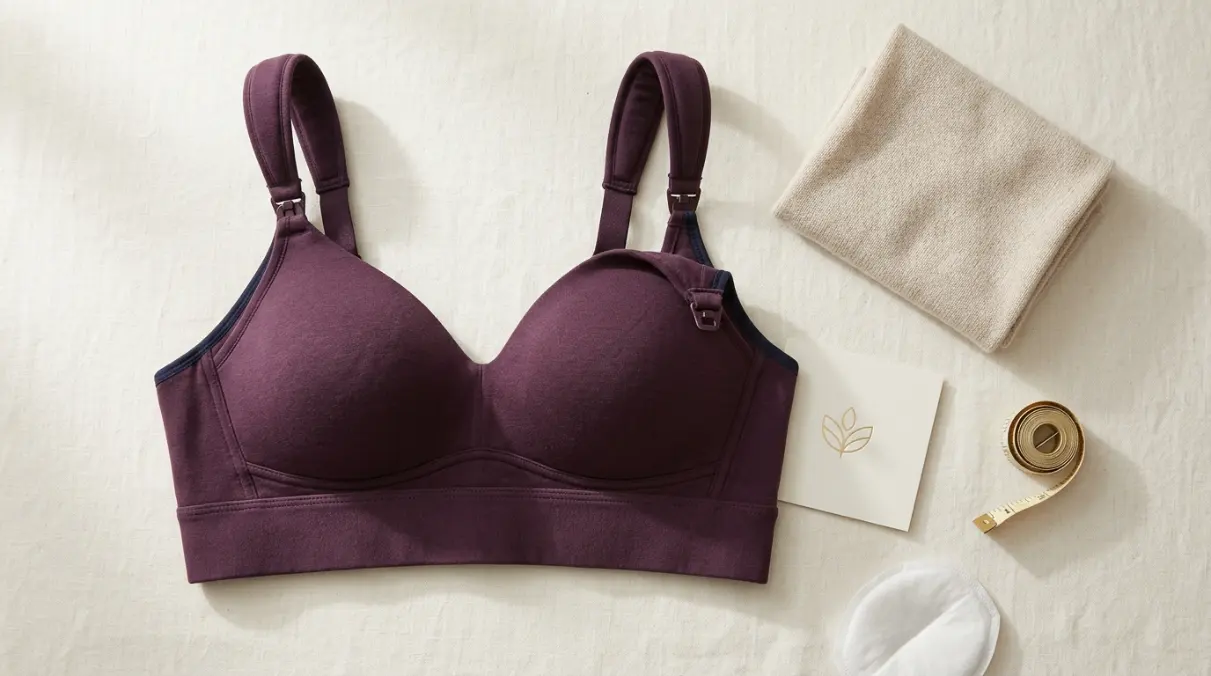
A fuller bust does not automatically need a wire, but it does need structure somewhere. In a good wireless nursing bra, that structure usually comes from the band, cup depth, side containment, internal support zones and strap placement working together—not from simply making a soft bralette bigger.

Bra-Calculator.com fit editor. This update focuses on fit mechanics, current fuller-bust product ranges and practical nursing access rather than treating one cup letter or one construction feature as a universal rule.
In this guide
- How wireless support actually works
- Support features compared
- What to prioritize for a fuller bust
- 60-second at-home fit check
- Cup depth vs cup letter
- Why straps should not do all the work
- Nursing access under load
- Current product examples
- Which construction solves which problem?
- Postpartum size changes
- Common buying mistakes
- FAQs
A Support System, Not a Single “Support Feature”
A fuller bust needs more than a generous cup. A bra can have wide straps and still feel unstable if the band is too stretchy. It can have molded cups and still push breast tissue sideways if the cups are too shallow. And a very firm band can become uncomfortable if the cup is stealing space from it.
Think of the bra as a system. The band anchors around the torso. The cup controls depth and shape. The side wing manages lateral movement. The straps fine-tune cup position. In a nursing bra, the access mechanism then has to open without destroying that support system.
Band = the anchor
A stable band reduces how much vertical load the straps have to manage. It should feel secure on the loosest comfortable hook when new, while still allowing normal breathing and movement.
Cup = depth + containment
Fuller busts often need more forward depth or carefully shaped volume. A cup that is too shallow can create spillage, flattening or downward pressure even when the label looks correct.
Wing = side control
Power mesh, firm knit or reinforced side zones can reduce rolling and keep the cup connected to a stable back band. Side boning is one option, not a universal requirement.
Straps = positioning
Wider or cushioned straps can improve comfort, but tightening them harder is not a substitute for a supportive band and correctly shaped cups.
What Changes as Support Demands Increase?

The chart is best read as a construction comparison, not a rigid rule that every larger cup needs every feature. Two people wearing the same cup letter can have different breast shape, root width, torso size and firmness. That is why cup letter alone is a poor shortcut for support needs.
What to Prioritize in Wireless Nursing Bras for a Large Bust
| Feature | Why it helps | What can go wrong |
|---|---|---|
| Firm multi-hook band | Creates a stable anchor and gives adjustment as the bra stretches or your ribcage changes. | An overly stretchy band shifts upward; an excessively tight one may distort cups or feel painful. |
| Adequate lower-cup depth | Lets the breast sit into the cup instead of pushing the bra downward or outward. | A shallow cup can mimic a too-small size even when the nominal cup letter is familiar. |
| Internal sling / structured knit | Helps lift and separate while allowing nursing access. | A weak inner layer can fold or lose position when the outer cup opens. |
| Supportive side wing | Helps connect the cup to the back band and controls lateral movement. | Very soft wings may roll; overly tall wings can rub the underarm. |
| Adjustable straps | Fine-tune cup height and accommodate different torso lengths. | Straps tightened to compensate for a loose band can cause shoulder discomfort. |
| Stretch with recovery | Accommodates fullness changes while returning toward its original shape. | Stretch without recovery can turn a supportive new bra into a loose one quickly. |
A 60-Second At-Home Fit Check for Fuller Busts
Settle your breast tissue fully into the cups, fasten the bra, then move. Repeat this later if your fullness changes noticeably between feeds.
Then look at your shoulders. Light strap impressions can happen with many bras, but deep pressure combined with a rising back band is a useful clue that the straps are carrying too much because the foundation is not doing enough.
Cup Depth Matters More Than “Just Go Up a Cup”
A common fuller-bust fitting mistake is to treat every spill or pressure point as a request for a bigger cup letter. Sometimes that is correct. Sometimes the cup is simply too shallow for your shape. Increasing volume in the same shallow pattern can produce a bigger cup that still fits poorly.
Look at where the pressure occurs. If the lower cup is pushed away from the ribcage or folds underneath the breast, the bra may lack lower-cup depth. If tissue escapes at the sides while the center looks empty, the cup may be too narrow or deep in the wrong place. If the neckline cuts in only when you are fuller before a feed, you may need more fluctuation room rather than a permanently larger everyday size.
Why Wider Straps Help—but Should Not Do All the Work
Wider or cushioned straps spread pressure across more surface area, which many fuller-bust shoppers find more comfortable. But strap width is not proof of support by itself. If you need to shorten straps aggressively just to lift the bust, check the band and cup first.
Some current fuller-bust designs even change strap construction in their larger size groups rather than putting exactly the same strap on every size. That kind of size-specific engineering is more meaningful than simply advertising “wide straps” across the whole range.
Nursing Access Has to Work Under Real Tension
On a fuller bust, nursing access is not just about whether the clip opens with one hand. The cup also has to stay organized after it opens. Look for an inner sling or support layer that keeps the strap connected to the band while the outer cup drops. Otherwise the whole side of the bra can lose position.
For pumping bras, double-layer systems add another consideration: flange openings need to hold equipment securely without creating localized pressure that becomes uncomfortable during a longer session. A pumping feature is valuable only if the underlying bra still fits.
Current Fuller-Bust Nursing Market: What the Size Charts Actually Show
The fuller-bust nursing market is broader than a simple “standard bras stop at DDD” rule suggests. Current brands reach larger cup ranges through conventional band-and-cup sizing, alpha Busty/Super Busty groups, and engineered stretch ranges.
Best Current Product Examples for This Fit Goal
All five original product image URLs are preserved. The editorial positioning is updated where the live product information differs from the old draft. Most importantly, Hotmilk Temptation is currently a Flexiwire bra, so it is included as a fuller-bust comparison rather than mislabeled as a wireless pick.

Cake Maternity Popping Candy Busty Maternity & Nursing Bra
A seamless wire-free fuller-bust nursing design using heat-moulded cups, ribbed support zones and internal slings. Current Cake product information positions it specifically for fuller cups.
- Strong point: engineered inner slings and double-layer support.
- Fit style: alpha-size mapping across fuller cup ranges.
- Watch for: use Cake’s current chart rather than converting loosely from another brand.

Kindred Bravely Sublime Hands-Free Pumping & Nursing Bra
A wireless double-layer design for pumping and nursing with adjustable straps, removable padding, hook-and-eye closure and an included extender. Current fit groups are Regular B–D, Busty E–H and Super Busty I–K.
- Strong point: one bra handles clip-down nursing and standard pump flanges.
- Fuller-bust detail: selected larger Busty sizes use wider cushioned straps.
- Watch for: alpha sizing spans many bra sizes, so use current measurements.

Panache Sophie Nursing Bra
A non-wired, cup-sized nursing bra from a full-bust specialist. Current specialist-retailer listings show traditional band/cup sizing extending into UK J.
- Strong point: more precise band-and-cup selection than broad alpha groups.
- Best for: shoppers who prefer seamed cup shaping.
- Watch for: stock varies significantly by band/cup combination.

Bravado Designs Body Silk Seamless Nursing Bra
A seamless wire-free nursing bra with 360° stretch, knit-in support zones, molded cups and removable inserts. Bravado’s current fit options include Standard, Full Cup and Extended Cup groups.
- Current range: Bravado states 30–50 bands and B–K cups overall, depending on fit group.
- Best for: shoppers prioritizing softness and stretch through fullness changes.
- Watch for: use the newest Bravado chart because older retailer listings can show prior sizing.
Which Construction Solves Which Support Problem?
Do Molded Cups Support a Large Bust Better?
Sometimes—but not automatically. Heat-moulded or lightly molded cups can provide a smooth silhouette and help a stretchy bra maintain shape. Seamed, non-padded cups can take a different route by using panel shaping and supportive wings. Both approaches can work when the cup shape matches the wearer.
The better question is whether the cup maintains its shape under your breast volume, gives enough lower depth, and returns to position after nursing. A technically molded cup that is too shallow can be less supportive than a well-cut seamed cup.
Postpartum Size Changes: Build in Adjustability, Not Guesswork
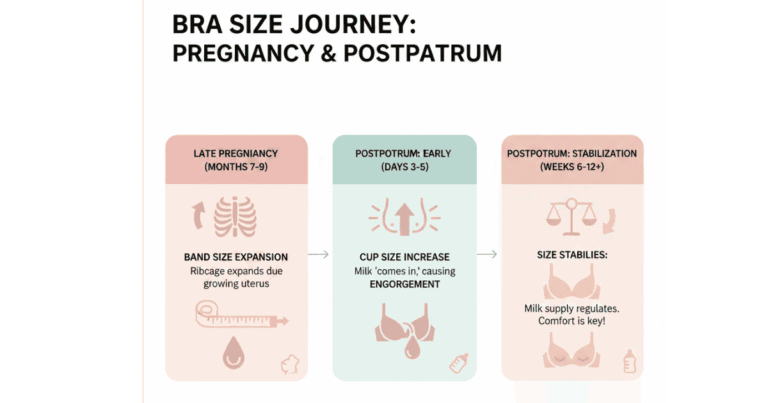
Breast fullness and ribcage measurements can change during pregnancy, after birth and as feeding patterns settle. This is why many nursing bras use longer hook-and-eye columns, stretch-recovery fabrics, extenders or grouped sizing.
An extender can help when a new band feels temporarily snug, but remember what it cannot do: an extender cannot fix a band that is already too loose. If your back band rides up on the tightest useful hook, the starting band size or construction is the problem.
Need a fresh starting size?
Common Buying Mistakes for Fuller-Bust Nursing Bras
Buying by cup letter alone. A 36G and a 40G do not have the same volume, and UK/US/EU cup labels do not map identically. Always check the specific brand chart.
Using the straps to manufacture lift. If pulling the straps tighter is the only way to feel supported, check band stability and cup shape before accepting shoulder pressure as inevitable.
Assuming every “Busty” alpha size is equivalent. Kindred Bravely, Cake and Bravado map grouped sizes differently. A label like L Busty is not a universal bra size.
Assuming every full-bust nursing bra is wireless. Some highly supportive nursing models—including the current Hotmilk Temptation—use flexible wire. Read the exact construction rather than shopping only from the category thumbnail.
Expecting one bra to handle sleep, everyday wear, pumping and high-impact exercise equally well. A comfortable daily nursing bra may not provide the motion control needed for exercise. Activity-specific support is a separate fit goal.
What About Underwire While Breastfeeding?
This page focuses on wireless choices because many readers prefer them for softness and flexibility. It is too broad, however, to say every breastfeeding person must avoid all underwire or wait a fixed number of weeks before wearing one. The practical concern is fit and pressure: any bra—wired or wireless—that creates persistent painful compression, pinching or localized pressure should be reassessed.
If you have ongoing breast pain, redness, fever, wounds, recurrent blocked-area symptoms, or feeding/pumping concerns, seek qualified medical or lactation support rather than trying to solve the problem only through bra changes.
Key Takeaways
- Wireless support comes from a system: band anchoring, cup depth, side containment, straps and nursing-access engineering.
- Molded is not automatically better. Structured knit and seamed non-wired cups can support fuller busts too.
- Do not use a single cup-size cutoff. Current nursing brands cover fuller cups through several different sizing systems.
- Band movement is a high-value clue. If the back rides up while straps dig, cup sizing alone is unlikely to fix the problem.
Frequently Asked Questions
Can a wireless nursing bra really support a large bust?
What is the single most important feature for a fuller bust?
Are molded cups best for a large bust?
Should breastfeeding parents avoid underwire?
Which current wireless nursing bras cover fuller cups?
Why do my straps hurt even though they are wide?
Do I need a different bra for postpartum exercise?
Editorial Sources & Product Verification
- Cake Maternity — Popping Candy Busty Maternity & Nursing Bra
- Kindred Bravely — Sublime Hands-Free Pumping & Nursing Bra
- Bravissimo — Panache Sophie Nursing Bra current listing
- Bravado Designs — Body Silk Seamless Nursing Bra
- Academy of Breastfeeding Medicine — Clinical Protocol #36
- NHS — Breast pain and breastfeeding
This page provides general garment-fit and shopping information, not medical diagnosis or individualized lactation care. Seek qualified medical or lactation support for persistent pain, fever, worsening redness, wounds, or feeding/pumping concerns. As an Amazon Associate, Bra-Calculator.com earns from qualifying purchases.
Editorial and product verification update: September 7, 2026. Product sizes, features, sellers and availability can change after publication.