How to Measure Your Bra Size at Home for a Fuller Bust: A Plus-Size Guide That Actually Fits
- Measure twice, in a mirror, with a soft tape that stays level all the way around.
- The underbust is a snug ribcage measurement, taken while you exhale, not a measurement of soft tissue.
- Take the bust standing and leaning forward, and use the difference between them as a clue to try two cup sizes.
- Calculators and brands use different methods, so treat your size as a starting point and confirm with a try-on.
- A fuller bust usually needs a wide band, several hooks, firm or encased cups and padded straps.
Before you pick up the tape
A fuller bust makes small measuring mistakes costly. When the difference between your bust and underbust is large, an error of one inch can mean the wrong cup by a whole letter. Most of those errors come from setup, not from the tape itself, so a few minutes of preparation pay off.
- Use the right tape. A soft, flexible tape with inches and centimeters. A stiff metal tape will not follow your body.
- Wear a thin, unpadded bra or none. A padded or lined bra adds volume to the reading. A thin, unlined bra gives a more honest number.
- Stand in front of a mirror. It is the easiest way to check that the tape is level around your back, which is the most common source of error.
- Write numbers down immediately. Do not rely on memory when you move on to the next measurement.
- Measure twice. Take each measurement two or three times and use the repeated result. If two readings differ by more than half an inch, measure again.
- Give yourself time. If you can, measure at the same time of day each time, because comfortable fit can vary during the day.
Measure the underbust
The underbust is the foundation of your size. It decides your band, and the band does most of the supporting. With a fuller bust it is also the measurement most often taken too loosely, because the tape tends to ride on soft tissue instead of on the ribcage.
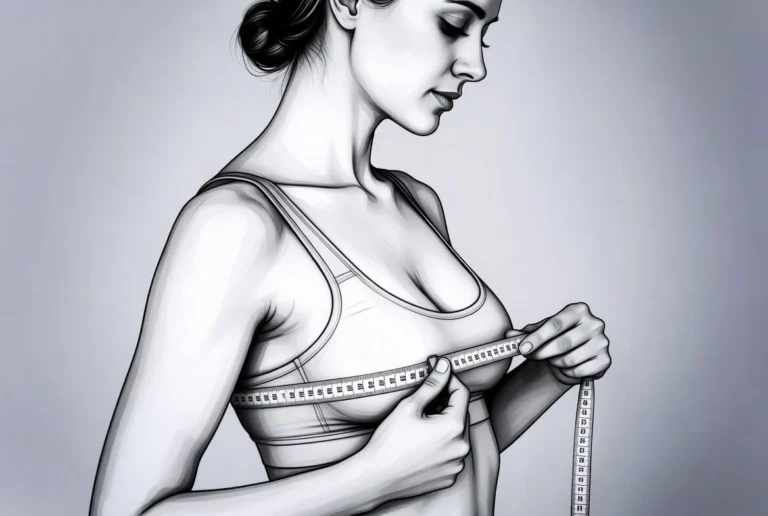
- Lift the breasts gently out of the way. Hold them up with one hand so you can place the tape on the ribcage right where the breast meets the chest wall.
- Bring the tape around your back. Keep it level with the front. Use the mirror to check that it does not slope up toward the shoulder blades.
- Exhale and pull snug. The tape should be firm on the ribcage, firm enough that it does not slip, but not digging into soft tissue.
- Read the number and repeat. Take it at least twice. If the numbers vary, use the average of the two closest.
If the tape sits on soft tissue around your back, the reading will be larger than your real ribcage. If you notice the tape is cutting a visible groove, ease it slightly and measure again. The goal is firm and level, not as tight as you can pull.
Measure the bust, standing and leaning forward
The bust measurement is taken at the fullest part of the breasts. With a fuller bust, the number can change depending on posture, so take it two ways and compare.
- Standing. Stand naturally with arms relaxed. Pass the tape around your back and across the fullest point of your breasts, level at both sides. It should rest gently on the skin without squeezing the tissue.
- Leaning forward. Lean forward from the waist about 90 degrees, let the breasts hang, and measure again at the fullest point. Keep the tape level and the same tension.
- Compare them. If the two numbers are within about half an inch, use either. If the leaning number is a full inch or more larger, you have two cup sizes worth testing.
Good tape habits
- Level at back and front, checked in the mirror.
- Same tension for each reading.
- Exhale for the underbust, relax for the bust.
- Write each number as you go.
Common mistakes
- Tape sloping up at the back.
- Pulling the bust tape tight and flattening the tissue.
- Measuring over a padded or lined bra.
- Reading the tape on soft tissue instead of the ribcage.
How to read your numbers
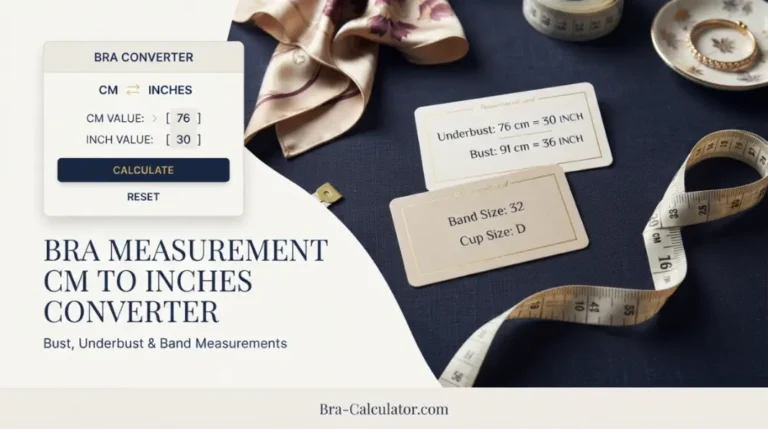
With both measurements in hand, the arithmetic is simple, and the checker above does it for you. The band comes from your underbust, rounded to a whole band size. The cup comes from the difference between your bust and underbust: each inch is one cup step.
| Difference (bust minus underbust) | US label | UK label |
|---|---|---|
| 1 inch | A | A |
| 2 inches | B | B |
| 3 inches | C | C |
| 4 inches | D | D |
| 5 inches | DD | DD |
| 6 inches | DDD or F | E |
| 7 inches | G | F |
| 8 inches | H | FF |
| 9 inches | I | G |
| 10 inches | J | GG |
| 11 inches | K | H |
| 12 inches | L | HH |
Labels beyond a D differ between brands and countries, which is why the same cup volume can carry different letters. If you are shopping across regions, the global bra size converter translates them, and the breast size comparison shows how cup volumes relate to each other.
Nearby sizes: your sister sizes
Your calculated size is rarely the last word. Sister sizes change the band and cup together while keeping the cup volume about the same. Going down a band means going up a cup letter, and going up a band means going down a cup letter. If the band feels loose, try the smaller band with the next cup up. If it feels tight, try the larger band with the next cup down. The sister size calculator lists every combination, and the checker above shows the closest two.
Confirm it with a try-on test
A measurement is a hypothesis. A try-on is the proof. For a fuller bust, a systematic try-on saves a lot of returns.
- Band: level around the ribs, firm but breathable, and it stays put when you raise your arms.
- Hooks: a new bra should fit on the loosest hooks so you can tighten as it stretches.
- Cups: breast tissue sits fully inside with no spilling over the top, side or underarm.
- Wire or cup edge: if your bra has a wire, it should enclose the breast on the ribcage and not press on tissue.
- Center panel: it should lie flat against your breastbone.
- Straps: they support without digging into your shoulders and do not carry the weight.
Order your best-guess size and one neighbor in the same style, compare them at home, and return the one that fits worse. That plan removes the guessing and works especially well at larger cup volumes, where each step matters.
Features worth looking for at larger sizes
A wide band
SupportA wider band spreads the weight across more of the back and ribs. Look for bands with three or four rows of hooks.
Side support
ShapeComfortPanels or boning at the sides help hold tissue forward and prevent bulge at the underarm. See our side bulge fix.
Firm or molded cups
StructureCups with some structure hold their shape. Full-coverage designs help prevent spilling.
Padded, adjustable straps
ComfortWide, cushioned straps spread pressure on the shoulders. They should fine-tune, not carry.
Wire or no wire is a personal choice. Our underwire vs wireless guide compares them, and the underwire digging in guide helps you diagnose a wire that bothers you. If you want more lift as your shape changes, the lifting bras guide covers support-first options.
Troubleshooting: what you notice and what to try
| What you notice | Likely cause | What to try |
|---|---|---|
| Band rides up the back | Band too loose. See why bands ride up | Smaller band with a sister-size cup |
| Band digs in or leaves deep grooves | Band too tight, or cups too small pulling it tight | Larger band with a sister-size cup, or check cup size |
| Tissue spills over the top of the cup | Cup too small | Go up a cup, or choose fuller coverage |
| Fabric gapes or wrinkles in the cup | Cup too big or wrong shape. See the cup gaping guide | Go down a cup or choose a different cup style |
| Wire presses on tissue | Cup too small or wire shape mismatch | Go up a cup, or try a different wire shape |
| Bulge at the side or underarm | Band too loose or cups too small | Adjust band and cup together, look for side support |
| Straps dig into shoulders | Straps carrying the weight because the band is loose | Fix the band first, then use wider padded straps |
If your size has changed after weight loss, the post-weight-loss bra size calculator can help, and the bra fit problem solver lets you start from the symptom.
Five myths worth retiring
Many brands offer wide size ranges. Calculators and charts help you find them.
Measurements are a starting point. A try-on makes the call.
Firm on the ribcage is right for the underbust. A tight bust tape flattens tissue and under-reads.
A band that is too large cannot support. Use a sister size instead.
Brands differ in cut and cup shape. Check each chart.
Once you have a reliable underbust and bust, run them through the calculator for a full set of size options.
Plus-size bra calculatorBra size calculatorAs an Amazon Associate, Bra-Calculator.com may earn from qualifying purchases at no extra cost to you.