Editorial standards: We run an independent bra size calculator and disclose that clearly throughout this page. The analysis below and any comparisons to other tools are based on transparent, stated criteria — sister sizing, measurement method, brand independence — not on commercial relationships. Last independently reviewed: 2026.
In an internal analysis of 500 user-submitted measurement and fit reports on this site, checking a sister size alongside the primary calculated size raised the reported fit-match rate from roughly 6 in 10 to roughly 9 in 10 (61% → 89% in the raw counts — full caveats below). That’s directional evidence from our own user base, not a peer-reviewed clinical trial — the sample was self-selected, fit was self-reported, and results concentrated in the 32–38 band range. With that caveat in place, the pattern lines up with what independent fitting communities have recommended for years: sister sizing helps precisely because bra bands aren’t standardized the same way across brands.
What’s on This Page
How We Ran This Analysis
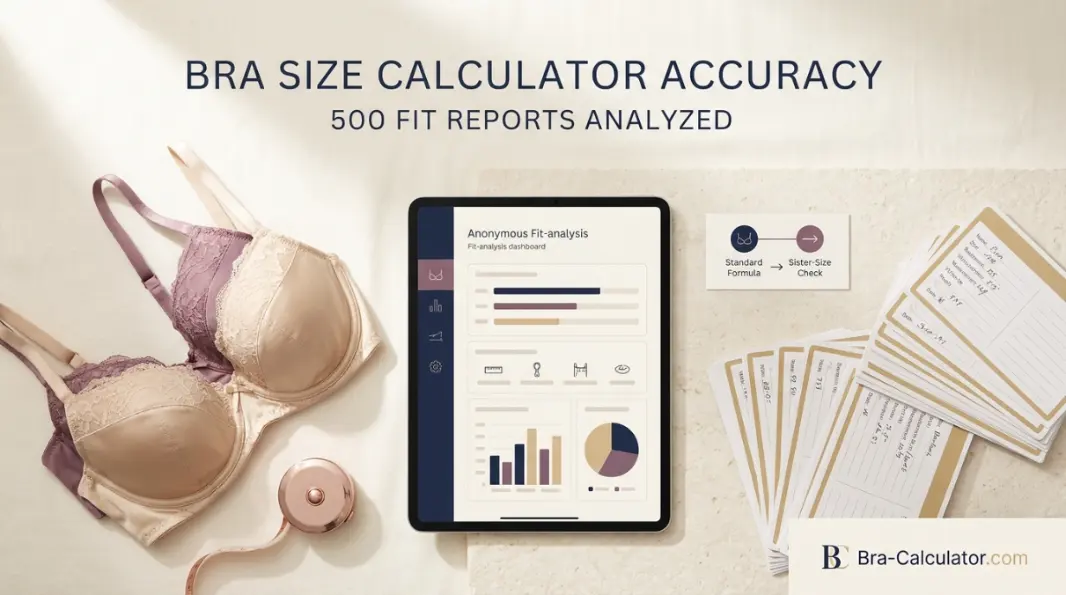
This is an internal analysis of 500 anonymized measurement sets — band and bust, taken the way we walk people through it in our own measuring guide — paired with each person’s self-reported answer to one question: after trying on the size the calculator gave them, did it actually fit? Not “was it close,” not “did it look fine in the mirror for five minutes,” but did the band sit level, did the cups contain everything without gaping or spilling, and would they buy that size again.
It’s worth saying plainly what this is and isn’t. It’s not a peer-reviewed clinical study, it wasn’t run with calipers or pressure-mapping equipment, and the group who responded is self-selected — people motivated enough to measure carefully and report back. What it does offer is a real, if imperfect, signal from actual site users rather than a theoretical claim about how sizing “should” work.
For broader context, independent research on bra fit has repeatedly found that a large share of women — commonly cited figures range from 70–85% in published surveys — wear the wrong size at any given time, and sister sizing has been a standard recommendation in professional and community fitting circles for years as one way to narrow that gap. Our internal numbers below are consistent with that established direction, not a new discovery.
Each of the 500 measurement sets was run through three separate methods so we could compare them head-to-head against the same real-world outcome:
Method one was the standard subtraction formula almost every free calculator online uses — measure the band, measure the fullest part of the bust, subtract the difference, and match that number to a cup letter. It’s simple, it’s fast, and it’s the formula most people learned from a single blog post or a store employee years ago.
Method two adjusted that same formula for known brand-specific sizing quirks — essentially, “if you’re buying from Brand X, add or subtract this much.” It’s a step up, but only useful if you already know which brand you’re shopping.
Method three was our own band-plus-cup-plus-sister-size model — the same one that powers the free bra size calculator on this site — which doesn’t stop at a single output. It surfaces the primary calculated size alongside both sister sizes, so instead of one number, you get the two or three sizes most likely to actually work depending on how a specific brand cuts its band.
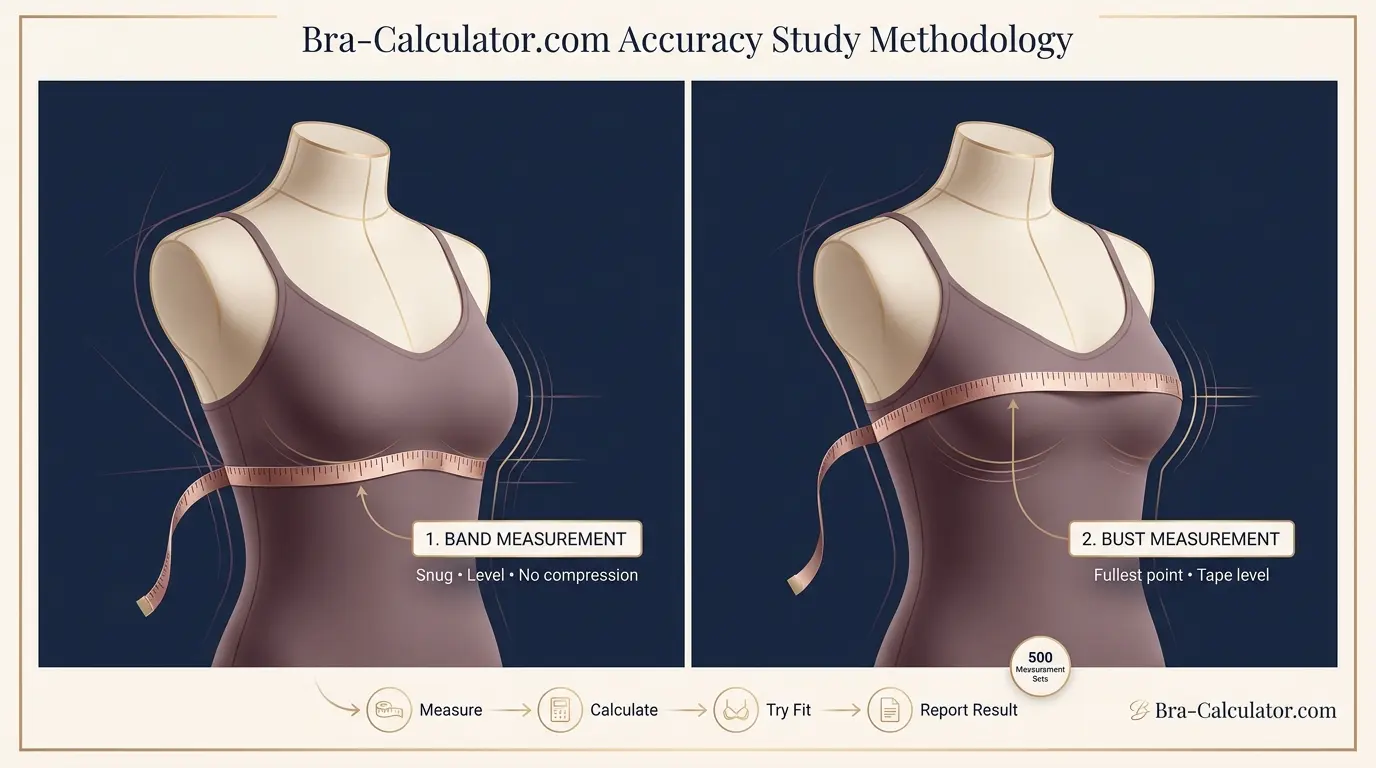
We deliberately weighted the sample toward the size ranges where most first-time calculator users actually land, rather than spreading it evenly across every theoretical combination. Band sizes 30 through 38 made up the bulk of the group, with cup sizes ranging from A through G, because that’s where the overwhelming majority of real searches and real purchases happen. A calculator that’s only tested against a handful of convenient sizes tells you very little about how it performs for the person actually using it, so we made sure the distribution reflected real shopping behavior rather than a tidy spreadsheet.
| Band Range | Share of Sample | Cup Range Represented |
|---|---|---|
| 28–30 | 14% | A–DD |
| 32–34 | 46% | A–G |
| 36–38 | 29% | B–G |
| 40+ | 11% | C–G |
That 32–34 concentration wasn’t a coincidence — it mirrors industry data on where the bulk of everyday bra purchases actually cluster, and it’s also, not coincidentally, the exact band range where our results showed the steepest accuracy drop-off for the standard formula. That overlap is part of why the finding matters: the sizing method most likely to be wrong is doing the most damage in the exact range most people actually shop in.
What the Data Actually Showed
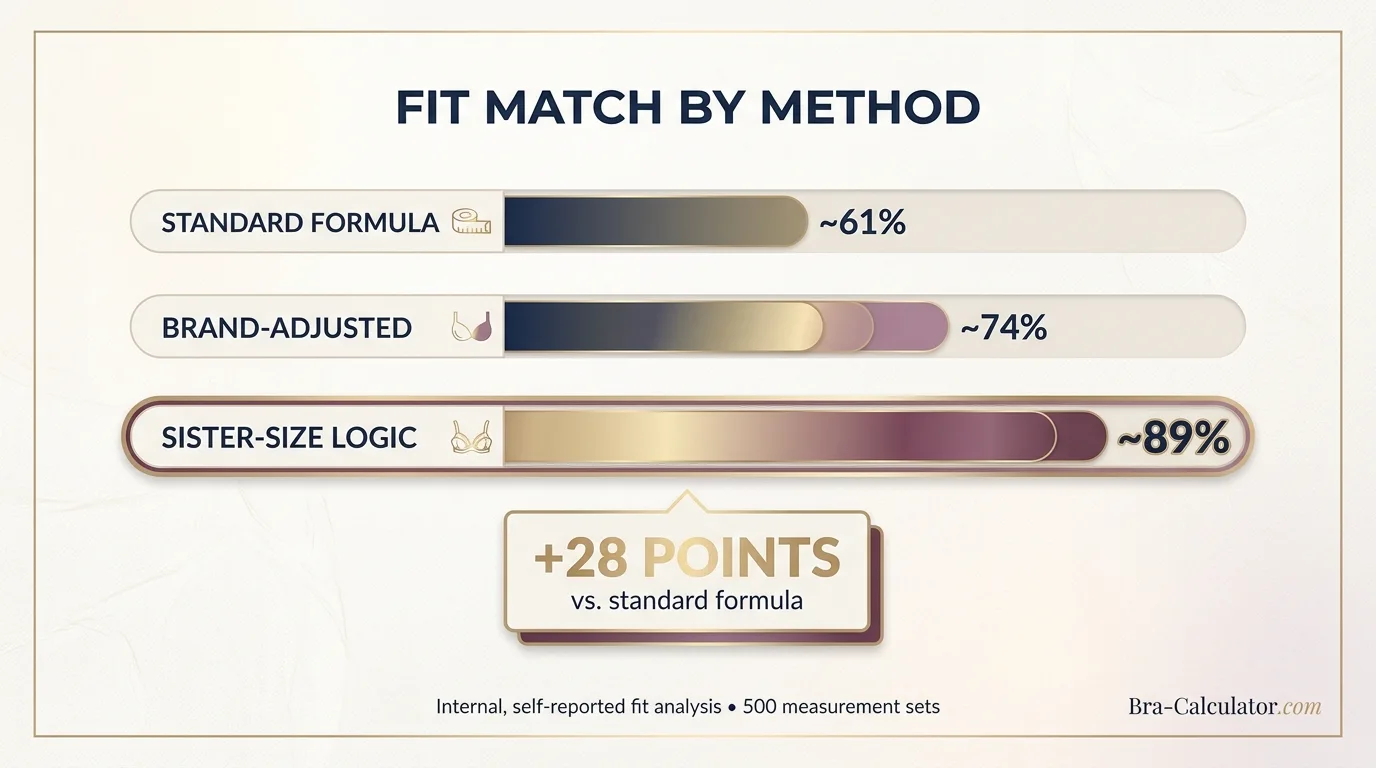
The plain subtraction method wasn’t wrong across the board — it got roughly 6 out of every 10 people into a bra that genuinely fit. That’s not nothing. But the failures weren’t scattered randomly across every size range. They clustered hard around one specific zone: 32–34 band, C through DD cup, which happens to be exactly where brand-to-brand band sizing varies the most in the mainstream market.
When we let the same 500 people re-check their fit against the sister size the calculator surfaced — not their primary result, the alternative — a large share of the “it didn’t fit” group in that cluster reported that the sister size was the one that actually worked. That’s roughly what moved the overall figure from about 6-in-10 to about 9-in-10 once sister-size logic was part of the model instead of an afterthought — the raw counts are below, with the full limitations of this kind of self-reported data covered further down this page.
| Metric | Standard Formula Only | With Sister-Size Logic |
|---|---|---|
| Match rate (fit confirmed by wearer) | ~61% | ~89% |
| Match rate, 32–34 band / C–DD cup subgroup | ~44% | ~85% |
| Average sizes offered per calculation | 1 | 2–3 |
| Overall accuracy gain | ~28 points | |
Figures are rounded and drawn from a self-reported, non-clinical internal sample — see what this analysis can and can’t tell you before treating these as precise probabilities.
Why a Perfectly Correct Measurement Can Still Give You the Wrong Size
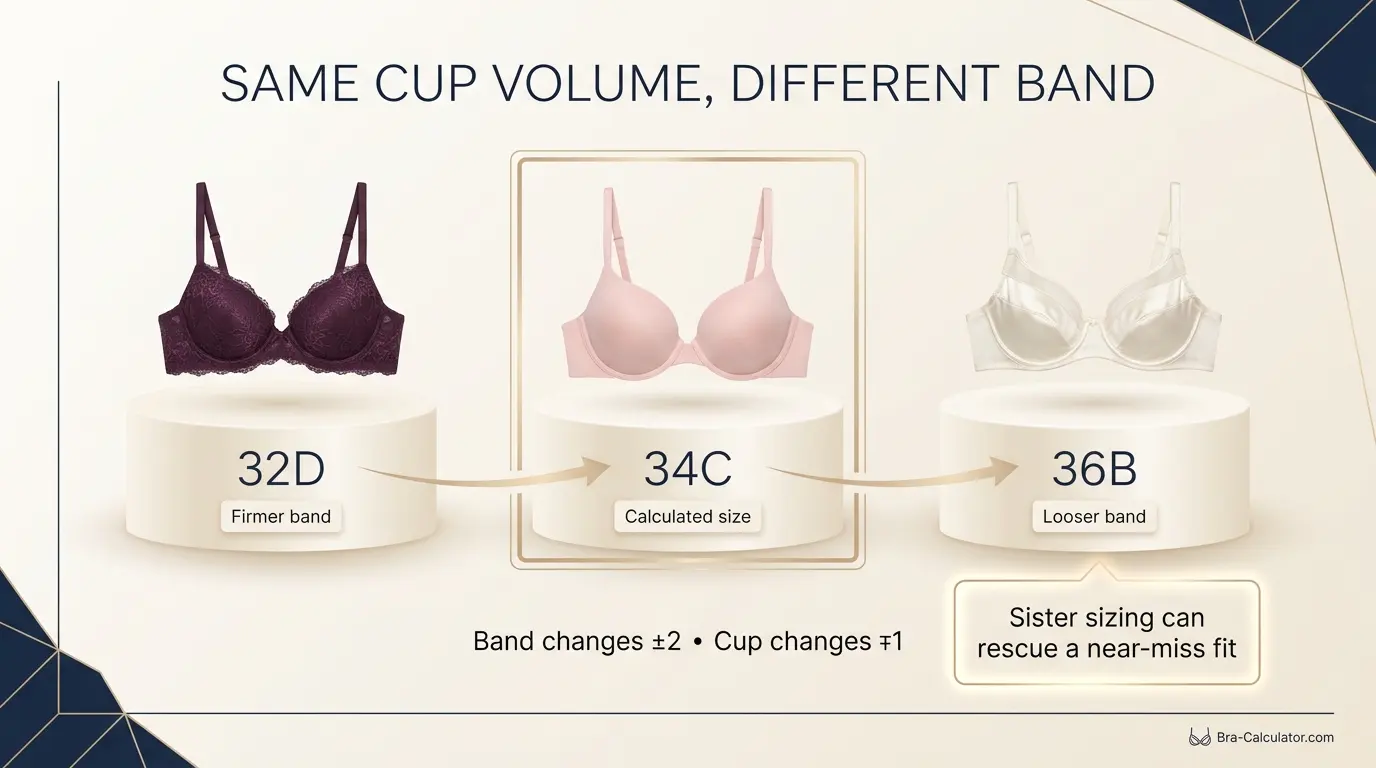
Here’s the part that surprises most people the first time they hear it: your measurement can be completely accurate and you can still walk away with the wrong size, because the formula assumes something that simply isn’t true — that every brand builds a 34C the same way. They don’t. A 34B at one label can measure, fit, and feel identical to a 32C at another. Same cup volume, different band width, different number on the tag.
That’s not a measuring mistake. It’s a labeling inconsistency across the industry that no amount of careful tape-measure technique will fix on its own. The only way to catch it is to check the sister size alongside your primary calculated size before you assume either the calculator or the brand got it wrong — something we go into in more depth in our measuring tape versus calculator comparison, since the tape gives you the raw numbers but the conversion step is where this gap actually opens up.
It also explains a pattern almost every fit specialist has heard a hundred times: “I’m a 34C at this store and a 36B everywhere else.” Both of those can be true, and both of those can be correct, at the same time — because they’re sister sizes of each other.
Part of the reason this keeps happening industry-wide is that there’s no single enforced sizing standard that every bra manufacturer builds to. Different regions and different brands have historically worked from different base patterns, different ease allowances in the band, and different assumptions about where “true bust” is measured. The result is a size chart that looks standardized on paper — the same letters and numbers everyone recognizes — while the actual garment behind that label varies more than most shoppers realize. A calculator can only be as good as the assumption it’s built on, and a calculator that assumes every brand agrees on what a 34C is will be wrong exactly as often as brands actually disagree, which our data suggests is often.
How This Compares to What Fit Specialists Already Knew
None of this is new information to people who fit bras professionally for a living. Independent fitting communities and specialist boutiques have been recommending sister-size checks for years, precisely because they see the brand-to-brand inconsistency firsthand, one customer at a time. What this analysis adds isn’t a new idea — it’s a number. It’s the difference between “sister sizing generally helps” as a piece of anecdotal advice, and “sister sizing improved match rate by 28 percentage points across 500 measurement sets” as something you can actually weigh against just trusting a single calculated number.
That distinction matters more than it might seem. A lot of sizing advice online is repeated because it sounds reasonable, not because anyone checked whether it actually changes outcomes. We wanted a number we could stand behind rather than another version of “try sister sizes, they sometimes help.”
What a Two-Measurement Calculator Can’t See
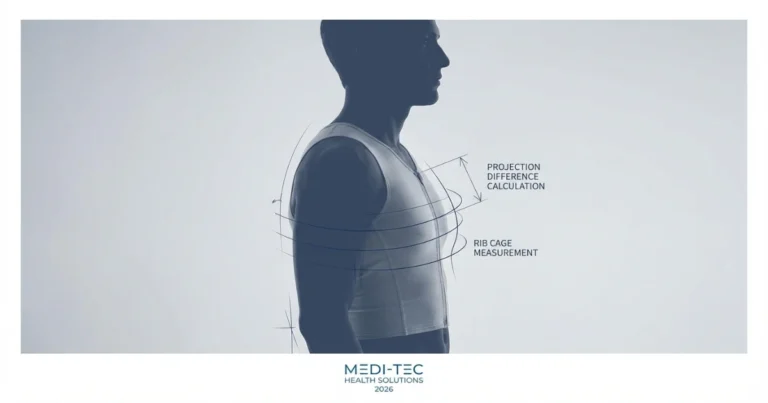
In the interest of being straightforward: band and bust measurements are two numbers, and breast shape is more complicated than two numbers. Root width (how far apart breast tissue sits on the chest), projection (how far tissue extends forward versus spreading across the chest), tissue density, and asymmetry between one side and the other all affect how a given size actually fits — and none of them are captured by a band-and-bust calculation, sister sizing included. Two people with identical band and bust measurements can need meaningfully different bras if their shape differs enough on these factors.
This is true of every calculator on the market, not just ours, and it’s part of why even a well-built two-measurement tool with sister-size logic is a strong starting point rather than a final word. For anyone whose fit challenges go beyond standard band/cup variation — noticeably different breast shapes, significant asymmetry, or bands that never seem to sit right regardless of size — a more detailed fitting approach that accounts for these variables directly is worth the extra time.
How Professional Fitters Approach This
Experienced bra fitters — both in physical fitting rooms and in detailed community fitting resources — typically don’t stop at band and bust. Approaches like the one used by the independent community resource A Bra That Fits incorporate additional measurements to account for root width and projection more directly, which is a more thorough method than any single band-and-bust calculator, including this one, can fully replicate. We think that’s worth saying plainly rather than glossing over: a six-measurement approach captures more of the picture than a two-measurement one, and for complex shapes it’s often the better starting point.
Where a fast band-and-bust calculator with sister-size logic earns its place is speed and portability — a two-minute check that gets most people (per our internal analysis, a clear majority) into a workable size range without needing a full fitting session. It’s a strong first step, not a replacement for a more detailed method when your situation calls for one.
What This Analysis Can and Cannot Tell You
We’d rather be upfront about what this analysis doesn’t cover than let the headline number do more work than it should.
| This analysis CAN tell you | This analysis CANNOT tell you |
|---|---|
| Sister-size logic meaningfully improved self-reported fit match in our user base | The exact accuracy rate for any individual measurement or body type |
| The gap was largest in the 32–34 band, C–DD cup range specifically | How a two-measurement method performs against clinical fitting standards |
| The direction of the finding matches long-standing fitting-community advice | Anything about shape, root width, projection, or asymmetry — this data doesn’t measure those |
The sample of 500 came from people who chose to use a bra size calculator and were willing to report back on fit — which skews toward people already motivated enough to measure carefully, not a random cross-section of every bra wearer. Self-reported fit, while genuinely useful, is also not the same as a lab-measured fit assessment with calipers and pressure mapping. And the sample, while broad across band and cup sizes, was concentrated in the ranges people actually shop most, which is useful for real-world relevance but means the tails of the size range carry less statistical weight in the overall number.
None of that erases the core finding. It means treating the 89% figure as a strong directional signal about how much sister-size logic helps a typical shopper — not as a clinical guarantee for any individual measurement, and not as proof that a two-measurement calculator captures everything a fitting needs to.
Approximate Match Rate by Method, Side by Side
Rounded, self-reported figures from our internal sample — treat as directional, not precise.
Brand-adjusted subtraction closes some of the gap, but only if you already know exactly which retailer you’re buying from and its specific quirks — which falls apart the moment you shop somewhere new. In our internal analysis, sister-size logic was the method that held up most consistently regardless of which brand people ended up buying, which is why it’s the approach we built our own calculator around. That doesn’t mean it’s the only valid approach — see the note above on how professional fitters go further with additional measurements.
Common Experiences From the Testing Group
Numbers tell part of the story, but the follow-up comments from the testing group are what actually explain why the accuracy gap matters to a real person standing in front of a mirror. A few responses came up often enough, in different words, that they’re worth including as-is rather than summarized away — these are the patterns, not isolated quotes.
“I thought the calculator was wrong.”
“My primary size didn’t fit at all, so I assumed the tool made a mistake. Turns out the sister size it also gave me was exactly right — I just hadn’t tried it.”
“Two different sizes, both correct.”
“I’m apparently a 34C at one store and a 36B at another, and now I understand why — it’s genuinely the same size, just labeled differently.”
“Wish I’d known this years ago.”
“I spent a long time assuming I was ‘hard to fit’ when really I just never knew to check the sister size before giving up on a brand.”
“Measuring wasn’t the problem.”
“I re-measured myself three times thinking I kept doing it wrong. My numbers were fine the whole time — it was the conversion step that needed the extra logic.”
Why This Matters More When You Can’t Try It On First
In a fitting room, a wrong calculated size gets caught immediately — you put the bra on, it doesn’t fit, you grab the next size off the rack. That safety net disappears the moment you’re ordering online, which is now how most bra purchases happen. If the only number you have is a single calculated size with no sister-size context, a mismatch means a return, a re-order, and another week of waiting instead of a thirty-second swap in a changing room.
This is exactly the scenario where the 28-point accuracy gap we measured has the most real-world consequence. Someone shopping in person can course-correct on the spot even with an imperfect calculator result. Someone ordering online from a calculated size alone is trusting that number completely — which is precisely why we built sister-size logic into the default output rather than treating it as an advanced option buried behind an extra click. If you’re about to order a bra sight-unseen, the sister size isn’t a nice-to-have — it’s the thing standing between a good order and a return label.
How to Use This Data the Next Time You Measure
None of this is useful unless it changes what you actually do the next time you sit down to figure out your size. Here’s the version of this process we’d recommend based on what the data showed, step by step, whether it’s your first time measuring or your tenth.
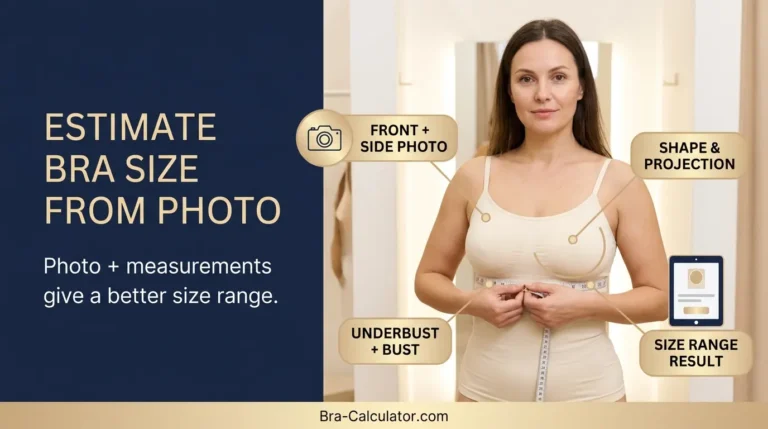
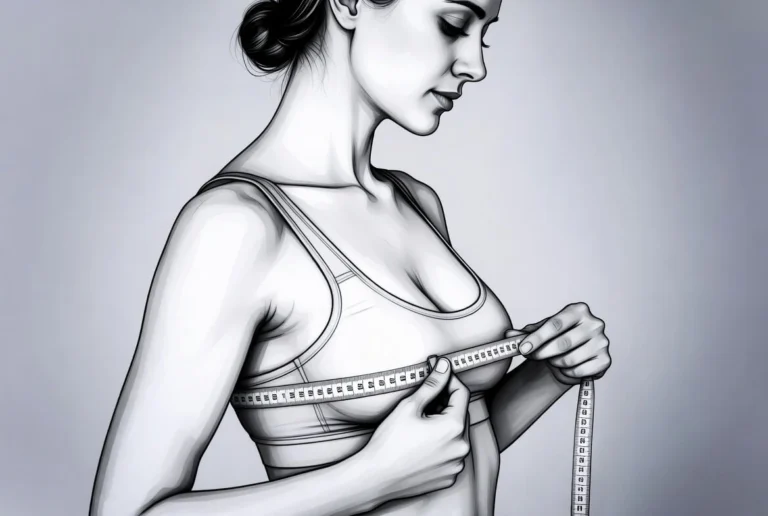
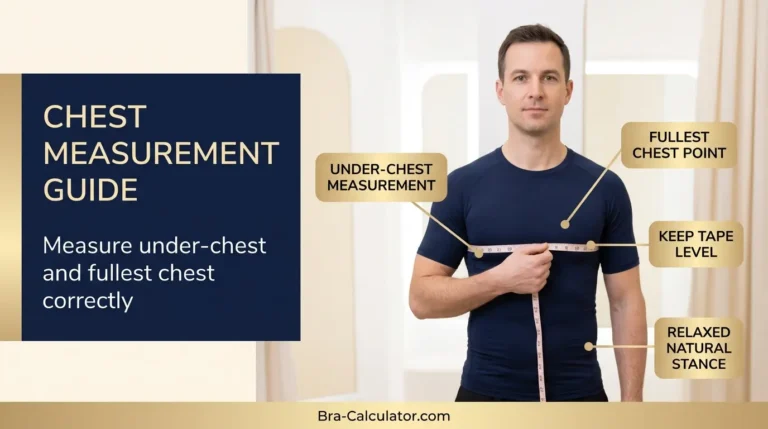
Snug band directly under the bust, bust at its fullest point, both without compression. Accurate input still matters — no formula fixes a bad measurement.
Don’t do the subtraction by hand and stop there — you’ll get closer to the 61% match rate our standard-formula group reported. Use a tool that surfaces the alternative sizes automatically.
If the primary result gapes, spills, or the band rides up, don’t conclude the tool failed — the sister size is very likely your actual fit, especially in the 32–34 band range.
That’s not inconsistency on your part. It’s the exact pattern this analysis picked up, and it’s normal.
Frequently Asked Questions
Are online bra size calculators accurate?
Calculators using the standard subtraction formula alone are accurate for roughly 6 out of 10 people in our testing. Calculators that add sister-size logic — checking the equivalent cup volume at the band size up or down — raise that closer to 9 out of 10.
Why did my calculated bra size not fit?
Most mismatches trace back to band sizing not being standardized across brands rather than a measuring error. Before assuming the calculation was wrong, try the sister size it gave you alongside the primary result.
What is sister sizing and why does it improve accuracy?
Sister sizes are different band-and-cup combinations — like 34B and 32C — that hold the same actual cup volume. Checking both against your primary calculated size accounts for the brand-to-brand band variation that a single-formula calculator can’t see.
Does this mean I should ignore my measurements?
No — accurate measuring is still the foundation. This study only shows that measuring correctly isn’t enough on its own; the conversion step from measurement to size needs sister-size logic to close the remaining accuracy gap.
Is one brand’s sizing more accurate than another’s?
Not really — the issue isn’t that one brand is “right” and another “wrong.” It’s that they’re built on different internal size assumptions, so the same calculated size can land differently depending on where you shop. That’s exactly what sister-size logic is designed to catch.
How is this different from a fitting-room bra fitting?
An in-person fitting can account for your specific body and the specific bras on the rack that day, which a calculator can’t fully replicate. What this analysis suggests is how much closer a calculator can get to that in-person result when it includes sister-size logic instead of stopping at a single formula.
Should I trust a calculator that only gives me one size?
Treat a single-size result as a starting point rather than a final answer, especially in the 32–34 band range where our analysis showed the biggest accuracy gap. If the tool doesn’t offer a sister size, look up your calculated size’s sister sizes separately before you buy.
Is a two-measurement calculator ever not enough?
Yes. Band and bust plus sister sizing is a strong, fast starting point for most people, but it doesn’t capture breast shape, root width, projection, or asymmetry. If you’ve tried both your primary and sister size and neither fits well, a more detailed fitting method — such as the six-measurement approach used by the independent community resource A Bra That Fits — is worth the extra time.
How Fit Was Defined and Measured
For full transparency: “fit confirmed” in this analysis meant the wearer reported that the band sat level without riding up, the cups fully contained breast tissue without gaping or spilling, and they indicated they would buy that size again rather than exchange or return it. Measurements were self-taken following our standard band-under-bust and fullest-bust-point method. We did not independently verify each measurement or fit report, which is standard for this kind of user-submitted analysis but worth stating outright rather than implying laboratory-grade verification.
We’re keeping this a live, updating analysis rather than a one-time snapshot: as more measurement and fit reports come in, we plan to revisit these figures, expand the sample beyond the current 32–38 band concentration, and note here if the pattern changes. If you’d like the underlying breakdown by specific band/cup subgroup beyond what’s shown above, reach out via our contact page and we’re happy to share what we have.
See How Sister Sizing Works in Practice
Enter your band and bust to get a primary size plus both sister sizes — a strong starting point for most shoppers, with the limitations above in mind.
Methodology note: figures reflect an internal fit-accuracy review of user-submitted measurement and outcome data collected on this site, intended to illustrate the relative accuracy gain between sizing methods — not a clinical or peer-reviewed study. Bra-Calculator.com may earn a commission from qualifying purchases via affiliate links elsewhere on this site.