Nursing Bra Sizing Timeline: Week by Week Postpartum

Amelia spent years as a lingerie buyer fitting customers across every band and cup size before founding Bra-Calculator.com. She built this timeline from patterns seen across thousands of postpartum fit questions — not a single clinical study, but a repeatable, practical structure. More about Amelia →
In This Guide
- Why a Timeline Approach Beats Guessing
- Week 1–2: Engorgement Phase
- Week 3–6: Supply Regulates
- Months 2–6: Stable Range With Daily Swing
- Return to Work / Schedule Change
- Weaning
- What If Your Timeline Doesn’t Match This Pattern?
- How Multiples (Twins/Triplets) Can Shift This Timeline
- Exclusive Pumping vs. Direct Nursing Timelines
- What “Recheck Fit” Actually Means at Each Checkpoint
- How Sleep Deprivation Can Make Sizing Feel More Confusing Than It Is
- The Role of Hydration and Diet in Perceived Size Fluctuation
- Documenting Your Own Timeline for Future Reference
- How Postpartum Recovery From Delivery Type Interacts With the Sizing Timeline
- When the General Timeline Genuinely Doesn’t Apply
- Building a Simple Personal Sizing Log
Why a Timeline Approach Beats Guessing
If you’re searching for a nursing bra sizing timeline, you’re probably tired of guessing. Nursing bra size doesn’t drift randomly — it follows a fairly predictable pattern tied to milk supply regulation, feeding frequency, and physical recovery. Understanding that pattern means you can plan purchases around actual sizing checkpoints instead of buying reactively every time something feels off.
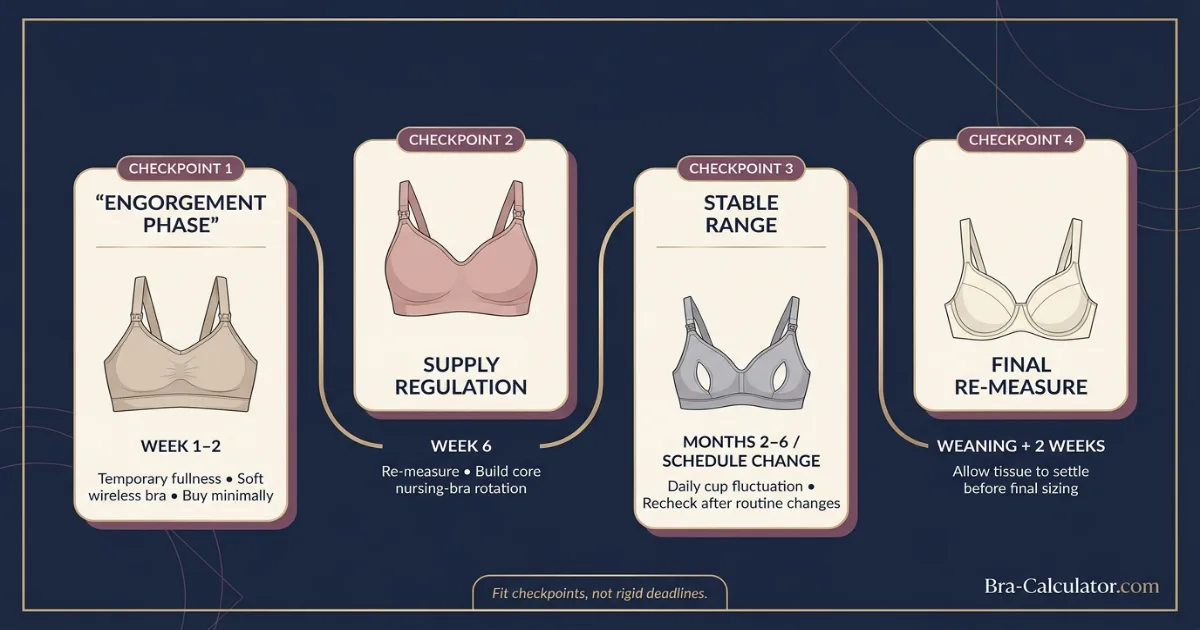
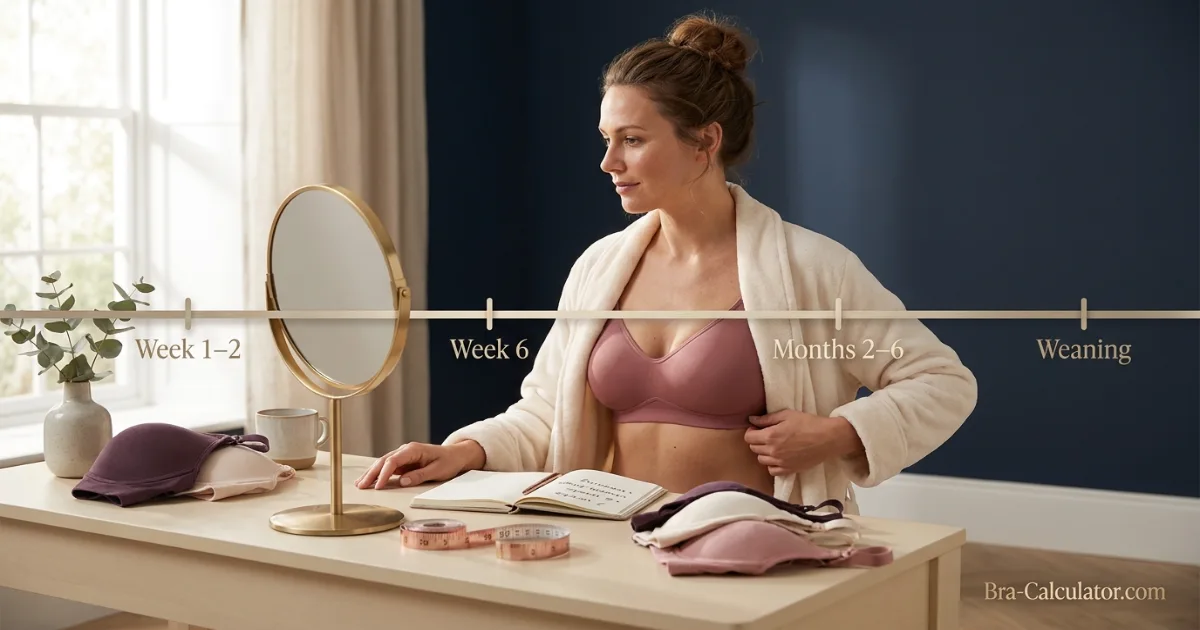
Four checkpoints cover the entire nursing period for most parents — this is not a constant recalibration process.
Week 1–2: Engorgement Phase
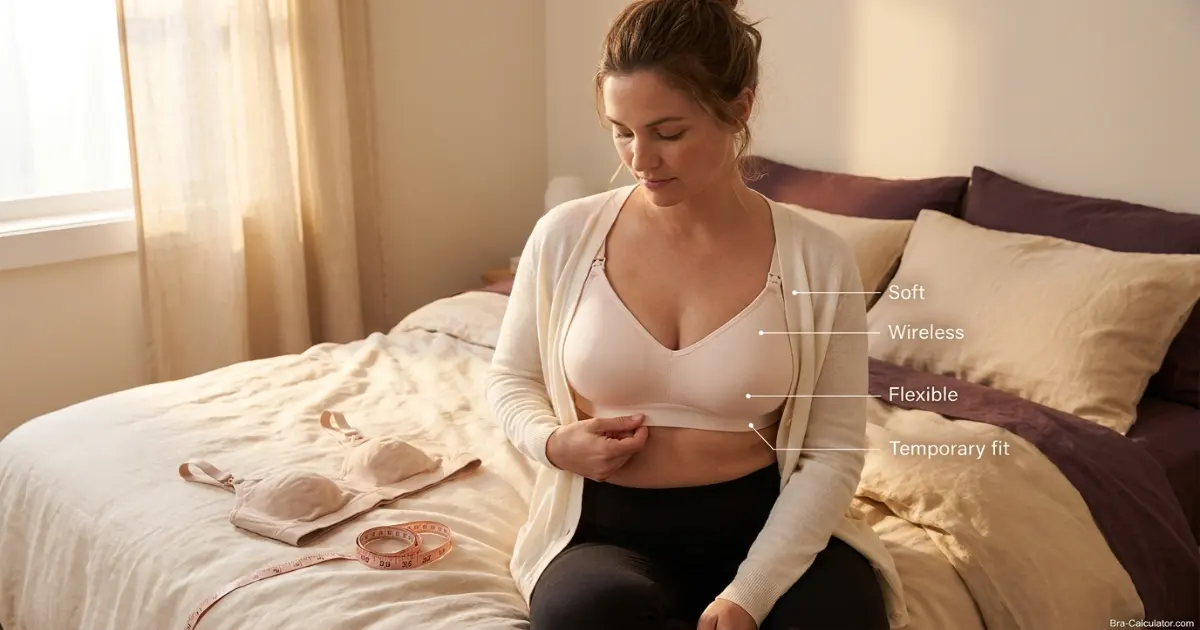
Milk coming in typically increases cup size by a full size or more temporarily, often accompanied by tenderness and visible swelling. This is not your “real” nursing size — buy one or two soft, wireless, size-up bras just to get through this window rather than committing to a full wardrobe here. Many parents report this being the most physically uncomfortable stage, and a bra that’s too snug can genuinely worsen engorgement-related pain.
Week 3–6: Supply Regulates
By six weeks, most parents’ supply has regulated to demand and cup fluctuation narrows to a half-size swing across the day rather than a full size swing. This is the point to properly re-measure and buy your core nursing bra rotation — buying earlier risks sizes that no longer fit by month two; buying much later means struggling through weeks of ill-fitting engorgement-size bras longer than necessary.
Months 2–6: Stable Range With Daily Swing
Expect the same half-cup daily swing to continue as long as you’re exclusively breastfeeding or pumping regularly. Band size is essentially locked at this point; only cup varies, and only within the range your nursing bras are designed to stretch across. This is typically the longest and most predictable stretch of the whole timeline.
Return to Work / Schedule Change
Any time feeding frequency changes significantly — starting daycare, night-weaning, or increasing formula supplementation — supply and cup size shift again over roughly 1–2 weeks. This is a commonly missed resizing trigger, because many parents assume sizing is “done” once the 6-week checkpoint has passed, and don’t think to recheck fit when their daily routine changes rather than their baby’s age.
Weaning
Cup size gradually decreases as feeds reduce, and this process is often more gradual than parents expect — it’s rarely an abrupt one-week drop. Re-measure once feeds have fully stopped for 2+ weeks, since breast tissue and volume continue adjusting for a period after milk production ends, and measuring too early can lock in a size that’s still shrinking.
| Timeline | Sizing Action | Common Mistake at This Stage |
|---|---|---|
| Week 1–2 | Temporary size-up, soft wireless only | Buying a full wardrobe at engorgement size |
| Week 6 | First real measurement + core rotation purchase | Skipping this checkpoint and staying in engorgement-size bras too long |
| Return to work | Recheck cup fit as feeding schedule changes | Assuming sizing is “finished” and missing this shift entirely |
| Weaning | Final re-measure 2+ weeks after last feed | Measuring immediately after the last feed, before tissue fully settles |
What If Your Timeline Doesn’t Match This Pattern?
Every body regulates differently — some parents see supply stabilize closer to 4 weeks, others closer to 8. Multiples (twins/triplets), exclusive pumping schedules, and supplementing with formula can all shift the timeline earlier or later than the general pattern above. Use the checkpoints as a guide for when to check, not a guarantee of exactly when your size will change — if something feels consistently off between checkpoints, it’s worth re-measuring regardless of where you are on the calendar.
How Multiples (Twins/Triplets) Can Shift This Timeline
Parents nursing or pumping for multiples often experience a higher and more sustained milk supply, which can extend the “stable range with daily swing” period differently than a single-baby timeline, and sometimes means engorgement resolves on a slightly different schedule due to more frequent overall feeding/pumping demand. The core checkpoints (2 weeks, 6 weeks, schedule changes, weaning) still apply as useful check-in points, but expect potentially more pronounced cup fluctuation given the higher overall volume involved.
Exclusive Pumping vs. Direct Nursing Timelines
Exclusive pumpers sometimes see supply regulate around pump-session frequency and flange fit rather than baby-driven feeding cues, which can shift the “week 3-6 regulation” checkpoint slightly earlier or later depending on pumping schedule consistency. The general pattern (large early fluctuation narrowing over the first six weeks) still applies, but exclusive pumpers may find it useful to track fit changes alongside pump output logs rather than purely by calendar week.
What “Recheck Fit” Actually Means at Each Checkpoint
Rechecking fit doesn’t require buying anything new at every checkpoint — it simply means trying on your current rotation and noting whether the band rides up, the cup gaps or spills, or straps need re-adjustment more than usual. Only when two or more of these signs show up consistently across several days is it worth actually re-measuring and adjusting your bra sizes, rather than treating every minor daily fluctuation as a signal to buy new bras.
How Sleep Deprivation Can Make Sizing Feel More Confusing Than It Is
New parents operating on fragmented sleep sometimes report feeling like their bra size is “changing constantly” in a way that feels harder to track than the general pattern this timeline describes. In practice, the underlying physical changes usually follow the same broad checkpoints outlined here; what’s often different is the parent’s capacity to notice and interpret smaller day-to-day fluctuations accurately while exhausted. Writing down measurements at each checkpoint (rather than relying purely on memory or a vague sense that “something feels off”) can make the pattern feel more manageable and less like unpredictable chaos, even when the underlying physiology is behaving in a fairly typical way.
The Role of Hydration and Diet in Perceived Size Fluctuation
General hydration levels and sodium intake can subtly affect overall body water retention, which in turn can produce minor perceived changes in breast fullness independent of milk-supply-driven fluctuation. This isn’t a major factor compared to feeding-cycle timing, but it can explain why bra fit sometimes feels slightly different from one day to the next even when feeding patterns haven’t changed — a useful piece of context for parents who might otherwise assume every fit variation reflects a milk-supply issue requiring intervention.
Documenting Your Own Timeline for Future Reference
Parents who plan to nurse multiple children sometimes find it useful to keep a simple record (even just a note on a phone) of their own actual sizing timeline — when engorgement peaked, when supply regulated, what sizes worked at each stage — since individual timelines, while following the general pattern, do vary in exact timing from pregnancy to pregnancy and person to person. Having your own prior data point can make future postpartum sizing decisions faster and less uncertain than starting from the general population pattern alone each time.
How Postpartum Recovery From Delivery Type Interacts With the Sizing Timeline
While this page focuses on breast and cup-size changes specifically, overall postpartum recovery pace (which can differ between vaginal delivery and C-section, and between straightforward and more complicated deliveries) can affect how quickly a parent feels able to actively re-measure and shop for new bras, even if the underlying breast-tissue timeline is progressing typically. It’s reasonable to delay the practical shopping task slightly if overall recovery is demanding more of your capacity, without worrying that this delay itself is causing any additional sizing problem.
When the General Timeline Genuinely Doesn’t Apply
Certain circumstances can meaningfully shift this timeline beyond the “normal variation” range discussed earlier — significant hormonal conditions, certain medications, glandular tissue differences (including a history of insufficient glandular tissue or previous breast surgery), and starting supplementation heavily from early on can all produce a genuinely different pattern than the general postpartum timeline. If your experience feels substantially different from the checkpoints described here — not just earlier or later by a week or two, but fundamentally different in character — that’s a reasonable signal to loop in a lactation consultant rather than continuing to map your experience onto the general pattern.
Building a Simple Personal Sizing Log
A minimal, practical version of the tracking approach mentioned earlier just needs four entries: the date and rough measurements at the 2-week engorgement check, the 6-week regulation check, any measurement taken around a schedule change, and a final weaning measurement. This doesn’t need to be elaborate — a note on a phone with four dated entries is enough to give you (or a future pregnancy) a genuinely useful personal reference point that’s more specific than the general population pattern this page describes.
How This Timeline Interacts With Buying Decisions Across the Cluster
Each checkpoint on this timeline corresponds to a specific buying decision covered elsewhere in this cluster: the engorgement checkpoint pairs with the engorgement-week shopping guidance, the 6-week checkpoint pairs with building your core four-bra rotation, the schedule-change checkpoint pairs with reassessing your pumping-specific bras if you’re returning to work, and the weaning checkpoint pairs with the post-weaning transition guidance. Thinking of the timeline and the buying decisions as one connected system, rather than separate topics, makes the whole nursing bra journey feel more like a single coherent plan than a series of disconnected purchases.
What Happens If You Miss a Checkpoint
Missing a checkpoint doesn’t cause any lasting problem — if you realize partway through the nursing period that you never formally re-measured at 6 weeks, simply doing that measurement whenever you notice the gap (rather than waiting for some “correct” future checkpoint) is the right move. The checkpoints are a helpful structure for staying ahead of sizing changes, not a rigid schedule where missing one causes a compounding problem.
How This Timeline Should Inform Your Shopping Calendar
Mapping the sizing timeline onto an actual shopping calendar can make the whole process feel less reactive. In the first week, plan only to acquire one or two temporary bras. Around week five or six, block time to properly re-measure and place your main rotation order, ideally with enough lead time before any known return-to-work date that a new hands-free pumping bra has arrived and been wear-tested before you actually need it in an office setting. Treating this as a planned calendar item, the same way you might plan childcare logistics or a pediatrician appointment schedule, tends to produce better outcomes than waiting until a bra genuinely stops fitting to start shopping.
Revisiting the Timeline If You Return to Nursing After a Pause
Some parents pause and later resume nursing or pumping — after a temporary illness, a supply dip addressed with lactation support, or a change in circumstances. If this happens, the general checkpoint logic still applies: treat the resumption similarly to the early postpartum period, watching for a settling pattern over the following weeks rather than assuming your pre-pause bra sizes are automatically still correct once nursing resumes.
A Last Practical Reminder
None of these checkpoints require perfection — they’re a reasonable structure to check in against, not a strict schedule that causes problems if life gets in the way of hitting them exactly on time. As Amelia puts it: measure at the checkpoints, buy in small batches, and let your own body’s pattern — not the calendar — have the final say.
Best Product Options for This Fit Goal
These are editorial shortlists based on published product construction, size information, pump compatibility, and the fit goal of this page. Bra-Calculator.com has not physically lab-tested every model, so treat each pick as a starting point and verify the current listing, size chart, materials, and return terms.
Bravado Designs Body Silk Seamless Nursing Bra
A wire-free 360-degree stretch design with knit-in support zones and a wide published band-and-cup range.
Check before buying: Use the newest size chart; older listings may show a different range or final-sale colorways.
View Options on AmazonAffiliate link · Availability and price can change
Bodily The Everything Bra
A low-pressure clip-down style designed to work from pregnancy into postpartum and beyond nursing.
Check before buying: This is a comfort-led option, not a high-impact or strongly projected full-bust bra.
View Options on AmazonAffiliate link · Availability and price can change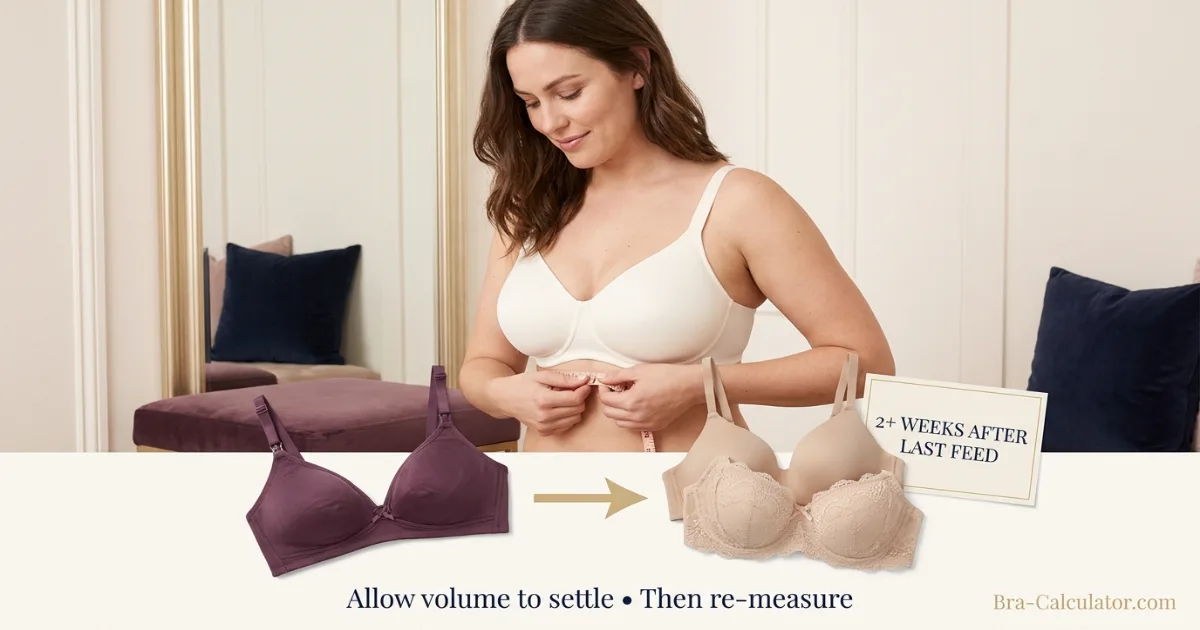
Kindred Bravely Simply Sublime Nursing Bra
Stretchy full-coverage construction suits everyday nursing and normal day-to-day fullness changes.
Check before buying: Use the brand chart rather than buying only from your pre-pregnancy alpha size.
View Options on AmazonAffiliate link · Availability and price can changeKey Takeaways
- The first two weeks postpartum are not representative of your ongoing nursing bra size — don’t overbuy here.
- Six weeks postpartum is the standard point to properly re-measure and build your core bra rotation.
- Returning to work or changing feeding schedule is a commonly missed resizing trigger.
- Weaning-related size changes are gradual — wait at least 2 weeks after the last feed before re-measuring for accuracy.
📐 Not sure which size to buy?
Check where you are in the sizing timeline with Amelia’s free bra size calculator →
Frequently Asked Questions
- When is nursing bra size most stable?
- Between months 2–6 of exclusive breastfeeding or pumping, once supply has regulated and before any major schedule change like returning to work.
- Do I need to resize when I go back to work?
- Often yes — feeding frequency changes are one of the most commonly missed resizing triggers, since parents assume sizing is finalized by 6 weeks.
- Does the timeline differ for exclusive pumping vs. direct nursing?
- The general checkpoints (engorgement, 6-week regulation, schedule changes, weaning) still apply, but exclusive pumpers sometimes see supply regulate on a slightly different schedule tied to pump sessions rather than feeding cues.
- Does nursing multiples change the sizing timeline?
- It can extend or intensify the stable-fluctuation period due to higher sustained supply, though the same general checkpoints (2 weeks, 6 weeks, schedule changes, weaning) remain useful guideposts.
- How do I know if I actually need to resize versus just having an off day?
- Look for two or more consistent signs across several days — band riding up, cup gapping or spilling, straps needing frequent readjustment — rather than reacting to a single uncomfortable day.
- Does hydration or diet affect how much my bra size fluctuates day to day?
- It can play a minor role through general body water retention, though feeding-cycle timing remains the dominant factor — this is useful context for understanding small day-to-day variation that isn’t purely milk-supply driven.
- Is it useful to track my own postpartum sizing timeline?
- Yes, especially for parents planning future pregnancies — individual timelines follow the general pattern but vary in exact timing, so your own recorded data point can speed up decision-making in a future postpartum period.
- Can a C-section delivery affect how I experience this sizing timeline?
- Overall recovery pace can affect how quickly you feel able to shop for new bras, even if the underlying breast-tissue changes follow a typical pattern — it’s reasonable to delay the practical shopping task if recovery demands more capacity.
- What’s a simple way to track my own postpartum sizing changes?
- A basic phone note with four dated entries — the 2-week, 6-week, schedule-change, and weaning checkpoints — is enough to create a genuinely useful personal reference for this and any future pregnancy.
- What if I missed one of the recommended re-measurement checkpoints?
- No lasting harm is done — simply re-measure whenever you notice the gap rather than waiting for a future ‘correct’ checkpoint; the timeline is a helpful structure, not a rigid schedule.
- Should I plan nursing bra shopping around specific dates, not just wait for fit problems?
- Yes — treating the 6-week core-rotation purchase and any pre-return-to-work pumping bra purchase as planned calendar items, rather than waiting for a bra to stop fitting, tends to produce smoother logistics overall.
- What size should I buy in the first two weeks after birth?
- Buy one size up from your pre-pregnancy band and cup in a soft, wireless style only — this engorgement-phase size is temporary and shouldn’t be used for your full nursing bra rotation.
Editorial Sources & Review Notes
Health and workplace statements were reviewed against the following primary or public-health sources. Product features can change, so current brand and Amazon listings should be checked before purchase.
This page provides general garment-fit and shopping information, not medical diagnosis or individualized lactation care. Contact a qualified clinician or lactation professional for persistent pain, fever, worsening redness, wound concerns, or pumping problems. As an Amazon Associate, Bra-Calculator.com earns from qualifying purchases.