38E vs 40D: Are They Sister Sizes? Band, Cup & Fit Explained
This is not a universal sister-size match. In some brand systems 38E and 40D are close in cup capacity; in others they are not. The chart matters.

Choose the fit signs you notice in the band, cups, center and straps. We’ll turn them into a practical next step for 38E.
Private fit check — your answers stay in your browser and are used only for this on-page guidance. Nothing is stored or submitted.
38E vs 40D: the practical difference
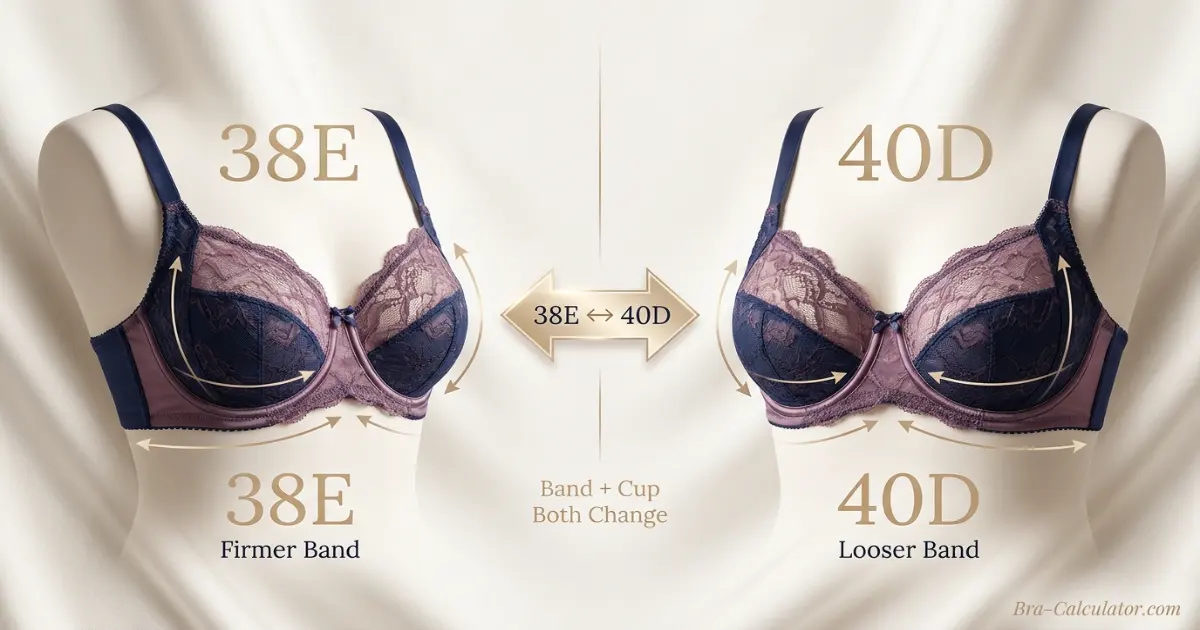
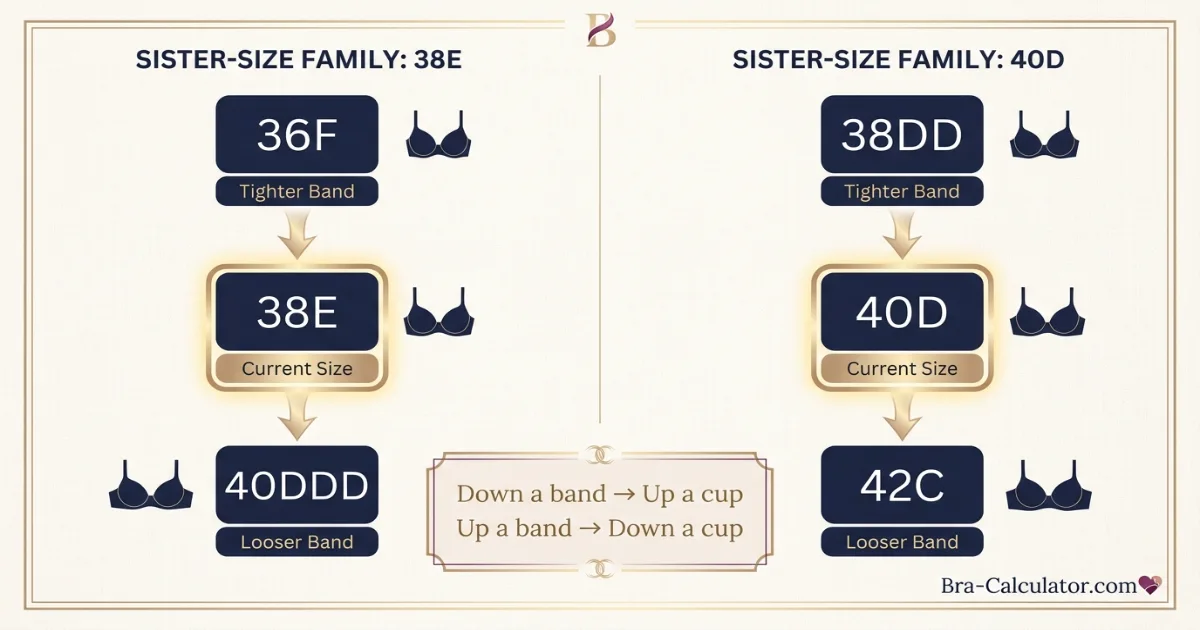
Choose 38E when you need the firmer 38-band anchor and the cup sits correctly. Choose 40D when the 38 band is genuinely too tight and your brand treats the labels as sister-size equivalents. Important: in UK sizing, 38E usually sisters to 40DD—not 40D—so 38E vs 40D cannot be treated as the same cup volume across every brand.
Which Should You Choose: 38E or 40D?
38E suits the wearer whose cups are broadly right but who benefits from a more secure band. It can also be the better option when a 40 band rides upward, shifts during the day or forces the straps to take over. The cup still has to match your shape; a firmer band cannot rescue a shallow or narrow cup.
40D is worth testing when ribcage comfort is the real problem and the brand chart confirms the sister relationship you expect. The looser band can reduce pressure around the torso, but it should not climb the back or let the cups drift forward when you raise your arms.
Best comparison method: Here the smartest control is the brand chart, not the letters. First establish whether 38E and 40D actually share cup capacity in that system; only then use the same bra model to judge the 38-versus-40 band change.
The Label-System Trap Behind 38E vs 40D
This comparison gets searched because the labels look like classic sister sizing: up one band, down one cup. That logic is sound only when the cup letters follow the sequence you think they do. A retailer using E as the step after DD may map differently from a UK brand that keeps DD and E as separate cup positions.
In practical terms, do not buy 40D because a generic chart says it is the sister size of 38E. Open the exact brand chart first. If 38E and 40D are not volume-equivalent in that system, you are changing both band tension and cup capacity at once.
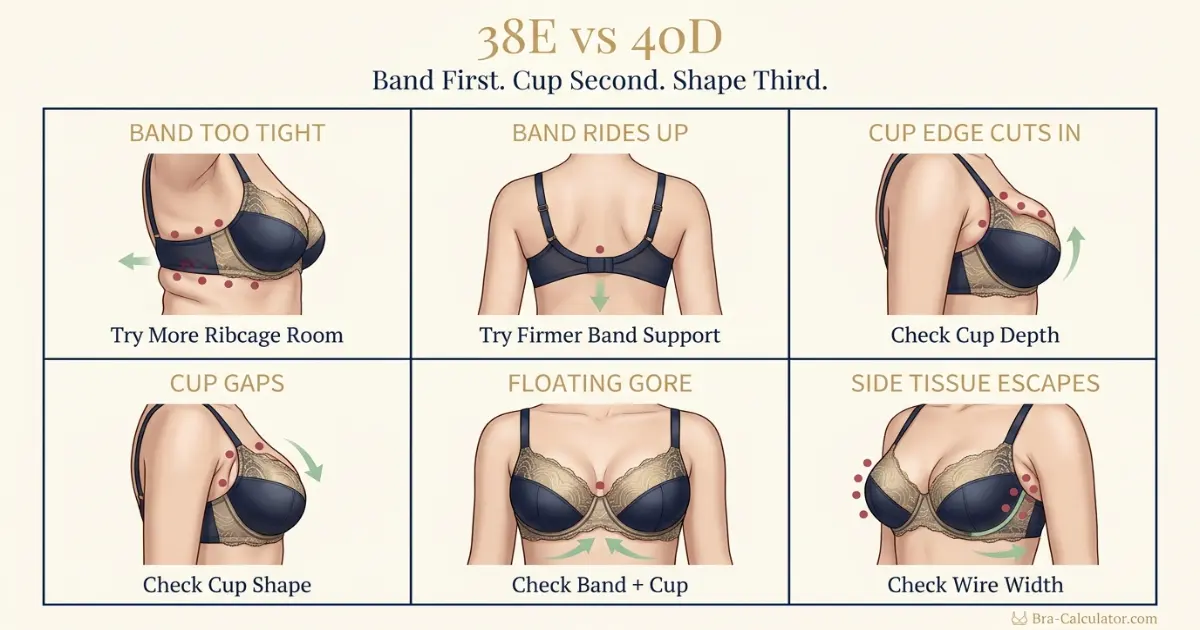
The best fitting clue is the band-only test. Put the bra on backward and upside down so the cups cannot distort the result. If the 38 band is comfortable there, the “tight band” feeling may actually be coming from cups that are too small or shallow.
How Measurements Change the 38E vs 40D Decision
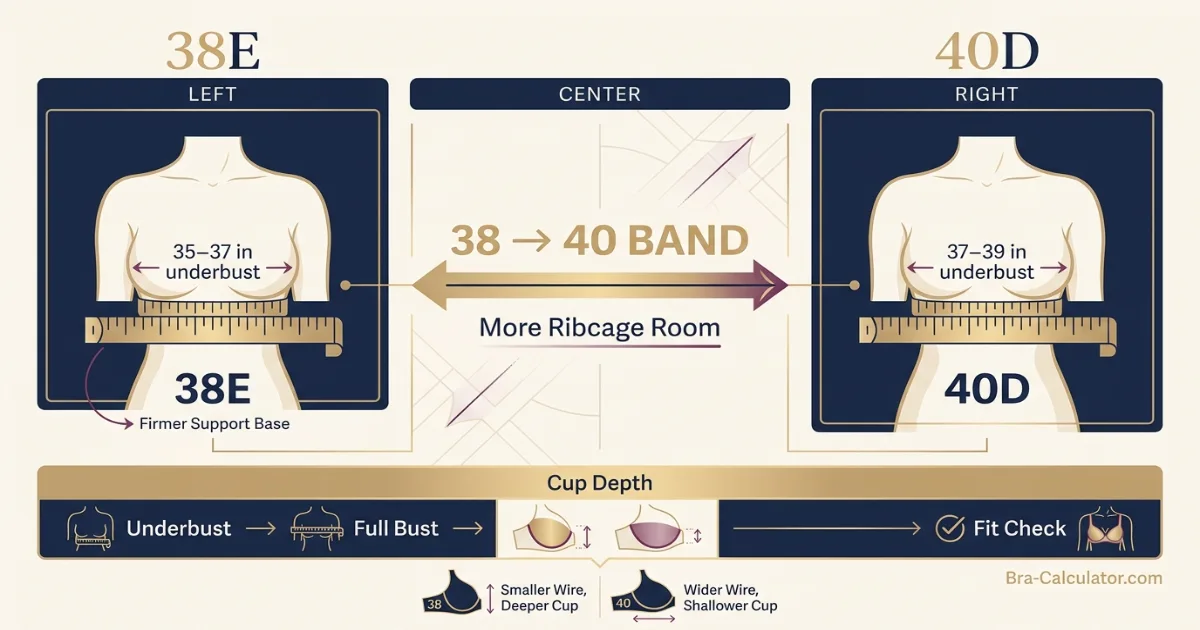
The nominal band changes from 38 to 40, so the 40 option provides more circumference and less anchoring tension. That difference is intentional. A person who measures near the boundary between bands may prefer either, depending on fabric stretch and comfort preference, but the back should still remain level.
Cup volume is the part that requires caution. If your brand maps 38E to the same capacity as 40D, then this becomes a clean band-tension comparison. If it does not, compare the brand’s direct sister size instead. Never use the letter alone as proof of equivalent volume.
Read the Bra, Not Just the Size Tag
| Fit area | What you want | What the comparison may reveal |
|---|---|---|
| Band position | 38E should feel firmer and more anchored | 40D should feel easier but must not ride up |
| Cup capacity | Depends on the brand’s letter sequence | May be sister-equivalent in some systems, smaller in others |
| Strap workload | Usually lower when the 38 band is correct | Can increase if the 40 band is too loose |
| Center front | Should remain stable without the band pulling backward | Watch for cups drifting forward if the band lacks tension |
| Best diagnostic | Backward/upside-down band test | Brand chart plus same-model comparison |
For 38E vs 40D, separate band symptoms from cup symptoms. If the 38 band feels fine without the cups, a larger band may only mask a capacity or projection problem at the front.
How to Compare 38E and 40D Without Guessing
Test the 38 band alone
Wear 38E backward and upside down. If the band is comfortable, do not size up just because the cups make the bra feel tight.
Confirm the brand sequence
Check whether that brand treats E as DD-equivalent, a separate cup, or uses another notation.
Try 40D in the same model
Compare back height, cup containment and how much work the straps are doing.
Raise both arms
A 40 band that slides up or lets the cups shift is too loose even if it feels softer at first.
Choose stability plus comfort
The winner should be secure enough to support you and comfortable enough to wear for hours.
Three Bra Constructions That Make the Difference Easier to See
A good test set for this pair should make band movement obvious. Stable wings, a structured cup and an active option help reveal whether 40D is genuinely more comfortable or simply less anchored.

Structured Everyday Full-Cup Bra
A stable everyday frame makes it easier to tell whether the 38 band is truly restrictive or the cups are creating the pressure.
- Firm frame highlights real band tension
- Full cup keeps tissue controlled during comparison
- Useful for checking gore and wire stability

Balconette Side-Support Bra
A supportive but less enclosing cup lets you compare anchoring without adding excessive upper-cup fabric. It can be useful when full cups feel too tall.
- Side support improves forward shape
- Lower neckline exposes cup-edge fit clearly
- Good for testing 38 vs 40 band behavior

Encapsulation Sports Bra
Movement quickly shows whether 40D is comfortably secure or simply too loose. Use it as a secondary check after you settle the everyday size.
- Band movement is easy to notice
- Separate cups help reveal containment differences
- Helpful for bounce-control comparisons
Breast Shape Can Change Which Size Looks Right
On a softer ribcage, the 38 band may feel firmer without being wrong; a wider, smoother band can distribute pressure better than moving straight to 40. On a sensitive or expanding ribcage, 40 may be the more wearable option if it remains level and the cup mapping is correct.
Projected breasts can make 38E feel “too tight” when the true issue is insufficient cup depth. Before increasing the band, check whether the wire is being pushed down and the gore is floating. Those are classic signs that the cups may be stealing space from the band.
Use Sister Sizing Only After You Know the Correct Cup Position
The phrase “sister size” means similar cup capacity on a different band—not simply one band up and one letter down by appearance. The letter sequence must be considered. That is why 38E → 40D is brand-dependent, while UK 38E typically maps to 40DD as the direct looser-band sister.
If you shop internationally, convert the entire size system rather than translating only the cup letter. A US 38E label, a UK 38E label and an EU 85E label can sit in different practical contexts.
Open the Sister Size Calculator → · Check International Conversions →
If You’re Ordering 38E or 40D Online
Online listings often compress several regional size systems into one dropdown. Look for a size-chart tab, inside-tag photo or manufacturer note that states US, UK or EU sizing. If the retailer does not make the system clear, the safest move is to buy by the brand’s official chart rather than a generic marketplace conversion.
If 38E is almost perfect and only the new band feels firm, a non-stretch extender can be a useful temporary test. It adds a smaller amount of room than jumping straight to a 40 band and lets you see whether your cup placement improves without changing cup labeling at the same time.
What Usually Goes Wrong in a 38E vs 40D Comparison
- Calling 40D the automatic sister size of every 38E.
- Sizing up the band because a shallow cup makes 38E feel tight.
- Keeping a comfortable 40D even when the back rides up and support disappears.
- Comparing different brands with different E/DD conventions.
- Forgetting that band stretch varies substantially between bra models.
Tools That Help You Confirm the Fit
38E vs 40D FAQs
Are 38E and 40D sister sizes?
Sometimes, depending on the brand’s cup notation. In UK sizing, 38E usually sisters to 40DD, so 40D is not the direct equivalent there.
Which has the tighter band?
38E. A 38 band is nominally smaller and usually provides firmer anchoring than a 40 band in the same bra.
Why does 38E feel tighter than expected?
A too-small or too-shallow cup can make the entire bra feel tight. Use the backward/upside-down band test before moving to 40.
When should I choose 40D?
When the 38 band itself is genuinely uncomfortable and the brand chart confirms that 40D gives the cup capacity you need.
Can 40D give less support?
Yes, if the band is too loose. Most bra support should come from a stable band, not from overtightened straps.
What is the safest way to order online?
Check the exact brand chart, confirm the return policy and, if possible, order the two closest mapped sizes in the same model for comparison.
The Bottom Line on 38E vs 40D
38E vs 40D is a band-and-label-system decision, not a universal sister-size shortcut. Confirm the brand’s cup sequence first, then choose the smallest band that feels comfortably secure while keeping the correct cup capacity.
Still Between 38E and 40D?
Before choosing 40D for comfort, confirm that it is the correct sister mapping for your brand. Then keep the option that remains level and supportive through a normal day, not merely the one that feels loosest in the fitting room.