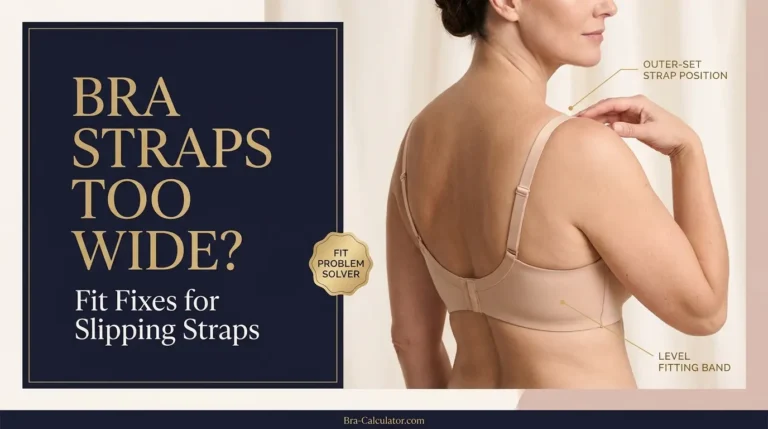
Bra cup gaping means part of the cup is not making smooth contact with your breast tissue, but it does not always mean the cup is too big. Cups may gape because the cup is too large, the top edge is too tall or open for your breast shape, molded foam does not flex with softer tissue, one breast is smaller, the straps need gentle adjustment, or the band is shifting. Scoop and swoop first, confirm the band is secure, and then judge whether you need a size change or a different cup shape.
Bra Cup Gaping at a Glance
| Fit Sign | What It Can Mean |
|---|---|
| Gap at the upper cup edge only | Cup may be too tall or too open on top for your breast shape, especially in molded styles. |
| Empty space throughout the whole cup | Cup volume may be too large after proper scoop-and-swoop fitting. |
| Gaping plus spillage or a floating gore | Do not automatically size down; the cup may be too shallow or the wrong shape. |
| Wrinkles close to the underwire | Fabric may be loose, or the cup may lack enough depth for tissue to settle at the wire. |
| One cup gaps more than the other | Natural breast asymmetry is common; fit the larger side first. |
| Gap appears when moving or sitting | Rigid molded cups may not flex with the body; a softer construction may fit better. |
What Does It Mean When Bra Cups Don’t Lay Flat?
A well-fitting bra cup should hold breast tissue comfortably with a smooth upper edge, no cutting in and no obvious empty pocket between the cup and the body. When the cup edge lifts away, folds, wrinkles or looks hollow, this is commonly described as bra cup gaping. It can happen along the neckline, near the strap, across a molded T-shirt cup or in only one side of the bra.
The mistake many shoppers make is assuming every gap equals “my bra cups are too big.” Sometimes that is true. If the entire cup looks empty after all breast tissue has been placed into it, a smaller cup may be appropriate. But many people experience bra cups gaping at the top while the bottom of the cup fits or even feels cramped. In that situation, reducing cup size can create spillage or underwire pressure without fixing the shape mismatch.
Breasts and bra cups are three-dimensional shapes. Two bras labeled the same size may fit very differently: one can be tall and open at the neckline, another short and closed; one can be shallow and molded, another deeper and seamed. A cup that is technically close in volume may still fail to lie smoothly if its shape does not match your fullness, projection or softness.
Fit truth: A small top gap does not automatically mean your breast size has changed. Before changing size, check your band, scoop all tissue into the cups, adjust straps gently and compare a softer or shorter cup style.
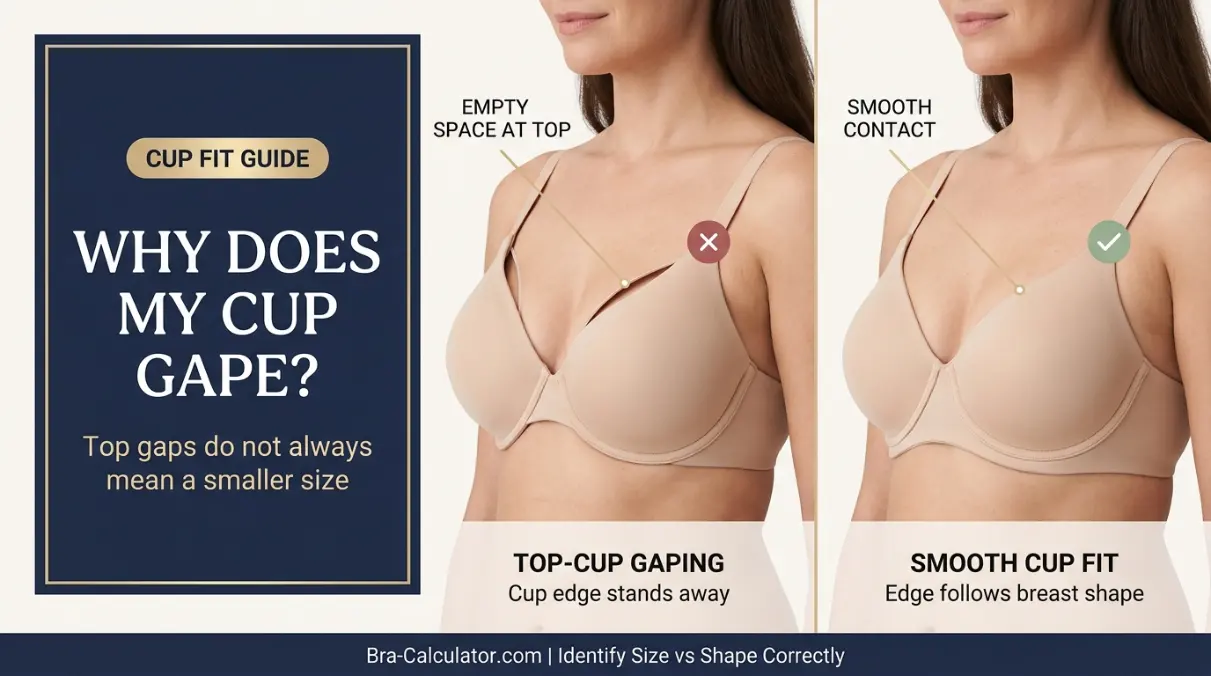
Five Checks Before You Try a Gaping Bra Cups Fix
Make these checks while wearing the bra you are evaluating. A single symptom is less useful than the full pattern of band, cup, strap and movement signs.
Lean slightly forward, reach into each cup and bring tissue from the side and underneath into the cup. A cup may appear empty simply because tissue has not been fully positioned inside it.
The band should stay horizontal around the torso and feel comfortably firm on the loosest secure hook in a new bra. If it rises or shifts, cups can tilt away and look loose at the neckline.
Shorten straps just enough to remove slack. If you must overtighten them to force the cup edge flat, the bra is probably not matching your size or shape properly.
Notice whether the opening is only at the upper edge, across the entire cup, in the smaller breast only, or near the bottom wire. Location changes the best solution.
Sit, lift your arms and bend slightly. If a rigid molded cup gaps mainly during movement, a softer stretch-lace, spacer or seamed cup may flex more naturally.
| Your Test Result | Likely Issue | Best First Change |
|---|---|---|
| Whole cup remains visibly empty | Cup may be too large | Try one cup size smaller on the same stable band. |
| Top gaps, but bottom cup fits smoothly | Cup shape or height mismatch | Try demi, balconette, stretch-lace or shorter cups. |
| Top gaps while breast tissue also spills | Likely shallow/wrong cup shape | Try a deeper or more projected cup, not an automatic size down. |
| Only one side gaps | Breast asymmetry | Fit the larger side; adjust or pad the smaller side. |
| Band rides up and cups shift | Band stability issue | Check band fit and consider a firmer sister size. |
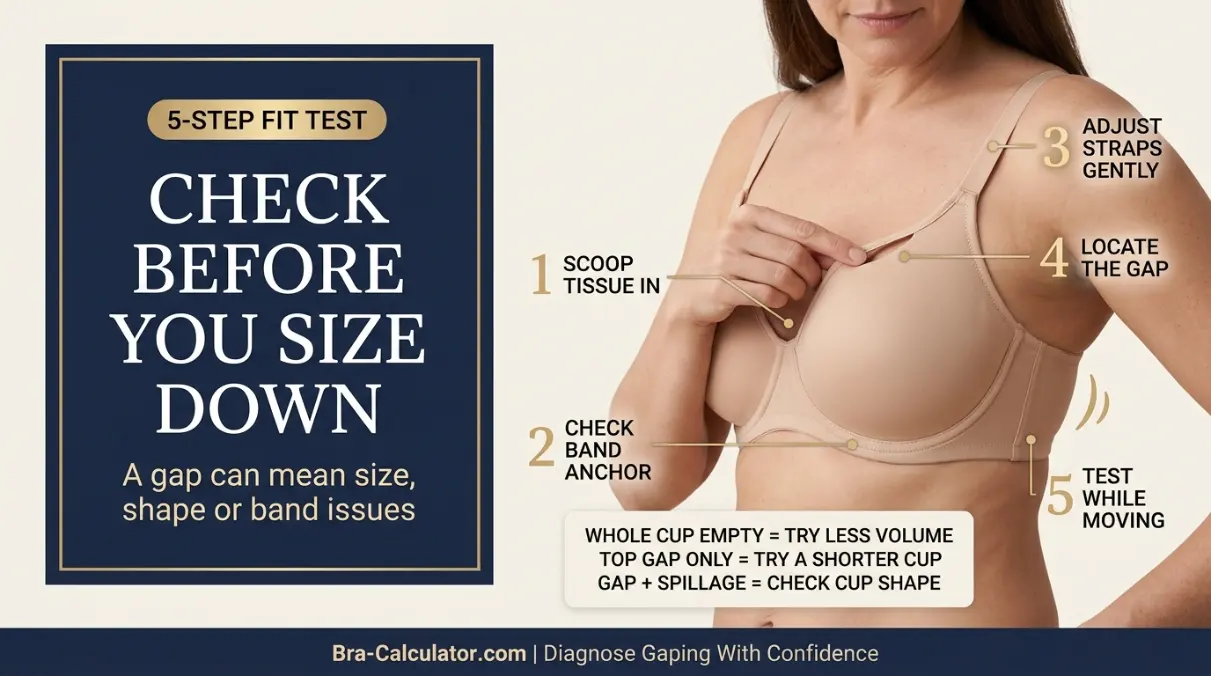
Why Your Bra Cups Are Gaping
1. The Cups Are Truly Too Big
If there is visible space throughout the cup, the fabric collapses broadly, and the bra still feels loose after tissue is fully scooped in, the cup may offer more volume than you need.
2. The Cup Is Too Tall or Too Open on Top
Some bras expect more upper-breast fullness. If your breasts are fuller on the bottom, shallow on top, teardrop shaped or softer, a tall neckline can stand away despite adequate overall volume.
3. Molded Cups Do Not Match Your Shape
Foam-molded T-shirt bras hold their own firm silhouette. They may look smooth under clothing when they match, but they can gape when the breast is softer, projected, asymmetric or changes with movement.
4. The Band Is Too Loose
A loose band cannot keep the wires and cups securely placed. As the bra shifts upward or forward, the cup edge may lift away and make it seem as if the cup is too large.
5. Cup Gaping Is Mixed With Spillage
This combination is especially important. A shallow cup can leave unused space in one area while cutting into tissue elsewhere. The bra may gape at the top yet be too small or too shallow overall.
6. One Breast Is Naturally Smaller
Many people have some asymmetry, so one cup may fit smoothly while the other gaps. Buying a smaller size to eliminate the gap can make the fuller side uncomfortable.
7. Breast Shape or Fullness Has Changed
Weight changes, pregnancy, breastfeeding, hormonal shifts and aging can alter upper fullness and tissue softness. A bra style that once sat flat may later gape even if your underbust measurement is similar.
Gaping, Wrinkles or Spillage: They Are Not the Same Problem
A bra cup can look imperfect in several ways, and the right correction depends on what the cup is doing. Understanding the difference prevents you from decreasing cup size when the true issue is shape or depth.
| What You See | What It Often Suggests | Avoid This Mistake |
|---|---|---|
| Top edge gapes while lower cup is filled | Too-tall/open cup edge or low upper fullness | Do not immediately choose a smaller cup if the bottom fits. |
| Cup wrinkles everywhere with no breast pressure | Extra volume or poorly supported fabric | Do not ignore the band; confirm it is anchoring correctly. |
| Wrinkles at the bottom near the wire | Cup may be pushed down by tissue needing more depth, or the wire is not in the breast root | Do not assume a smaller cup is the answer. |
| Gaping plus spillage | Cup shape mismatch, often too shallow or wrong neckline | Do not size down simply to close the top edge. |
| One cup gaps only | Normal asymmetry | Do not fit to the smaller side and compress the fuller breast. |
Especially with molded bras: A little standing room at the cup edge can be a construction issue, not proof that your body is “wrong” for the size. Softer cups often show the true fit more accurately.
Step-by-Step: How to Fix Gaping Bra Cups
Make changes in this order. It prevents buying a smaller cup when the actual solution is band stability or a different cup shape.
Fasten the bra on the appropriate hook, scoop breast tissue fully forward into each cup and settle the wires at the breast root. Check the gap again only after this step.
A band that moves is not giving the cups a stable base. It should feel secure without painful tightness and stay horizontal when you lift your arms. Review the bra band too loose guide if the band shifts.
Tighten each strap only until the upper cup is held in place without shoulder digging or band lift. For one-sided gaping, adjust the smaller side individually rather than tightening both straps equally.
If empty space remains throughout both cups and the band fits, try one cup size smaller. If the band is too loose while cup volume looks close, use sister sizing rather than reducing only the cup.
When the lower cup is filled but the top stays open, test a shorter or more flexible neckline: demi, balconette, stretch lace, spacer foam or an unlined seamed bra may lay more smoothly.
Why Cup Gaping Happens on Different Bodies
Bra cup gaping is not a judgment about breast size or appearance. It is simply a fit signal: the cup design is not contacting tissue evenly. Shape and tissue behavior often explain why the same labeled size fits beautifully in one style but gaps in another.
Top Edge May Look Empty
Breasts that are fuller below can fit better in shorter cups or cups with a more forgiving top edge.
Try demi cupsRigid Foam Can Stand Away
Flexible lace or seamed cups may conform better than a firm molded shell.
Try stretch laceOne Cup Can Gape
Fit the fuller side first and fine-tune the smaller side with an insert or strap adjustment.
Fit larger sideFullness Can Change
Upper fullness and tissue firmness can shift, so an older molded style may stop fitting smoothly.
Remeasure firstWhen to Change Cup Size or Try a Sister Size
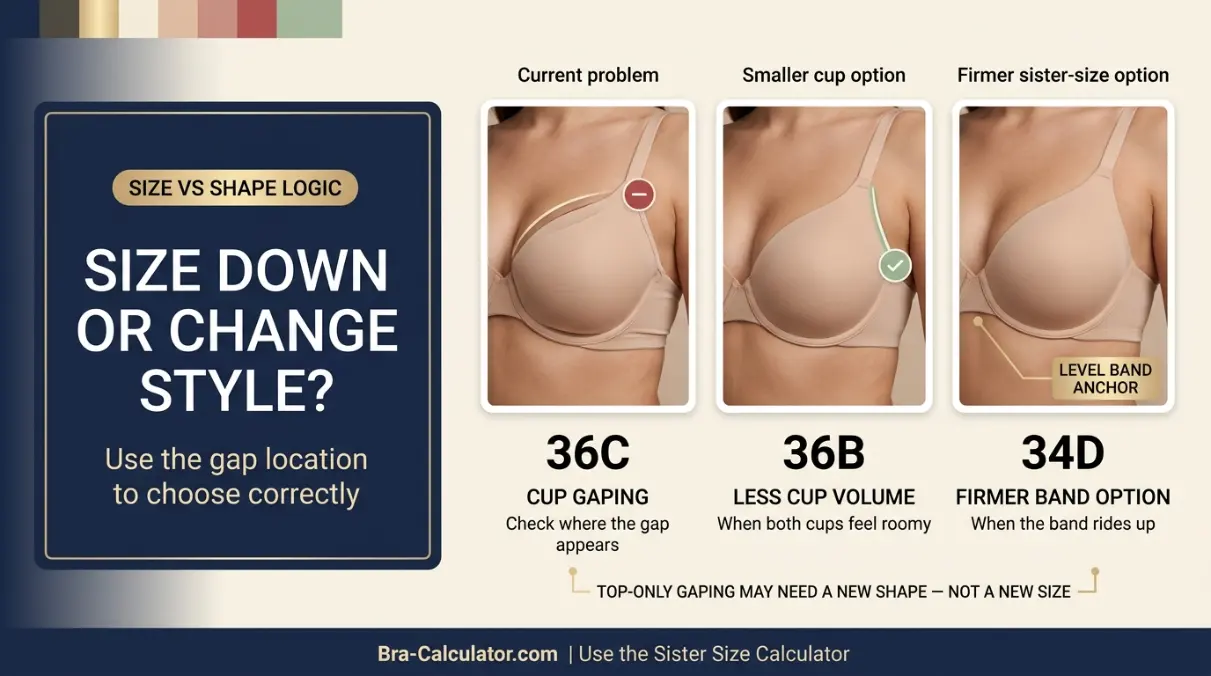
There are two very different sizing corrections for gaping: reducing cup volume when cups are genuinely roomy, or stabilizing the band while keeping similar cup volume when cups are shifting because the band is loose.
| Your Fit Signs | Try First | Why |
|---|---|---|
| Both cups are loose everywhere; band is stable | Same band, one cup smaller | There may be too much cup volume. |
| Cups gape only along the neckline; bottom fits | Different cup shape in same size | Top edge may be too tall/open rather than too large. |
| Band rides up and cups shift or gape | Down one band, up one cup | Firmer sister sizing can anchor similar volume. |
| Cups gape and tissue spills at the top/side | More cup depth or projected style | Shape mismatch can create empty space and overflow at once. |
| Only smaller breast gaps | Fit larger side; add insert if desired | A smaller overall cup may hurt the fuller side. |
What Should You Fix First?
- Both cups appear empty overall
- Fabric is loose across most of the cup
- Band stays secure and level
- Try one cup size smaller
- Keep the band size if stable
- Retest after scoop-and-swoop
- Gap occurs at the top edge only
- Bottom cup is filled
- Molded cups gap more than soft cups
- Try shorter or stretch neckline
- Compare demi or balconette bras
- Do not automatically size down
- Band rises at the back
- Cups move when arms lift
- Gap changes through the day
- Test a firmer band anchor
- Use sister sizing if cup volume fits
- Recheck cup edge after stabilizing
- Only one cup opens at the top
- Other side fits smoothly
- One breast is slightly fuller
- Size to the fuller side
- Adjust smaller-side strap gently
- Try removable insert or flexible cups
Bra Styles That Often Help With Top-Cup Gaping
Flexible upper lace can follow changing or softer tissue and reduce an open cup edge.
A shorter cup can suit less upper fullness without leaving excess fabric near the neckline.
Provides smoothness under clothes while flexing more naturally than rigid molded foam.
Makes shape and projection easier to assess, especially when molded bras repeatedly gape.
Helpful when one cup gaps because one breast is naturally smaller than the other.
May stand away at the upper edge if you have less top fullness or softer tissue.
Support Styles to Consider After Solving the Gap
With cup gaping, cup shape should be checked first. Once the neckline and volume sit smoothly, a secure band and comfortable straps can help keep that corrected fit stable during daily wear. Review the product’s exact cup construction and return policy before purchasing.

Wide Padded-Strap Full-Coverage Bras
- Can help maintain a steady everyday fit once the correct cup shape is confirmed.
- Look carefully at cup height: very tall coverage may not suit top-only gaping.
- Choose only after confirming that the band and cup volume are correct.

U-Back Support Bras With Wide Straps
- A stable back design may help cups stay positioned when movement contributes to gaping.
- Adjustable straps allow separate fine-tuning when one cup sits differently.
- Still check for a neckline that matches your breast fullness before buying.

Wireless Comfort Bras With Cushioned Straps
- A softer everyday option for wearers who dislike rigid cup pressure.
- Check whether flexible cups adapt more smoothly than firm molded cups.
- Do not use softness alone to mask a band or cup-size mismatch.
Problems Often Confused With Gaping Cups
Overflow means tissue is being compressed or cut off; it is not the same as a harmless gap.
A loose band can make cups move away from the body even when their volume is close.
Loose or widely spaced straps may let the upper cup collapse or open near the strap attachment.
Overtightening straps to flatten a gaping cup can create a second comfort problem.
Frequently Asked Questions
Why are my bra cups gaping at the top?
Cups may gape at the top when they are too tall, too open along the neckline, too rigid for softer tissue, or genuinely too large. Top-only gaping often points to cup style or shape mismatch rather than a simple need to go down in cup size.
Does bra cup gaping mean my cups are too big?
Not always. If your whole cup is empty after scoop-and-swoop and your band fits securely, a smaller cup may help. If the bottom fits or you have spillage at the same time, try a different cup shape or more depth first.
What is the fastest gaping bra cups fix?
Start by scooping tissue fully into the cups, confirming the band stays level and adjusting straps gently. If gaping remains, identify whether it is top-only, all-over, one-sided or paired with spillage before choosing a new size or style.
Why do my molded T-shirt bra cups not lay flat?
Molded cups keep a fixed shape. When your natural shape is softer, less full on top, more projected or asymmetric, the foam edge may stand away even when the labeled size is close. A spacer or flexible cup may suit you better.
Are bra cup wrinkles a sign the cup is too big?
Wrinkles can indicate excess room, but wrinkles near the bottom or wire may also occur when a cup is too shallow and breast tissue cannot settle fully into the deepest part. Consider location and other fit signs before sizing down.
What should I do when only one bra cup gapes?
Fit your bra to the fuller breast first. For the smaller side, adjust the strap gently, use a removable insert if preferred, or choose stretch-lace cups that adapt more naturally to asymmetry.
Can a loose band make the cups gape?
Yes. If the band rides up or shifts, the cup frame can lose contact with the body. When cup volume otherwise seems right, testing a firmer sister size may give the cups a more stable anchor.
Which bra styles are best for cups gaping at the top?
Many wearers with top-only gaping do better in stretch-lace cups, shorter demi or balconette cuts, spacer bras, seamed unlined bras or insert-compatible styles for asymmetry. The best option depends on your size and breast shape.
Stop Guessing Why Your Cups Gape
A cup that sits smoothly starts with the right band, correct cup volume and a shape that works with your body. Check your size, then use the symptom clues above to choose your next bra style confidently.