Projection Depth Analyzer 2026
Find Your Cup Depth Needs
Get a Projection Index, shape category & personalised bra-style recommendations in 60 seconds.
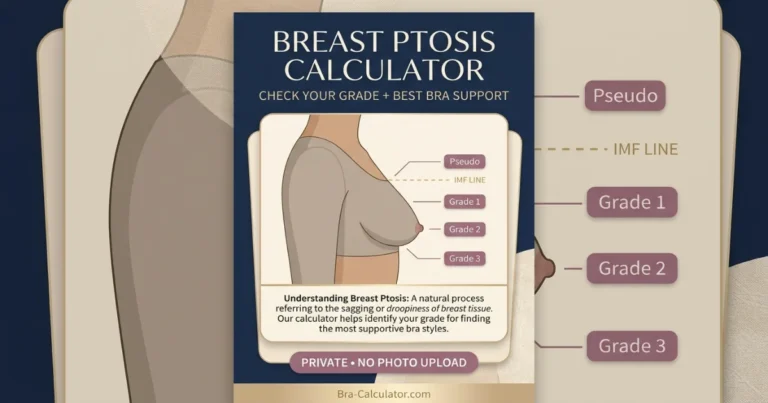
Breast projection is how far breast tissue extends forward from the chest wall. Cup size measures volume; the Projection Depth Analyzer measures shape—so you can match the cup depth your breasts actually need and avoid gaping, quad-boob, and wires being pushed forward.
If you have ever bought a bra that looked great on the hanger and felt like it fit your band and cup size — yet still gaped at the top, overflowed at the apex, or left tissue sitting awkwardly outside the wire — there is a good chance projection mismatch was the cause. Cup size tells you volume. Projection tells you shape. They are not the same thing, and confusing them is behind the majority of fit problems that even well-fitted bra-wearers experience.
This guide explains the science and the practical takeaways so you can use the Projection Depth Analyzer with full confidence in what the numbers mean.
What Does “Breast Projection” Actually Mean?
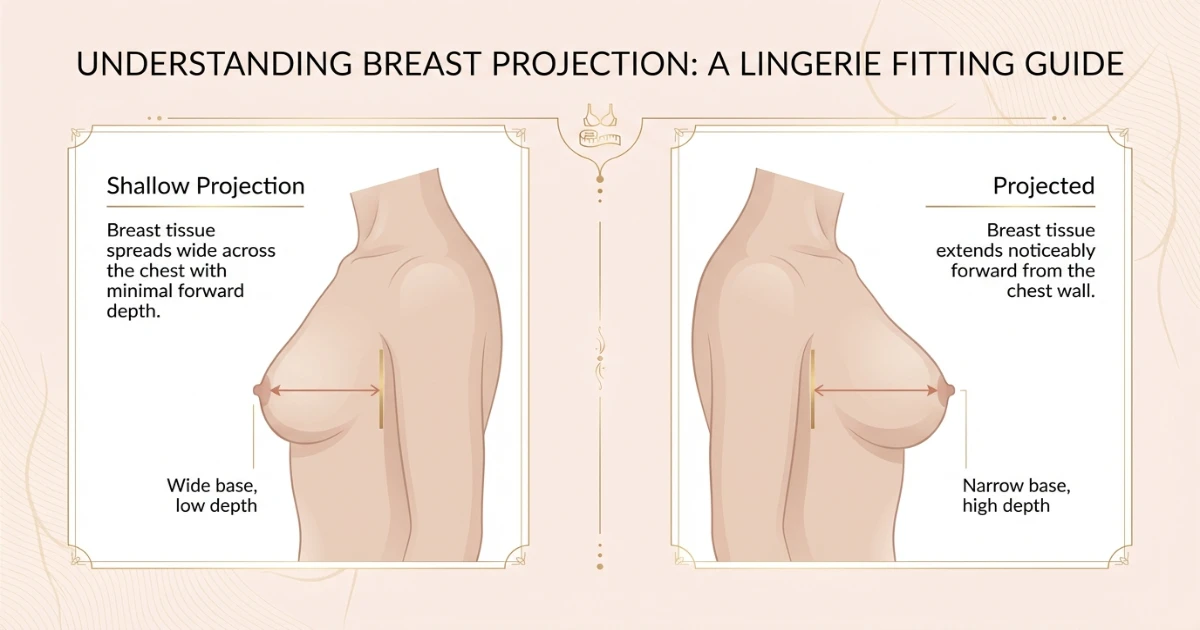
Projection describes how far forward your breast tissue extends from your chest wall relative to its width and volume. It is a measure of shape, not size. Two people can wear the same 34D and have completely opposite projection profiles — one with tissue that spreads wide and sits close to the chest (shallow), and one with tissue that juts forward significantly (projected).
Think of it this way: if you placed a sphere against a wall, shallow projection is like a disc — wide and flat. High projection is like a hemisphere — narrow at the base and forward-reaching. Both discs and hemispheres can have exactly the same volume (same “cup size”), but they need completely different cup constructions to be held comfortably.
This matters because the cup of a bra is built around a specific projection assumption. A molded foam t-shirt bra is designed for an average-to-shallow projection profile. A 3-part seamed cup is designed with more forward depth. Put the wrong cup construction on the wrong projection profile, and no amount of size adjustment will fix the fit.
Who the Projection Depth Analyzer is for
This tool is most useful if you’re thinking, “My size looks right… but the bra still feels wrong.” It’s especially relevant when you notice:
- Top gaping in molded cups (even when the band feels correct)
- Apex overflow or “quad-boob” in plunges and demis
- Wires pushed forward and the band riding up by midday
Why Standard Fitting Advice Often Misses This
Most sizing methods — and even many professional fittings — focus on underbust band size and the volume difference between underbust and bust. This produces a letter (A, B, C, D…) that describes volume. But the same volume of tissue can project very differently depending on density, root width, and how tissue is distributed. The Projection Index bridges this gap by capturing the forward-hang dimension directly, using your leaning measurement as the key input.
How We Calculate Your Projection Index
The analyzer uses a two-step method: first, extract the raw projection signal from your measurements; second, refine it using your personal fit profile.
Sanity checks that prevent bad results
- Leaning bust is usually equal to or larger than standing bust.
- Lying bust is often smaller than leaning (that’s why it’s useful).
- If your numbers sit near a boundary (e.g., 2.1–2.3 in delta), re-measure once and use the average.
Step 1 — Projection Delta
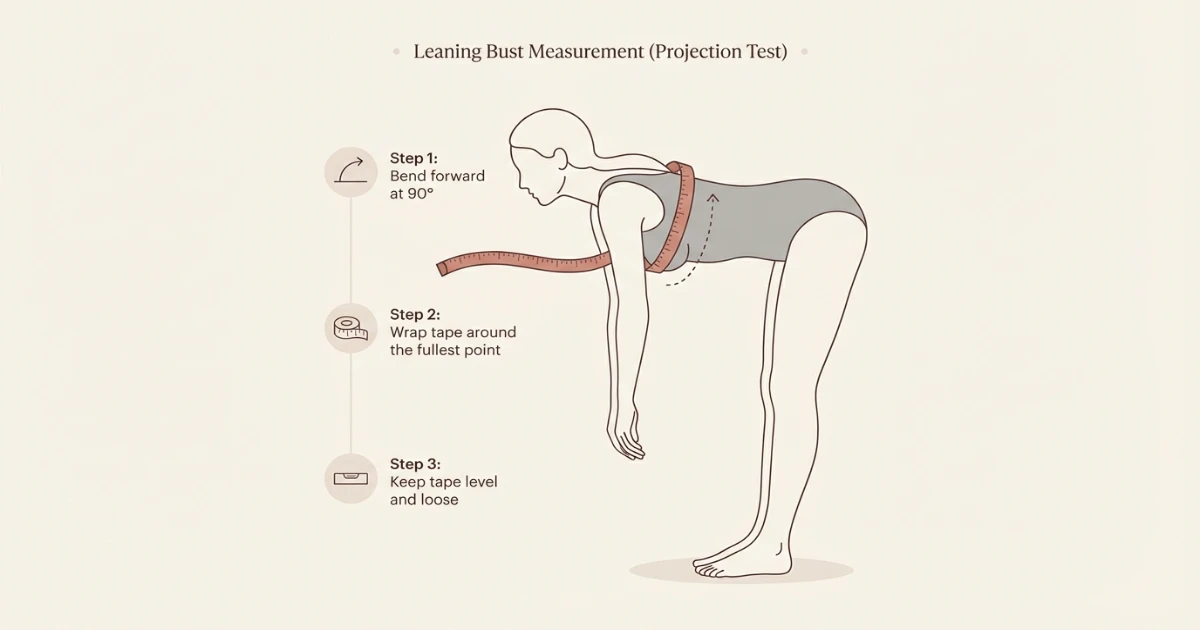
The core signal is the difference between your leaning bust and your standing bust:
The reason the leaning measurement is so powerful is that when you bend forward 90° and let your breast tissue hang freely, gravity removes the “standing compression” effect. The tissue falls into its natural shape, giving a direct read on how far it would project if fully supported in a deep cup. The difference between that hanging measurement and your upright standing measurement is your projection signal.
Step 2 — Profile Adjustments
Raw delta is a strong predictor, but two people with the same delta can still experience different fit challenges based on tissue behaviour. We apply small, evidence-based adjustments from your Fit Profile:
| Profile Factor | Adjustment | Reasoning |
|---|---|---|
| Soft / relaxed tissue | +0.3 index points | Soft tissue “fills” a cup more aggressively and behaves like higher projection in fit practice |
| Firm / dense tissue | −0.2 index points | Firm tissue holds its shape and often fits more easily in slightly shallower cups |
| Narrow root width | +0.3 index points | Narrow-rooted tissue concentrates projection forward, increasing depth demand |
| Wide root width | −0.2 index points | Wide-spread tissue distributes across a broader base, reducing effective depth need |
These adjustments are intentionally small — they refine, they do not override. The delta remains the primary driver.
Step 3 — Shape Stability (Optional)
If you enter a lying bust measurement, the tool unlocks a Shape Stability score:
Medium difference (1–2.5 in / 2.5–6.4 cm) → Medium stability
Large difference (above 2.5 in / 6.4 cm) → Low stability — tissue shifts significantly
The 5 Projection Categories — What Each One Means
| Category | Delta Range | What it feels like | Index Range |
|---|---|---|---|
| Very Shallow | 0.0 – 0.5 in | Tissue spreads wide and sits close to the chest. Standard molded cups often feel too deep. | 0 – 1.5 |
| Shallow | 0.6 – 1.2 in | Slight forward projection. Most mainstream bras fit, but deep cups can wrinkle at apex. | 1.5 – 3.5 |
| Average | 1.3 – 2.1 in | The widest selection of bra styles fits well. This is what most mainstream bras are designed for. | 3.5 – 6.0 |
| Projected | 2.2 – 3.0 in | Consistent overflow in shallow cups. Needs deeper constructions. Molded t-shirt bras almost never fit well. | 6.0 – 8.5 |
| Very Projected | 3.1 in + | Standard cups fall short consistently. Requires specialist construction — 3-part seamed, tall apex, stretch top panels. | 8.5 – 10 |
Fast Cup-Depth Check (No measuring)
Use this when you’re reading product descriptions or reviews. It helps you spot shallow vs deep constructions instantly.
Best Bras by Projection Type
Very Shallow & Shallow Projection
If you land in these two categories, your fit challenge is the opposite of what most projection content assumes. You are not looking for more depth — you are looking for cups that sit flatter and do not create volume your tissue cannot fill. The classic symptom is the dreaded apex gap: the cup fabric lifts away from your tissue at the top or centre because the cup was designed for a more forward-projecting shape.
✅ Styles that work for shallow projection
⚠️ Styles to avoid
Construction cues to look for: A lower, more horizontal seam at the apex, wide wires relative to breast root, and modest cup height. Brands that offer “petite” or “plunge” cuts are often calibrated for shallower projection profiles.
Average Projection
The good news: most of the bra market is designed with average projection in mind. You have the widest selection of styles available to you. The risk is complacency — even within average projection, the difference between the shallow end (1.3 in) and the deeper end (2.0 in) matters. If you land toward the upper range, some very shallow demi styles may still cause minor spillage at the apex.
✅ Strong options for average projection
Your priority is finding the right band and volume fit — projection is rarely your limiting factor. Focus on wire width matching your root, and gore height sitting flat against your sternum.
Projected & Very Projected
This is where most fit problems cluster for forward-projecting shapes. The mainstream bra market under-serves projected profiles — not because good bras do not exist, but because the dominant mass-market construction (firm foam molded cups) is designed for average-to-shallow shapes. When projected tissue meets a shallow molded cup, one of three things happens: the tissue overflows the cup; the wires are pushed forward and outward; or the band rides up because the cup cannot contain what it needs to.
✅ What projected shapes need
⚠️ What typically fails for projected shapes
For Very Projected profiles specifically, it is worth researching brands that explicitly cater to fuller, more forward-projecting shapes. Many specialist ranges design cups with noticeably more forward depth than mainstream equivalents in the same letter size.
2 Great Starting Bras by Projection Type
These are safe “first tries” based on cup construction.


Projection vs. Cup Size — Understanding the Difference
This is the most important conceptual point in this entire guide: you can have large cup volume and shallow projection, or small cup volume and high projection. These are independent dimensions.
A 32G wearer with shallow projection may fit well in a 32G molded t-shirt bra. A 32C wearer with high projection may overflow that same style despite having less volume. The letter is not the limiting factor — cup depth construction is.
This also explains why sister sizing does not solve projection mismatch. If a 34D is gaping at the top because you have shallow projection, going to a 34C (less volume) does not help — you still have the same shape, just in a cup that now holds even less tissue. The fix is not size, it is construction style.
How Tissue Firmness and Root Width Modify Projection Behaviour
Two people can have identical projection deltas and still experience meaningfully different fit outcomes. The reason comes down to tissue firmness and root width — the two profile factors that most reliably shift how projection translates into cup depth demand.
Tissue Firmness
Firm, dense tissue holds its shape and may tolerate slightly shallower cups than the delta alone suggests. Soft, relaxed tissue tends to flow into available space and can overflow cups that lack depth—especially in projected profiles.
Root Width
Narrow root width concentrates projection forward (higher depth demand). Wide root width spreads volume across a broader base (often lower effective depth demand).
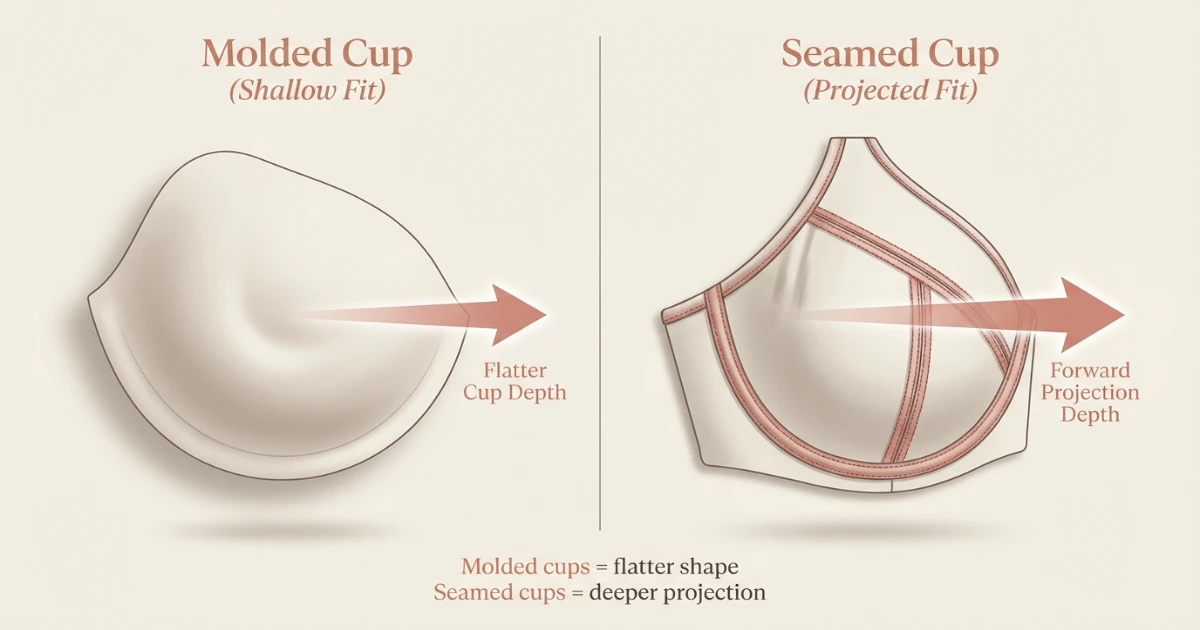
Common Fit Symptoms and What They Reveal About Projection
If you have ever dismissed a fit problem as “just the wrong size” without resolving it through resizing, it may be a projection mismatch. Here are the most common symptoms mapped to their likely cause:
| Symptom | Most likely projection cause | Fix direction |
|---|---|---|
| Gaping at the top of the cup | Cup projects more than your tissue — you are shallow | Try shallower/demi constructions; avoid deep 3-part seamed cups |
| Tissue overflowing at the apex | Cup projects less than your tissue — you are projected | Look for 3-part seamed, stretch top panel, taller cup height |
| Wires pushed outward or forward | Projected tissue pushing against a too-shallow cup | Choose deeper construction; check wire width matches root width |
| Band riding up (especially in back) | Often the cup can’t contain tissue, levering the band upward | Fix cup depth match before changing band size |
| Wrinkled/puckered cup fabric | Too much depth for your tissue | Try shallower cup construction (often molded demi) |
| Side tissue escaping | Wire width mismatch (root width issue) | Match wire width; consider side support panels |
Common measuring mistakes (quick fix)
Projection and Specific Bra Styles
Strapless Bras
Projection matters enormously for strapless fit. Without straps taking any load, the band + cup construction does everything. A projected wearer in a strapless bra with a too-shallow cup often experiences forward roll and downward migration. For projected profiles, look for structured side boning, a deeper inner cup, and secure underwire placement. Avoid foam-forward push-up strapless styles. Use our Strapless Bra Calculator alongside the Projection Depth Analyzer results for the best strapless outcome.
Minimizer Bras
Many mainstream minimizers use a flatter, wider cup to redistribute tissue sideways—great for shallow shapes, but uncomfortable for very projected profiles. If you’re projected and want a minimizing look, prioritize a seamed full cup minimizer (encapsulation + smarter seam placement) rather than rigid foam compression.
Sports Bras
High-projection tissue usually does best with encapsulation (individual cups) instead of pure compression. If you train at higher impact, deeper cup construction controls forward movement more comfortably. See our Sports Bra Calculator for impact-level guidance.
Balconette Bras
A standard balconette is cut wide and lower—often perfect for average-to-shallow projection. Some balconettes (with taller side panels or higher apex cuts) can also work beautifully for projected shapes. The key variable is the upper cup opening: wider U-shaped openings often suit shallow tissue; narrower/higher openings often suit projected tissue.
Frequently Asked Questions About Breast Projection
How to Use These Results When Shopping
Your Projection Index and category give you two concrete filters when evaluating any bra:
Filter 1 — Cup construction. If you’re projected (index ~6+), check for a vertical seam or stretch top panel first. If you’re shallow (index below ~3), prioritize flatter molded cups, demis, and shallow plunges.
Filter 2 — Brand fit philosophy. Some brands are calibrated for average-to-shallow shapes; others build deeper cups at the same size. Reading construction details (seams, materials, cup height) is often more useful than the size label alone.
If you haven’t confirmed your baseline size yet, start with the AI Smart Fit Calculator. Projection works best when band and volume are correct first.