Bralette vs Bra: Differences, Support and Who Each Suits
In a bralette vs bra comparison, the key difference is structure and support. A bralette is a soft, unstructured bra, usually wire-free with unlined or lightly lined triangle or scoop cups, a stretch band and letter sizing (XS–XL). It gives light support and a natural shape and is very comfortable for AA–C cups. A structured bra has a firm band, shaped cups and often an underwire, and is sized by band and cup (for example 34C). It gives real lift, separation and support, which most people with D cups and above need for daily wear.
Jump to a Section
Bralette vs Bra at a Glance
| Feature | Bralette | Structured bra |
|---|---|---|
| Underwire | Almost never | Often (wireless options exist) |
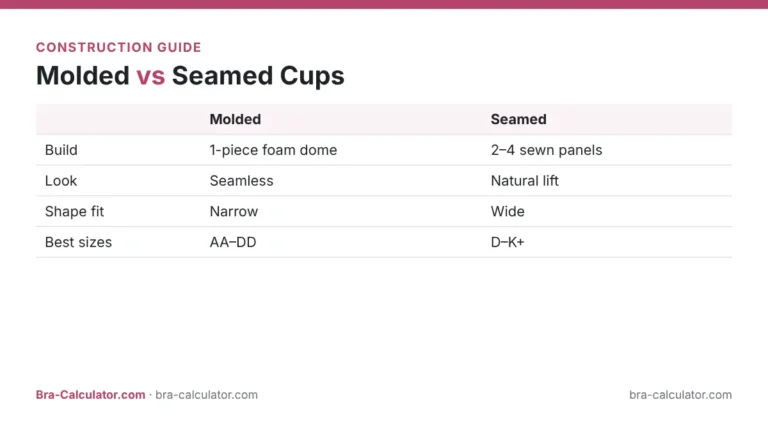
| Cups | Unlined or lightly lined, soft | Molded, seamed or padded |
| Band | Soft stretch elastic | Firm band with hook-and-eye closure |
| Sizing | Letter sizes (XS–XL) or limited band/cup | Band + cup (e.g. 34C) |
| Support | Light | Medium to high |
| Shape | Natural, often flatter | Lifted, separated, shaped |
| Best bust sizes | AA–C (some brands make DD+ bralettes) | Every size, essential for most D+ |
| Best for | Lounging, sleep, light days, styling under sheer tops | Daily support, fitted clothes, fuller busts |
What Makes a Bralette Different from a Bra?
A bralette is defined by what it leaves out. There is usually no underwire, no rigid moulded cup and no firm, multi-hook band. Instead there is a soft elastic underband, simple triangle, scoop or longline cups in lace, cotton or microfibre, and often a pull-on design with no closure at all. Because the structure is minimal, the bralette shapes itself to you rather than shaping you. Breasts look natural, slightly lower and less separated than in a structured bra.
A structured bra is engineered to lift, separate and hold. A firm band, tensioned to your ribcage measurement, carries most of the weight. Shaped cups, molded or seamed, contain and project the breast, and an underwire or side support anchors each cup to the chest wall. That structure is why bras are sized by band and cup: the band has to match your ribcage and the cup has to match your volume. Our bra size calculator measures both.
The difference in sizing is the key practical point. A bralette sized “M” covers a range of band and cup combinations, which works when cups are small and the support needed is light. Once cup volume increases, a letter size cannot match both band and cup closely enough to give real support. That is why bralettes are mostly a small and mid-cup category. The exception is the newer band-and-cup sized bralette, which keeps the soft look but borrows the sizing logic of a structured bra.
The two are not rivals. Most wardrobes have room for both: a bralette for comfort and style, and a structured bra for days that need support and shape.
There is no good evidence that wearing a bra, or not wearing one, causes or prevents sagging or any health problem. The choice between a bralette and a bra is about comfort, support and how you want to look and feel.
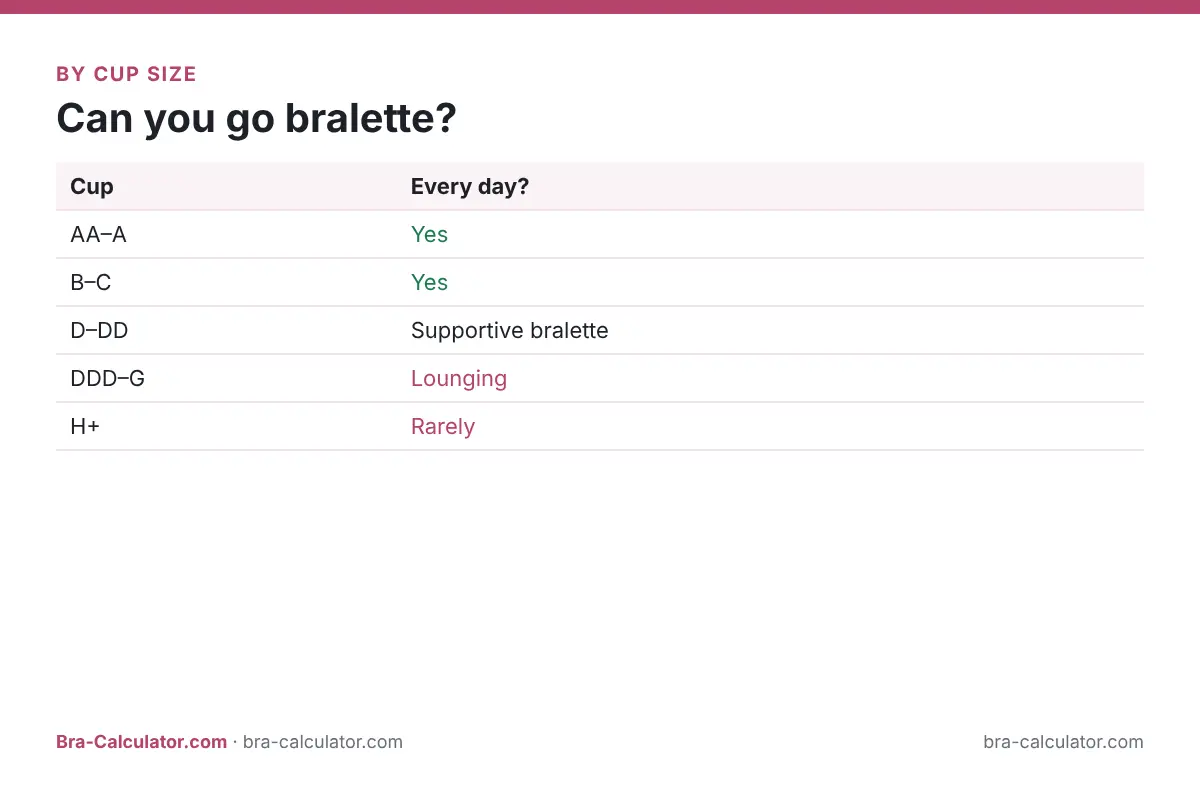
Bralette by cup size
How They Look and Feel
- Natural, softer shape
- Less lift and separation
- Pretty lace or straps meant to show
- Nipples may show if unlined
- Lifted and separated
- Rounded or projected shape
- Smooth under fitted tops
- Consistent shape all day
- Very soft and light
- No wire, no hooks digging in
- Feels like a crop top
- Great for lounging and sleep
- Held and supported
- Less movement when walking
- Can feel restrictive if poorly fitted
- Takes weight off the back and shoulders
- AA–C cups most days
- Sensitive skin
- Lounging, travel days, sleep
- Styling under sheer and low tops
- D cups and above
- Long days on your feet
- Fitted, professional clothing
- Anyone who wants lift
Can You Wear a Bralette at Your Size?
| Cup size | Bralette everyday? | Notes | Next step |
|---|---|---|---|
| AA–A | ✓ Yes, often the best fit | Molded cups often gape; bralettes follow the shape | AA cup bras |
| B–C | ✓ Yes for most activities | Choose a bralette with a wider band for more hold | B cup bras |
| D–DD | Sometimes | Look for band-and-cup sized “supportive bralettes” with a deeper cup and wider band | D cup guide |
| DDD/E–G | Lounging only, for most people | Light support; a structured or wire-free supportive bra is better for the day | wireless bras for large busts |
| H+ | Rarely | Specialist full-bust soft-cup bras exist; standard bralettes will not support | large-bust bras |
Many brands now make “supportive bralettes” in band-and-cup sizes up to G or H, with wider bands, side slings and deeper cups. They are really wire-free bras with a bralette look, and they can be a great middle ground for fuller busts. Plus-size options are covered in our guides to plus-size lace bralettes and spaghetti-strap bralettes.
Bralette sizing
How Bralette Sizing Works
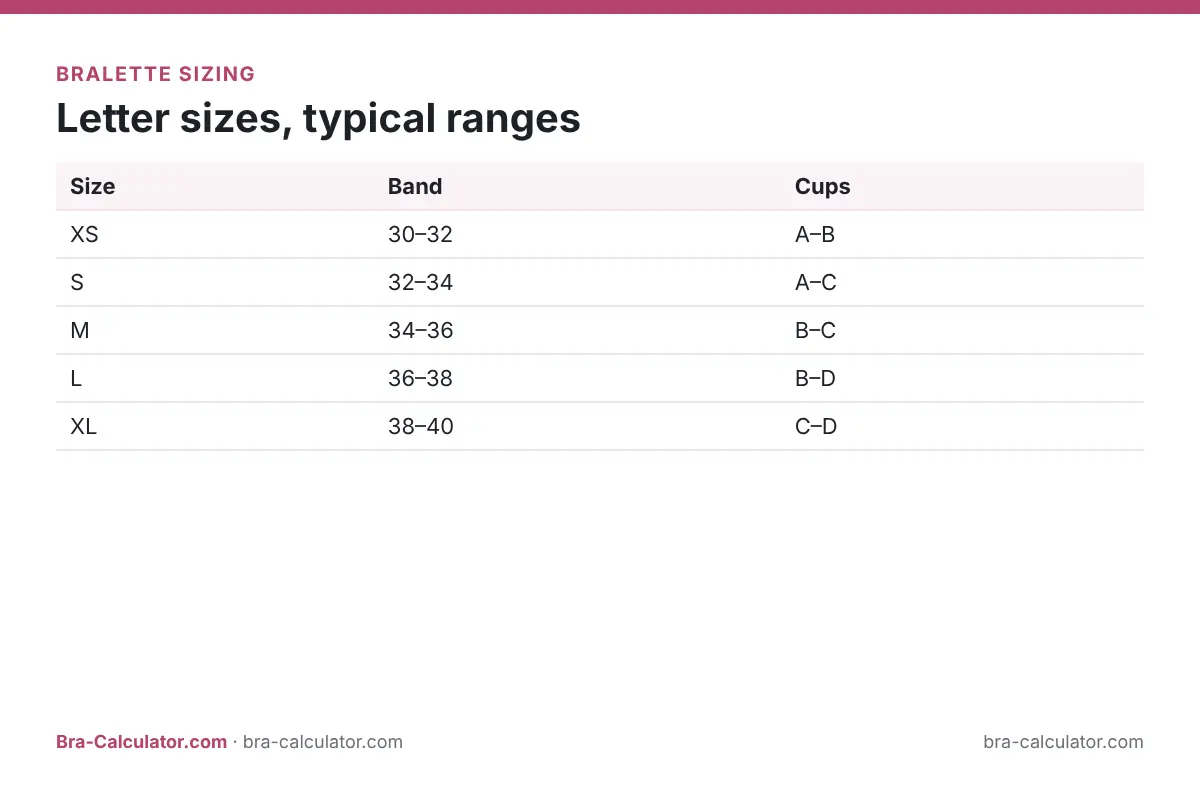
Most bralettes use letter sizes, and each brand maps them to band and cup ranges differently. A typical mapping looks like this:
| Letter size | Typical band | Typical cups |
|---|---|---|
| XS | 30–32 | A–B |
| S | 32–34 | A–C |
| M | 34–36 | B–C |
| L | 36–38 | B–D |
| XL | 38–40 | C–D |
The ranges overlap and vary by brand, so always check the brand chart. When you are between letters, size by your band: a bralette band that is too loose gives no support at all, while a slightly snug one still feels comfortable because the fabric stretches. Our bralette size converter translates your bra size into letter sizes across common sizing systems.
How Much Support Do You Actually Need?
Support needs depend on three things: cup volume, activity and personal comfort. Heavier breasts need a firm band to carry the weight; without it, the load goes to the shoulders and upper back. That is why many people with fuller busts feel neck and shoulder fatigue in a bralette after a few hours. Activity matters too. A bralette is fine at a desk or on the sofa, but walking all day or running for a bus is a different job.
A practical test: wear a bralette for a full ordinary day, including a brisk walk. If you notice shoulder or back discomfort, breast soreness from movement, or constant adjusting, you need more structure for that kind of day. That might be a supportive wire-free bra rather than an underwire. See our guide to underwire vs wireless bras for the middle options, and bras for back pain if you already notice discomfort.
Which One for Which Occasion?
| Occasion | Bralette | Structured bra |
|---|---|---|
| Lounging / working from home | ✓ Ideal | Optional |
| Sleep | ✓ A soft sleep bralette, or nothing | ✗ Avoid underwire at night |
| Office / fitted clothing | Small cups only | ✓ Smooth and supported |
| Long day on your feet | Small cups only | ✓ Better for most |
| Sheer top or low back, as a style piece | ✓ Lace bralettes are designed to show | Depends |
| Exercise | ✗ Use a sports bra | ✗ Use a sports bra |
| Travel days | ✓ Comfortable for flights | Wire-free options also work |
For exercise, neither is the right tool. A sports bra is built to control movement in a way that bralettes and everyday bras are not. See how to choose a sports bra and the sports bra calculator.
Types of Bralette
Two triangular cups on a narrow band. The lightest support; best for AA–B.
Rounded cups and a wider band give a little more hold for B–C.
A deeper band adds stability and works as a visible style piece.
Band-and-cup sizes, side slings and a wider band. Can work up to G.
Removable pads hide nipples; check that they do not bunch.
Which Breast Shapes Suit Bralettes?
| Breast shape | Bralette fit | Why |
|---|---|---|
| Shallow | ✓ Excellent | Soft cups follow wide, flat tissue with no gaping dome |
| Projected | Fair | Triangle cups can flatten forward tissue; scoop styles work better |
| Wide-set | ✓ Good | Triangle bralettes sit naturally on separated breasts |
| Close-set | ✓ Good | No gore to dig in, which is a common underwire complaint |
| Bottom-heavy | Fair | Little lift from below; longline styles help |
| Asymmetric | ✓ Good | Stretch fabric adapts to each side; add a pad if needed |
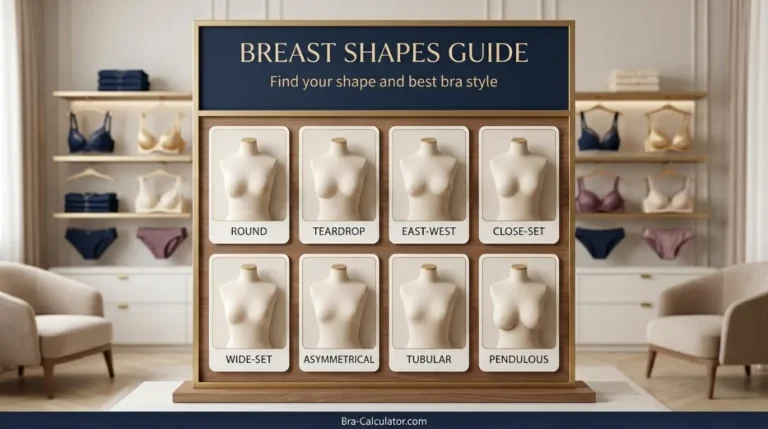
Bralettes are often the answer for shapes that struggle with underwires: shallow and close-set breasts in particular. If underwire gores dig in or molded cups always gape, a well-sized bralette may simply fit you better. Our breast shapes guide explains each shape.
Bralette Fabrics and What They Mean for Comfort
| Fabric | Feel | Support | Notes |
|---|---|---|---|
| Lace (nylon/elastane) | Pretty, light | Light | Designed to show; can feel scratchy if unlined |
| Cotton | Soft, breathable | Light | Comfortable for lounging and sensitive skin |
| Modal / viscose | Very soft, drapey | Very light | Best for sleep |
| Microfibre | Smooth | Light to medium | Invisible under T-shirts |
| Power mesh lining | Firm | Medium | Gives supportive bralettes their hold |
If you want a bralette for daily wear rather than lounging, look for a power-mesh lining in the cups and a band at least 1 inch (2.5 cm) wide. Those two features add more support than any amount of padding.
Bralettes in Pregnancy, Nursing and Later Life
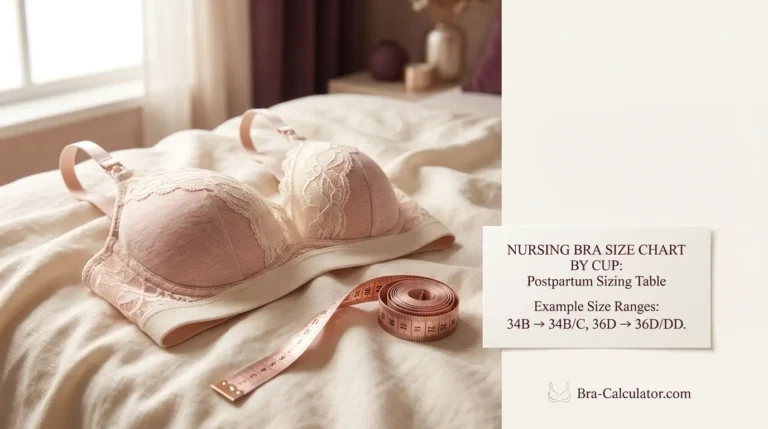
Bralettes are popular during pregnancy, when breast size changes week to week and wires can feel uncomfortable. A stretchy bralette adapts as you grow, though fuller busts may still want a supportive wire-free maternity bra. See maternity bras. For nursing, clip-down bralette-style nursing bras are comfortable for night feeds; see the nursing and pumping guide. In later life, many people prefer soft, wire-free options with front closures and wide, gentle bands. Supportive bralettes fill that role well for small and mid cups.
Worth Trying
All picks are in stock on Amazon with at least a 4.0-star average and hundreds of verified ratings. Ratings were checked in November 2026.
A seamless, lightly lined triangle bralette, smooth under T-shirts. Best for A–C. Check sizes on Amazon
A soft, lightly lined wire-free bra that feels like a bralette but is sized for more support. Check sizes on Amazon
A seamed full-bust underwire for D–H, for when you need real lift and support. Check sizes on Amazon
Affiliate disclosure: we earn a commission on qualifying Amazon purchases at no extra cost to you. Picks are chosen for fit, never for commission.
Common Problems and Fixes
The band is too loose.
Not enough cup depth or band tension for your volume.
The straps are carrying weight that a firm band should hold.
Unlined cups.
Often a wrong size: band too tight or cup too small.
Caring for Bralettes and Bras
Bralettes are delicate in a different way from structured bras. Lace and thin elastic snag easily, so wash bralettes in a mesh bag on a cool, gentle cycle, or by hand, and never tumble-dry them. Heat breaks down elastane quickly, and a bralette depends entirely on its stretch to stay in place. Dry them flat. Because there is no structure to hold the shape, a bralette that has lost its stretch simply stops supporting you, so replace it once the band feels loose on your body.
Structured bras need the same cool, gentle care, plus attention to cups: store molded cups nested and never fold them inside out. Rotate at least three everyday bras or bralettes so each has a day to recover. That single habit makes both types last much longer. For the signs a bra has reached the end of its life, see how often to replace a bra.
Choose in 60 Seconds
AA–C: a bralette can work every day. D+: a structured or supportive wire-free bra for most days.
Sitting and lounging: bralette. Walking all day, or fitted clothes: structured.
Yes: more structure and a firmer band.
Yes: a lace bralette is designed for it.
Lift: structured bra. Natural: bralette.
Related guides
Frequently Asked Questions
A bralette is a soft, unstructured bra, usually without underwire or molded cups, sized S–XL. A structured bra has a firm band, shaped cups and often a wire, and is sized by band and cup.
Light support. They are comfortable for AA–C cups and lounging, but most people with D cups and above need a structured or supportive wire-free bra for daily wear.
For lounging, yes. For daily wear, look for band-and-cup sized "supportive bralettes" with wide bands and side slings, which can work up to around G.
Use the brand chart and choose by band when you are between sizes. A bralette band that is too loose gives no support.
No. If it is comfortable and you do not experience discomfort, a bralette is fine for daily wear. There is no good evidence that bras prevent sagging.
Yes. A soft, wire-free bralette is a common choice for sleep if you like light support at night.
Often yes: they have no wire and few hooks. Choose tagless, flat-seamed bralettes in soft fabric.
Not exactly. All bralettes are wireless, but many wireless bras have firm bands, shaped cups and band-and-cup sizing, so they give more support than a bralette.
Know your size, even for bralettes
Your band and cup size tell you which letter size and how much support you need.