38D vs 38DD: Are They the Same Size? Same Band, Different Cup Explained (2026)
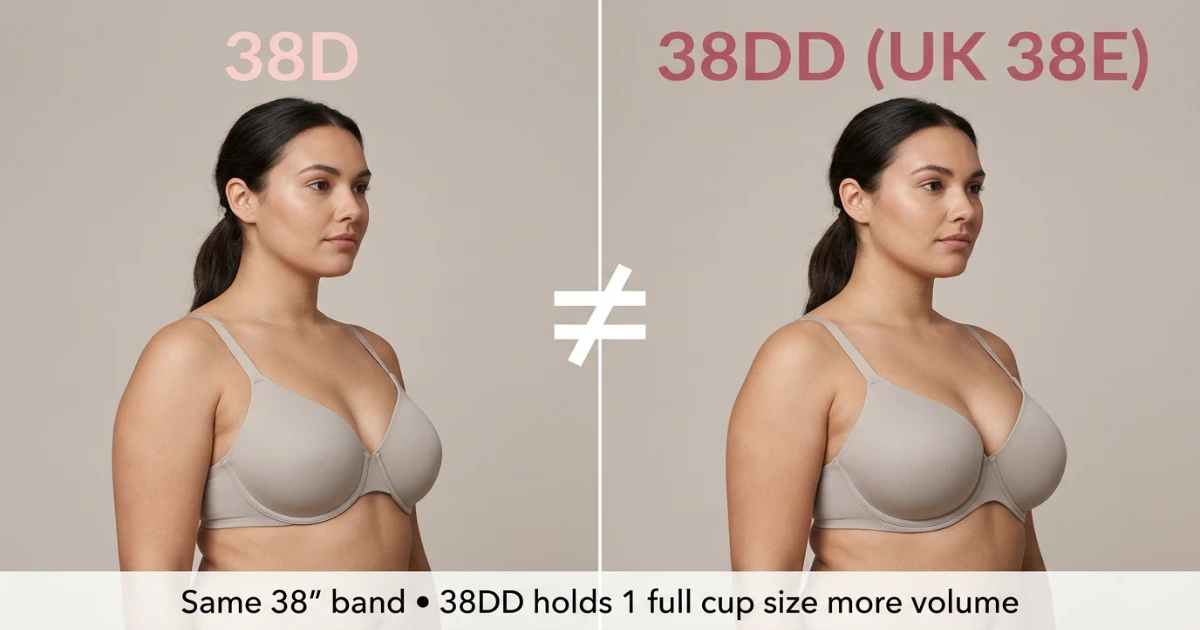
Quick Answer: No — 38D and 38DD are not the same size. They share the same 38-inch band but have different cup letters and significantly different cup volumes. The 38DD holds one full cup size more breast tissue than the 38D. Same band number does not mean same size when the cup letters differ. The correct sister size of 38D is 36DD or 40C — never 38DD.
⚠️ This is NOT a sister size comparison. Unlike comparisons such as 38DD vs 36DDD — where a different band and letter combination shares equal cup volume — 38D vs 38DD is a same-band, different-cup comparison. These two sizes share the same band but belong to entirely different volume families. The 38DD holds one full cup size more volume than the 38D. Switching between them changes your cup category entirely.
ℹ️ UK / EU sizing note: In UK and European sizing, DD is labelled E. So US 38DD = UK 38E — the exact same cup size with a different letter convention. When shopping brands like Freya, Panache, or Elomi, search for 38E to find what US brands call 38DD. This article uses US labels throughout, but all comparisons apply equally to 38D vs 38E (UK/EU).
Choose the fit signs you notice in the band, cups, center and straps. We’ll turn them into a practical next step for 38D.
Private fit check — your answers stay in your browser and are used only for this on-page guidance. Nothing is stored or submitted.
⚡ Key Takeaways
- NOT the same size: 38D and 38DD share a band but are one full cup size apart in volume.
- 38DD is larger: The 38DD cup holds one complete cup size more breast tissue than the 38D.
- Same band ≠ same size: Cup volume is determined by letter AND band together — changing only the letter on a 38 band makes a real, visible difference.
- Same underbust, different bust: Both fit a ~33–34″ (84–86 cm) underbust; 38D = ~42″ bust; 38DD = ~43″ bust.
- UK/EU naming: US 38DD = UK/EU 38E. The same physical cup, different label convention.
- Different sister families: 38D sisters are 36DD and 40C; 38DD sisters are 36DDD and 40D.
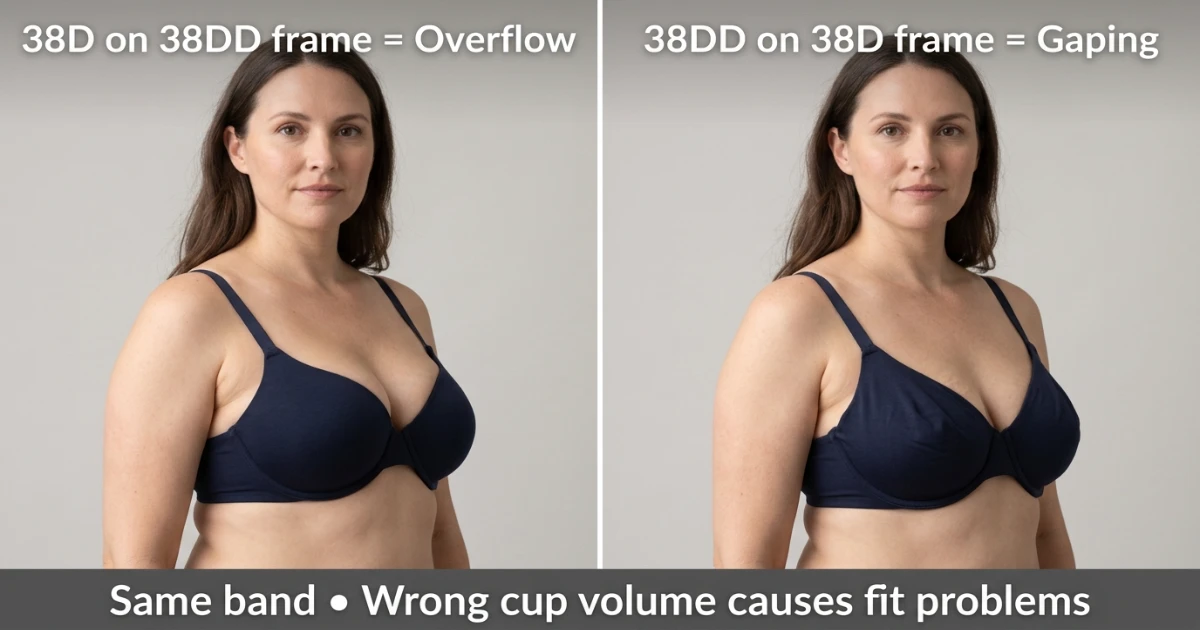
- Not interchangeable: A 38D on a 38DD frame means overflow and underwire pain; a 38DD on a 38D frame means gaping cups and wasted support.
- Correct cup-up move: If your 38D cups are too small, go to 38DD — same band, next cup. Never change the band to solve a cup problem.
- Band rides up? That is not a D vs DD problem. A riding 38 band means your underbust is narrower than 33 inches — try 36DD (same volume as 38D) or 36DDD (same volume as 38DD).
Why the Same Band Does Not Mean the Same Size
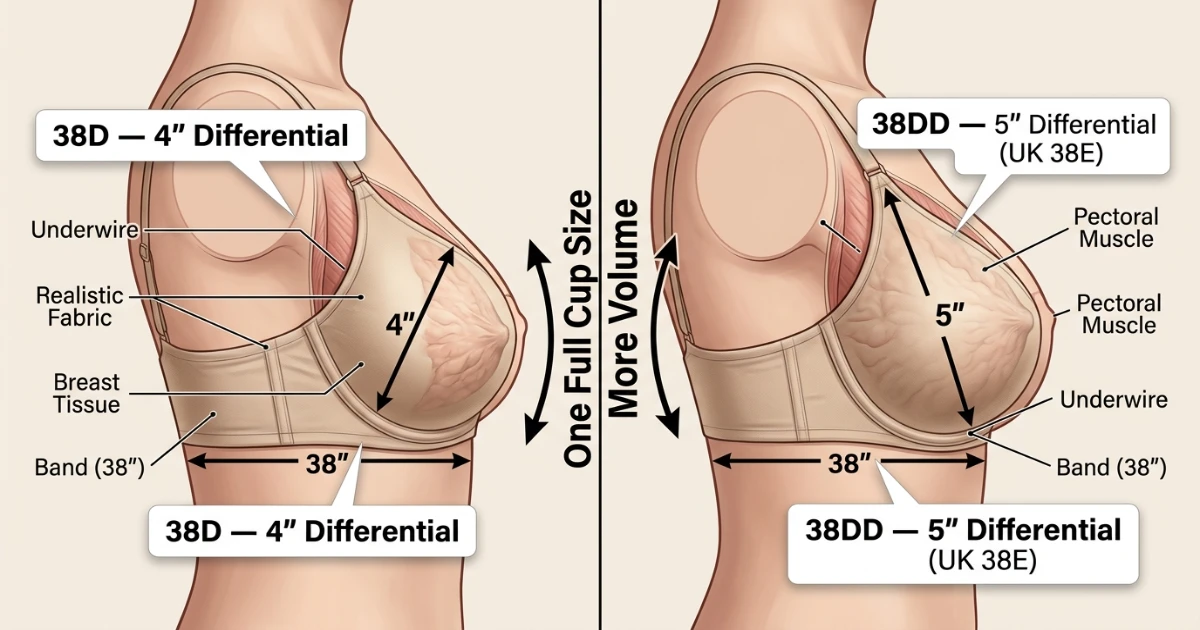
The band number tells you one thing only: your underbust circumference. A 38 band is built for a ribcage of approximately 33–34 inches — that’s true for both 38D and 38DD equally. But the cup letter tells you something completely separate: how far the bust extends beyond that ribcage. Change the letter and you change the volume entirely, even on the same band.
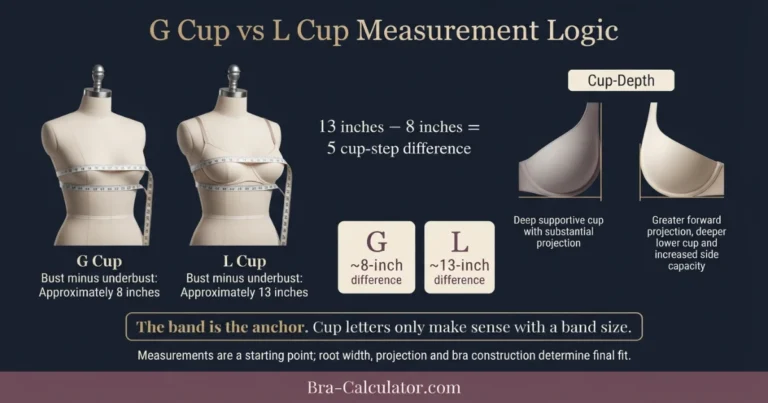
Cup size is the difference between your bust measurement and your underbust measurement, expressed as a letter. Each inch of difference equals one cup letter:
- 1″ = A | 2″ = B | 3″ = C | 4″ = D | 5″ = DD/E | 6″ = DDD/F | 7″ = DDDD/G
A 38D means the bust is 4 inches larger than the underbust on a 38-inch frame — producing a bust of approximately 42 inches. A 38DD means the bust is 5 inches larger than the same underbust — producing a bust of approximately 43 inches. That single extra inch of differential represents one full cup size of additional breast tissue volume on an already wide base. At a 38-inch band, that difference is immediately felt and seen.
The Volume Gap Between 38D and 38DD
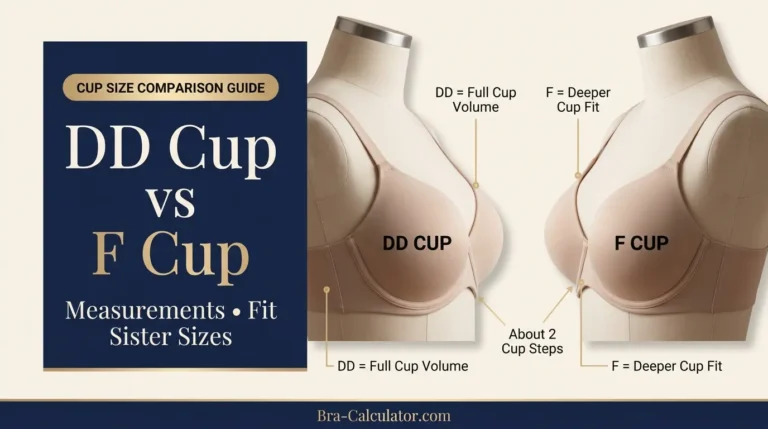
The underwire base width is the same for both — both are constructed on a 38-inch chest. But the cup depth, cup height, and enclosed volume are one complete letter apart. The critical distinction: this is not the same as comparing 38DD to 36DDD. A 36DDD holds the same volume as a 38DD on a smaller band (sister sizes). A 38D holds less volume than a 38DD on the exact same band — a genuinely different size. For a complete visual breakdown, see our cup size visuals page.
Measurement Breakdown: 38D vs 38DD
The table below shows exactly how these two sizes are built. The band and underbust are identical — but the bust measurement and cup differential are one inch apart, and that inch is everything.
| Size | Underbust (Band) | Bust (Fullest Point) | Cup Difference | Cup Volume |
|---|---|---|---|---|
| 38D | ~33–34″ (84–86 cm) | ~42″ (107 cm) | 4″ (10 cm) | Smaller ↓ |
| 38DD (38E UK) | ~33–34″ (84–86 cm) | ~43″ (109 cm) | 5″ (13 cm) | Larger ↑ |
The underbust (band) is identical — both fit the same ribcage. But the bust at the fullest point differs by approximately 1 inch (2.5 cm), confirming that the 38DD cup encloses one full cup size more breast tissue. These sizes are not interchangeable and are not sister sizes — they are adjacent cup sizes on the same band.
EU sizing: 38D = 85D; 38DD = 85E. UK sizing uses the same band number but labels DD as E universally. Always check which system a brand uses before ordering. Cross-reference with our international bra size charts.
Different Sister Size Families: Where 38D and 38DD Each Belong
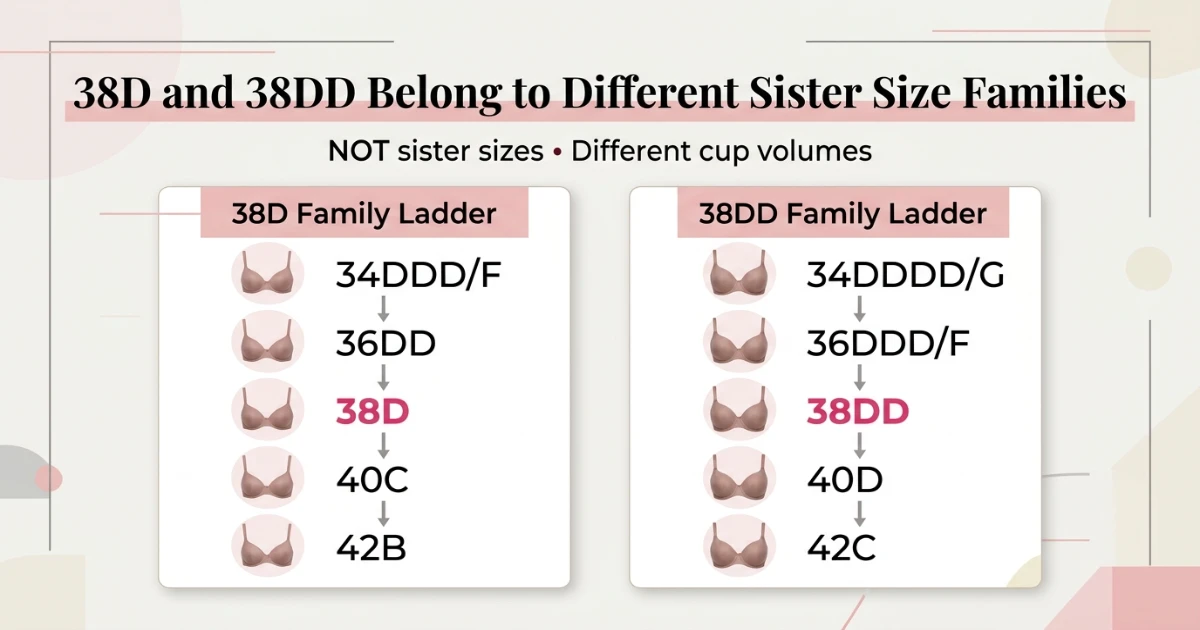
Because 38D and 38DD hold different cup volumes, they belong to completely separate sister size families. A sister size family is a chain of bra sizes that all hold equal cup volume on different band sizes. 38D and 38DD do not share a family — they sit on adjacent rungs of a volume ladder, one step apart.
38D Sister Size Family
38DD Sister Size Family
The 38DD family sits one full row higher in volume than the 38D family. Notice that 36DDD (36F) is a sister size of 38DD — meaning a 36DDD and a 38DD hold equal cup volume on different bands. If your 38D is unavailable, the correct sister size substitution is 36DD (firmer band, same volume) or 40C (looser band, same volume) — never a 38DD. Explore the full sister size logic on our sister sizes guide or calculate your own chain with the sister size bra calculator.
Real Fit Differences Between 38D and 38DD
The band and underwire base are identical — both sized for a 38-inch chest wall. But because the cup volumes differ by a full letter, the fit experience in the cups is completely different. At D and DD cup sizes, that difference matters more than it does in smaller cups — the weight of the breast tissue involved makes cup containment a structural necessity, not just a cosmetic concern.
Cup Overflow vs Cup Gaping — The Two Wrong Fits
A person who genuinely measures as a 38DD wearing a 38D will experience immediate cup overflow: the cup is too shallow and too small to contain all the breast tissue. The underwire will sit on breast tissue at the sides rather than on the ribcage beneath it, the gore will lift away from the sternum throughout the day, and significant tissue will spill over the top and toward the underarms — particularly after a few hours of movement. At D and DD cup volumes, breast tissue is heavy enough that this overflow translates directly into strap dig-in, shoulder ache, and posture strain by midday.
The opposite is equally problematic. A person who measures as a 38D wearing a 38DD will find the cups gaping or wrinkling at the top, the breast tissue sitting loose inside a cup that has more space than it needs, and the bra visibly pulling away from the chest at the top of the cups throughout the day. Neither problem is a structural failure — both are simply a cup size mismatch, solved by moving one letter up or down on the same 38 band.
Band Fit — The Element That Doesn’t Change
Because the band size is identical, the back band fit, side support, and overall ribcage anchoring are the same for both 38D and 38DD. If your band is riding up, sitting away from the ribcage, or feels too loose throughout the day, that is not a D vs DD question — it’s a band question. A riding 38 band almost always means your underbust is closer to 31–32 inches and you need a 36 band. In that case: try 36DD if your cup currently fits as a 38D, or 36DDD/36F if your cup fits as a 38DD. See our bra fit problems guide for a complete diagnosis.
Underwire Width and Cup Projection at D and DD
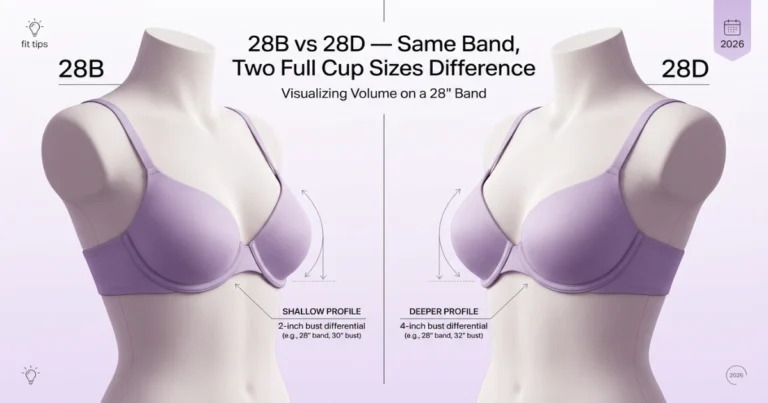
At D and DD cup sizes, underwire width is particularly important because the breast root — the area where breast tissue meets the ribcage — is broader and extends further toward the underarms. Since both 38D and 38DD share the same band and therefore the same underwire width, a wire that fits correctly for one will also fit correctly for the other. What changes is the cup height and projection: the 38DD cup stands taller and projects slightly further forward, because it contains more volume on the same base. If your underwire sits correctly but the cup overflows at the top: go up to 38DD. If the wire sits correctly but the cup gapes: drop to 38D.
Who Should Choose 38D?
- Your underbust measures approximately 33–34 inches (84–86 cm) snugly beneath the breasts.
- Your bust at the fullest point measures approximately 42 inches (107 cm) — a 4-inch differential.
- You’ve tried a 38DD and found the cups gaping, wrinkling at the top, or the bra sitting away from the chest wall.
- After scooping, your breast tissue fills the 38D cup completely without overflowing at the top or sides.
- The gore lies flat against the sternum and stays flat throughout a full day of wear.
- In UK sizing, you shop for 38D when buying from British brands — the D label is the same in US and UK at this cup size.
If your 38D cups feel slightly small but the band is working well, move to 38DD on the same band. Never change the band to solve a cup problem. Verify your fit at our how to know your bra fits page.
Who Should Choose 38DD (38E UK)?
- Your underbust measures approximately 33–34 inches (84–86 cm) snugly beneath the breasts.
- Your bust at the fullest point measures approximately 43 inches (109 cm) — a 5-inch differential on a 38-inch frame.
- You’ve tried a 38D and experienced cup overflow, a gore that won’t stay flat, or underwire sitting on breast tissue rather than the ribcage.
- After scooping, there is still tissue spilling over the top or sides of the 38D cup.
- Your breast tissue has significant volume and needs the taller, deeper 38DD cup to contain it correctly through movement.
- In UK sizing, shop for 38E when buying from British brands — US DD = UK E at this cup size.
If your 38DD cups feel slightly small but the band is correct, move to 38DDD (38F) on the same band. Use our size charts and breast shape identifier to confirm the best style for your specific shape.
🛍️ Best Bras for 38D and 38DD — Our Top Picks
D and DD cup wearers on a 38 band need bras specifically engineered for fuller cup volumes — reinforced side panels, adequate cup height, cushioned straps, and a band that stays anchored level on a wider ribcage throughout the day. These two highly rated options on Amazon are available in both 38D and 38DD and are built to handle the structural demands of this cup range.

Glamorise Women’s MagicLift Active Support Wirefree Bra #1005
The most trusted wire-free bra for D and DD cup wearers on a 38 band — and for good reason. The MagicLift inner sling system lifts and separates without an underwire, which is critical at D and DD cup volumes where wire discomfort on a 38-inch frame is a common complaint. The wide, cushioned straps carry load without digging in, and the multi-hook back keeps the band anchored level throughout a full day of activity. Available in both 38D and 38DD with the cups sized appropriately to the letter — not just scaled generically. One of the few wire-free options that genuinely delivers on support at this cup size rather than just claiming it.
Available in: 38D, 38DD, and full range through 46H
View on Amazon →
Glamorise Women’s WonderWire Front-Close Underwire Bra #1245
A front-closure underwire bra specifically designed for large cup sizes including D and DD on a 38 band. The WonderWire technology distributes underwire pressure evenly across a wider channel — the single most common complaint at D and DD cup sizes on a 38 band is underwire digging into side breast tissue, and this design addresses it directly. The front close eliminates the back-reaching struggle that wider bands create, wide side panels contain lateral tissue escape that a standard 38D or 38DD cup can miss, and an excellent multi-hook back provides long-term band adjustability as the fabric relaxes with wear. Available in both 38D and 38DD with cups that respect the volume difference between the two sizes.
Available in: 38D, 38DD, and extended range through 48H
View on Amazon →ℹ️ As an Amazon Associate, Bra Calculator earns from qualifying purchases. Product availability and pricing subject to change.
The Sister Size Rule Applied to 38D and 38DD
| Comparison Type | Example | Same Volume? | Relationship |
|---|---|---|---|
| Same band, cup up | 38D → 38DD | ❌ No | 38DD is one full cup larger — different volume family |
| Same band, cup down | 38DD → 38D | ❌ No | 38D is one full cup smaller — different volume family |
| Band down + Cup letter up | 38D → 36DD | ✅ Yes | Sister sizes — equal volume, firmer band |
| Band up + Cup letter down | 38D → 40C | ✅ Yes | Sister sizes — equal volume, looser band |
| Band down + Cup letter up | 38DD → 36DDD | ✅ Yes | Sister sizes — equal volume, firmer band |
| Band up + Cup letter down | 38DD → 40D | ✅ Yes | Sister sizes — equal volume, looser band |
| Same band, two cups up | 38D → 38DDD | ❌ No | 38DDD is two full cups larger — significantly more volume |
The golden rule: change the cup letter to fix a cup problem; change the band to fix a band problem. If your 38D cups overflow — go to 38DD, same band. If your 38DD cups gap — go to 38D, same band. If your 38 band rides up regardless of the cup — go to 36 and take your current cup volume with you via the sister size (36DD for 38D volume, 36DDD for 38DD volume).
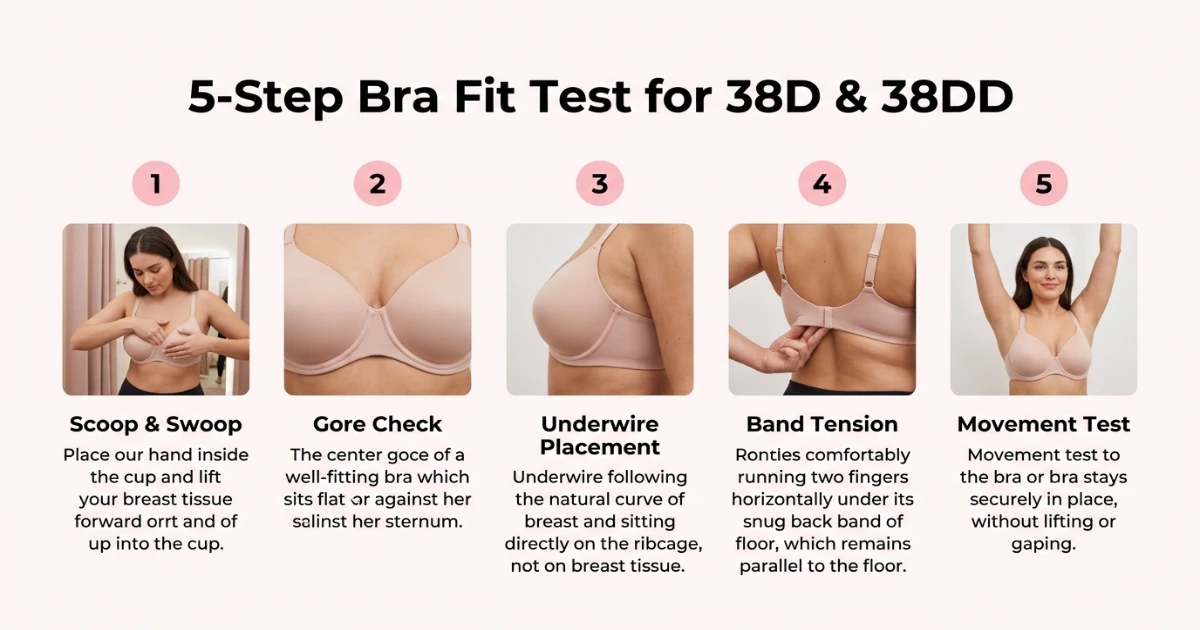
Quick Bra Fit Test: 5 Checks for D and DD Cup Wearers on a 38 Band
At D and DD cup sizes on a 38-inch band, fit errors compound quickly. The weight of the breast tissue makes a cup that’s even one size too small uncomfortable within the first hour — and a cup that’s too large provides no meaningful support regardless of how tight the band is. Run these five checks carefully.
Lean forward and scoop all breast tissue — including the significant side fullness that develops at D and DD cup sizes — fully forward and upward into the cup. After scooping, overflow at the top or sides means cup too small: go up to 38DD (from 38D) or 38DDD (from 38DD) on the same band. Wrinkling or gaping fabric means cup too large: drop to 38D (from 38DD) on the same band. Never change the band to solve overflow or gaping.
The gore must lie completely flat against the sternum and stay flat throughout the entire day — not just when you first put the bra on. At D and DD cup sizes, a floating gore is an unambiguous sign that the cup is too small. It will not fix itself during the day; it will get worse as the band settles and the breast tissue redistributes under the weight of wear. Go up one cup letter on the same 38 band before adjusting anything else.
The underwire must sit fully on the ribcage and encircle all breast tissue at every point from the gore to the side seam. At D and DD cup sizes, check the side seam specifically: the wire should end precisely at the natural outer edge of your breast tissue. Because 38D and 38DD share the same underwire width, if the wire is sitting correctly but the cup overflows — the cup letter is wrong, not the wire. Go up one letter. If the wire presses into side breast tissue: that is also a cup-too-small sign at this size. If the wire extends onto bare ribcage beyond the breast: unlikely at a 38 band, but check on both sizes.
On the loosest hook, slide two fingers under the back band with firm, consistent resistance. If your whole hand slides under easily, the 38 band is too loose for your actual underbust — you likely measure closer to 31–32 inches and need a 36 band. If you’re currently in a 38D and the cups fit, your target is 36DD (sister size, same volume). If you’re in a 38DD and the cups fit, your target is 36DDD/36F (sister size, same volume). Do not tighten the straps to compensate for a band that is too loose — at D and DD cup sizes, an unsupported band transfers the full weight of the bust directly to the shoulders within the hour.
Raise both arms overhead, twist from side to side, and walk briskly for 60 seconds. The band must stay completely level front and back, cups must remain fully in position, and straps must stay on shoulders. At D and DD cup sizes, any downward shift of the cups during movement is almost always a band problem — the band is too loose to anchor the weight of the breast tissue. Tightening straps alone will not fix this and causes shoulder and neck pain. The band carries approximately 80% of breast support; the straps carry the remaining 20%.
Still unsure whether 38D or 38DD — or a completely different size — is right for your measurements? Our AI calculator gives you a precise answer in under 2 minutes.
Try the AI-Powered Bra Size Calculator →38D vs 38DD: Full Side-by-Side Comparison
| Feature | 38D | 38DD (38E UK) |
|---|---|---|
| Band Size | 38 (33–34″ / 84–86 cm underbust) | 38 (33–34″ / 84–86 cm underbust) |
| Cup Letter (US) | D — 4″ (10 cm) over underbust | DD — 5″ (13 cm) over underbust |
| Cup Letter (UK/EU) | D | E |
| EU Approximate | 85D | 85E |
| Cup Volume | Smaller ↓ | Larger ↑ (one full cup size more) |
| Bust Measurement | ~42″ (107 cm) | ~43″ (109 cm) |
| Sister Size? | ❌ No — different volume families on the same band | |
| Underwire Width | Identical — both built on a 38-inch band | |
| Cup Height / Depth | Shallower — 4″ differential | Taller / deeper — 5″ differential, more volume |
| Full Sister Family | 34DDD — 36DD — 38D — 40C — 42B | 34DDDD — 36DDD — 38DD — 40D — 42C |
| If cups too small | Try 38DD (same band, cup up) | Try 38DDD/38F (same band, cup up) |
| If cups too large | Try 38C (same band, cup down) | Try 38D (same band, cup down) |
| If band too tight | Try 40C (sister size — same volume) | Try 40D (sister size — same volume) |
| If band too loose | Try 36DD (sister size — same volume) | Try 36DDD/36F (sister size — same volume) |
| Best For | Underbust ~33–34″, bust ~42″ | Underbust ~33–34″, bust ~43″ |
| Availability | Widely stocked — common in mid-range and specialist brands | Widely stocked — well covered by specialist fuller-bust brands |
People Also Ask: 38D vs 38DD — Answered
Are 38D and 38DD the same size?
No — 38D and 38DD are not the same size and are not sister sizes. They share the same 38-inch band and the same underbust measurement, but they have different cup letters and different cup volumes. The 38DD holds one full cup size more breast tissue than the 38D. On a 38-inch band at these cup volumes, that difference is immediately apparent in how the cups fit and support.
Which is bigger — 38D or 38DD?
The 38DD is bigger in cup volume. Both share the same 33–34 inch underbust, but the 38DD bust is approximately 43 inches versus the 38D’s approximately 42 inches. That 1-inch difference represents one complete cup size of additional breast tissue. At D and DD cup volumes on a 38-inch band, this is a meaningful and visible size difference — not a marginal one.
Is 38DD the same as 38E?
Yes — completely. In UK and European sizing, DD is universally labelled E. So US 38DD and UK 38E refer to exactly the same cup size: a 5-inch bust-to-underbust differential on a 38-inch band. When shopping UK brands like Freya, Panache, Elomi, or Curvy Kate, search for 38E to find what US brands label 38DD. Always check which labelling convention a brand uses before ordering.
Can I wear a 38DD instead of a 38D?
Not as a direct substitution — these are genuinely different cup sizes. Wearing a 38DD when you measure as a 38D will give you cups that are too large: gaping at the top, wrinkling fabric, and breast tissue floating inside the cup rather than being properly contained. The band will feel the same, but the cup problems will be immediate. If your 38D is unavailable and you need the same cup volume on a different band, the correct sister size alternatives are 36DD (firmer band) or 40C (looser band).
My 38D cups feel too small — should I try 38DD or 36DD?
If your 38D cups feel too small but the band fits correctly (stays level, two fingers under the back with firm resistance), try 38DD — same band, next cup letter up. Do not switch to 36DD: a 36DD is the sister size of 38D, meaning it holds the same cup volume as your current 38D on a smaller band. Moving to 36DD gives you a tighter band with no additional cup volume, which solves neither problem. Fix cup fit by changing the cup letter on the same band.
My 38DD cups feel too large — should I try 38D or 40D?
If your 38DD cups are gaping but the band fits correctly, try 38D — same band, one cup letter down. Do not switch to 40D: a 40D is the sister size of 38DD, meaning it holds the same cup volume as your current 38DD on a looser band. Moving to 40D gives you a looser band with the same cup volume — again, this solves neither the cup nor the band problem. Always fix cup fit by moving the cup letter up or down on the same band.
What are the sister sizes of 38D?
The sister sizes of 38D — sizes that hold equal cup volume on different bands — are 34DDD (34F), 36DD (36E UK), 40C, and 42B. Each holds approximately the same breast tissue volume as 38D, just on a different band tightness. If your 38D is unavailable, 36DD (firmer band, same volume) or 40C (looser band, same volume) are the correct substitutions. The 38DD is not in this family — it holds more cup volume.
What are the sister sizes of 38DD?
The sister sizes of 38DD (38E UK) are 34DDDD (34G), 36DDD (36F / 36E UK), 40D, and 42C — all holding approximately equal cup volume to 38DD. The 36DDD and 38DD are direct sister sizes: same volume, firmer band. If your 38DD is unavailable, 36DDD (firmer band, same volume) or 40D (looser band, same volume) are the correct alternatives. The 38D, despite the same band number, is not in this family and holds less volume.
My 38 band rides up my back — should I try 36DD or 36D?
If your 38D band rides up, your underbust likely measures closer to 31–32 inches and you need a 36 band. If you’re currently in a 38D and the cup fits correctly, try 36DD — this is the sister size of 38D and holds the same cup volume on the firmer 36 band. If you’re in a 38DD and the cup fits correctly, try 36DDD (36F) — the sister size of 38DD. Never go to 36D from 38D — that would give you a firmer band with less cup volume, creating an overflow problem.
How do I know my correct bra size?
Measure your underbust snugly for your band and your bust at the fullest point for your cup. Subtract underbust from bust — 4 inches = D cup, 5 inches = DD cup. Verify fit with five checks: band level all around, flat gore throughout the day, underwire fully on ribcage, two fingers under back band on loosest hook with firm resistance, and no cup movement during activity. Use our bra size chart calculator for a precise, personalised result based on your actual measurements.