Nursing Bra Size Chart by Cup: Postpartum Sizing Table

Amelia spent years as a lingerie buyer fitting customers across every band and cup size before founding Bra-Calculator.com. This chart reflects the sizing logic she used on the fitting-room floor, translated into a self-serve table and tool. More about Amelia →
Nursing Bra Cup Finder
Pick your pre-pregnancy band and cup — Amelia’s cup-up logic instantly converts it into a recommended nursing bra size and highlights the matching row on the chart below.
This tool applies the general one-cup-up rule used throughout this chart. Always confirm against your chosen brand’s specific size guide before ordering.
In This Guide
- Reading a Nursing Bra Size Chart Correctly
- The Daily Fullness Curve: Why Your Cup Size Moves
- Full Nursing Bra Size Chart
- Band Size Rarely Changes — Cup Size Does
- How to Double-Check Your Size at Home
- Why Cup Letters Alone Aren’t Enough for Nursing
- When to Trust the Chart vs. When to Size Between Numbers
- Troubleshooting: What to Do If You Don’t Match Any Row on the Chart
- How International Sizing Converts for Nursing Bras
- Re-Measuring as Your Body Continues to Change
- Why Manufacturers Build Nursing Bras Around a Range Instead of a Point
- Regional and Retailer Variation in Nursing Bra Charts
- How Pregnancy-Stage Sizing Differs From Postpartum Nursing Sizing
- Reading Between the Lines of Online Size Charts
- A Deeper Look at the Band-to-Cup Ratio Assumption
- What Changes on a Chart After a Second or Third Pregnancy
- How to Use This Chart Alongside a Physical Fitting
Reading a Nursing Bra Size Chart Correctly
Most confusion around nursing bra sizing comes from reading a nursing chart the way you’d read a regular bra chart. A regular chart maps to one fixed bust measurement. A nursing chart is built differently on purpose: it lists a cup range because your actual bust measurement — your breast volume, milk supply, and overall fullness — moves across a single day. Amelia calls this “designing for the swing, not the snapshot,” and it’s the single idea that makes every other row on this chart make sense.
This is a deliberate engineering decision, not a sizing inconsistency between brands. A well-made nursing bra uses stretch panels, drop-cup mechanisms, and reinforced elastic specifically so the label size holds shape from your fullest point to your emptiest, rather than fitting perfectly at only one moment.
The Daily Fullness Curve: Why Your Cup Size Moves
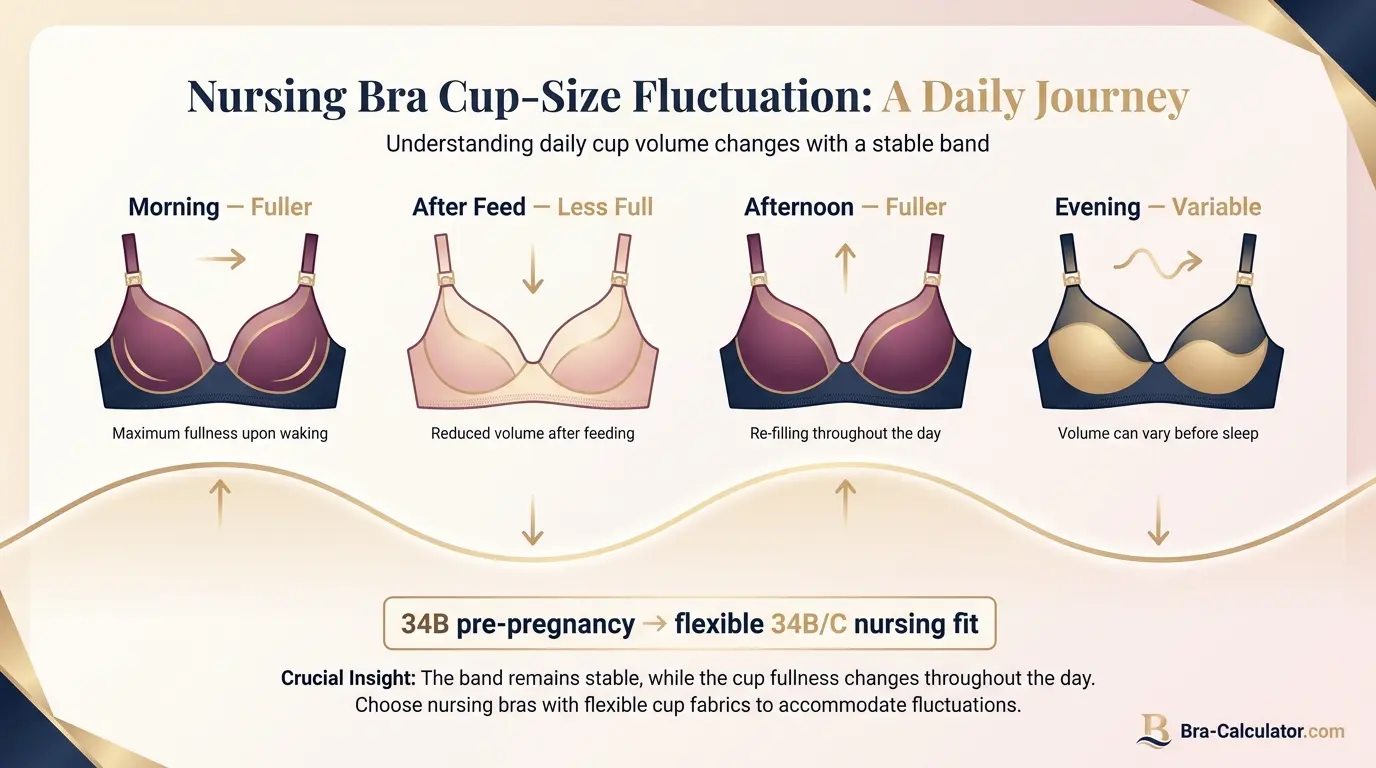
Think of your bust measurement across a nursing day as a curve, not a fixed number. It rises after each feed or pumping session, and gradually settles as milk is removed. The chart below visualizes that rise-and-settle pattern — the same fluctuation your nursing bra’s cup range is engineered to absorb.
Full Nursing Bra Size Chart
| Pre-Pregnancy Band/Cup | Recommended Nursing Size | Notes |
|---|---|---|
| 32A | 32A/B | Add a light stretch panel, minimal padding |
| 32B | 32B/C | Common starting size for petite frames |
| 34A | 34A/B | Watch for gapping at the top of the cup |
| 34B | 34B/C | Most common size range for first-time nursing bra buyers |
| 34C | 34C/D | Molded cup recommended over unlined |
| 36B | 36B/C | Wider band range available in most standard lines |
| 36C | 36C/D | Look for reinforced under-band support |
| 36D | 36D/DD | Consider a 4-row hook closure for extra range |
| 38D | 38D/DD | Wider set straps recommended for daily comfort |
| 40DD+ | Size up cup only, keep band | Consider a dedicated plus-size/full-bust nursing line |
Band Size Rarely Changes — Cup Size Does
Ribcage width typically returns to its pre-pregnancy measurement within a few weeks of delivery unless there was significant weight change during pregnancy. Cup volume is what swings through the day, which is exactly why a nursing bra chart lists a cup range instead of a single letter — it’s telling you the bra is designed to flex across that range, not that you should own two separate bras for “before” and “after” a feed.
How to Double-Check Your Size at Home
- Measure your band directly under the bust, snug but not tight, keeping the tape level all the way around.
- Measure bust at the fullest point, ideally mid-morning before a feed for the most representative reading.
- Subtract band from bust — each inch of difference is roughly one cup size (1 inch = A, 2 inches = B, 3 inches = C, and so on).
- Cross-reference against the chart above (or use the Cup Finder tool at the top of this page) and size the cup up, not the band, if you land between two sizes.
- Recheck the fit after your first full day of wear — if the band rides up in back or the cup gaps at the top, adjust based on which symptom shows up, not by guessing a whole size change.
Why Cup Letters Alone Aren’t Enough for Nursing
Two people with the same cup letter can have very different breast shapes and tissue density, especially postpartum when breast composition genuinely changes from the glandular tissue increase during milk production. This is part of why nursing-specific brands often run their own internal size charts rather than mapping directly onto standard department-store sizing — a 34C from one nursing brand can fit meaningfully differently from a 34C in another, so always check that brand’s specific chart before ordering.
When to Trust the Chart vs. When to Size Between Numbers
If your measurement lands squarely on a size in the chart, trust it. If you’re between two sizes, the safer default during nursing is to size the cup up rather than down, since a slightly loose cup with good strap adjustment is more comfortable through a feeding cycle than a cup that’s tight at its fullest point. The one exception is early engorgement — sizing up too far during that window can mean the bra fits loosely once swelling resolves at 2–3 weeks.
Troubleshooting: What to Do If You Don’t Match Any Row on the Chart
Real bodies don’t always land neatly on standard chart increments, and that’s normal rather than a sign you’re an unusual outlier. If your measured band falls between two listed sizes (say, 33 inches), round up rather than down for nursing bras specifically, since a slightly looser band is more comfortable through daily fluctuation than a snug one. If your cup measurement falls between letters, the same logic applies — size up the cup rather than down, and rely on the bra’s built-in stretch panel to take up any minor excess rather than sizing down and risking tightness during engorged periods.
How International Sizing Converts for Nursing Bras
| US | UK | EU | AU |
|---|---|---|---|
| 32B | 32B | 70B | 10B |
| 34C | 34C | 75C | 12C |
| 36D | 36D | 80D | 14D |
| 38DD | 38DD | 85E | 16DD |
Band numbers convert directly in US/UK sizing, but cup letters shift meaningfully once you cross into EU or AU systems — an EU “D” is not the same volume as a US “D.” Always check a brand’s specific conversion chart before ordering internationally rather than assuming a straight letter-for-letter match, since this is one of the most common causes of online nursing bra returns.
Re-Measuring as Your Body Continues to Change
Unlike a regular bra purchase, a nursing bra size chart reading isn’t a “set it and forget it” measurement. Plan to re-measure using this same method at each of the checkpoints described in the postpartum sizing timeline (2 weeks, 6 weeks, any major schedule change, and weaning) rather than assuming your first chart-matched size holds for the entire nursing period.
Why Manufacturers Build Nursing Bras Around a Range Instead of a Point
Regular bra manufacturing assumes a fixed target measurement and engineers the cup around that single point, which is why a well-fitted regular bra can feel almost tailored. Nursing bra manufacturing works backward from a different assumption entirely: that the wearer’s actual measurement will move within a predictable window across any given day, and possibly across weeks as supply regulates. Engineers building these garments add stretch panels, drop-cup mechanisms, and reinforced but flexible elastic specifically to keep the fit acceptable across that whole window rather than perfect at one single point. Understanding this design philosophy explains why comparing a nursing bra’s “true to size” reviews against a regular bra’s reviews can be misleading — reviewers evaluating a nursing bra are often (often unknowingly) reporting on how it felt at whatever point in their day or feeding cycle they happened to try it on, which naturally produces more varied feedback than you’d see for a fixed-fit garment.
Regional and Retailer Variation in Nursing Bra Charts
Beyond the US/UK/EU/AU conversion already covered, individual retailers sometimes publish their own house-brand sizing charts that diverge slightly even within the same country system. A department store’s private-label nursing bra and a specialty maternity brand’s chart can both claim to be “US sizing” while actually reflecting different underlying block patterns. The safest practice is to treat any printed chart as a starting estimate rather than a guarantee, and to check a retailer’s specific return policy for nursing bras before ordering multiple sizes to compare, since some retailers restrict returns on intimate apparel more tightly than on other clothing categories.
How Pregnancy-Stage Sizing Differs From Postpartum Nursing Sizing
Many parents start shopping for nursing bras during late pregnancy, using a maternity bra size chart that maps to third-trimester measurements. It’s worth being aware that this pregnancy-stage size is not necessarily the same size you’ll need postpartum, since breast tissue and volume typically continue changing meaningfully in the days immediately following birth as milk production begins. Buying one or two nursing bras in your late-pregnancy size for early hospital and immediate postpartum wear is reasonable, but treat the 6-week re-measurement described elsewhere in this cluster as the point where your “real” nursing bra chart size gets established, not your pregnancy-stage purchase.
Reading Between the Lines of Online Size Charts
Online nursing bra retailers frequently publish a size chart alongside a separate “fit guide” or “how to measure” page — these are not redundant, and skipping the fit guide in favor of jumping straight to the numeric chart is a common source of sizing mistakes. The fit guide typically explains brand-specific quirks (for example, whether a brand runs its band snug or generous, or whether its cup volume skews larger or smaller than the numeric label suggests relative to competitors), information the bare numeric chart alone doesn’t convey.
A Deeper Look at the Band-to-Cup Ratio Assumption
Standard sizing charts assume that as band size increases, cup volume at “the same letter” also increases by a fixed, predictable amount — this is why a 34D and a 38D are actually different total cup volumes despite sharing the same letter, a frequently misunderstood point even among people who nurse regularly. Nursing bra charts inherit this same underlying assumption, which is part of why sister-sizing (detailed further in this cluster) becomes such a useful practical tool: it lets you navigate around the ratio assumption to find genuinely equivalent volume in a different band, rather than guessing at a cup letter change and hoping it lands correctly.
What Changes on a Chart After a Second or Third Pregnancy
Parents nursing a second or subsequent child sometimes assume their prior nursing bra size chart position will hold again, but tissue changes from a prior pregnancy and nursing period can shift both band and cup measurements from where they were the first time around — sometimes larger, sometimes smaller, without a fully predictable pattern. Re-measuring fresh for each pregnancy, rather than assuming your prior nursing size still applies, avoids an otherwise easy assumption to make.
How to Use This Chart Alongside a Physical Fitting
A printed or online chart is the right starting point, not the final word — the most reliable approach combines self-measurement against the chart with an actual physical try-on before committing to multiple bras in one size. If ordering online without a fitting room available, ordering your charted size plus one sister-size option (covered in more detail elsewhere in this cluster) in your first order, then returning whichever doesn’t fit, is a practical way to bridge the gap between a chart’s estimate and your body’s actual response to a specific brand’s construction.
Why This Chart Focuses on Cup Range Rather Than a Single Recommended Brand
This page deliberately presents sizing logic and a general chart rather than a single “best brand” recommendation, because brand-specific fit varies enough that a chart optimized around one brand’s proportions could actively mislead shoppers using a different brand. Pairing this general chart with the specific product recommendations found on the hands-free pumping, large-bust, and plus-size pages elsewhere in this cluster gives a more complete picture: general sizing logic here, brand-specific application there.
Best Product Options for This Fit Goal
These are editorial shortlists based on published product construction, size information, pump compatibility, and the fit goal of this page. Bra-Calculator.com has not physically lab-tested every model, so treat each pick as a starting point and verify the current listing, size chart, materials, and return terms.
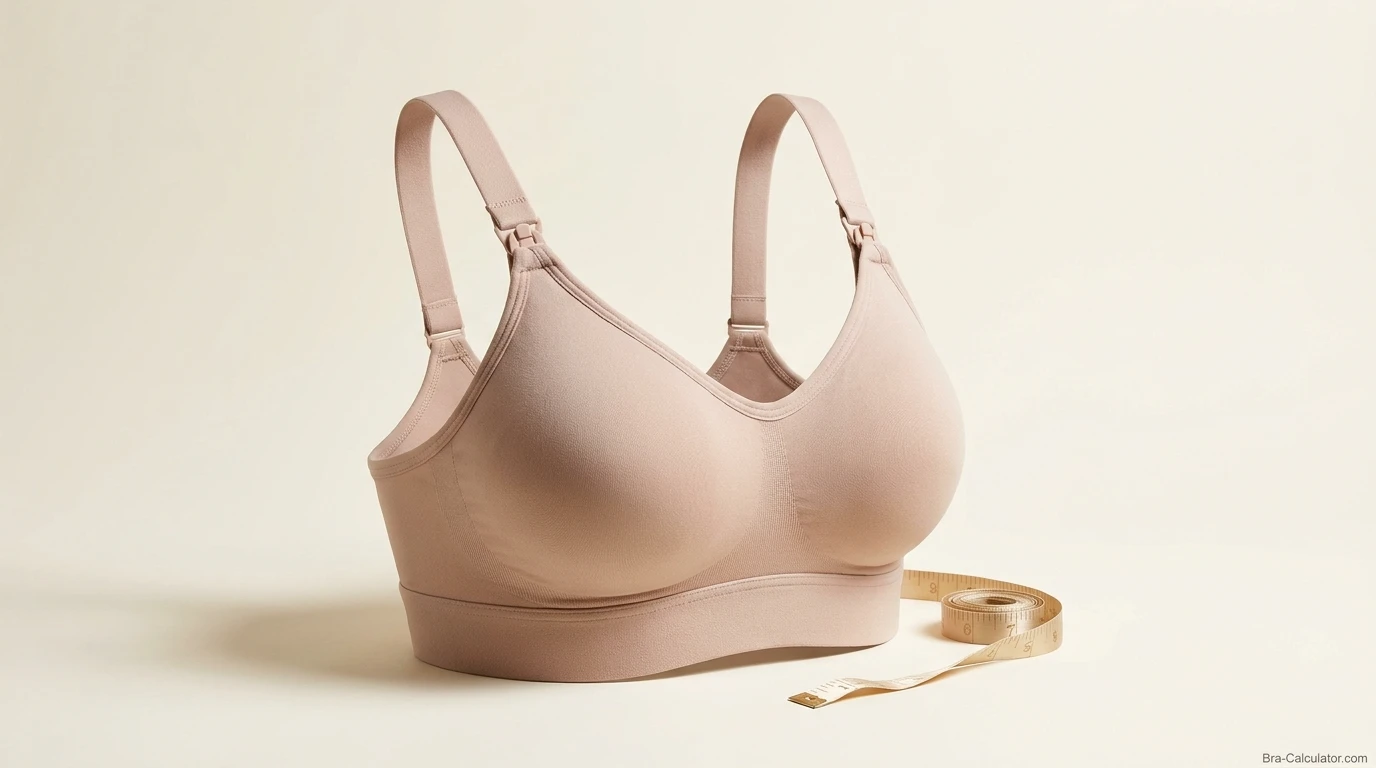
Bravado Designs Body Silk Seamless Nursing Bra
A wire-free 360-degree stretch design with knit-in support zones and a wide published band-and-cup range.
Check before buying: Use the newest size chart; older listings may show a different range or final-sale colorways.
View Options on AmazonAffiliate link · Availability and price can change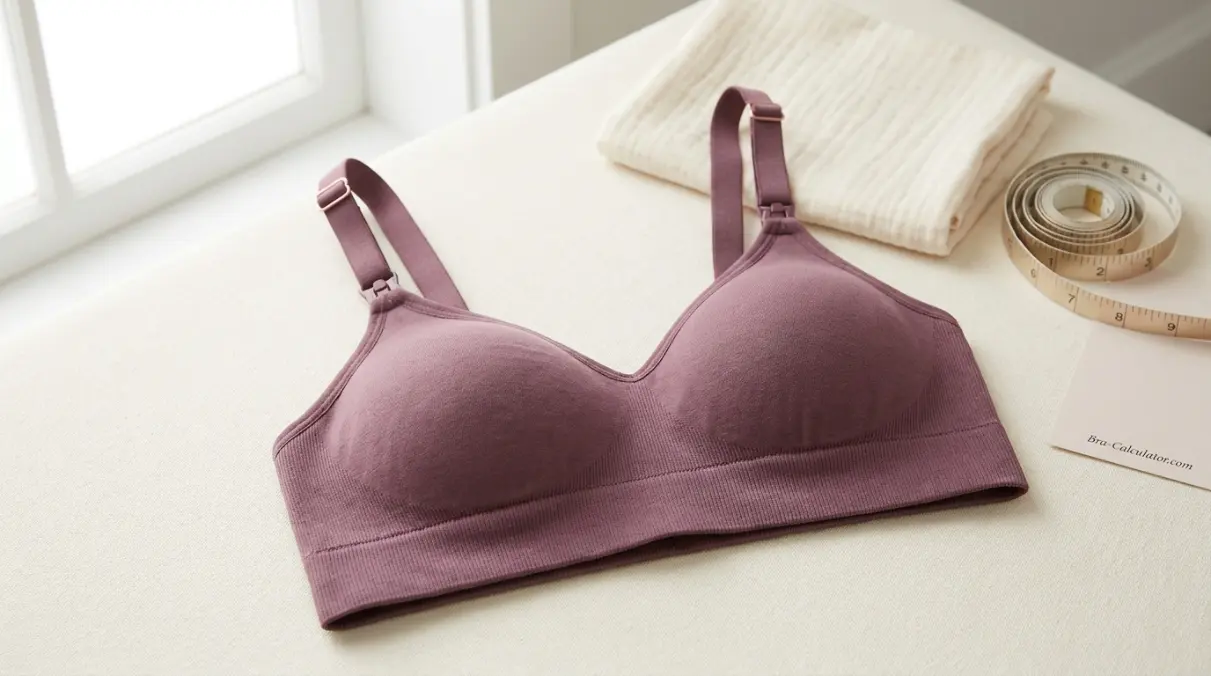
Kindred Bravely Simply Sublime Nursing Bra
Stretchy full-coverage construction suits everyday nursing and normal day-to-day fullness changes.
Check before buying: Use the brand chart rather than buying only from your pre-pregnancy alpha size.
View Options on AmazonAffiliate link · Availability and price can change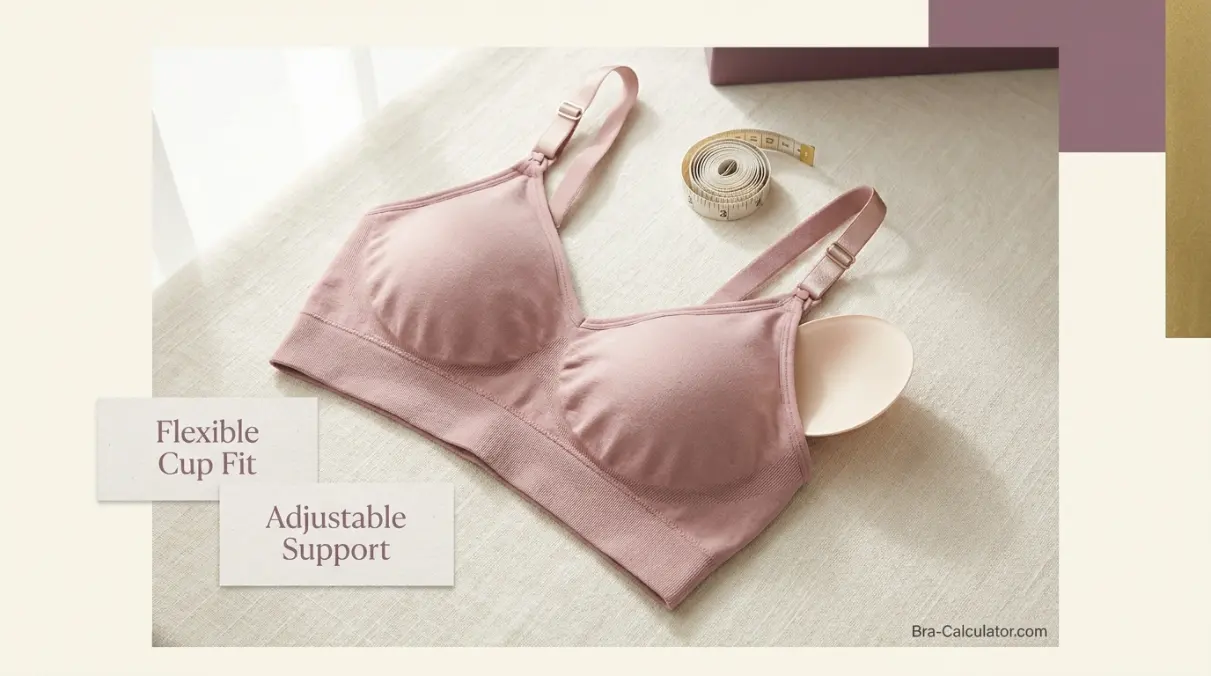
Cake Maternity Rock Candy Nursing Bra
A double-layer seamless nursing bra with removable cups and a wide adjustment range.
Check before buying: Confirm the current regional availability and size chart before ordering.
View Options on AmazonAffiliate link · Availability and price can changeKey Takeaways
- Nursing bra charts intentionally list a cup range, not a single letter, to cover daily fluctuation.
- Band size almost never changes after the first few postpartum weeks — resist the urge to size the band up.
- Measure mid-morning before a feed for the most representative cup reading.
- Different nursing brands can size the same cup letter differently due to postpartum tissue changes — always check brand-specific charts.
📐 Not sure which size to buy?
Get your exact size from Amelia’s free bra size calculator →
Frequently Asked Questions
- Should I size up my band or my cup for nursing?
- Cup, not band. Sizing the band up creates a bra that rides up and loses support once the initial postpartum swelling goes down.
- What if I’m between two cup sizes on the chart?
- Choose the smaller nursing-specific size — the built-in stretch panel is designed to expand, whereas a too-large bra will sag and lose shape faster.
- Do nursing bra sizes run the same as regular bra brands?
- Not always. Nursing-specific brands often cut slightly generous in the cup to accommodate flexible drop-cup mechanisms, so always check that brand’s specific size chart rather than assuming standard sizing.
- Why does the same cup letter fit differently across nursing brands?
- Postpartum breast tissue composition changes with milk production, and brands calibrate their internal charts differently — always check brand-specific size guides rather than assuming universal sizing.
- What if my measurement falls between two sizes on the chart?
- Round up for both band and cup during nursing — a slightly looser fit is more comfortable through daily fluctuation than a snug one, and the built-in stretch panel is designed to take up minor excess.
- Do nursing bra sizes convert directly between US, UK, and EU sizing?
- Band numbers convert directly between US and UK, but cup letters shift meaningfully in EU and AU systems — always check the brand’s specific conversion chart rather than assuming a direct letter match.
- Does my late-pregnancy bra size predict my postpartum nursing bra size?
- Not reliably — breast tissue and volume typically change further in the days after birth as milk production begins, so treat your pregnancy-stage size as temporary and re-measure around 6 weeks postpartum for your ongoing nursing size.
- Why do two brands’ nursing bra charts sometimes disagree even in the same country’s sizing system?
- Different brands use different underlying block patterns even within the same nominal size system, which is why checking a brand’s specific fit guide (not just its numeric chart) matters before ordering.
- Does my nursing bra size from a previous pregnancy still apply for a second child?
- Not necessarily — tissue changes from a prior pregnancy and nursing period can shift band and cup measurements in either direction, so it’s worth re-measuring fresh rather than assuming your prior size still holds.
- Why do two people with the same cup letter but different band sizes not have the same actual bust volume?
- Cup volume scales with band size under standard sizing logic, so a 34D and 38D share a letter but represent different total volumes — this is also why sister sizing works as a practical tool for finding equivalent volume across different bands.
- Should I trust a size chart completely, or also try the bra on?
- Use the chart as a starting point, but confirm with an actual try-on when possible — for online-only purchases, ordering your charted size plus a sister-size option in the same first order is a practical way to bridge the gap.
- How does the nursing bra cup finder tool work?
- Select your pre-pregnancy band and cup size and the tool instantly converts it into a recommended nursing bra cup range, using the same one-cup-up logic explained throughout this chart.
Editorial Sources & Review Notes
Health and workplace statements were reviewed against the following primary or public-health sources. Product features can change, so current brand and Amazon listings should be checked before purchase.
This page provides general garment-fit and shopping information, not medical diagnosis or individualized lactation care. Contact a qualified clinician or lactation professional for persistent pain, fever, worsening redness, wound concerns, or pumping problems. As an Amazon Associate, Bra-Calculator.com earns from qualifying purchases.