Best Underwear for Wide Hips
Amelia B. · Bra Fit Specialist · A practical guide for choosing underwear that has enough room through the hips without leaving a loose, unstable waistband.
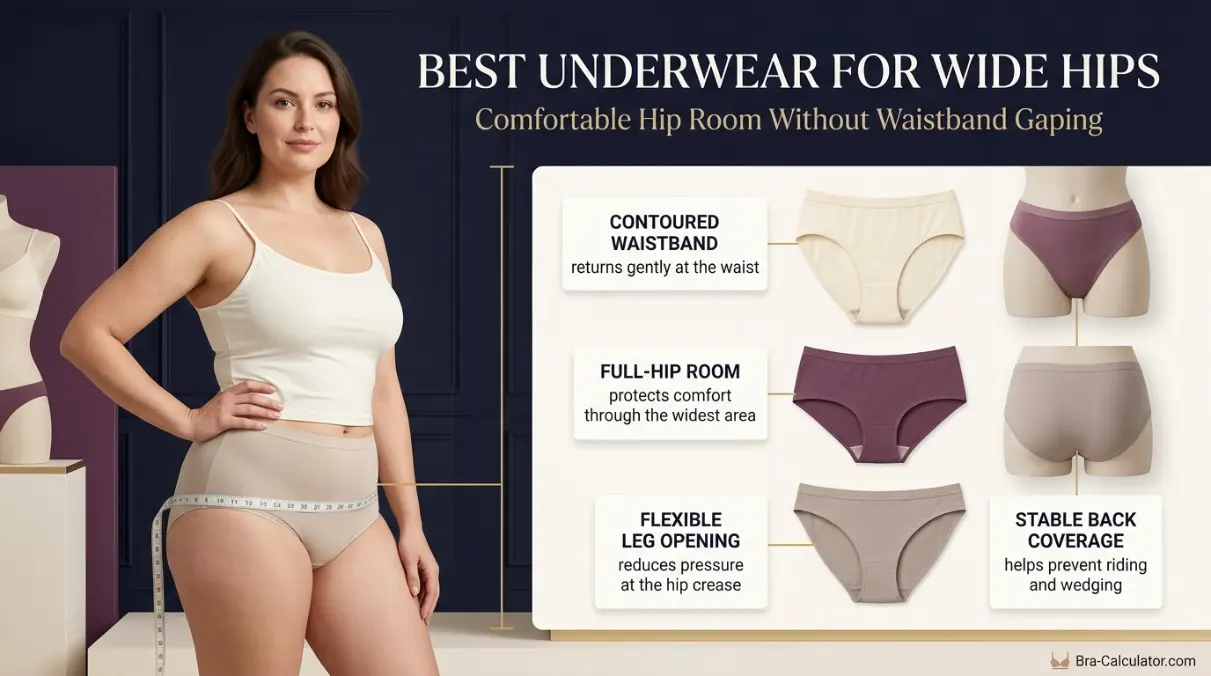
The best underwear for wide hips usually starts with the fullest-hip measurement, then solves waist looseness through better construction—not by forcing a smaller size over the hips. Prioritize a contoured waistband, a back panel with enough depth, flexible leg openings and a gusset that stays centered. High-cut briefs, shaped hipsters and curvy-fit bikinis are often the easiest starting points.
In This Guide
- The common waist-to-hip conflict
- Features that usually help
- Styles to compare
- Why sizing down often fails
- Low rise versus high rise
- Leg openings and gusset width
- Measurement-first method
- Shopping checklist
- What “made for wider hips” should actually mean
- At-home fit test
- Common mistakes
- Product-page checklist
- Amazon product comparisons
- Frequently asked questions
The common waist-to-hip conflict
A familiar fitting-room problem goes like this: the underwear feels smooth across the seat, but the waistband stands away at the back. The next size down closes the gap—then the leg openings bite, the gusset shifts, or the back starts creeping inward. That is not a body problem. It is a proportion mismatch between the garment’s waist and hip shaping.
When the fullest hip lands one or more size-chart rows above the waist, a straight-cut pair may ask one size to do two incompatible jobs. The hips need room to move; the waist needs enough recovery or contour to stay anchored. Choosing only by the waist can make the whole garment work under tension.
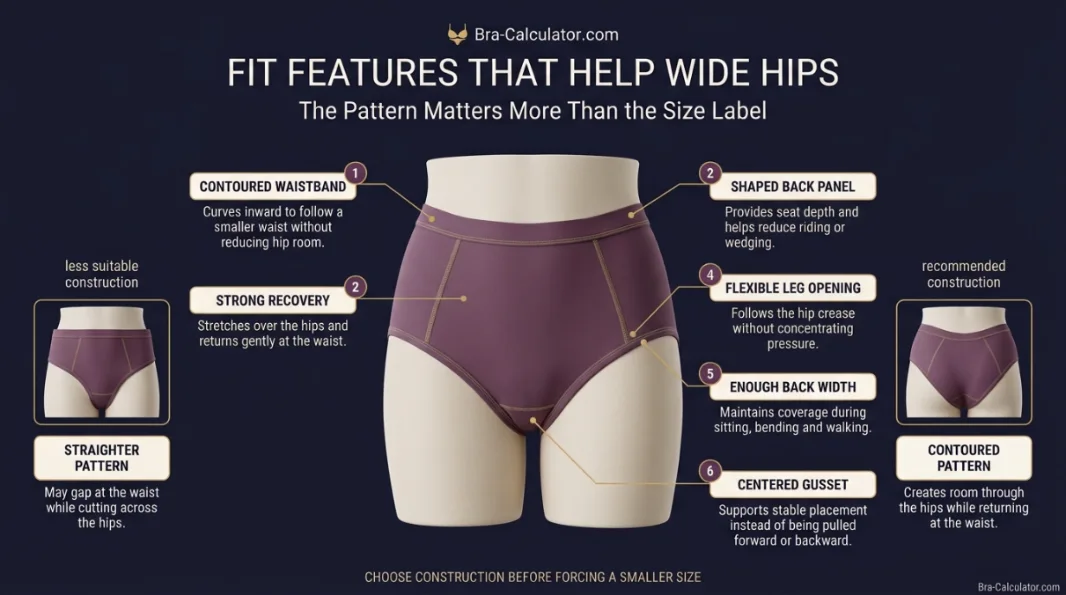
The most reliable fix is usually more shape in the pattern: a contoured waistband, curved center-back seam, deeper seat panel, softer leg edge or a style designed for a larger waist-to-hip difference.
best-underwear-for-wide-hips-hero.webp to replace this fallback.Features that usually help
Marketing terms such as “curvy,” “stretch” or “full coverage” are useful only when the actual pattern supports them. These four details make the biggest practical difference:
Contoured waistband
A curved band narrows toward the waist instead of behaving like a straight elastic tube. This is especially helpful when the seat fits but the back waist lifts away.
High-cut or flexible openings
A higher or softer leg line can clear the fullest hip and upper-thigh curve without concentrating pressure in one narrow strip of elastic.
Shaped back panel
Extra depth through the back helps the fabric follow the seat rather than borrowing length from the waistband or pulling the gusset backward.
Stretch with recovery
The fabric should open comfortably over the hips, then return at the waist. Stretch without recovery may feel easy at first but can bag, slide or roll later.
Worth remembering: a soft fabric is not automatically a forgiving fit, and a firm fabric is not automatically restrictive. Pattern shape, elastic tension and recovery work together.
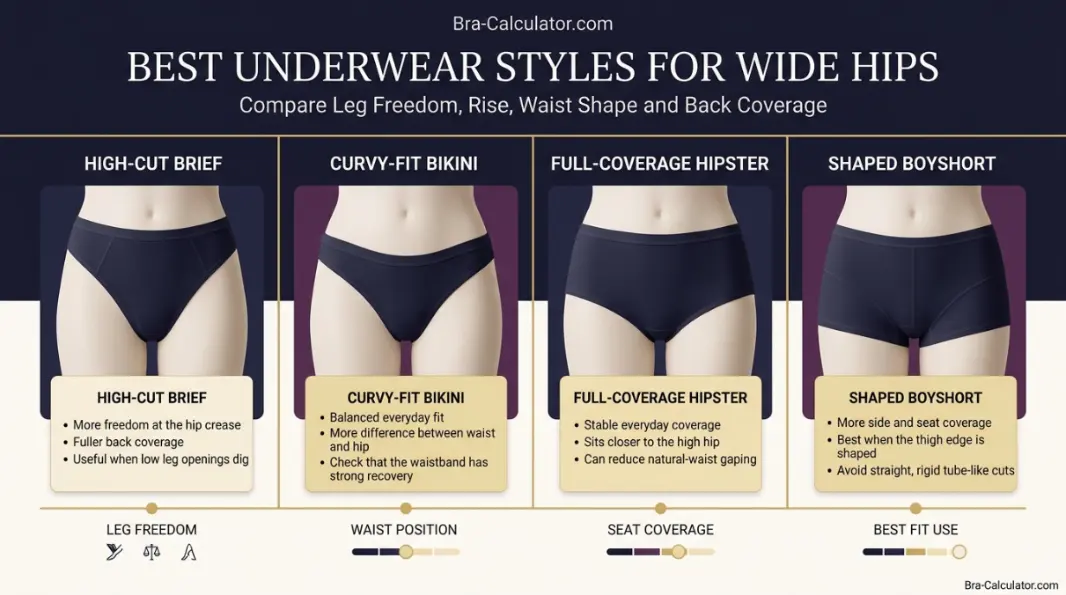
Which underwear styles are most promising?
No single cut wins for every fuller-hip shape. The right starting point depends on where you want the waistband to sit, how much seat coverage you prefer and whether your upper thighs are also full.
| Style | Why it can work | What to inspect | Best starting use |
|---|---|---|---|
| High-cut brief | Opens the leg line while keeping more fabric across the seat. | Make sure the leg edge is soft and the back does not narrow too sharply. | Strong first choice |
| Curvy-fit bikini | Can combine a lower waistband with more room through the hip and seat. | Check waistband recovery and whether the rise stays in place when sitting. | Lower-rise everyday wear |
| Full-coverage hipster | A broad back panel can improve stability and reduce repeated adjustment. | A very straight waistband may still gap; a low horizontal leg may cut in. | Secure daily coverage |
| Boyshort | Offers more side coverage and can feel smooth under relaxed clothing. | Look for a curved seat and flexible thigh edge; straight tubular cuts often roll. | Coverage-first preference |
| Seamless brief | Bonded edges may reduce localized pressure and visible lines. | Weak recovery can cause sliding; thin fabric still needs enough seat depth. | Smooth finish under clothes |
Start with the style that solves your most frequent problem. Choose a high-cut brief when leg edges dig, a shaped hipster when the seat rides, or a curvy bikini when a natural-waist band consistently gaps.
best-underwear-styles-for-wide-hips.webp to replace this fallback.Why sizing down often fails
Sizing down can make the waistband look neater for a moment, but it often transfers the problem elsewhere. The leg elastic tightens, the back loses coverage, the gusset is pulled out of position and the waistband may be dragged downward by tension across the hips.
You may also notice diagonal strain lines from the crotch toward the side seam, fabric that becomes unusually sheer, or a pair that feels acceptable while standing but uncomfortable as soon as you sit. Those are signs that the smaller label is not truly solving the fit.
wide-hips-underwear-fit-features.webp to replace this fallback.Low rise versus high rise
A low-rise waistband sits closer to the high hip, so it may avoid the smaller natural-waist area altogether. This can reduce gaping, but the band still needs enough stretch to pass over the fullest hip and enough recovery to stay put once worn.
High-rise underwear can feel more stable and can distribute pressure across a wider area. It works best when the waistband is shaped inward and the body length matches your torso. A straight, firm high-rise band may highlight the waist-to-hip difference instead of accommodating it.
You dislike waist compression
Useful when the natural waist is much smaller, the high hip fits comfortably and you prefer less fabric through the torso.
You want anchoring and coverage
Useful when the band is contoured, the rise does not roll and you want the back panel to remain stable while sitting or bending.
Leg openings and gusset width
Wide hips do not automatically mean large thighs, so the answer is not simply “choose a bigger leg hole.” The opening must follow the curve where the garment meets your body. A soft high-cut edge may feel excellent, while a low horizontal elastic can create a pressure line even in the correct size.
The gusset also needs enough width and length to stay centered. If it is pulled backward, the rise may be too short or the hips may be taking up more fabric than the pattern allows. If it floats or bunches, the cut may be too long, too loose or poorly matched to your torso.
- Look for calm side seams. They should sit vertically rather than being pulled toward the front or back.
- Check the leg crease while seated. A pair that looks smooth while standing can become sharply restrictive when the hip flexes.
- Notice gusset direction. Repeated forward or backward shifting usually points to rise or seat-shape mismatch, not a need for constant adjustment.
A measurement-first method that stays practical
Underwear labels are not standardized. One brand’s Medium can overlap another brand’s Large, and two collections from the same company may fit differently because the rise, elastic, gusset and fabric are not identical. Treat the label as a navigation tool—not a verdict about your body.
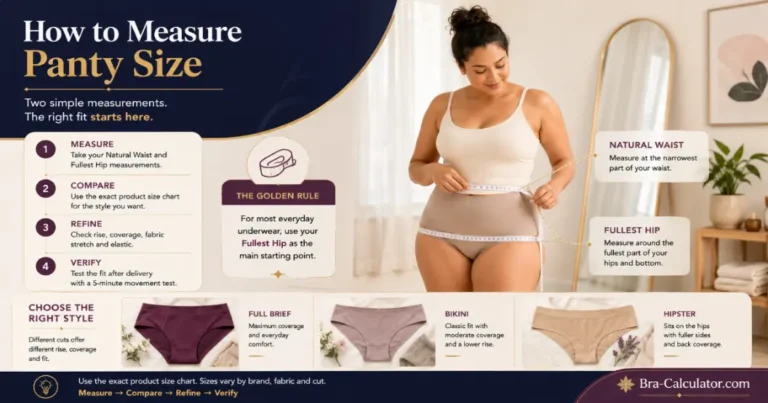
For most everyday underwear, begin with the fullest hip. That measurement tells you whether the garment can pass over and settle around the widest area without distorting. Use the natural waist as the second check, especially for high-rise briefs, shaping styles and period underwear.
Measure level
Keep the tape parallel to the floor around the fullest seat and hip point.
Read the exact chart
Use the chart attached to the specific product, not a generic brand memory.
Protect the larger need
When waist and hip suggest different sizes, preserve comfortable hip room first.
Refine with construction
Use rise, waistband contour and leg shape to solve the smaller-area mismatch.
For a private starting point, use the Panty Size Calculator. For tape placement, open How to Measure Panty Size. Always return to the current seller chart before ordering.
A three-minute shopping checklist
Check the exact product range
Confirm whether the chart belongs to everyday underwear, period underwear, shapewear or a special curvy/plus collection. Do not assume one company uses one universal fit.
Read beyond fabric percentages
Look for waistband type, rise, leg finish, back coverage and review language about rolling, bagging, digging or sliding. These details reveal how the garment behaves.
Protect your comparison
When two adjacent sizes are plausible, compare them only when the retailer allows hygienic try-ons. Keep liners, tags and packaging intact until the fit is settled.
What “made for wider hips” should actually mean
Less empty space at the back
The waistband should follow inward toward the waist without stealing room from the seat or creating a hard pressure ridge.
Less cutting at the hip crease
Soft elastic, a higher leg line or a well-finished bonded edge can move with the hip instead of gripping one narrow point.
Less riding and wedging
Enough back width, center-back depth and gusset length help the garment remain anchored during normal movement.
In other words, “wide-hip friendly” should describe a real pattern relationship—not simply a very stretchy fabric or a larger size range. The hips need space; the waist needs contour; the leg and seat need enough shape to remain quiet while you move.
How to confirm the result after delivery
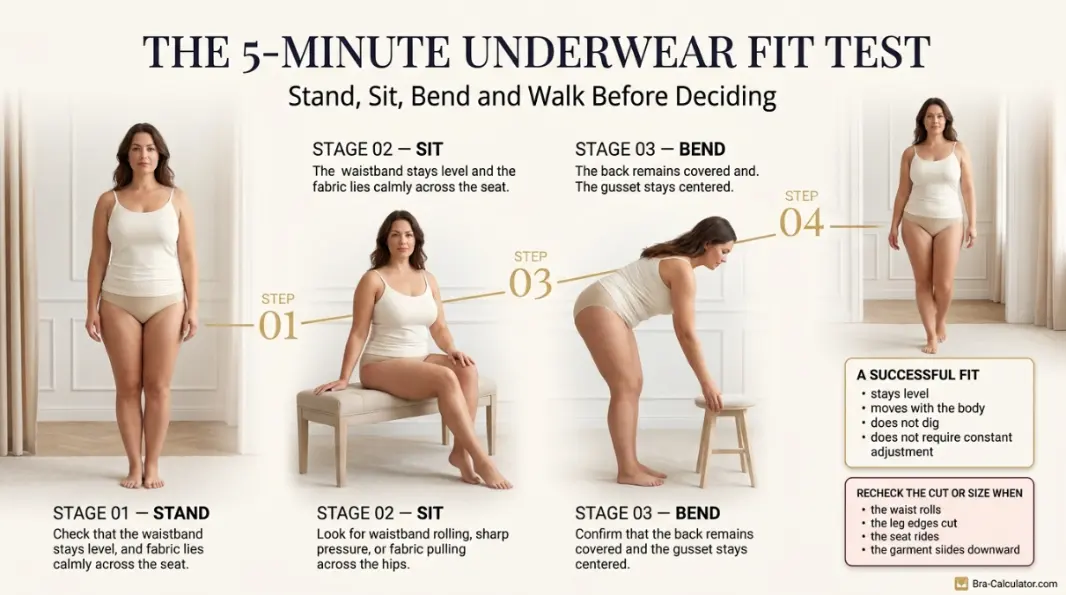
A size chart gives you a starting hypothesis. A short movement test tells you whether the pattern actually works on your body.
Check pressure and anchoring
The waistband should stay at its intended level without folding, sliding or demanding repeated adjustment. A faint temporary imprint can be normal; sharp pressure, numbness or a deep mark that lingers is not.
Sit, walk and lift one knee
The edge should follow the body without cutting into the hip crease or floating away. If the legs dig while the waist is loose, the opening shape or hip room is the likely problem—not a need to size down.
Look for calm fabric
The back should remain in place during ordinary movement. Wedging, crawling or excess fabric points to a mismatch in seat width, gusset length or coverage shape. The “better” pair is usually the one you stop noticing.
Confirm centered placement
The gusset should remain centered rather than being pulled forward or backward. Persistent shifting can come from a short rise, tight hips, insufficient seat depth or a cut that simply does not suit your proportions.
Use five quiet minutes indoors: stand, sit, bend, walk and take a few stairs if available. Keep tags attached and follow the retailer’s hygiene policy.
- Test for at least five minutes. A still mirror check cannot reveal rolling, dragging or repeated wedging.
- Compare like with like. Keep brand, style and fabric identical when testing two adjacent sizes.
- Count adjustments. Pulling the waistband or leg edge back into place is useful fit evidence.
- Stop at discomfort. Pain, numbness or sharp pressure is not a “break-in” stage for everyday underwear.
wide-hips-underwear-movement-fit-test.webp to replace this fallback.Common mistakes that create avoidable fit problems
Using an old measurement
Measurements can change while a familiar jeans or underwear label stays in your drawer for years. Re-measure before buying a firmer fabric, a new brand or a noticeably different rise.
Measuring the waistband location
The natural waist, high hip and fullest hip are separate points. Measure the location requested by the chart rather than placing the tape where your favorite pair happens to sit.
Assuming “stretchy” means size down
Stretch tells you how far a fabric can open. Recovery tells you whether it returns and stays stable. A very stretchy pair with weak recovery can slide or bag; firm recovery can feel smaller.
Changing every variable at once
Switching brand, size, rise and fabric together makes the result hard to read. Compare adjacent sizes in one product before deciding whether the problem is the label or the construction.
Read the product page like a fit document
The useful information is often below the marketing headline. Before ordering, look for the body-measurement chart, rise description, front/side/back images, fabric composition, model measurements, fit notes and return conditions.
Body measurements or garment measurements?
A body chart describes the intended wearer range. A garment measurement describes the item itself and already includes stretch or ease. They are not interchangeable.
Where will the waistband actually sit?
Low, mid and high rise are relative terms. Side views, side-seam height and “sits at” descriptions help you estimate whether the band crosses your high hip or natural waist.
Look for behavior, not just elastane
Knit density, elastic construction and paneling affect recovery. Reviews mentioning rolling, bagging, sliding or unusually firm edges are often more useful than “very stretchy.”
Study the back and leg angle
Coverage names vary. Look at seat width, how sharply the back narrows, the leg-opening angle and whether the gusset appears long enough for the rise.
Give more weight to reviews from shoppers who describe a similar waist-to-hip proportion than to reviews based only on height or weight. Finally, confirm whether underwear returns are accepted and whether liners, tags or multipack packaging must remain intact.
How this guide handles uncertainty
Bra-Calculator.com separates three questions that are often mixed together: what your measurements suggest, which regional label helps you shop, and how a specific garment behaves once fabric and construction enter the picture.
Official brand size guidance was reviewed on July 20, 2026, and this page was structurally updated on July 26, 2026. No universal chart overrides the seller’s current chart. We also avoid fixed price, stock and star-rating claims because those can become stale quickly.
Primary editorial references
- Jockey Size Charts — Natural-waist and fullest-hip measurement guidance.
- Wacoal Size Charts — Published panty waist and hip ranges illustrating why exact brand charts matter.
Relevant products to compare
These recommendations are selected by construction and fit purpose. They open current Amazon search results rather than making fixed price, stock or rating claims.
Affiliate disclosure: As an Amazon Associate, Bra-Calculator.com earns from qualifying purchases at no extra cost to you. Recommendations are based on fit criteria, not commission rates.
Contoured-waist briefs
Curved waist construction can reduce back gaping.
- Compare the exact seller size chart.
- Check rise, fabric and coverage before ordering.
- Prices and availability can change.
Full-coverage hipsters
More seat coverage may reduce riding during movement.
- Compare the exact seller size chart.
- Check rise, fabric and coverage before ordering.
- Prices and availability can change.
High-cut briefs
Higher openings can reduce pressure at the hip crease.
- Compare the exact seller size chart.
- Check rise, fabric and coverage before ordering.
- Prices and availability can change.
Frequently asked questions
High-cut briefs, shaped hipsters and curvy-fit bikinis are strong starting points. The best choice depends on rise preference, upper-thigh fullness and how much back coverage keeps the garment stable.
Use the fullest-hip range on the exact product chart. When the hips indicate a larger size than the waist, protect hip room first and solve waist looseness with a contoured waistband or a different cut.
Try a curved waistband, stronger-recovery elastic or a lower rise that sits closer to the high hip. Automatically sizing down can create digging and reduce seat coverage.
The size may be too small, the leg line may be too low or straight, or the elastic may be too firm. A softer or higher-cut opening often works better than simply choosing a larger waistband.
They can be, especially when the back is shaped and the thigh edge is flexible. Very straight, tube-like boyshorts are more likely to roll, ride or cut across fuller thighs.
Yes. The higher leg line can create freedom at the hip crease while fuller back coverage helps the garment stay anchored.
It usually describes a pattern built for more difference between waist and hip, often with a narrower or more contoured waist and additional seat depth. Brand definitions still vary.
For most everyday panties, use the fullest hip as the starting measurement. Give the waist more influence for firm high-rise, shaping or compression styles.
Continue through the sizing system
Let the Hips Fit. Let the Pattern Refine the Waist.
Use the Panty Size Calculator for a private starting size, then compare the exact product chart and choose the rise, waistband and leg opening that solve your real fit issue.