AI Bra Style Architect
Find the bra construction built for your shape.
Enter your bra size, sizing system, breast-shape clues and current fit symptoms. This private bra style calculator turns them into a personalized cup, wire, gore and support blueprint you can use in a fitting room or online search.
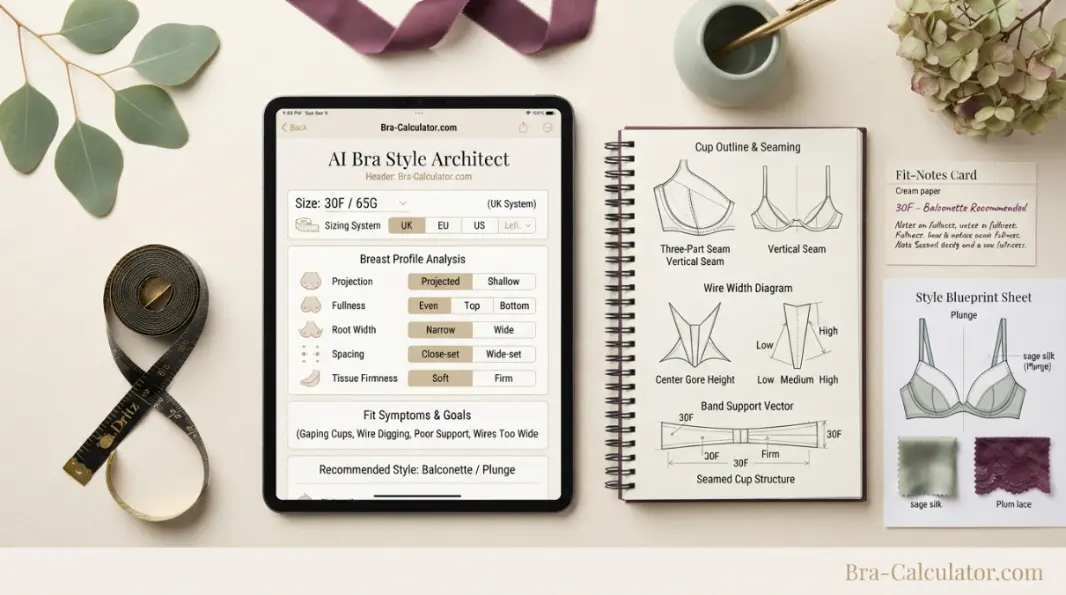
Start with a lightly structured seamed cup, balanced wires, a firm center tack, a forgiving upper cup, and comfortable everyday lift.
Quick answer
What is the best bra style for your breast shape?
The best bra is the one whose cup depth, wire width, upper-cup edge, gore and support panels match your anatomy. Size supplies the starting volume; shape determines how that volume needs to be distributed and supported.
Personalized bra style calculator
How the AI Bra Style Architect works
Two people can wear the same labeled bra size and still need completely different styles. One may need a shallow, open demi cup; the other may need strong immediate projection, narrower wires and a stretch-lace upper cup. This tool separates size from shape so the recommendation is based on bra construction rather than cup letters alone.
Direct answer: enter your current bra size and system, select the shape clues you know, then add the fit problems you notice. The tool returns three style families, construction benchmarks, a shopping checklist, cautions and an adjustment path.
- Confirm the starting size.
Choose UK, US, EU, AU/NZ or JP sizing so the band and cup label are interpreted in the correct system. - Describe the architecture.
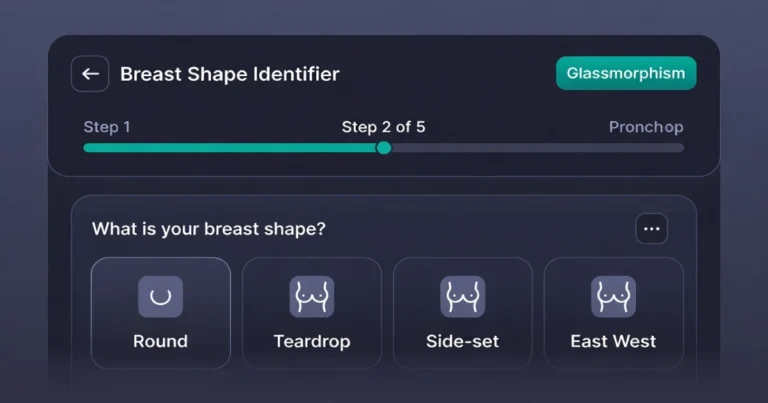
Add projection, fullness, root width, root height, spacing, orientation and tissue behavior. “Unsure” is acceptable. - Refine with symptoms.
Floating gores, sliding wires, gaping, overflow and side escape often reveal exactly where the cup shape conflicts with the body.
The calculations run inside this page. The tool code does not transmit your size, selections or notes to an external fitting service.
Recommendations focus on depth, seams, wires, gores and side support before naming style families or products.
The displayed size always keeps its sizing-system label because UK, US, EU, AU/NZ and Japanese cup progressions are not interchangeable.
What your fit blueprint tells you
Your result is a shopping brief, not a promise that every bra with the same style name will fit. Brands use different wires, cup heights, seam placements and fabric tensions. Use the result to filter out incompatible construction and to choose smarter try-on options.
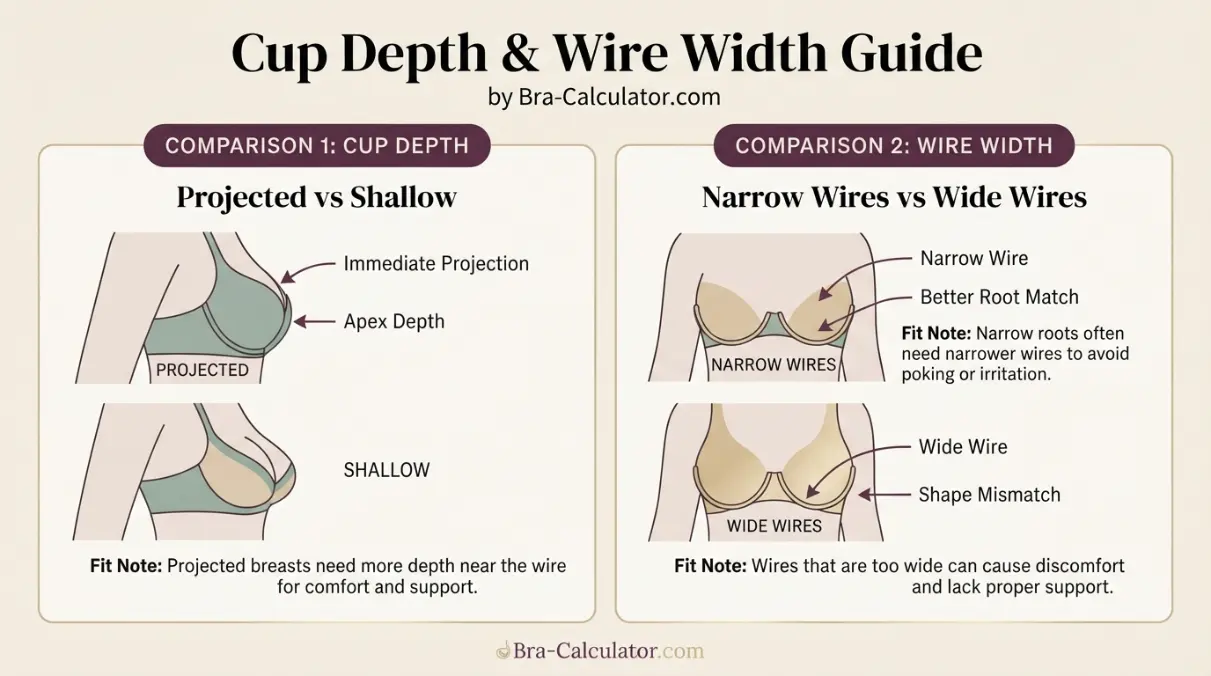
- Cup depth: whether you need shallow, balanced, projected or very projected space.
- Immediate projection: depth directly above the underwire, where many projected breasts need room.
- Root match: whether narrower, average or wider wires are more likely to follow the breast root.
- Upper-cup behavior: whether the neckline should be open, stretchable, balanced or more containing.
- Gore compatibility: whether the center panel should be low, narrow, overlapping or more stable and medium-width.
- Support direction: whether side panels, centered straps, encapsulation or reinforced lower cups are useful.
Breast shape and bra style
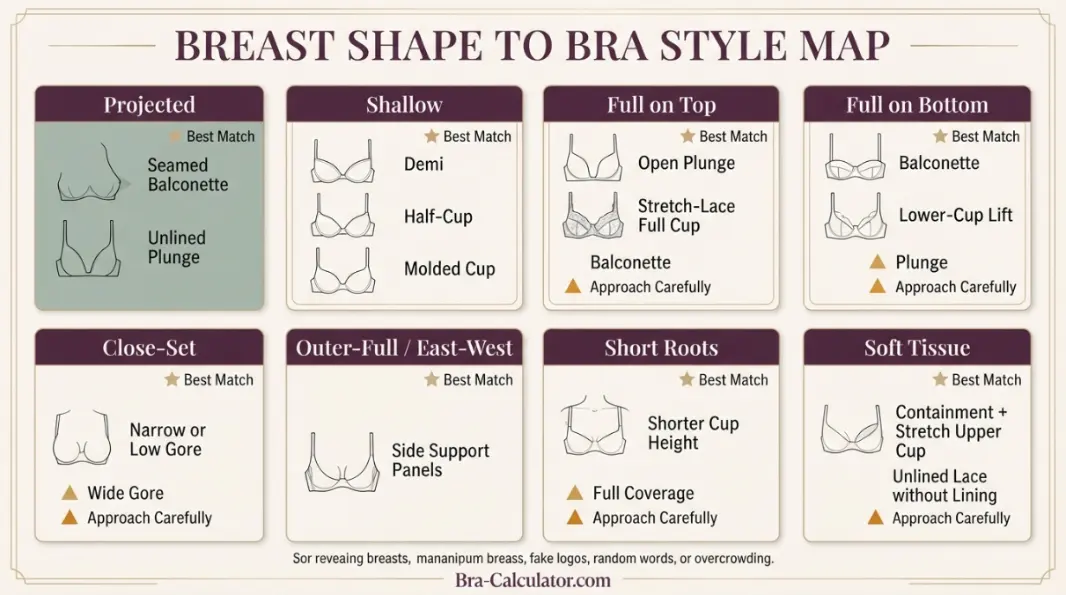
Best bra construction by projection, fullness and breast root
The table below is a starting framework. Shape characteristics can overlap, so the tool combines several signals instead of treating one label as the whole answer.
| Shape clue | Prioritize | Approach carefully | Common reason |
|---|---|---|---|
| Projected or very projected | Seamed cups, immediate depth, projected balconettes and supportive plunges | Rigid, shallow molded shells | A shallow cup may force the wire below the inframammary fold. |
| Shallow | Demi, half-cup, flexible molded and open spacer styles | Very deep, narrow cups | Excess apex depth can wrinkle or remain empty. |
| Full on top or tall roots | Open necklines and stretch upper cups | Rigid, closed upper edges | A closed edge may cut into upper breast tissue. |
| Full on bottom or short roots | Strong lower-cup lift, shorter cups and flexible upper panels | Very tall rigid cups | Unused upper volume often creates gaping. |
| Close-set or center-full | Low, narrow or overlapping gores with center depth | Tall, wide center gores | The gore may rest on breast tissue instead of the sternum. |
| Outer-full or east-west | Side-support panels, inward seams and centered straps | Weak outer cups and very wide-set straps | Lateral support can guide tissue toward a forward-facing shape. |
| Narrow roots | Narrower wires with enough cup depth | Broad, shallow wires | Wide wires may extend behind the root and irritate the underarm. |
| Wide roots | Wider wires and broad side coverage | Very narrow wires | Narrow wires may sit on side breast tissue. |
| Soft or pendulous tissue | Stable lower cups, center containment and side support | Very open, unstructured cups | Softer tissue may escape at the center or neckline. |
| Asymmetry | Stretch cups, adjustable straps and optional removable inserts | Rigid identical molded shells | Flexible construction accommodates natural volume differences. |
Breast spacing, fullness and orientation are not the same
Wide-set describes the distance between the breast roots. Outer-full describes where more volume sits. East-west describes outward orientation. A person can be wide-set but center-full, or close-set with outward-facing tissue. Keeping these variables separate prevents generic recommendations such as automatically prescribing a narrow gore for every outward-facing shape.
Why the same bra size fits differently across styles
A 34F UK balconette and a 34F UK molded T-shirt bra may hold a similar nominal volume, yet distribute it differently. The balconette may provide depth through seams and a lower neckline, while the molded cup may spread volume across a broader, shallower shell. If one fits and the other gaps or slides, the problem may be cup architecture rather than the labeled size.
Established product benchmarks
Amazon bra recommendations by construction type
These bras are included as recognizable construction benchmarks—not universal winners. Start with the architecture produced by the tool, then confirm the product’s sizing system, current size range, wire shape and return terms before ordering.
Affiliate disclosure: As an Amazon Associate I earn from qualifying purchases. Every Amazon button below uses the Bra-Calculator.com tracking tag bracalculator-20, at no additional cost to the shopper.
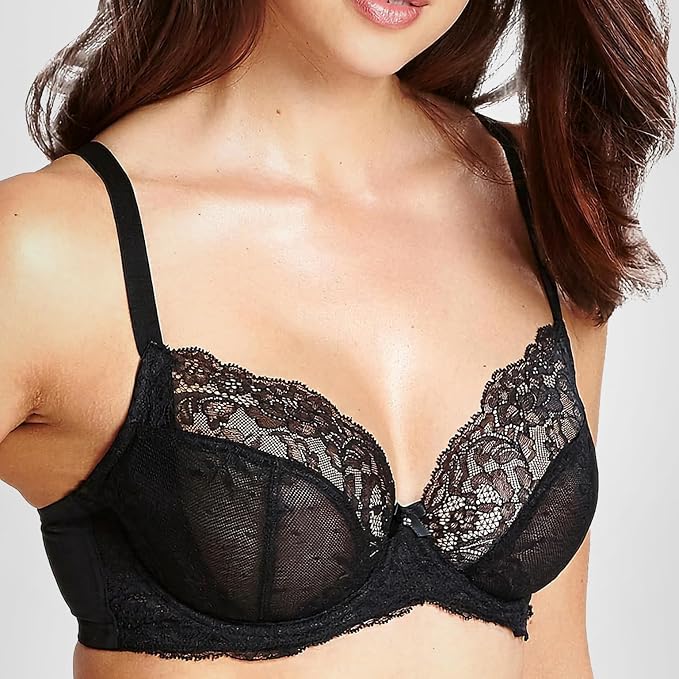
Projected seamed benchmark · UK sizing
Panache Andorra Full Cup Bra
Best starting point for: shoppers seeking multi-part seamed support, lower-cup lift and a more accommodating upper cup.
- Useful benchmark for projected or fuller breast shapes.
- Seamed construction makes fit behavior easier to assess than a rigid molded shell.
- Confirm the current brand chart and available size range before ordering.

Side support benchmark · UK sizing
Elomi Matilda Underwire Bra
Best starting point for: fuller-bust shoppers who need a stable frame, side control and a lower center than many traditional full cups.
- Useful benchmark when outer fullness or side escape is a major concern.
- Often considered by shoppers needing stronger support in fuller band-and-cup combinations.
- Check current size availability and conversion before purchase.

Smooth everyday benchmark · US sizing
Wacoal Basic Beauty Full Figure Underwire Bra
Best starting point for: shoppers who prefer US sizing, fuller coverage and a smoother everyday profile.
- Useful comparison point for support with less visible seaming under clothing.
- More appropriate for many average-to-wide-root profiles than very narrow-root shapes.
- Verify the exact listing’s size chart because cup labeling varies by system.
Product listings, size ranges, colors, construction details and stock can change. These links are shopping starting points only. Do not use a named bra as a substitute for the tool’s cup-depth, wire-width and gore guidance.
Bra fit troubleshooting
What common bra fit problems usually mean
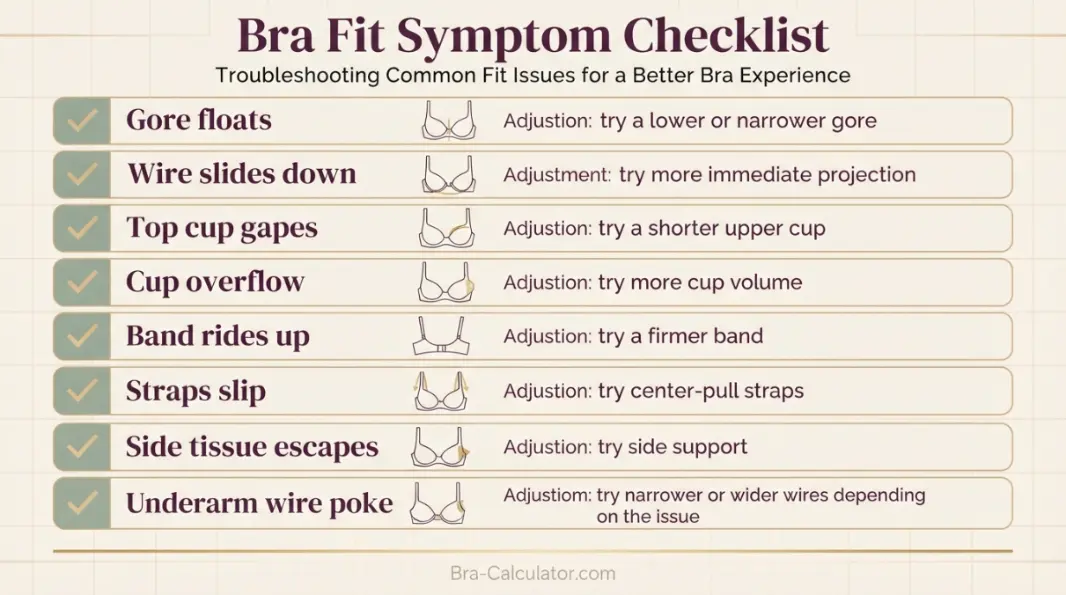
Fit symptoms are evidence. They help distinguish a band problem from a cup-volume problem, wire mismatch or lack of projection.
| Fit symptom | Possible cause | What to test next |
|---|---|---|
| Band rides up | The band may be too loose or overstretched. | Test a firmer band while preserving cup volume through careful sister sizing. |
| Band feels tight | The band may be small, but cups that are too small or shallow can also steal band space. | Test the band backward with cups pointing down before increasing the band. |
| Wire slides down | Insufficient immediate projection, too-small cups or an incompatible wire shape. | Try greater depth directly above the wire before assuming the band is wrong. |
| Gore floats | Insufficient cup volume, shallow center depth or close-set anatomy. | Compare a larger or more projected cup and a lower or narrower gore. |
| Top cup gapes | The cup may be too tall, too open or too large; short roots can also create space. | Try a shorter or more closed upper cup before changing several variables. |
| Cup overflow | Not enough cup volume, a neckline that is too closed or insufficient center containment. | Try one cup volume up or a more open/containing construction as appropriate. |
| Wire pokes underarm | The wire may be too wide or the wing may be too tall for the torso. | Try narrower wires or lower side wings. |
| Side tissue escapes | The cup may be too small, the wire too narrow or the outer cup too weak. | Check wire width and add side-support construction. |
| Straps slip | Straps may be too widely placed, the band may ride up or shoulders may slope. | Try center-pull, convertible or racerback straps before overtightening. |
How to test any recommended bra
Fasten a new bra on the loosest hook, place the wire in the inframammary fold and complete a full scoop-and-swoop. The band should stay level, the wire should surround rather than rest on breast tissue, and the gore should be compatible with your spacing. Lift your arms, bend forward, sit and walk. Recheck after ten to fifteen minutes because pressure, sliding and edge cutting may not appear immediately.
Editorial methodology
How recommendations are generated
The tool uses a construction-first hierarchy. It evaluates cup depth before style name, then considers wire/root compatibility, upper fullness, spacing and gore needs, side support, tissue behavior and the user’s primary purpose.
Determines whether the cup needs shallow distribution, balanced volume, strong immediate depth or greater apex projection.
Compares narrow, average or wide roots and short, average or tall root height with likely wire and cup-height needs.
Adjusts upper-cup openness, center containment, side support and lower-cup stability.
Balances fit architecture with smoothness, movement control, wireless comfort, low necklines, strapless wear or occasion styling.
Uses current fit problems to suggest what to change first without altering every variable at once.
Unknown shape inputs lower confidence. “Excellent” is reserved for profiles with broad alignment across the major variables.
What this tool does not do
It does not diagnose health conditions, guarantee that a product will fit, verify live retailer stock or replace an in-person fitting when complex pain, post-surgical requirements or major asymmetry are involved. A product name—when shown—is a benchmark, not a guarantee. Individual models can also change construction across sizes or seasons.
Health boundary: a bra can aggravate pressure or irritation, but a new lump, unexplained discharge, sudden asymmetry, persistent localized pain, skin dimpling, redness, warmth or swelling should be assessed by a qualified healthcare professional.
People also ask
AI Bra Style Architect FAQs
Clear answers to common questions about choosing a bra style by breast shape, projection, root width and fit symptoms.
What is an AI Bra Style Architect?
An AI Bra Style Architect is a bra style calculator that combines your bra size, sizing system, projection, fullness, root width, spacing, tissue behavior and fit problems. It recommends cup construction, wire width, gore style, side support and suitable bra style families rather than relying on cup size alone.
Does breast shape matter if my bra size is correct?
Yes. Size estimates band proportion and cup volume, while shape determines how that volume needs to be distributed. A correct size can still gap, cut in, slide down or poke if the cup is too shallow, too tall, too wide or incompatible with your fullness.
How do I know whether my breasts are shallow or projected?
Shallow breasts usually spread volume across a wider base and may fit open demi or flexible molded cups. Projected breasts extend farther forward and often need depth directly above the wire. A wire that repeatedly slides down despite a firm band can indicate insufficient immediate projection.
What is immediate projection in a bra?
Immediate projection is the cup depth available directly above the underwire. When that area is too shallow, projected breast tissue can push the cup downward, creating empty space near the wire even when the upper cup appears full.
What bra style is best for projected breasts?
Projected breasts often suit seamed balconettes, multi-part cups, unlined plunges and other styles with clear depth near the wire. Traditional rigid molded cups can be difficult when they spread volume into a broad, shallow shape, although projected spacer styles may work.
What bra style is best for shallow breasts?
Shallow breasts often do well in demi, half-cup, open molded and flexible spacer bras with broader wires and moderate cup depth. Very deep, narrow cups may wrinkle or leave empty space near the apex.
Which bras work for full-on-bottom breasts?
Look for strong lower-cup lift, vertical or diagonal seams, shorter cup height and a flexible upper edge. Full-coverage bras can still work when they provide enough lower depth and use a stretch upper panel rather than a rigid tall cup.
Which bras work for full-on-top breasts?
Full-on-top breasts generally need an open or stretchable upper cup that does not cut into tissue. Open balconettes, selected plunges and stretch-lace full cups can work, but the exact result also depends on projection, root height and tissue firmness.
Are wide-set, outer-full and east-west breasts the same?
No. Wide-set describes spacing between the breast roots, outer-full describes where more volume sits, and east-west describes outward orientation. These features can overlap, but each affects bra construction differently.
Why does one bra fit in my size while another does not?
Bra models in the same size can use different wires, cup depths, gores, seam placements and fabric tensions. One may match your root and projection while another distributes the same nominal volume into an incompatible shape.
Can this tool recommend an exact bra model?
The tool focuses first on construction benchmarks. Exact models should only be treated as examples because size availability, grading and product construction can change. Always confirm the model’s sizing system and current size range before purchasing.
Should I use a sister size when the bra style feels wrong?
Sister sizing is useful mainly when cup volume feels correct but band tension needs adjustment. It will not reliably fix a cup that is too shallow, too tall, too narrow or otherwise mismatched to your breast shape.
How often should I remeasure my bra size?
Remeasure when your current bras change fit, after meaningful weight or hormonal changes, during or after pregnancy and nursing, or whenever the band and cups no longer sit as expected. Your shape and tissue behavior can also change even when the label remains similar.
Is the AI Bra Style Architect private?
Yes. In this version, calculations run in your browser and the tool does not send the entered size, shape selections or notes to an external fitting API. Standard website analytics or plugins are separate from the calculator itself.
How are the Amazon bra recommendations selected?
The Amazon recommendations are established construction benchmarks selected to represent different fit needs, such as projected seamed support, side control and smoother US-sized coverage. They are not guaranteed matches. Use your personalized architecture first, then confirm the current size chart, return policy and product construction before ordering.