A Bra That Fits Calculator vs. Bra-Calculator.com: A Fair Methodology Comparison
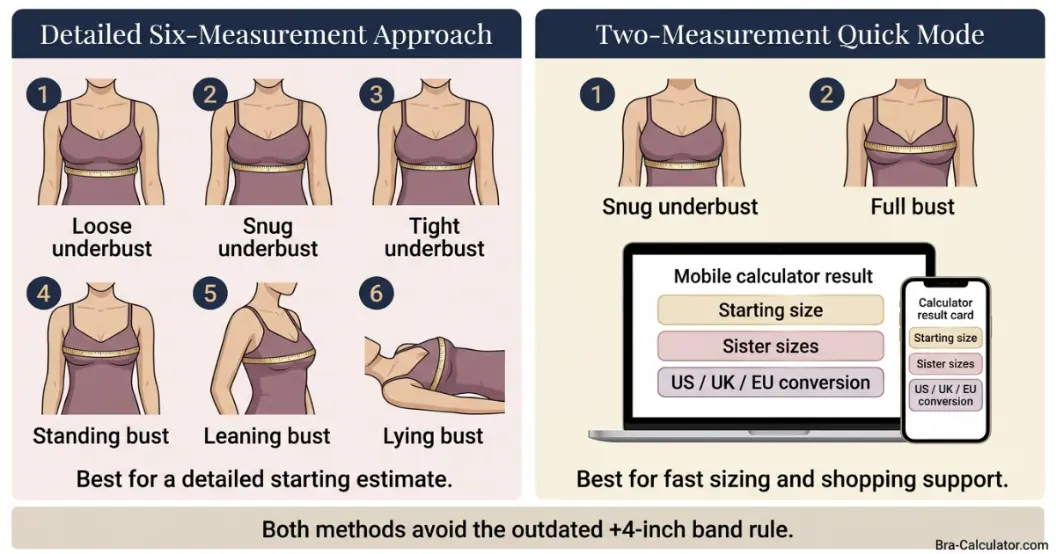
The A Bra That Fits (ABTF) method is a six-measurement approach built by the r/ABraThatFits Reddit community that rejects the outdated “+4 inch” band rule. Bra-Calculator.com shares the same no-plus-4 philosophy, offering a fast two-measurement mode and a six-measurement RBCD advanced mode, with instant sister-size charts and international conversions built into a single tool. ABTF is community-vetted and detailed; Bra-Calculator.com is built for speed plus depth in one interface. Many people use both together.
Key Takeaways
- Both ABTF and Bra-Calculator.com reject the “+4 inch” band-padding rule used by traditional department stores.
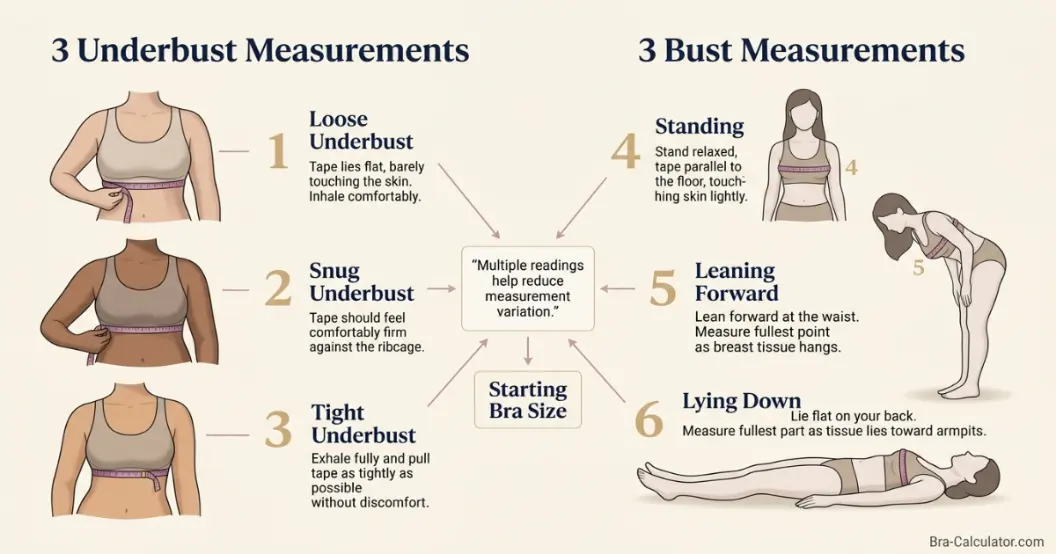
- ABTF uses six measurements (three underbust, three bust) averaged together to reduce tape-measure error.
- Bra-Calculator.com offers a two-measurement quick mode and a six-measurement RBCD advanced mode in the same tool.
- Sister sizing and international conversions (US, UK, EU, French, AU/NZ) are built directly into Bra-Calculator.com; ABTF provides these via separate community reference charts.
- ABTF is best for a thorough first-time sizing from scratch; Bra-Calculator.com is best when you need sister sizes or conversions quickly while shopping.
- Using both methods together — ABTF multi-measurement for accuracy, Bra-Calculator.com for conversion and sister-size lookup — gives the most complete result.
What Is the A Bra That Fits (ABTF) Method?
The ABTF method grew from years of fit troubleshooting in the r/ABraThatFits community, where members compared measurements against real-world fit results across thousands of individual cases. The outcome is a six-measurement system: three underbust readings taken at different tensions (loose, snug, and tight) and three bust readings taken at different body positions (standing, leaning forward 45°, and lying down). Averaging multiple readings smooths out the natural variation you get from a single tape-measure pull.
Crucially, the method explicitly rejects the old department-store convention of adding four inches to the underbust measurement before calculating the band size — a practice that systematically produces band sizes that are too large and cup sizes that are too small. Because the calculation logic was refined by a large, peer-review-style community rather than a single retailer, it carries strong grassroots credibility, particularly among people who were incorrectly sized using traditional in-store methods.
The trade-off is time and setup: six measurements taken in specific positions correctly takes ten to fifteen minutes the first time, and the community wiki format means new visitors sometimes need a few minutes to locate the exact steps before starting.
What Is the Bra-Calculator.com Method?
Bra-Calculator.com also rejects the “+4 inch” rule and structures the measurement experience around two entry points. The standard mode uses a single underbust and a single bust measurement for a fast starting size — aimed at people who want a quick estimate before shopping or who already have a reasonable baseline. The advanced RBCD mode (Root-Band-Cup-Depth) mirrors the multi-measurement philosophy of community methods like ABTF, factoring in breast projection and tissue distribution alongside band and bust readings, then immediately layers on sister-size results and conversions across US, UK, EU, French, and AU/NZ sizing in the same interface — no separate chart lookups required.
The practical difference is workflow integration: ABTF is a measuring philosophy documented and supported by a community, while Bra-Calculator.com is a single tool that compresses a similar no-“+4” calculation, sister sizing, and conversion into one page so you don’t need to cross-reference multiple tabs or charts.
Method-by-Method Breakdown
Community A Bra That Fits
Measurements: 6 (3 underbust tensions + 3 bust positions)
Band rule: No +4 inch padding — measures directly
Sister sizes: Via community wiki charts
Conversions: Community reference charts
Time to result: 10–15 minutes first time
Best for: Thorough first-time sizing; people who want full peer-tested process
Tool Bra-Calculator.com
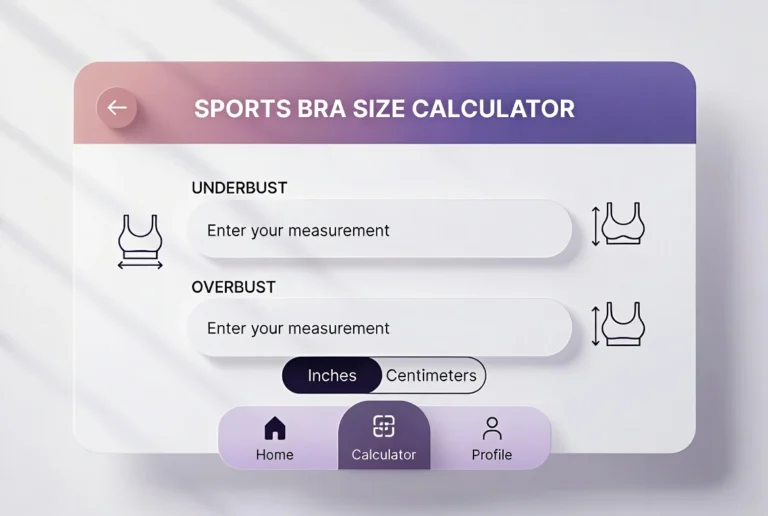
Measurements: 2 (quick) or 6 (RBCD advanced)
Band rule: No +4 inch padding — measures directly
Sister sizes: Built-in, instant results in the same tool
Conversions: US, UK, EU, French, AU/NZ in one step
Time to result: Under 2 minutes (quick mode)
Best for: Speed, sister-size lookup, shopping on the go
Side-by-Side Feature Comparison
| Factor | A Bra That Fits (ABTF) | Bra-Calculator.com |
|---|---|---|
| Total measurements | 6 | 2 (quick) or 6 (RBCD advanced) |
| “+4 inch” band rule | ✕ Not used | ✕ Not used |
| Multi-position bust readings | ✓ Yes — standing, leaning, lying | ✓ Yes — in RBCD advanced mode |
| Averaging to reduce error | ✓ Yes — core of the method | Optional — quick mode uses single reading |
| Sister size results | Community wiki charts (manual lookup) | Built-in, instant, same page |
| International conversion | Community reference charts | US, UK, EU, French, AU/NZ in one step |
| Breast projection guidance | Community discussion threads | Built into RBCD advanced calculation |
| Speed to first result | 10–15 min (6 measurements + chart lookup) | Under 2 min (quick mode) |
| Depth of methodology | Community-tested over many years | Editorial team, updated regularly |
| Best for first-time sizing | ✓ Strong — most thorough starting point | Good — RBCD mode reaches similar depth |
| Best for shopping quickly | Slower — multiple manual steps | ✓ Strong — quick mode + conversions instant |
| Affiliation / backing | Volunteer Reddit community | Independent sizing tool |
Which Method Should You Use? (Use-Case Scenarios)
Neither method is objectively better — the right choice depends on what problem you’re trying to solve right now.
🏆 Choose ABTF if…
You’ve never been accurately measured and want the most thorough, peer-tested process. You have 10–15 minutes and want to minimize measurement error by averaging multiple readings across different positions.
⚡ Choose Bra-Calculator.com if…
You already have a rough baseline size and need a fast starting point, instant sister-size alternatives, or an international conversion while actively shopping. Speed matters and you don’t want to juggle multiple tabs.
🔄 Use ABTF first when…
You suspect your current size is significantly wrong. The six-measurement averaging approach is specifically designed to surface sizes that a quick two-measurement tool might miss due to a single off pull of the tape.
🛒 Use Bra-Calculator.com when…
Your exact size is out of stock and you need sister sizes instantly. Or when you’re buying from a brand that sizes in EU or UK and need a fast conversion without leaving the shopping page.
Many people use both in sequence: take ABTF-style multi-position measurements to establish a highly accurate baseline, then use Bra-Calculator.com’s built-in sister-size chart and conversion tool when a specific size is unavailable or a brand runs differently than expected.
Step-by-Step: How to Measure Using Each Method
Six-Measurement Approach (ABTF-Style)
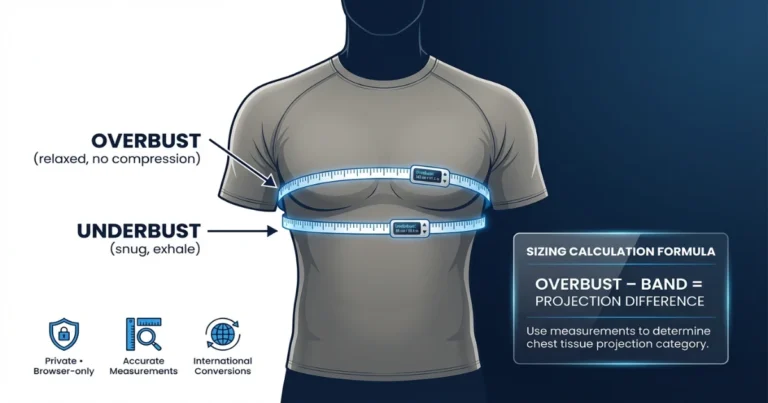
- Remove your bra. Stand upright and wrap the tape loosely around your ribcage, directly under your bust. Record this number.
- Pull the tape snug (firm but not tight). Record this second underbust reading.
- Pull the tape as tight as comfortable without discomfort. Record this third underbust reading. Average all three underbust numbers.
- Standing upright, measure your bust at the fullest point with a relaxed tape. Record this reading.
- Lean forward at 45 degrees and re-measure your bust. Record this reading.
- Lie flat on your back and re-measure your bust. Record this reading. Average all three bust numbers.
- Subtract your averaged underbust from your averaged bust to estimate cup volume, then cross-check against a size chart to assign a band and cup letter.
Two-Measurement Approach (Bra-Calculator.com Quick Mode)
- Remove your bra. Wrap the tape snugly and level around your ribcage directly under your bust. Record your underbust measurement.
- Measure your bust at the fullest point with the tape relaxed (not tight). Record this number.
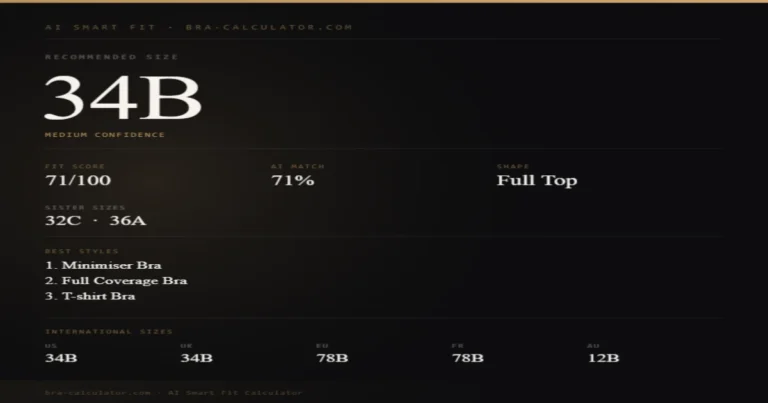
- Enter both measurements into the Bra Size Calculator. Receive your starting size, sister sizes across two band widths, and international conversions in seconds.
Understanding Sister Sizes: Why Both Methods Recommend Them
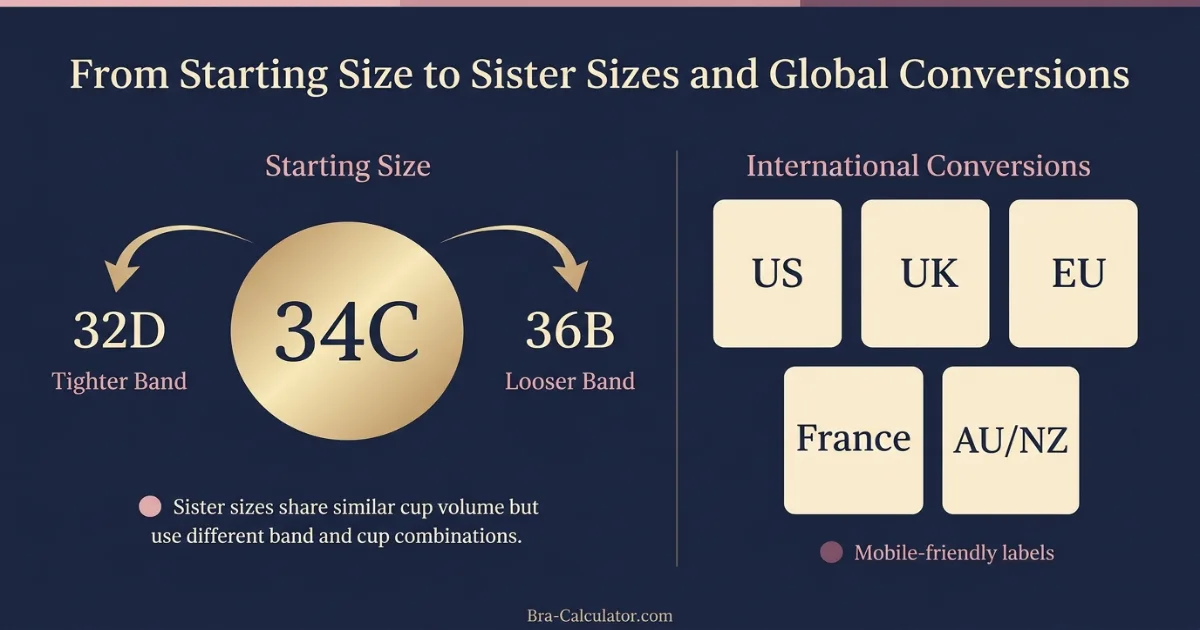
A sister size is a different band-and-cup combination that holds the same cup volume as your primary size. Moving one band size up and one cup size down — or one band size down and one cup size up — preserves cup volume while changing how the bra wraps around your torso.
| Sister Size Down | Primary Size | Sister Size Up |
|---|---|---|
| 32C | 34B | 36A |
| 32D | 34C | 36B |
| 32DD/E | 34D | 36C |
| 34DD/E | 36D | 38C |
| 36DD/E | 38D | 40C |
| 34F | 36E/DD | 38D |
Both ABTF and Bra-Calculator.com recommend checking sister sizes after finding your base size, because bra grading varies by brand — a 34C in one brand may fit more like a 32D or 36B in another. The difference is that Bra-Calculator.com surfaces these instantly in the same tool, while ABTF directs you to separate community reference charts.
Found your size? Browse bras in your exact size on Amazon — including hard-to-find extended sizes from Panache, Elomi, and Wacoal.
Shop Bras by Size on Amazon →The +4 Inch Rule: Why Both Methods Reject It
The traditional “+4 inch method” — adding 4 inches to your underbust measurement to determine your band size — was developed in an era when bra elastic was far less stretchy than it is today. A woman with a 30-inch underbust would be sized into a 34-band, producing a band too loose to provide support and a cup too small for her actual volume.
Both ABTF and Bra-Calculator.com calculate directly from your measured underbust, rounding to the nearest even number to assign the band. This produces band sizes that are tighter and more supportive, and cup sizes that accurately reflect breast volume — which is why both methods frequently output cup letters that look surprisingly large to people accustomed to the old system.
Which Method Is More Accurate?
Accuracy in bra sizing is difficult to define precisely because “correct” fit is partly subjective and because bra grading is not universal across manufacturers. That said, some structural observations apply:
- Six-measurement averaging reduces random error. Taking three underbust and three bust readings and averaging them smooths out the variation from a single imperfect tape pull, especially important for women with looser skin, asymmetry, or measurement anxiety.
- Multi-position bust readings capture total tissue volume. Breast tissue shifts position when you lean or lie down. Measuring in all three positions and averaging captures tissue that may be missed in a single standing measurement.
- Two-measurement quick results are reliable enough for a starting point. For most women, a careful single underbust and single bust reading produces a result within one cup size of their ideal fit, which is then refined by trying sister sizes.
Neither result should be treated as final without trying the bra on and performing a physical fit check. Both methods recommend fitting adjustments after the initial calculation.
Verdict: Use Both for the Best Result
If you’re sizing from scratch and want the most thorough first result, spend the extra ten minutes on an ABTF-style six-measurement approach — the averaging process genuinely catches errors that a single-pull reading can miss. Once you have that accurate baseline, use Bra-Calculator.com to instantly surface your sister sizes and convert your result to UK, EU, French, or AU/NZ sizing without opening separate tabs.
If you’re shopping quickly — your size is out of stock, you’re buying from a European brand, or you’re checking alternates — Bra-Calculator.com’s quick mode and built-in conversion table is the faster tool for that specific job.
Frequently Asked Questions about A Bra That Fits Calculator vs Bra-Calculator.com
Is A Bra That Fits the same as Bra-Calculator.com?
No. A Bra That Fits is a sizing method associated with the volunteer r/ABraThatFits Reddit community, while Bra-Calculator.com is a separate, independent tool. The two are unaffiliated. This comparison exists to help shoppers understand the methodology differences, not to suggest any partnership or endorsement.
Which is more accurate — six measurements or two?
Averaging six measurements reduces the error from a single imperfect tape pull, which is why ABTF favors it for a first-time accurate size. A two-measurement quick mode works well once you already have a reliable baseline to start from. For the most complete first-time result, use six measurements — then use the quick mode for ongoing shopping or conversions.
Does Bra-Calculator.com use the “+4 inch” method?
No. Bra-Calculator.com calculates directly from your measured underbust and bust numbers without adding extra inches — matching the same no-plus-4 principle used by community methods like ABTF. The “+4 inch” convention is an outdated rule from when bra elastic was less stretchy and is no longer recommended by modern fit specialists.
What is a sister size and why do both methods mention it?
A sister size is a different band-and-cup combination that holds the same cup volume as your primary bra size. For example, 34C, 32D, and 36B are all sister sizes — same volume, different band width. Sister sizing matters when your exact size is sold out, when a specific style runs differently than expected, or when you’re shopping across brands with inconsistent grading. Both ABTF and Bra-Calculator.com recommend checking sister sizes after finding your base size.
Can I enter my ABTF measurements into Bra-Calculator.com?
Yes. If you’ve already taken the six ABTF-style measurements, average your underbust readings and average your bust readings, then enter those averages into Bra-Calculator.com’s advanced RBCD mode. You’ll receive a starting size plus instant sister sizes and international conversions without manually looking up any additional charts.
Why do different bra size calculators give different results from the same measurements?
Bra brands don’t follow a single universal grading system, and calculators built around different reference charts can output slightly different band or cup letters from identical raw measurements. This is normal — treat any calculator result as a strong starting point, then confirm fit using sister sizes and a physical fit check in the actual bra.
How often should I remeasure my bra size?
Remeasure every six to twelve months or whenever your current bras start fitting differently. Bust and ribcage measurements shift with weight change, pregnancy, hormonal fluctuations, muscle gain, and age. Both ABTF and Bra-Calculator.com recommend remeasuring as a first step whenever fit problems arise rather than assuming your previous size is still correct.
Does the ABTF method work for plus sizes and large cup sizes?
Yes. The ABTF six-measurement approach was specifically developed to address systematic misfitting that affects larger cup sizes (DD+) and fuller figures most severely, since the old “+4 inch” rule produced especially poor results in extended sizing. Bra-Calculator.com’s RBCD mode is also designed to handle extended band and cup sizes accurately.
What is the RBCD method used by Bra-Calculator.com?
RBCD stands for Root-Band-Cup-Depth. It is an advanced measurement approach used in Bra-Calculator.com’s deeper calculation mode that factors in breast projection and tissue distribution — not just underbust and bust circumference — to produce a more refined size estimate. It serves a similar purpose to the ABTF six-measurement approach: capturing data points that a basic two-measurement tool would miss.
Which method should I use if I’m buying a bra from a UK or European brand?
Either method will give you an accurate base size; the key next step is conversion. Bra-Calculator.com’s built-in size converter translates your US size to UK, EU, French, and AU/NZ sizing instantly in the same tool, which is particularly useful when shopping European brands that use different cup letter progressions — EU sizing uses sequential letters while UK sizing uses double letters like DD and FF.